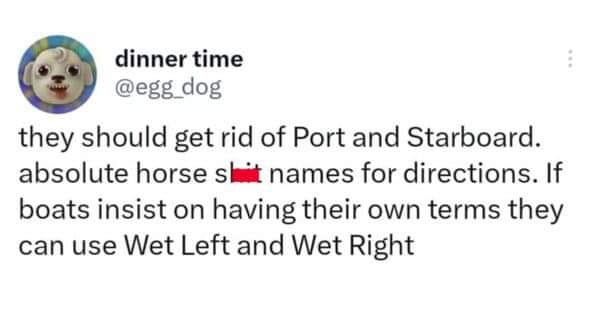
▲ 471 ▼ Port and starboard (lemmy.world) submitted 3 years ago by ReadyUser31@lemmy.world [M] to c/microblogmemes@lemmy.world 56 comments fedilink hide all child comments
[–] ThatWeirdGuy1001@sh.itjust.works 15 points 3 years ago (1 child) So you just collectively agree that left is the ships left while you're on the ship. Problem solved. permalink fedilink source parent hideshow 2 child comments replies: [–] Nougat@kbin.social 16 points 3 years ago (2 children) The left is always the ship's left, just like the left side of a car is always the left side of a car. permalink fedilink source parent hideshow 4 child comments replies: [–] LifeInMultipleChoice@lemmy.world 18 points 3 years ago (4 children) Except we say drivers/passengers side when referring to the side of a car. People dislike port because they can't remember it from lack of use. Insecurities cause this whole discussion. I don't use it often at all, but when I was 6, I just remembered left/port had 4 letters and haven't forgotten yet. Some day I might, but me forgetting doesn't mean I should ask everyone else to stop using language. E.g. I have a plethora of grapes. We should stop using the term plethora because they could just say "a lot." permalink fedilink source parent hideshow 8 child comments replies: [–] dufkm@lemmy.world 8 points 3 years ago E.g. I have a plethora of grapes. We should stop using the term plethora because they could just say “a lot.” That reminds me of the old joke: A widow was holding a funeral for her husband, when a man asked if he could say a word. "Of course" said the widow, so he stood up and exclaimed "plethora!". The widow replied "thanks, that means a lot". permalink fedilink source parent [–] Rusty@lemmy.ca 4 points 3 years ago (1 child) Does drivers/passenger side work when you don't know if you are speaking with British or American people? permalink fedilink source parent hideshow 2 child comments replies: [–] LifeInMultipleChoice@lemmy.world 1 point 3 years ago It could, "the car got t-boned on the drivers side of the vehicle." You would ask if the driver was alright, passenger side you may state "oh thank goodness (insert significant other name here) wasn't with them. ... better wording recommended, that may sound like you didn't care about the driver permalink fedilink source parent [–] Afrazzle@sh.itjust.works 3 points 3 years ago Also if you always say "left and right" instead of "right and left" (which must english speakers probably do) you can remember that port and starboard are the same order. permalink fedilink source parent [–] XaeroDegreaz@lemmy.world 3 points 3 years ago The way I taught myself to remember is "starboard" has more "R"s in it, so that means "right". permalink fedilink source parent [–] Lepsea@sh.itjust.works 1 point 3 years ago Right permalink fedilink source parent
[–] Nougat@kbin.social 16 points 3 years ago (2 children) The left is always the ship's left, just like the left side of a car is always the left side of a car. permalink fedilink source parent hideshow 4 child comments replies: [–] LifeInMultipleChoice@lemmy.world 18 points 3 years ago (4 children) Except we say drivers/passengers side when referring to the side of a car. People dislike port because they can't remember it from lack of use. Insecurities cause this whole discussion. I don't use it often at all, but when I was 6, I just remembered left/port had 4 letters and haven't forgotten yet. Some day I might, but me forgetting doesn't mean I should ask everyone else to stop using language. E.g. I have a plethora of grapes. We should stop using the term plethora because they could just say "a lot." permalink fedilink source parent hideshow 8 child comments replies: [–] dufkm@lemmy.world 8 points 3 years ago E.g. I have a plethora of grapes. We should stop using the term plethora because they could just say “a lot.” That reminds me of the old joke: A widow was holding a funeral for her husband, when a man asked if he could say a word. "Of course" said the widow, so he stood up and exclaimed "plethora!". The widow replied "thanks, that means a lot". permalink fedilink source parent [–] Rusty@lemmy.ca 4 points 3 years ago (1 child) Does drivers/passenger side work when you don't know if you are speaking with British or American people? permalink fedilink source parent hideshow 2 child comments replies: [–] LifeInMultipleChoice@lemmy.world 1 point 3 years ago It could, "the car got t-boned on the drivers side of the vehicle." You would ask if the driver was alright, passenger side you may state "oh thank goodness (insert significant other name here) wasn't with them. ... better wording recommended, that may sound like you didn't care about the driver permalink fedilink source parent [–] Afrazzle@sh.itjust.works 3 points 3 years ago Also if you always say "left and right" instead of "right and left" (which must english speakers probably do) you can remember that port and starboard are the same order. permalink fedilink source parent [–] XaeroDegreaz@lemmy.world 3 points 3 years ago The way I taught myself to remember is "starboard" has more "R"s in it, so that means "right". permalink fedilink source parent [–] Lepsea@sh.itjust.works 1 point 3 years ago Right permalink fedilink source parent
[–] LifeInMultipleChoice@lemmy.world 18 points 3 years ago (4 children) Except we say drivers/passengers side when referring to the side of a car. People dislike port because they can't remember it from lack of use. Insecurities cause this whole discussion. I don't use it often at all, but when I was 6, I just remembered left/port had 4 letters and haven't forgotten yet. Some day I might, but me forgetting doesn't mean I should ask everyone else to stop using language. E.g. I have a plethora of grapes. We should stop using the term plethora because they could just say "a lot." permalink fedilink source parent hideshow 8 child comments replies: [–] dufkm@lemmy.world 8 points 3 years ago E.g. I have a plethora of grapes. We should stop using the term plethora because they could just say “a lot.” That reminds me of the old joke: A widow was holding a funeral for her husband, when a man asked if he could say a word. "Of course" said the widow, so he stood up and exclaimed "plethora!". The widow replied "thanks, that means a lot". permalink fedilink source parent [–] Rusty@lemmy.ca 4 points 3 years ago (1 child) Does drivers/passenger side work when you don't know if you are speaking with British or American people? permalink fedilink source parent hideshow 2 child comments replies: [–] LifeInMultipleChoice@lemmy.world 1 point 3 years ago It could, "the car got t-boned on the drivers side of the vehicle." You would ask if the driver was alright, passenger side you may state "oh thank goodness (insert significant other name here) wasn't with them. ... better wording recommended, that may sound like you didn't care about the driver permalink fedilink source parent [–] Afrazzle@sh.itjust.works 3 points 3 years ago Also if you always say "left and right" instead of "right and left" (which must english speakers probably do) you can remember that port and starboard are the same order. permalink fedilink source parent [–] XaeroDegreaz@lemmy.world 3 points 3 years ago The way I taught myself to remember is "starboard" has more "R"s in it, so that means "right". permalink fedilink source parent
[–] dufkm@lemmy.world 8 points 3 years ago E.g. I have a plethora of grapes. We should stop using the term plethora because they could just say “a lot.” That reminds me of the old joke: A widow was holding a funeral for her husband, when a man asked if he could say a word. "Of course" said the widow, so he stood up and exclaimed "plethora!". The widow replied "thanks, that means a lot". permalink fedilink source parent
[–] Rusty@lemmy.ca 4 points 3 years ago (1 child) Does drivers/passenger side work when you don't know if you are speaking with British or American people? permalink fedilink source parent hideshow 2 child comments replies: [–] LifeInMultipleChoice@lemmy.world 1 point 3 years ago It could, "the car got t-boned on the drivers side of the vehicle." You would ask if the driver was alright, passenger side you may state "oh thank goodness (insert significant other name here) wasn't with them. ... better wording recommended, that may sound like you didn't care about the driver permalink fedilink source parent
[–] LifeInMultipleChoice@lemmy.world 1 point 3 years ago It could, "the car got t-boned on the drivers side of the vehicle." You would ask if the driver was alright, passenger side you may state "oh thank goodness (insert significant other name here) wasn't with them. ... better wording recommended, that may sound like you didn't care about the driver permalink fedilink source parent
[–] Afrazzle@sh.itjust.works 3 points 3 years ago Also if you always say "left and right" instead of "right and left" (which must english speakers probably do) you can remember that port and starboard are the same order. permalink fedilink source parent
[–] XaeroDegreaz@lemmy.world 3 points 3 years ago The way I taught myself to remember is "starboard" has more "R"s in it, so that means "right". permalink fedilink source parent