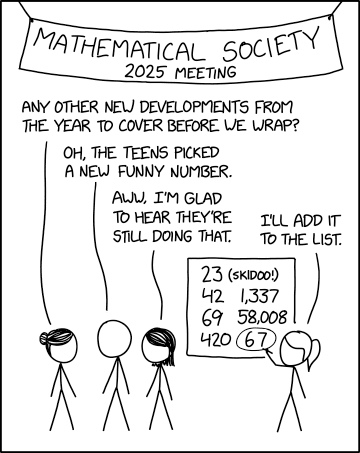
xkcd #3184: Funny Numbers

Title text:

In 1899, people were walking around shouting '23' at each other and laughing, and confused reporters were writing articles trying to figure out what it meant.

Transcript:

Transcript will show once it’s been added to explainxkcd.com

Source: https://xkcd.com/3184/
explainxkcd for #3184

you are viewing a single comment's thread
view the rest of the comments
[–] 96 points 7 months ago* (last edited 7 months ago) (10 children)

For millennials, like me: 1337 means "LEET" which is short for "Elite".

  • source
  • hideshow 20 child comments
  • [–] 198 points 7 months ago (2 children)

    Sorry, what? I'm a millennial, this is common knowledge for anyone who played a videogame in the last quarter century.

  • source
  • parent
  • hideshow 4 child comments
  • [–] 75 points 7 months ago* (2 children)

    What the h311 is wrong with you? Us millennials invented 1337!

  • source
  • parent
  • hideshow 4 child comments
  • [–] 33 points 7 months ago (2 children)
  • [–] 38 points 7 months ago (3 children)

    Yep I think pops here has this one, us Millennials grew up with leet speak, it already was a thing in the 80s.

  • source
  • parent
  • hideshow 6 child comments
  • [–] 19 points 7 months ago (2 children)

    That's the first time anyone called me pops! NOW I feel old!

  • source
  • parent
  • hideshow 4 child comments
  • [–] 2 points 7 months ago (1 child)
  • [–] 5 points 7 months ago* (1 child)

    I remember it well.

    The newspapers were apoplectic about the coming millennium bug Armageddon (hospital equipment was all going to crash because programmers encoded a date as two digits to save what was then rather sparse memory and storage space, and everyone was going to accidentally become of negative age and all timers would temporarily give very wrong answers.

    COBOL programmers: there's a serious issue with banking and other business systems and we need to concentrate on this above above other issues to resolve it
    Managers and newspapers: ARMAGEDDON!
    COBOL programmers: we've got this.
    Newspapers: nobody is doing anything about it! Armageddon!
    COBOL programmers: It's a lot of work but we're cracking on, we've been working at it a while and it's going to be tight and we're going to need to put in some overtime, but really, we've got this.
    Newspapers: OH FUCK LITERALLY EVERYTHING IS GOING TO CRASH

    Millienium dawns. Some slight issues remain. Most important systems already patched and fine. Society does not crash.

    Newspapers: There was no millennium bug after all!
    COBOL programmers: no, there was, but we fixed it like we said we needed to and then we did. Boy, that was hard work.
    Newspapers: It was ALL A HOAX.
    COBOL programmers: no, it was a problem and we fixed it.
    Newpapers: CELEBRITY WOMAN WEARS DRESS.
    COBOL programmers: we just see the world differently, I guess. Can I retire early with all this emergency business critical overtime money?

  • source
  • parent
  • hideshow 2 child comments
  • [–] 2 points 7 months ago (1 child)

    Ahahah I experienced only the media narrative, and it did play out exactly as you described it.

    Of course now it comes to reason that many people were actively working to fix the problem, but they never really explained that part on TV.

  • source
  • parent
  • hideshow 2 child comments
  • [–] 1 point 7 months ago

    Lol no, they did not!

    NERDS WORK VERY HARD INDEED AND FIX BUGS IN MASSIVE NUMBERS OF SYSTEMS doesn't sell papers.

    For that matter, neither does TEENAGERS WORK NIGHT AND DAY IN UNPRECEDENTED LEVELS OF REVISION AND EXAM PREPARATION AND BREAK PREVIOUS SUCCESS RECORDS AGAIN BECAUSE TEACHERS AND SCHOOLS ARE GRADED AS FAILING UNLESS RESULTS RISE CONTINUOUSLY. Can you tell I have friends in the teaching profession?!

  • source
  • parent
  • [–] 66 points 7 months ago (1 child)

    I'm confused as to where you fit in the Millennial demographic for you to have not known this already

  • source
  • parent
  • hideshow 2 child comments
  • [–] -2 points 7 months ago (2 children)

    It seems, I'm on the older side.

  • source
  • parent
  • hideshow 4 child comments
  • [–] 27 points 7 months ago (2 children)

    Millenials pwnd the n00bs with the best of the genX back in the day, but I think leetspeak was a lot more niche than say 67 is, it was very gamercoded/nerdcoded when that wasn't cool.

    Source: am millenial who had a leetspeak AIM handle back then

  • source
  • parent
  • hideshow 4 child comments
  • [–] 26 points 7 months ago (2 children)

    Ragebait. Millenials are like 40 and have back pain.

  • source
  • parent
  • hideshow 4 child comments
  • [+] 20 points 7 months ago* (last edited 7 months ago) (3 children)
  • [–] 5 points 7 months ago (1 child)

    I did that too, but back then it was called Backtrack Linux. I bought a special Atheros chipset WiFi card for my laptop's PCMCIA slot. The built-in 802.11b WiFi card worked under Linux but only by using the Windows ME driver in NDISWrapper, which didn't support promiscuous mode.

    The Atheros chipsets could be configured (by flashing the firmware with a blob I got from a BBS, if I recall) to capture the traffic from nearby wireless networks. In particular, I wanted to pick up the signal from when a device first connects. There was a bug in Windows XP that could cause the WiFi to drop briefly, then promptly reconnect. By triggering that bug over and over I could capture a lot of reconnect packets in a short time frame.

    Then I'd save the data to a big file and pipe it to Aircrack and extract the Wired Equivalent Privacy password.

    I was a 1337 H4XX0|2 B-)

    Tap for spoilerWell, that's how the tutorial said it would work anyway. I actually never could get enough packets captured. The signal strength was too low

  • source
  • parent
  • hideshow 2 child comments
  • [–] 2 points 7 months ago

    Just to toss this in there, it totally wasn't a bug, you were sending a deauth packet to force them to reconnect then recapturing their auth sequence until you had enough packets to crack the WEP key. A pretty fun demo back then was to setup a wireless bridge between an open public network and a rogue AP (usually we'd just use a pcmcia WiFi card bridge to the internal WiFi adapter); then (due to pretty much no https anywhere), you could follow peoples browsing habits, log into their MySpace/LiveJournal/DeadJournal/GeoCities/etc (passwords were pretty commonly passed in plaintext), etc.

    It was never done nefariously, but allowed us to learn a lot.

  • source
  • parent