1


I’ve been using a de-Googled Android setup and found myself running into the same issue a lot of people probably do: the privacy-first option is great right up until the everyday stuff stops working properly.

In my case, banking apps and Android Auto were the sticking points. GrapheneOS was excellent in principle, but iodéOS ended up being the more practical fit for my actual use case.

I’d be interested to hear where other people draw that line between privacy, convenience, and reliability.

2
3
CalyxOS is back! (calyxos.org)
submitted 3 weeks ago by to c/degoogle@discuss.tchncs.de


After being on hiatus for almost a year Calyx OS has started releasing again. A degoogled Android ROM for Pixels, Fairphones, Shift phones and Motorolas.

4
5
6


Torrent-Tube is a set of tools to help decentralize YouTube videos, by moving them to torrents, which can be shared by many people. It includes:

  • A Torrent-Tube search site which searches the Torrents-csv search engine to see if the given YouTube video already exists, and is being seeded.
  • It does this by extracting the YouTube [VIDEO_ID] from a link, which you can also do manually if you like (IE, the text after watch?v=...).
  • A script to check for previously made torrents, and if there are none, then download, and create torrent files from YouTube videos, with a uniform naming style and format, taken from TheFrenchGhosty's YouTube-DL-Scripts.
  • You will need to upload these torrent files yourself to a service (details below), and seed them.
  • You can also post these videos to lemmy.dbzer0.com/c/torrenttube, with the magnet link as the URL, and a webp video thumbnail contained in the videos/MY_VIDEO folder.

lemmy.dbzer0.com Torrent-Tube community

Torrent-Tube Search

Torrents-CSV Search

Future plans

  • Create a browser plugin that checks a video link that you're currently watching for existing torrents.
  • Create a UI for viewing these additions. (The lemmy.dbzer0.com community works for now)
7


Looking for a non-Google-based way to identify things from photos, like the species of a tree I’m looking at or the purpose of an object I’m not familiar with

8
9
 
 
10
11
12


Hi, I’m looking for a Google Docs alternative that will show how my drafts change every few minutes. I want to be able to show my writing process (i.e., show that my work isn’t AI-generated.) Either no AI features or the ability to turn them off/remove them from your screen. Ideally I’d like something that works for collaborating on projects, but that’s less important. Any recs?

13


I Installed a Graphene-Based OS on Non-Pixel Phones… Here’s the Catch

https://www.youtube.com/watch?v=-RjGjqBAAgQ


"I was watching youtube(Invidious) and notied RestlessOS . Have you heard of this and are there people actually tried this on non-pixel phone?

"RestlessOS is an unofficial, unaffiliated fork of GrapheneOS packaged as a Generic System Image (GSI) for Project Treble devices. It is not endorsed by, sponsored by, or in any way connected to the GrapheneOS project or its developers."

https://github.com/cawilliamson/treble_restlessos

I'm very hesitant to give money to Google pixel so I'm going to experiment on this one."

14


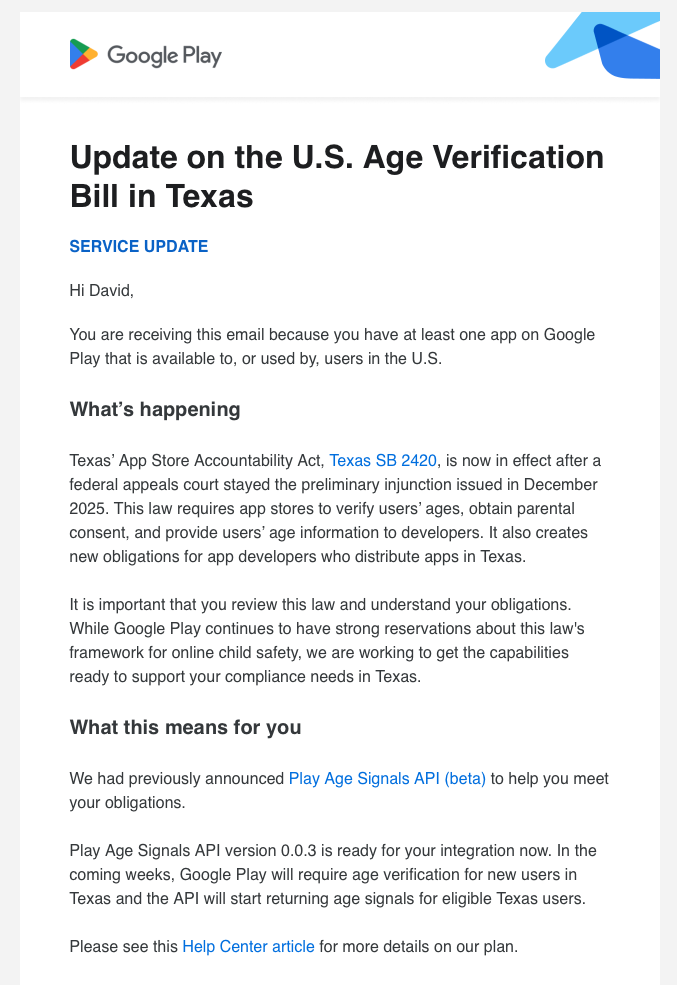
His comment:

I don't understand why developers have to change the apps for new age verification, that should be up to the store when selling the product to do on purchase, why are they even getting their % of money anyway?

The attached image, the email he got:
https://media.thebrainbin.org/3f/f8/3ff8b193449ba67ac4e41546a1c8b106e224f6b71bc851a7f6dcf27b04973478.png

Besides what I commented in his post, some more things come to mind that I think add to it:

The US is a federation, meaning one province's laws shouldn't directly affect the others. But the email he received says that he has "at least one app (...) available to (...) users in the U.S.", and right next explaining it's due to Texas' App Store Accountability Act. This implies the laws of one province are affecting how the program is provided for the whole union, or at least that Google is making it so. Granularity is nowhere to be found it seems.

Also in the part that I quoted, the second omitted element is "or used by (users in the U.S.)". People can get access to stuff not officially available in their countries legitimately, apparently those being considered imports in such cases (please correct me if I'm wrong). And extrapolating, such programs could even "be used" by pirates and people circumventing geoblocking. So in all cases, would the developer be tied to the laws of a country by how an user uses it? Feels like a trap.

15


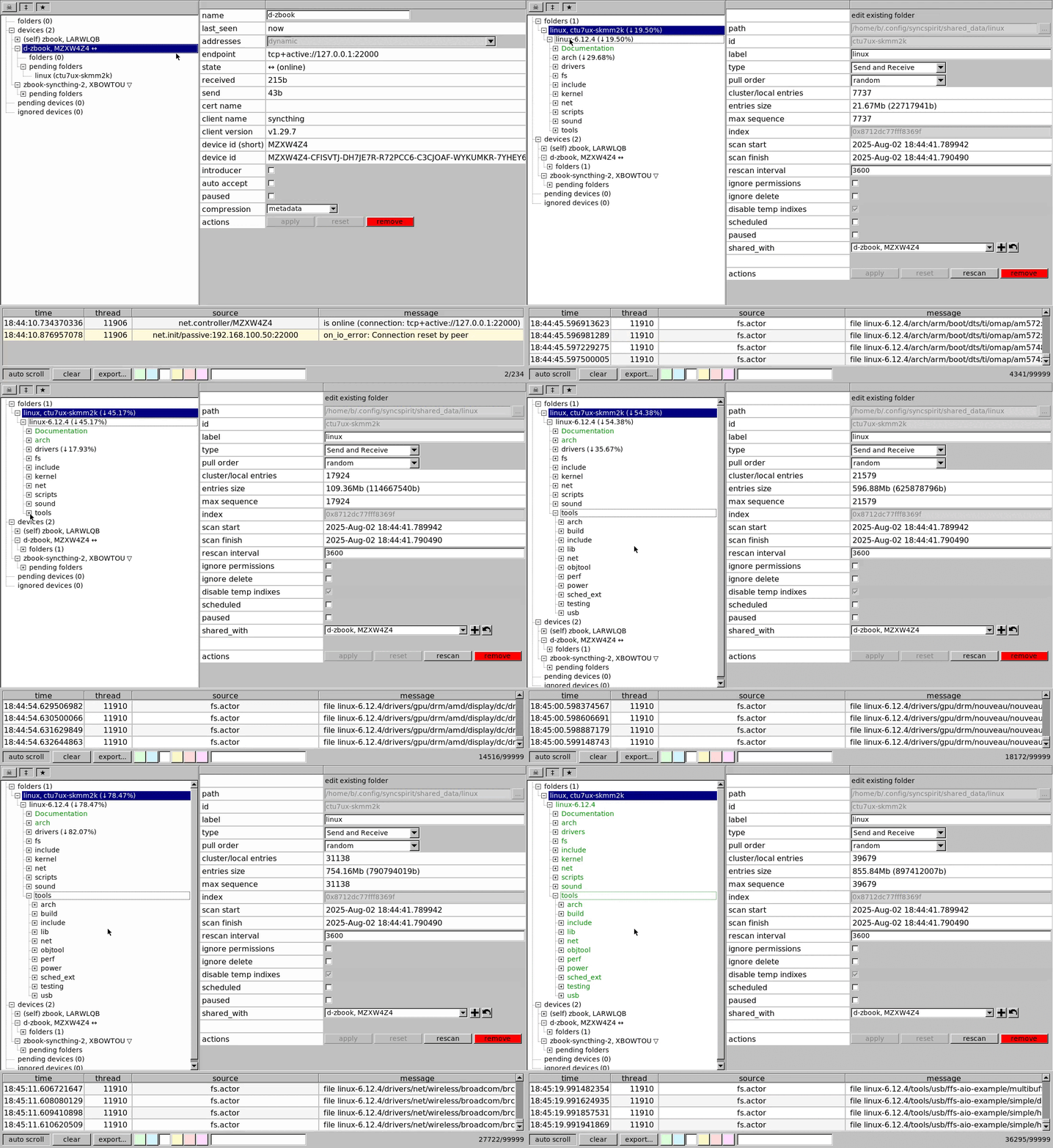
I'm glad to announce v0.4.5 release!

Syncspirit is continuous peer-to-peer realtime syncrhonization tool. It implements BEP protocol and provides seamless interoperability with existing syncthing nodes and clients.

https://raw.githubusercontent.com/basiliscos/syncspirit/refs/heads/master/docs/fltk-overview.gif

You can download ready-to-use binaries for Linux x86_64 (AppImage), Windows 32 bit (WindowsXP is supported), Windows 64 bit and Mac OS X (Apple silicon).

Notable changes:

  • [core] monitor local filesystem changes in realtime and propagate updates across the cluster (inotify/ReadDirectoryChangesW/kqueue)
  • [core] allow arbitrary subfolder rescan
  • [core] do not accept files with non-valid utf8 filenames
  • [ci/cd] use https://sourcecraft.dev/ infrastructure for building
  • [core] bugfixes

Syncspirt source code uses GPLv3 license.

By Developer @basiliscos2@lemmy.ml

16


When invideous craps out I use this. Its nice... I use a appimage. It is so stupid easy

17
Google served me Malware (www.youtube.com)
submitted 2 months ago by to c/degoogle@discuss.tchncs.de
18
submitted 2 months ago by to c/degoogle@discuss.tchncs.de


When Google was founded in 1998 it solved a big problem: spammy and chaotic web. Does this sound familiar? Because it's happening again. The World-Wide-Web is still a place for everyone, but if it doesn't have good SEO nobody will find it. AI webs and images are surrounding the internet.

How is Google handling that? By deleting blue links and replacing them with AI agents. How are other search engines handling that? By creating blacklists and scanning websites using AI detectors. That will never work.

Well, I have an idea...

[ ? ] Basic concept

Basically, imagine Wikidata (a big database of lots of things filled with data, similar to Wikipedia), but not for objects, but for websites. Websites would have their own pages with information about them - what kind of website it is, whether it has ads, a short description, when it was created/who founded it, how big it is, etc. It would be all open-source and managed by the community.

[ * ] Features

Sounds weird, right? Why would someone do it? Well because of the advantages:

  • You can filter your search in hundreds of ways! One example: you want to find something on a small forums, that are ad-free and founded more than four years ago for no AI garbage. On google? Impossible. In this idea you would just type it into the search. Super useful. Do you know any other search engines where you can do this? I don't.
  • What about the history of websites? Normal search engines only work with how the pages look at the moment. But that's not always efficient. With a database of website history, a search engine can find out that a website has been changed (all its content) four times in a month. That's not how normal websites look, is it?
  • Another thing is SEO. SEO requires experts and a lot of money. In this system, you just enter data into a database - anyone can do it!

[ @ ] Image search

These days, some AI images are that that realistic, that is impossible to tell if the image is AI or not. So we have to do it differently, not by checking when the image is already taken, but by when the image is being taken - insert cryptic metadata into the photo. And I'm not talking about that garbage EXIF metadata that can be overwritten, but about C2PA.

It's still not mainstream, but it's groundbreaking. It’s also the only way to make sure that the photo was taken by a human.

[ # ] Potential Challenges

As every project in it early stage, it have potential challenges. But they are not impossible to solve, they only require some effort. The database can be filled it can be full of spam from random people, from bots from anyone. To solve this problem, we would need to implement a system similar to the one used by Wikipedia.

Another thing, MONEY. I don't have any idea, how much it can cost, but it will be not for free.

The internet is changing rapidly. It would hard to keep the database fresh, hm? Well, bots can help a lot, by checking important info (if website is only or not and countless other details).

[ / ] Final though

I am releasing this here, because I want someone to make it real. I'm not planning to do it myself, I don't havr enough skills to do it. I just want to make search fun again.

If Wikipedia could build the world’s biggest encyclopedia from scratch, it's possible to build the world’s biggest web directory.

OC writeup by @ok1computer@lemmy.world

19
20
21


So they finally went and broke the Google Weather app so the widget won't work because it wants location permissions even when the app is not in use.

Homie don't play that shit. You don't need my location except when I am actively needing to use the app; go fuck yourself Google.

Is there anything Lemmy recommends?

22
23
24


Google is making its Search more centred around AI, turning it into a conversation.

Besides being a worse experience, the websites from which it sources its information are losing all traffic and recognition.

Recommend a list of alternatives:

  • Kagi - Paid but better experience than Google
  • Ecosia - Similar experience while supporting a good cause
  • Qwant - Increasingly unique results and building a EU-first index
  • DuckDuckGo - Privacy-focused search, but quality of results may vary
25


Archive.Today starting to use Google's QR-based reCaptcha

#recaptcha #degoogle #datahoarder

The site has a few variant domains, unsure why, and archive.md, the one I'd been using, threw the QR reCaptcha just now, as per the attached image, while archive.today directly threw the good ol' "try to verify a dozen times" version.

The recaptcha may appear even when the user is not using a VPN if it grows suspicious, meaning the site may soon be inaccessible without bending to Google.

OC by @Auster@thebrainbin.org

view more: next ›