[–] 4 points 1 week ago

Here are the publications that matter. Everyone should be watching these for updates. When a change is proposed they hold public hearings that lists the contact information for the committee members and feedback phases open to the public.

Manual for Assessing Safety Hardware (MASH), 2016, AASHTO

These are the engineers who are responsible for running the experiments that determine safety standards.

Manual on Uniform Traffic Control Devices (MUTCD)

"The MUTCD is the law governing all traffic control devices. Non-compliance with the MUTCD ultimately can result in the loss of federal-aid funds as well as in a significant increase in tort liability."

Notes:

  • the MUTCD's compliance deadlines are hard to nail down.
  • each state's regulatory traffic laws (search for "standard drawings") often exceed the MUTCD's requirements. Actually suing a state for non-compliance would be extremely difficult, but might be good publicity.
  • the state's DOT engineers can avoid having to cater to bikes or peds by simply changing the classification of a road, e.g. lowering the speed limit from 40 to 35 in dangerous areas.
  • source
  • [–] 3 points 2 years ago (1 child)

    Running a Debian VM with Docker solved all those issues for me. I set the arrs root /data folder on my NAS to mount with CIFS at boot. It works so well with a ceiling of 4/8 cores and 12GB RAM I've moved all my containers to it and mostly just use Proxmox for monitoring and reliable backups/images over NFS.

    The only issue I've had in the last year or so took me about 30 minutes between realizing something was wrong and fixing it: Make sure you put your CIFS credentials file in a folder accessible to Debian's main user account or a power loss will break automount until you re-establish the link with a root user. Or create a locked down arrs-only user on your NAS so the CIFS command can include the username and password with less concern.

  • source
  • [–] 3 points 2 years ago

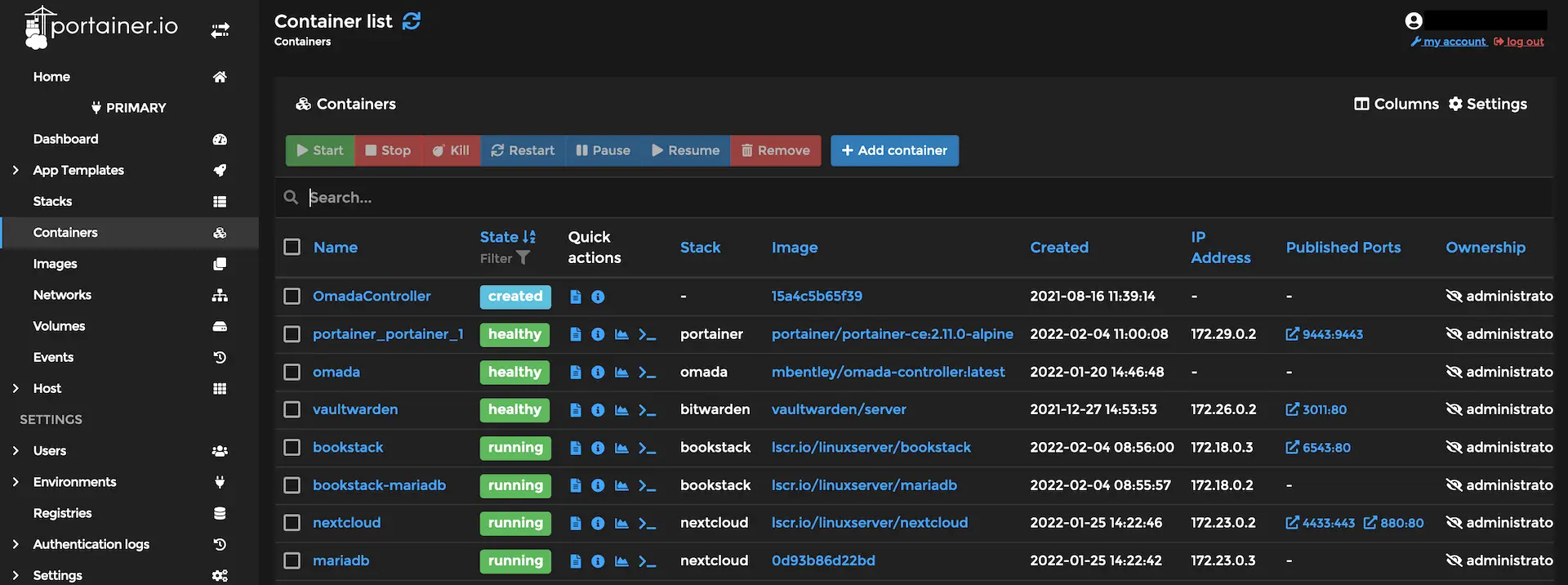
    It's essentially a GUI for Docker. It has its own quirks that, in my opinion, don't match Docker's UX and can make it more complicated to customize deployment. But Portainer can make multiple environments or dozens of containers easier to manage. e.g. I do most of the actual work using compose yamls but use Portainer as a reference to organize subnets, ports, and volumes. Or if I'm unsure what the problem is and just want to see all the details of each container faster.

  • source
  • parent
  • context
  • [–] 12 points 2 years ago

    These highlight videos are so frustrating, they hype the synergy combos then seem to struggle or avoid executing them consistently. The Blind Beast went virtually unscathed for the first 25 seconds and I only saw 1 wolf, 2 clear debuffs (the icon could have been covered up by the body or blended in with the red flesh), and 4 stuns in that whole fight. But even so out of ~11 attempts at the combo 3 of them did over 60% of the damage.

  • source