[–] 4 points 8 months ago (1 child)

I don't know who this Jack person is but it seems like you know a lot about someone you don't want to know anything about. Also have never heard of "truth broker" but that sounds like something to avoid as much as an "influencer". Do people wear this title willingly?

But I would agree that a lot of once-respectable or thought-to-have-been-respectable outlets have been twisting headlines for clicks. The New Republic is one that I subscribe to for what I thought was valuable reporting but every day it's just full of narrative-enforcing click bait, similar to what you've described. Time to unsub.

The greater problem is that responsible journalism has a hard time staying in business when it competes with 15 seconds of rage bait. Our attention spans are minuscule and we don't want or are unable to pay for anything that promotes authenticity. Nervermind "the algorithm" pushing salacious content over informative content and how you have little control over what you take in.

And it's just going to get worse as time goes on. John Stewart and Amanpour were talking a bit about this on Monday's show.

  • source
  • parent
  • context
  • [–] 95 points 8 months ago (6 children)

    Holy ever living fuck - this is some of the worst click bait I've ever read.

    Karoline later shared another quote that read, "What a privilege it is to have your bed taken up by a small human who thinks it's the safest place in the world to be," and wrote "crying" over it.

    She's fucking "crying" at the thought of her child sleeping in a safe place. She's "crying" about the privilege of being a mother.

    There is nothing at all in this article about her crying about burnout. This entire article is about her having a good time then quoting some completely random psychologist making assumptions about the stress someone must live with in this position (no fucking doi).

  • source
  • [–] 2 points 8 months ago (1 child)

    With the vice-like grip they have on Macs now thanks to Apple Silicon, new Mac computers now forbid you from installing free software applications or operating systems, due to improper use of code signing.

    So you're saying the alternative, allowing free software to be installed without any sort of system check, is what we should be fighting for?

    I get that some people don't want a corporation dictating what they can or can't do with a product they purchased but I think there's a whole lot more people who are buying into an ecosystem where we put our trust into the same corporation to protect us from malware running on our devices that contain essentially all our personal information.

    Personally, I'd prefer to argue for much, much more restriction on my devices, not less.

    All Apple products accept and welcome DRM (Digital Restrictions Management) that takes control of your music, movies and games away from you. Even though it's possible to download DRM-free music on an Apple device, its streaming music and movies have DRM.

    That's not really an Apple argument as much as a media creator argument. Apple is one of dozens of media creators that have been using "DRM" / Copyright protection since the 1980s to prevent source duplication. The fact is that you have the right to copy media that you have purchased for archival purposes. What's illegal is breaking the lock preventing you from consuming that media on other platforms. The intention here is to prevent you from sharing a legally acquired copy with others. This is why we now purchase a license to consume media, not the media itself. You may not like this restriction but this is not an Apple issue.

    As part of its micromanaging of the apps available for iOS, Apple censors all free software. Additionally, Apple Music, which comes with their desktop and mobile devices, refuses to play media in free formats like Ogg Vorbis and Ogg Theora.

    😹

    Apple keeps users' personal data in a sketchy corporate database Apple operates a network of services for managing contacts, calendars and correspondence across all its devices. This amounts to a huge vacuum sucking up users' personal information and storing it in a centralized server farms that are vulnerable to attacks. And since the software running on people's Apple devices is proprietary, no one except Apple can audit it and know exactly what it is sending to the mothership. If you're using an iPhone, the situation is particularly bad: the devices exposes your whereabouts and provides ways for others to track you without your knowledge.

    This can not be over-shared enough. Apple has even published a paper showing how your information is auctioned off by app developers. You think TikTok is bad? Look up Conde Nast. Again, I wish Apple were more restrictive. The best thing you can do is review what the app does with your information in the App Store before you download it and disable ad-tracking, etc on the device.

    I don't see how you can argue for more freedom to "own" your device while using the argument about protecting your information. The argument should be for more transparency.

    The brighter idea would be to promote an open source organization that uses something like blockchain to hold your data while sandboxing it out to apps and operating systems.

  • source
  • [–] 21 points 8 months ago (1 child)

    Jesus. This article is like getting through a recipe blog. The first third (at leas, I didn't make it further) is about the author's knowledge of pennies.

    I can only assume, as a person with a functioning brain who has lived on planet earth for nearly 50 years, that the pennies are not in fact trash but perfectly legal tender. I was hoping to find a line in this story to contradict its initial bold claim but...

    The initial draft of the story I filed for a popular New York City–based publication was 20,000 words long. (Sadly, all of the best parts everyone would have loved were cut by my psychotic editor, whose No. 1 passion in life was removing 13,000 perfect words from my first drafts; I’m not worried about him reading these words, because a low-class butcher like that doesn’t possess enough humanity to subscribe to The Atlantic—though, if you happen to know William, I would thank you not to send him a gift link to this article.) And what I learned was that there was no sane reason why.

    This article should be title: Journalism is Trash.

  • source
  • [–] 2 points 8 months ago (1 child)

    When I acquired my dad's turntable and a handful of records (I was about 15-16) this is one of the first records I played. I brought it over to a friend's house and we played it over and over, sometimes in slow-mo (buuuut I goooot thhhhe crystaaaaal baaaall), sometimes in reverse, because it was so bizarre and hilarious. And so perfect for a teenage boy's sense of humor.

    I listened to this record so much that just reading what you wrote reminded me of smells in the room when I listened to this about 35 years ago. No, not pot, actually - just a stinky attic.

    Music can be a time machine. It works best when you play full albums on repeat at different moments in your life - in the car, on vacation, with friends, when you're happy, or sad.

    Randomly generated playlists full of music you have little connection with lack the ability to latch onto your emotions and create memories.

  • source
  • [–] 27 points 8 months ago*

    You Should Know:
    OP's account is only 2 hours old and the claim they have made on 'YouShouldKnow' is wrong.
    This post should be removed for misinformation.

    https://www.thoughtco.com/the-supermajority-vote-in-us-government-3322045
    When Is a Supermajority Vote Required?
    By far, most measures considered by the U.S. Congress as part of the legislative process require only a simple majority vote for passage. However, some actions, like impeaching presidents or amending the Constitution, are considered so important that they require a supermajority vote.

    • Impeaching
    • Expelling a Member of Congress
    • Overriding a Veto
    • Suspending the Rules
    • Ending a Filibuster
    • Amending the Constitution
    • Calling a Constitutional Convention
    • Ratifying an Amendment
    • Ratifying a Treaty
    • Postponing a Treaty
    • Repatriating Rebels
    • Removing a President from Office

    https://en.wikipedia.org/wiki/Government_shutdowns_in_the_United_States
    Government shutdowns in the United States
    The US Government has shut down 11 times in the past 45 years for a total of 132 days.
    Seven times for six days or less.
    Once for 21 days under Bill Clinton in 1995-96 (total of 27 days under Clinton).
    Once for 16 days under Barack Obama in 2013.
    Three times for a total of 79 days under Donal Trump (so far).

    https://www.britannica.com/science/US-abortion-rights-by-state-2236312
    U.S. Abortion Rights by State
    Legal with no gestation limit or Legal before viability: 23 states
    Full ban: 13 states

  • source
  • [–] 35 points 9 months ago (16 children)

    Disappointing that the linked article doesn't include a photo of the tattoo. When a report lacks important relevant information, the reader has a choice to take it for its word or seek out supporting facts. So, when I searched for Planter Nazi Tattoo, there are plenty of articles taking the opposing tone - in that he knew what the tattoo was.

    https://www.dailykos.com/story/2025/10/21/2349761/-Not-one-diary-or-mention-about-Graham-Platner-s-Nazi-tattoo-Really This sounds more like he has been aware of what the tattoo represented and he hasn't really cared about it until now. Which I personally find much more believable. Good on him for getting it covered up but, ehhh. Maybe don't believe every word a politician exhales.

    I don't know this person or anything about Maine. I don't really care either. But journalism needs to be held accountable. I expect more from PBS / AP.

  • source
  •  

    I get that anything is worth whatever someone is willing to pay for it. That's besides the point. My point is, beyond speculation, what do crypto coins represent?

    I also understand that the value of the US dollar is being questioned almost as much without the backing of gold.

    But what I really want to know is what is at the foundation level of Bitcoin that people are buying into?

    I have a basic understanding of the blockchain, etc. I sold 1BTC in 2017 for $1200 when I thought that was as high as it would go. At this point, at over $100kUSD and rising steadily, what is the $ limit and what is that limit based upon? I thought it was based on the value of mining to check transactions but this seems... not worth $100k to me.

    I've been thinking, the only tangible value I personally see in Bitcoin, because it's not really being used as legitimate currency, is for criminals. By now, there must be trillions of dollars in BTC acquired by criminals holding corporations hostage. When you've got people like Trump involved (either explicitly or by way of manipulation) with an executive order to establish a crypto czar, this suggests to me that he's creating pathways for bad actors to more effectively gain more wealth. These are the people who are most excited in Bitcoin, beyond speculation.

    I mean, there's little to nothing on the up and up with crypto, right? It's a scam. Right?

    Please, factual answers only. I'm looking for someone to dispel my speculation with genuine economics of the matter.


    Excerpts:

    When the president talks about security in the Arctic, he’s talking about climate change.

    Their aim, the vice president said in a video on X, is to check up on Greenland’s security, because unnamed other countries could “use its territories and its waterways to threaten the United States.” And these are real concerns for the United States, rooted in climate change: As polar ice melts away, superpowers are vying for newly open shipping routes in the Arctic Ocean and largely unexplored mineral and fossil-fuel reserves. Arctic warming could pose a direct threat to America’s security interests too: Alaska could have new vulnerabilities to both China and Russia; changes in ocean salinity and temperature might interfere with submarine detection systems; the extremes of climate change, including permafrost thaw in Russia, could drive economic instability, social unrest, and territorial claims.

    So far this term, Trump has acted as if climate change does not matter: He has withdrawn from the Paris Agreement, announced plans to reopen the Arctic National Wildlife Refuge for oil and gas drilling, and paused new offshore-wind development and Inflation Reduction Act clean-energy funding. But if the president’s bid for Greenland—or the U.S. military’s quiet cooperation with Canada to boost Arctic defenses—is any indication, the U.S. is weighing its options for a warmer future. “We live in the real world,” Evan Bloom, a global fellow at the Wilson Center’s Polar Institute and former State Department official, told me. “The military and other agencies will continue to take climate change into account, because they have to.” When he hears Trump talk about Greenland, he hears the president speaking about the geopolitics of climate change—“whether he’s willing to call it that or not.”


    Proton Drive has decided to duplicate about a thousand files on me. It has also decided to stop syncing properly. Not sure what the issue is but it's broken. I've restarted it, reinstalled it, restarted my computer (Mac). It keeps saying that it synced X minutes ago but it's very evident that there are files present on the web version that are not on my computer. There should be no reason for these files to be missing. And there's files my Finder says "this file doesn't exist" even though it does.

    So, I'm in the process of (1) deleting the duplicates and (2) downloading all my files from Proton Drive on the web.

    If I decide I still want to use Proton Drive after this disaster, what's the best way to remove the app and the directory from my computer in order to start over again - ideally by syncing the files from the web to my computer.


    I've just been archiving about 75 of my deceased uncle's CD-Rs which, I'm assuming, he had archived from his EMusic account. The labeling of the CDs (ex., 13/08/23) and the order of tracks is completely wacked but I really appreciate that I have "hard copies".

    Last year, I gave my 16 year old nephew a classic (refurbed) iPod full of about 10,000 songs. Don't think he really appreciated it (and the months it took me to curate it). Kid was touching the screen and had no idea what a click wheel was.

    I'm an avid record (500) and CD (100) collector but I have close to 100,000 tracks in my digital library. This music was acquired in a number of ways but only about a quarter of it was ever paid for by me. I know how to get music for free. I'm sure most of this sub knows too.

    I've mostly resorted to buying physical media for the albums I really like and sourcing digital music with abandon for background music, playlists, and iPod playback.

    For a wide variety of reasons, I do not use streaming music services. For one, with such a large music collection of my own, I was never listening to it. Two, and more importantly for this post, you can't pass down a subscription service.

    I'm just curious, is anyone buying digital music anymore?

    Bandcamp is an easy place to pay for music but it's not really mainstream. If you wanted to buy the new Teddy Swims album, where would you buy that? I just pulled this album out as an example because it's in the iTunes Store. Apple has it for $8 but the artist has a 24/44 MP3 for $5.

    Where are you buying digital music from and why?

    Ooh - and is anyone either buying digital and burning to CD for backup or buying CDs and ripping them for playback? Or are you all too young for CDs over here?


    Given the previews of the new Plex experience, I think I'm going to need an alternative media player.

    Here's my background.

    • My media is stored on a QNAP NAS. All my devices are made by Apple.

    • My library is a decent size. About 1,500 movies, 50 TV series, 75,000 songs, plus 2,000 classical pieces (would love a better way to manage classical music).

    • I use PlexAmp on my computer to listen to music all day. If I were to listen to music outside the house, PlexAmp is my only music app.

    • I use Plex on Apple TV to watch my movie and TV library. To a lesser degree, I watch home movies, music videos, and various media obtained from archive.org - I call this my VHS library. I also listen to music and look at my photo library from my Apple TV.

    • The Plex UX for VOD is bad so I instead use Pluto and Tubi (not that they're much better).

    • I'll never watch content on my iPhone. I may watch on my iPad but not often.

    • I share my library with family so we can watch home movies during the holidays. They sign into Plex on either Apple TV, Roku, or their phones. I've also been happy to share photos from within Plex but this is being stripped out to another app which will not work for us.

    It's evident that Plex is intent to shove VOD down our throats at the expense of an enjoyable experience with our own content. For the older people in my family, this simple will not work at all.

    The most important aspects are (1) an Apple TV app and (2) music apps.

    I want something that's relatively easy to setup. I'm not going to spend time building docker containers and reverse proxies (unless it's a one-click process).


    Importantly, scientists have determined that the genetic changes in the bird flu’s genome, that have accelerated the development of the panzootic, have been driven by climate change. A comment by wildlife ecologist Diann Prosser at the Eastern Ecological Science Center located in Maryland Laurel US and her team, published in Nature Microbiology in November 2023, titled, “Climate change impacts on bird migration and highly pathogenic avian influenza,” stated that “Climate change patterns appear to parallel an unprecedented global spread of highly pathogenic avian influenza (HPAI).”

    The current outbreak in US dairy cows poses an enormous threat to human populations. This threat is being expanded by the US ruling elites’ program of trashing basic public health measures in the interests of big business with the continuing SARS-CoV-2 pandemic. “Forever COVID” is being expanded to avian influenza, but with even more lethal consequences if it becomes a pandemic.

    President elect Donald Trump’s recent selection of anti-vaccine zealot Robert F. Kennedy Jr. to head the Department of Health and Human Services (HHS), as well as his appointment of Great Barrington Declaration co-author Jay Bhattacharya to head the National Institutes of Health (NIH) and television doctor Mehmet Oz to head the Centers for Medicare & Medicaid Services (CMS), alongside other vicious opponents of public health to fill out the health agencies, clearly demonstrates that public health will be further eviscerated for the interests of big business, neutering the potential of science to solve these crucial questions for the future of humanity.

    Edit:
    Since 2003, 51% of the 903 people infected have died.

    Currently, without a vaccine, there is the potential for this being a very grave threat.

    Please take a moment to read this article and continue to pay attention to this issue. The CDC has a page here https://www.cdc.gov/bird-flu/situation-summary/index.html Given the situation with the US presidency, I would suggest finding other trustworthy sources.

    I've pulled quotes from the article to express my personal opinion on the issue. That being that our increasing consumption of animals raised on factory farms, our reliance on fossil fuels, and general culture of over-consumption is contributing to both climate change and a measurable increase in livestock disease.

    From my perspective, we are quite literally on the path of a death spiral. Everyone should be taking their consumption of animal products very seriously and finding ways to reduce by any amount. I'm not vegan nor do I intend to be but I do go out of my way to source animal products from smaller local farms. Please, take time to learn to cook for yourself using fresh foods. I believe quality nutritional intake should be the single highest priority for everyone.

    submitted 2 years ago* (last edited 2 years ago) by to c/movies@lemmy.world
     

    I can understand people looking at the cast and the budget and the trailers and going into the film expecting one thing and getting something entirely different. I, however, thought this movie was incredible. And terrifying.

    I'm not really one to watch movie trailers anymore. They're too long and tell too much of the story while too often setting up misguided expectations. But they're also difficult to avoid.

    I went into this movie knowing little more than some visuals from the trailer, it's Coppola with Driver, and it's been poorly reviewed.

    After watching the film on the comfort of my couch, I was gassed. This movie is a warning. It's warning us about greed and capitalism and nationalism and rejecting our humanity. There have been countless works of fiction warning us about the consequences of merely being human. It's evident that too few of us have been heeding these warnings.

    Having little knowledge of the stories this is based on (see: Catilinarian conspiracy), I searched for some interviews with Coppola. Now, you can say a movie should be complete all on its own without additional knowledge; and that's fine. I disagree. I enjoy movies that pull from other works and history. This film retches with metaphor and I love it. I like stories that breathe outside the theater, that ask me to make connections, that keep me thinking about them long after the credits are over.

    The premise of the film is that the United States was intentionally based on the Roman Republic and, like Rome, is on a course towards collapsing. It's a great argument that Coppola has illustrated and it should be a moment for us all to reflect upon. He's been working on this film since the 1980s it could not be more pertinent right now. We should dissect this film as we should dissect the rise and fall of Rome.

    The film claims, Utopia isn't a place - it's the commonness of genuine debate, empathy, equity, and not being a pawn in a corporatocracy.

    It ends in a way today's youth should resent. It says, look at all this shit your elders and governments have done - now it's up to you to fix it. Because if you don't, sorry, but you're on the path towards the Empire of America. Still, it says so in a hopeful way.

    I don't think it's a perfect movie. I wish some things were done differently - perhaps a little more specifically or apparently - a tiny bit more cohesion. My politics and my rage-buttons might prefer more direct lines to modern day personalities. But I really enjoy the opportunity it gives us to debate and compare and to, maybe, step outside our echo chambers.

    Compared to the vast majority of cinema that's been put out in recent years, Megalopolis "leaps into the unknown". Preexisting Hollywood franchises are continually regurgitated for people who fear the unknown. Discomfort is divisive. Populism is comforting. Populism rejects freedom. What's gained from repetitiveness but disconnection from our imagination? Imagination created the gods. We need to reject populism to create great things.

    The film itself may have some flaws but Coppola's story is monumental. I'm looking forward to watching this movie again and studying up on the rise and fall of the Roman Republic and the Catilinarian Conspiracy.

    Edit: I just saw a tv ad for crypto and their tag line is “fortune favors the brave”. Hilariously, it’s a very pertinent statement.


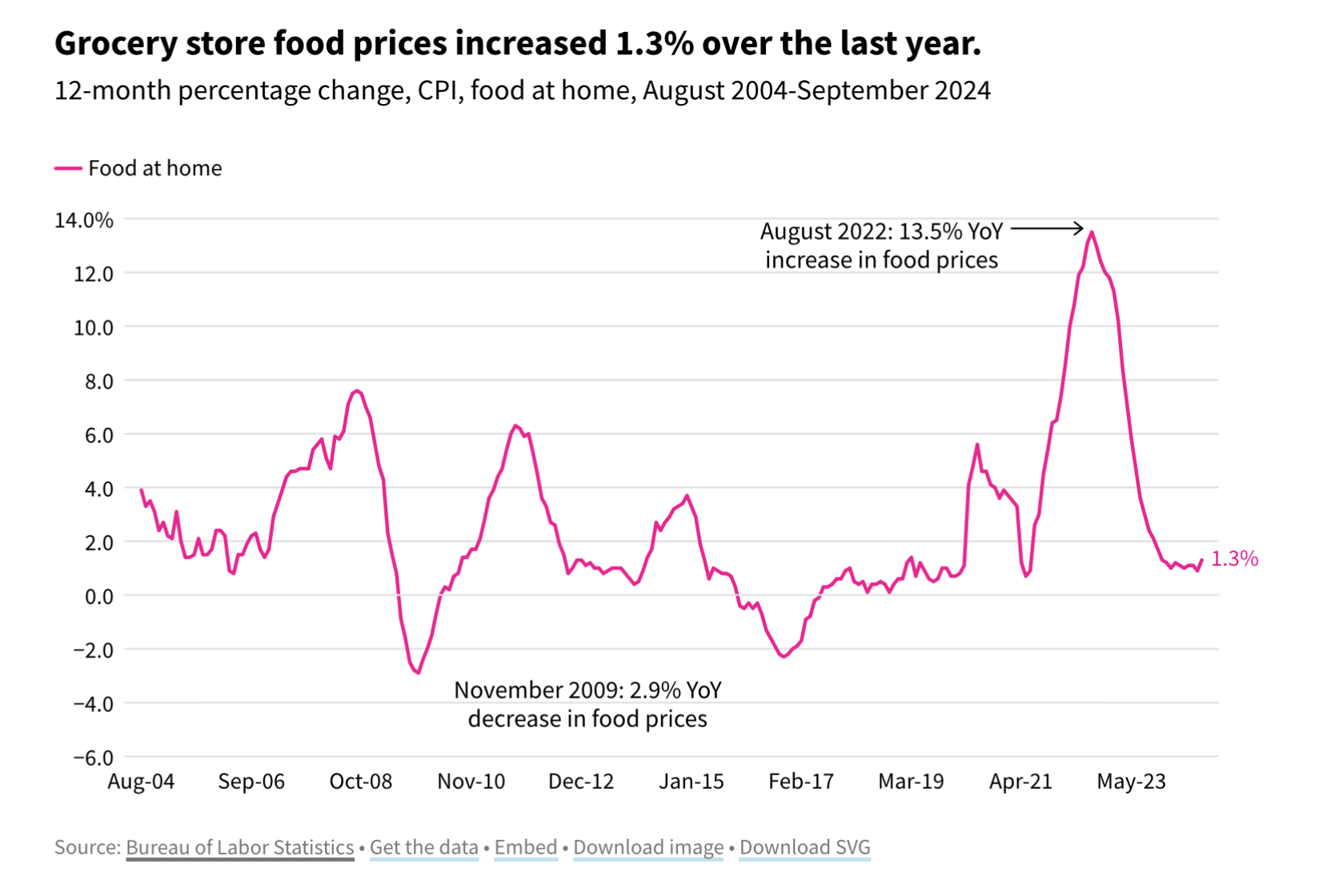
    Why are grocery prices so high?

    Several factors affect food prices, such as:

    • Supply chain challenges, including those related to COVID-19 and global relations such as the war in Ukraine.
    • Inflation.
    • Higher labor and transportation costs.
    • Animal disease, such as the avian flu in 2022 which impacted egg and chicken prices.
    • Extreme weather events which damage crops and affect animals.

    The USDA expects grocery store prices to increase 1.2% in 2024 compared to 2023. Although the federal government can take indirect action to help manage grocery prices, it does not have a direct say in controlling price increases.
    view more: next ›