[–] 7 points 3 months ago* (9 children)

I don't know the German market, but I've been really happy with the Kia EV9 for the two years I've owned it. Has 3 rows and gets 2.1-ish mi/kWh in snowy winter and about 3ish during the summer. Overall mi/kWh for the two years has been about 2.8 mostly city driving with some highway and occasional road trips

  • source
  • [–] 6 points 1 year ago* (2 children)

    Hoping to be constructive: how do you think search engines should operate? Or maybe how would you like one you consider "good" to operate?

    Also wondering how you see something like Privacy Pass that Kagi announced recently: https://blog.kagi.com/kagi-privacy-pass

    This is particularly useful in the context of a privacy-respecting paid search engine, where the Server wants to ensure that the Client can access the services, and the Client seeks strong guarantees that, for example, the searches are not associated with them.

  • source
  • parent
  • context
  •  

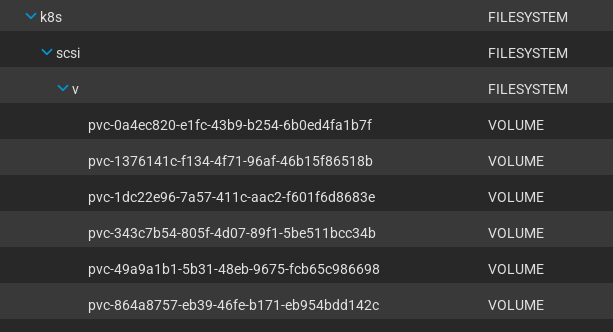
    I've started using iscsi volumes for kubernetes storage, and it seems to be working fine. I have volumes automatically created under Data/k8s/scsi/v for each PV.

    As a backup strategy I have periodic snapshots of every volume set up and I am also replicating the entire k8s dataset to a different pool.

    I've done this kind of thing for other "normal" filesystem datasets and restoring from snapshots or replications usually just entails copying files. However I'm new to iscsi and "volume" datasets, so if something went wrong with one of my iscsi volume datasets, and I have snapshots and/or replicated them, how do I go about restoring them?

    I'm not sure if I'm even asking the right question :) Is the "right" thing to do here to do application-level backups, ie. run sidecars for my k8s workloads that back up the files inside the volumes rather than rely on backups at the TrueNAS level?

    Picture of the setup for reference:
    [–] 8 points 2 years ago* (4 children)

    I ended up canceling my order and in the form let them know the reason. They refunded me my money and didn't respond.

    Now I'm trying to figure out what two actually get to replace my ender 3, currently trying to do research on the K1C and the Sovol SV08. I'm fine with tinkering, but I really want multiple color support

  • source
  • parent
  • context
  • [–] 10 points 2 years ago (8 children)

    I have an order for a P1S that hasn't shipped yet but am now considering cancelling it and buying a Creality K1C. Anyone have thoughts on that as an alternative? It seems their multi material thing is coming out soon

  • source
  • [–] 1 point 2 years ago

    I can't wait for this. I've gone down a few rabbit holes looking into solar and battery storage, and even just battery storage by itself to replace the generator we have for when power is out and/or to offset peak use time rates. But batteries are really expensive and I've already got a hundred kilowatt hours sitting in my garage.

  • source
  •  

    About a year ago I hired a financial planner to manage assets in my retirement accounts but am starting to think about doing it myself.

    I don't disagree with the general approach they're taking, but it seems like it should be simple enough for me to do myself every 6 months or whatever.

    The gist of the strategy is a balance across large/mid/small cap and sectors at certain percents along with some % of bond funds and some real estate funds.

    I think my main questions are how do I identify and compare various funds that fall into these broad categories to try and pick the ones I want to actually invest in.


    I'd love to hear some stories about how you or your organization is using Kubernetes for development! My team is experimenting with using it because our "platform" is getting into the territory of too large to run or manage on a single developer machine. We've previously used Docker Compose to enable starting things up locally, but that started getting complicated.

    The approach we're trying now is to have a Helm chart to deploy the entire platform to a k8s namespace unique to each developer and then using Telepresence to connect a developer's laptop to the cluster and allow them to run specific services they're working on locally.

    This seems to be working well, but now I'm finding myself concerned with resource utilization in the cluster as devs don't remember to uninstall or scale down their workloads when they're not active any more, leading to inflation of the cluster size.

    Would love to hear some stories from others!

    view more: next ›