Unfortunately no amount of emotional support can fix ai slop.
Unfortunately no amount of emotional support can fix ai slop.
AFAIK you can't do this with BPF as it doesn't have any kind of sleep functionality. I'm also not sure how would you achive this using cgroup, which are about quotas AFAIK.
It should be easy to edit the existing code to add support for i18n, but there's probably no way to make in generic (except for macros).
Yeah, that was basically it.
There's no purpose really. It was more of "wonder if I can" and also nice way to learn custom literals.
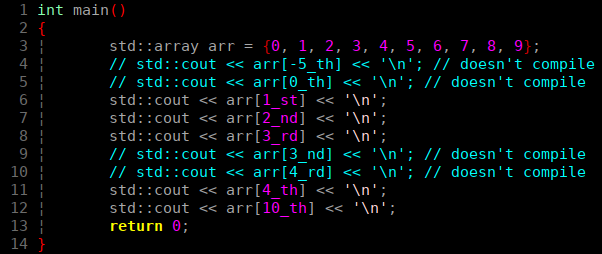
I did a code that uses custom literals to allow indexing arrays with ordinals (1st, 2nd, 3rd), all at compile time. Additionally _st works only with 1, _nd only with 2, _rd only with 3. Zero and negative numbers are also not supported and fail compilation.
https://github.com/serpent7776/bits/blob/master/th.cpp/th.cpp
I can actually define this in TCL:
% proc ifn't {cond cmds} {if {!$cond} {uplevel $cmds}}
% ifn't false {puts 12}
12
% ifn't true {puts 12}
%
view more:
next ›