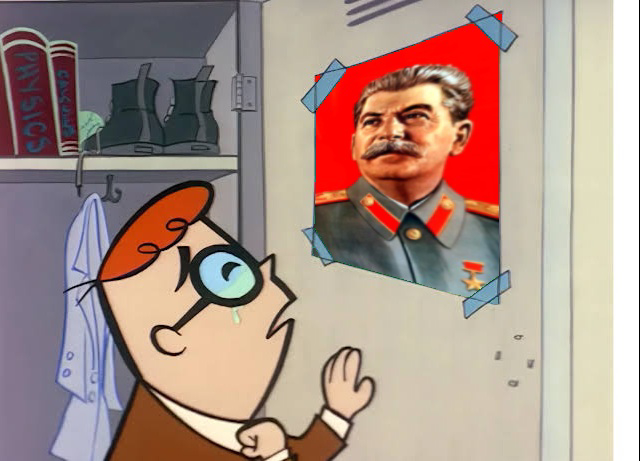
...because I'll never be him
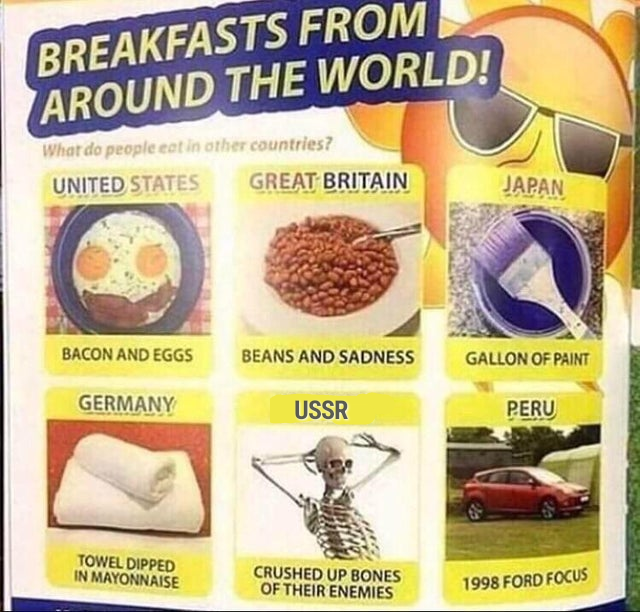
¡Venceremos!
Agreed.
It's stuff like this that makes me realise how much better a head of state Thomas Sankara was than I'll ever be though. Homie refused to use airconditioning in his office because it was considered a luxury in Burkina Faso.
I believe Suslov was another revolutionary figure who eschewed the privileges that he had access to on the grounds that if it was good enough for the masses then it's good enough for him.
NAFO and its consequences have been a disaster for the online discourse.
Imagine having the confidence to make ahistorical claims that are this outrageous. Either you're duped or you're an op.
Oh, I forgot to mention something in my previous comment so please excuse the double-tap.
There's absolutely no reason why you have to focus your learning on the ongoing dark history of the US. It's still going to be there waiting for you whenever you're ready to come back to it.
If you feel like you're getting doompilled by staring long into that particular abyss then it is no longer serving you or the greater struggle. So abandon it, at least temporarily.
There are a ton of inspiring things from the past and the present moment that you can focus on so seek out those things and give yourself permission to put investigation into the stuff that brings you down on hold. Also, when you return to this stuff, remember that you need to be doing this with a sense of purpose. Mindless consumption of the doom doesn't work towards anything but if you are learning about this stuff to develop your thoughts about how to intervene in it and defend the revolution (e.g. learning about Salvador Allende's presidency and the coup in order to take lessons to heart which will inform your politics and how you would guard against subversions and coups) then it gives much more meaning to the difficult subject matter and it makes it less likely to sap your revolutionary spirit.
You might want to consider reducing your intake or disconnecting entirely from the news cycle as well. Of all the things I am exposed to, I find this brings me down like nothing else.
Try to find time for developing your aspirations and hopes as well as for your own leisure. I'm not of the opinion that self-care is a revolutionary act but it sure as hell is a radical act and it's of critical importance because you're not going to be of much use to communism, your community, your circle of loved ones, or yourself if you end up in a pit of endless despair.
You are far too important for that.
Israel has the right to exist
...in the dustbin of history
Thank you, robot.
Which probably doesn’t track well with my posts as I tend to ramble a lot but I’m going to try and cut back on that as much as possible. I would hate for anyone to get bored or frustrated reading my posts.
Unless it serves your interests or your own purposes not to, ramble away.
It's entirely up to the readers of your posts to determine whether or not they choose to read your posts and how they decide to go about that (e.g. reading closely, skimming, skipping to the parts that interest them etc.) Let the reader figure out what they want to get from your post and to seek that out themselves. Don't concern yourself with their needs because this is an exercise in reinforcing and enriching your own learnings. You aren't writing a paper or a book, so your concern for the reader shouldn't really be a high priority imo.
Im sure most of you know who Antonio Gramsci but he was discussed in class
Just be aware that Gramsci is used in the service of many purposes and his materialism is often downplayed or even erased from how his theory is interpreted or applied.
This is in large part a product of the fact that he was never able to really produce a body of work that is coherent and which nailed down his positions due to the circumstances of his imprisonment.
What this means is that I'd urge you to approach people's takes and applications of Gramsci with a healthy skepticism unless they are Gramsci scholars.
Out of interest, it's worth noting that the chief prosecutor for Mussolini said of Gramsci during his trial "We must prevent this brain from functioning for 20 years."
My professor answered this in the pluralist perspective there’s production bourgeoisie vs some other type of bourgeoisie that I couldn’t quite catch but that hardly matters.
Potentially "rent-seeking bourgeoisie", which is more relevant to liberalism but this is the group of bourgeoisie who are extractive rather than productive in the economy; landlords, speculators, financiers and investors etc.
To illustrate the point, imagine what the consequences would be if every member of the bourgeoisie made their money by being a landlord or an investment banker; the economy would collapse in a week.
My professor made sure to mention that in the Soviet Union, contrary to popular beliefs, it had factions and worked more like pluralists and he made this remark in regards to the criticism that pluralists cannot explain authoritarian regimes. He didn’t talk about the USSR with any contempt, and I feel like that’s important to mention.
This is promising!
Next, of course, was postmodernism
I'm an ex-postmodernist/poststructuralist. While there are useful tools in the poststructuralist toolkit, these days I am extremely skeptical of the overall utility of this intellectual movement.
If you want a crucial perspective on poststructuralism from an insider, the articles of Gabriel Rockhill are excellent and many his lectures hosted on his YouTube channel The Critical Theory workshop are also great. I can provide links if you need but I'm being lazy rn.
It depends on what your purpose is but, as a party which has not achieved a successful revolution, the party line on AES means very little.
It's hard to imagine a successful socialist revolution being established that won't rely upon China as a major trading partner and I suspect a lot of the pre-revolution positions will shake out in a post-revolution situation due to the material conditions.
Say your country achieves socialism tomorrow and it is faced with internal and external attempts at subversion, an effective blockade from the US and potentially other liberal economic blocs. Where do you think that your country will turn to in order for economic development and general support?
It's going to turn to AES countries, undoubtedly. Either it will be incredibly isolationist and almost certainly doomed to fail or the pragmatic elements of the party will seek out support from AES countries and those ties will develop and sentiment towards AES countries will shift within the party as a matter of necessary.
But I'm rambling.
Maybe you can use the party as a platform to develop political connections. Maybe you can instigate a split. Maybe you can stay within the party and drive a line struggle.
There are many options but it depends on what your goal is and what the conditions are.
There are a few things to consider:
The average lifespan of an empire is 250 years
That the situation has always been desperate and hopeless, perhaps moreso in periods of history than it is today. We can look to the battle of Stalingrad or the Long March or the period around the October Revolution as examples of just how desperate things have been and how we have been able to prevail against all odds. Heck, Lenin didn't expect to see the revolution in his lifetime and then in a few short years he ended up leading it.
I'm not going to go into depth on this because I don't have the focus rn but ultimately this is a question of having a world to win and daring to invent the future. We have two propositions:
The importance of revolutionary optimism cannot be overstated. (There are some good video essays out there on this topic.)
Ultimately, the choice is between an attitude of defeatism or revolutionary optimism. If we choose defeatism then we foreclose on the potential for revolution because, if an opportunity for revolution exists, we will not be in a position to seize it.
If we choose revolutionary optimism, on the other hand, we have the ability to seize the opportunity.
We cannot allow ourselves to foreclose on the opportunity for revolution because we will only ever know if something is possible by striving for it and, in achieving it, proving that it is in fact possible retrospectively.
I'm assuming that's because you uploaded the PDF directly and it attempted to extract the (non-existent) embedded text within the PDF and so it just skipped all the pages because it presumed that the pages were just images.
Here's what the first page of the pdf returned for me by screenshotting it and uploading it to Google Lens:

As someone who does deep dives into finding historical sources to confirm what is claimed in secondary sources, believe me that it's actually really hard work to turn up primary sources from the era prior to digitisation of media (as before the period where stuff like newspapers were regularly added into online archives as searchable text — say around the 70s or 80s.)
No shade on India here but because it was colonised for such a long time, it never had a chance to industrialise and develop its archiving and its historical record comprehensively while under the boot of colonialism in the same way that countries like the US or Britain have been able to, not until recently anyways, so it's probably a later era that you're looking at when it comes to newspapers being digitised.
What you'd likely need to do would be to go digging through a the major newspapers of the time in that year, likely in national archives or in the archives of major newspaper companies, in order to find the quote in question because it was likely published in the print news first and later quoted in this flyer. And I'm talking stuff which is likely scanned but never indexed or converted to searchable text. Which would be a ton of legwork to do and there's no guarantee that you'd be able to find the exact newspaper article or that the newspaper article itself has been preserved in archives. It might even require searching in hard copy archives.
I appreciate your skepticism and it's definitely an open question as to the historicity of this quote but at the same time, when you're digging this far back into history for a particular source (especially when it's across languages), it quickly become an especially arduous task to find primary sources. It's the sort of thing that you'd likely need to get in contact with a historian who specialises in the famine from the perspective of India to ask for their assistance with tbh.
...because I'll never be him
Anti-Outside Aktion on blast

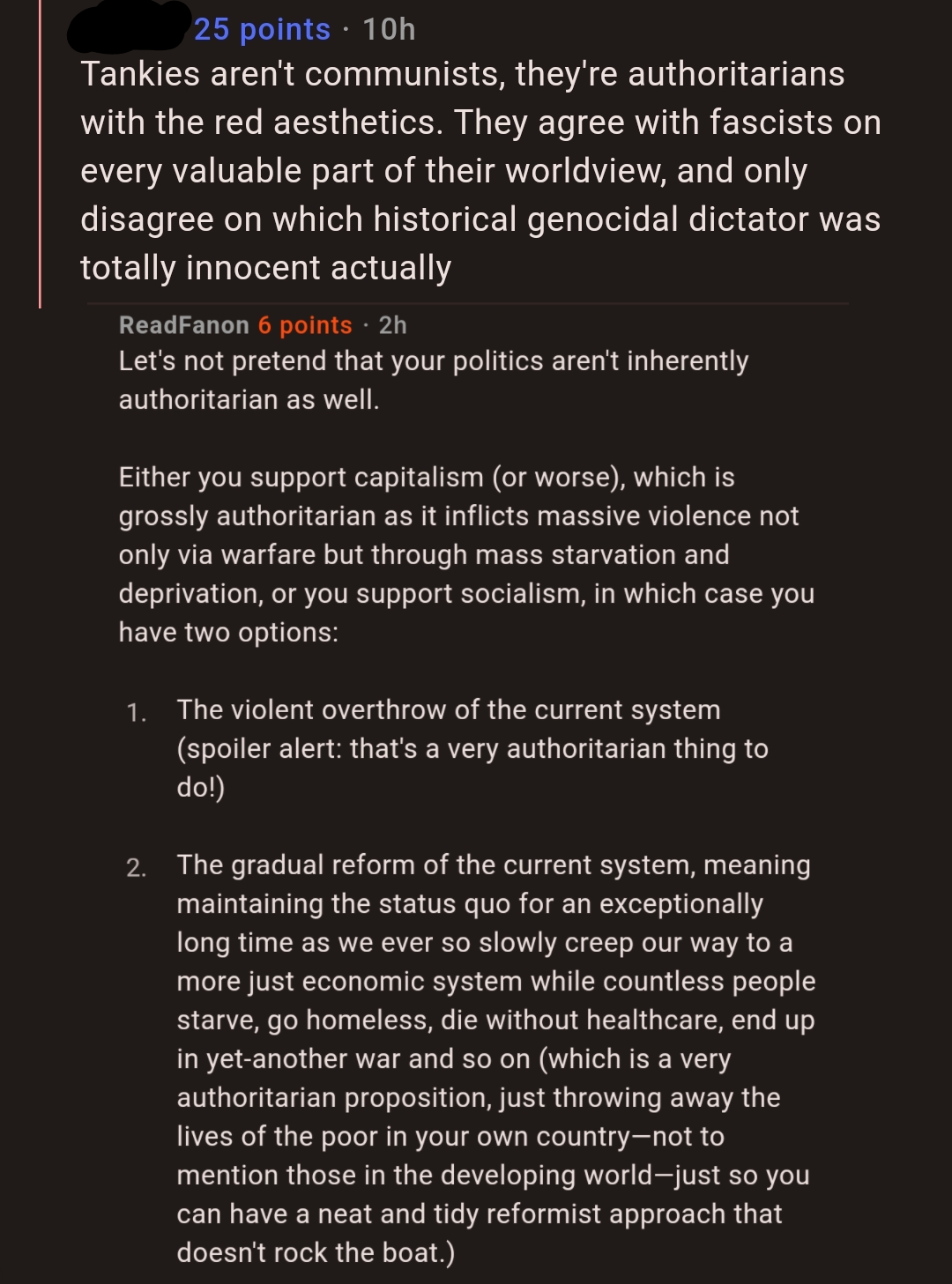
I'm astonished at how sensitive the mods must be over there.
Apparently you're allowed to say whatever baseless slander you like about the eeeeevil tankies but the minute someone says "Hold up a sec, you claim to be anti-authoritarian and yet you support authoritarianism either explicitly or implicitly?" and they have to shut it down immediately.
Regardless, I think I made a pretty solid counterargument to the typical complaint about communism being authoritarian.
Mfers skim read the Wikipedia entry on Hannah Arendt and start thinking they're justified in slinging accusations about "muh authoritarianism" smh.