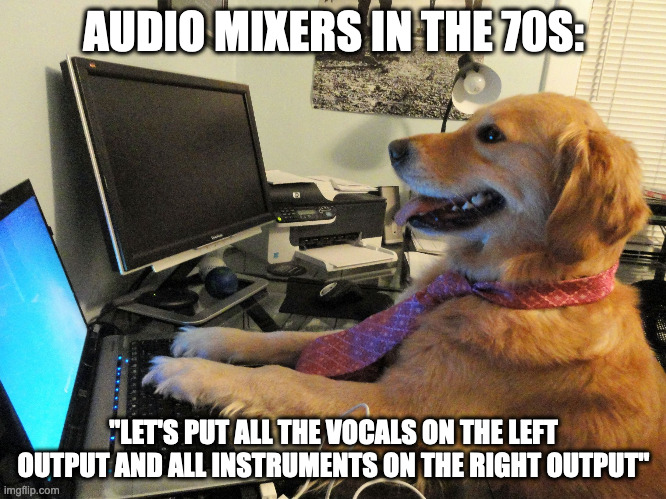
Turns out early audio consoles with stereo didn’t have a pan knob. They had a pan switch. So choices were limited to left, right, or center (mono).
Wasn’t til later that the pan pot was invented allowing incremental panning and true stereo mixing.
The jump from mono to stereo made a lot of engineers' heads spin. Then again, how many 100% perfect 5.1 albums have you heard?
Actually, I've listened to only three 5.1 remixes, all of them phenomenal albums to begin with, and their 5.1 jobs were pretty meh. Yoshimi Battles the Pink Robots came out pretty good, but mainly because they just fucked around and tried stuff.
This would be more early 60’s, mostly because those engineers were working with 2 track stereo which really limits your options. Most artists were recording on at least 8 track stereo by the 70’s.
Just put it in mono. Now, how can I fix this infamous autotune trend?
What's interesting is just how different the quality was of some of the stereo releases vs the mono bounces. For an example, the stereo HDCD version of Pet Sounds is a little wack, but even if you joined the two channels to mono it sounds a hundred times better than the shittastic mono release. Got to wonder if they optimized it for AM radio play the way that similarly awful sounding releases in the early 2000s optimized for iPod earbuds.
It was the early days of a new technology and way of listening that was completely different compared to the past 60+ years of recorded audio. I guess as a more modern analogy it's like those cheap 3D films at the height of the fad that felt the need to gratuitously shove objects directly in front of the camera to get the most out of the 3D effect.
The things people did with mixing in the 70s and 80s were revolutionary, and a lot of the sound you hear today was invented in that time. Things like the drum sound in "In the Air Tonight" with compression gating has been used ever since.
https://www.musicradar.com/news/drums/classic-drum-sounds-in-the-air-tonight-590970
Does make it easier to isolate vocals I guess
It was designed to show off stereo sound which was still fairly new at the time. I like the way those recordings sound actually.
I believe that they had stereo mixing pretty figured out by the 70s...
Early-mid 60s though? Sure.
Unless you're referring to when they started mixing mono albums into stereo, then yeah. Those albums were never meant to be listened in stereo, and I wouldn't listen to a remaster of any of them unless they were officially approved by the band, or done by the band's own producer. And even then...
Wild guess but stereo equipment wasn't a thing in households and it was a way to get the adoption going
Today's music is digitally mixed on laptops and has zero dynamic range or feeling. Then again people listen on Bluetooth now so they are only getting 20% of the music anyways. Makes me very sad
You know, I love those albums where they fucked around did things like hard-pan all the drums to the right channel. I'm here for the experimentation.
It’s fun and interesting all the experimentation that went on back then. As someone deaf in one ear… it’s hard to truly appreciate, but I get it.
My dad had some albums, maybe Mike Oldfield or others...there was a train going through a station, and hearing it pass from left to right in stereo was amazing at the time
The early days of stereo (which is what you’re talking about, the recordings of 70s which aren’t using stereo as an “effect” almost universally have the vocals panned to the center. The old way to take the vocals out of a recording was to adjust how much of the signal present equally on both channels was allowed to be played) were all about two things: backwards compatibility with mono systems and giving people with stereo systems a recognizable effect no matter what goofy system they had.
Wild panning accomplishes both goals.
Studio engineering that used the stereo format to create the illusion of a room or capture the sound of the room the players were playing in wasn’t developed yet and came from the experimental stereo recordings that sound crazy now like silver apples of the moon.
This might explain why old players had a mono/stereo setting.
There's actually a biological reason for this, believe it or not. Language and music "time share" many characteristics of both hemispheres of the brain. Language and music are processed in different hemispheres.
Read pages 20-26 of the book "How Music Really Works" by Wayne Chase. It breaks it down in detail.
CMV: Mono mix of Jefferson Airplane's "White Rabbit" is better.
top 50 comments