top 50 comments

sorted by: hot top controversial new old
[–] 83 points 2 years ago (1 child)

Relevant xkcd alt-text 841.

For years, I took the wrong lesson from that Monster Cable experiment and only listened to my music through alligator-clipped coat hangers.

  • source
  • hideshow 2 child comments
  • [–] 57 points 2 years ago (5 children)

    I have a feeling that would pick up noise

  • source
  • hideshow 10 child comments
  • [–] 13 points 2 years ago (1 child)

    If the connections are solid it wouldn't pick up any more noise than a 6.5mm to RCA adaptor would have. Any jiggle to the cable would result in popping or cracking though, depending on the configuration could be quite jarring.

  • source
  • parent
  • hideshow 2 child comments
  • [–] 4 points 2 years ago (1 child)

    I think it does act like an antenna a little, so some noise is to be expected. Might be easy to attenuate that band though.

  • source
  • parent
  • hideshow 2 child comments
  • [–] 6 points 2 years ago

    Well every conductor is an antenna in theory, in practice it's the signal to noise ratio that matters, and I really don't think this would add anything noticeable. The sticky uppy bit on the OP is connected to ground though so that's negated.

  • source
  • parent
  • [–] 11 points 2 years ago (2 children)

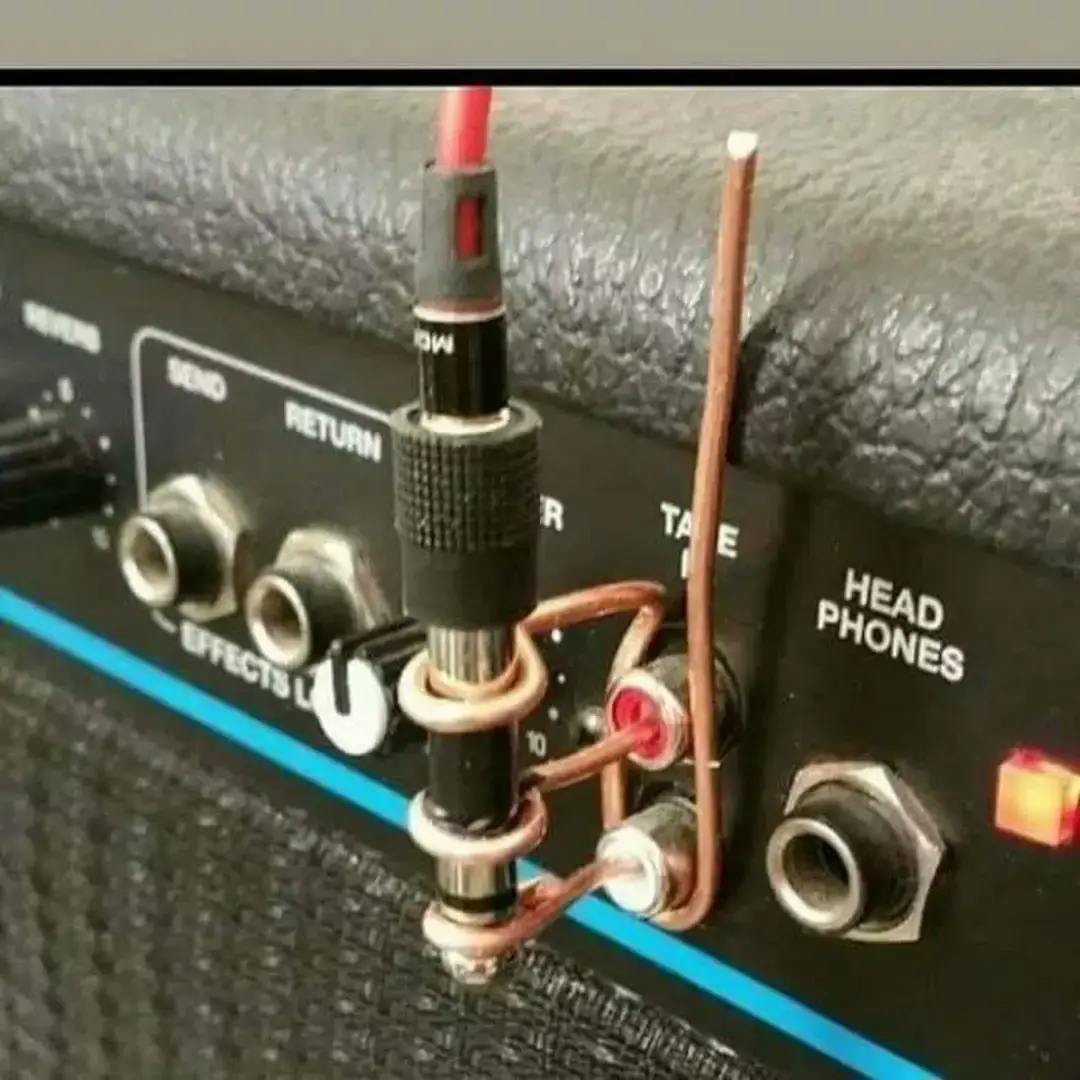
    Especially with that makeshift antenna hanging 💀

  • source
  • parent
  • hideshow 4 child comments
  • [–] 33 points 2 years ago (1 child)

    The antenna looking piece of wire is the ground so it doesn't matter if it picks up anything.

  • source
  • parent
  • hideshow 2 child comments
  • [–] 6 points 2 years ago (1 child)

    No more than a standard connection. Every cable inherently acts as an antenna, so that’s why we try to avoid running them parallel to power lines and other things that would give off audible interference. If you actually want to reject interference, you’d need a balanced signal. Regular RCA and 1/4” are both unbalanced, so they’ll both pick up interference regardless of how they’re tied together.

    When dealing with unbalanced cable, the most important part is making sure your signal to noise ratio is good. If you can get a hot enough signal that your gain can be lowered, you may be able to reduce the interference completely below your noise floor. Of course there are arguments against this (like how running things that hot could potentially mean you’re clipping your outputs, which introduces a whole host of other issues) but as a general rule, you want your gain to be as low as possible, so you can reduce the amount of background interference and noise you’re picking up.

  • source
  • parent
  • hideshow 1 child comment
  • load more comments (1 reply)
  • [–] 42 points 2 years ago (4 children)

    You can order an adapter for like a dollar on multiple websites. I mean yeah, there's no Radio Shack anymore, but this seems unnecessary.

  • source
  • hideshow 7 child comments
  • [–] 39 points 2 years ago (3 children)

    I think this is more for that time you're at a gig and realise you're missing the adapter.

  • source
  • parent
  • hideshow 6 child comments
  • [–] 27 points 2 years ago (4 children)

    That does make sense, although it would be weird to go to a gig and not have a 1/4" to RCA adapter but happen to have large-gauge copper wire.

  • source
  • parent
  • hideshow 8 child comments
  • [–] 5 points 2 years ago (3 children)

    ... And you just happen to have a piece of like 12 or 14 AWG copper wire on hand?

  • source
  • parent
  • hideshow 4 child comments
  • load more comments (2 replies)
  • [–] 25 points 2 years ago (1 child)

    You don’t always have the luxury of time though. I work in entertainment, and I’ve definitely scrapped adapters together in a pinch. When you have a show starting in 15 minutes and a musician rolls up with some bespoke gear with weird connections, your only real choice is to bodge something together and make it work.

    Nothing quite like seeing five adapters chained together, to go from stereo RCA to TRS 1/8” to TRS 1/4” to dual TS 1/4”, to XLR… All because you didn’t have a direct box that went straight from RCA to XLR, because another musician walked off with it after their show wrapped up at 2AM last night.

  • source
  • parent
  • hideshow 2 child comments
  • [–] 5 points 2 years ago (1 child)

    Apparently there is at least one RadioShack open. I saw a dude post a video on YouTube about one he found in Wyoming.

  • source
  • parent
  • hideshow 2 child comments
  • load more comments (1 reply)
    [+] 38 points 2 years ago (1 child)
  • [–] 31 points 2 years ago (1 child)

    As long as whatever is on the other end doesn't reproduce anything at 60Hz or does so with a lot of loss and there are no heavy vibrations closeby (such as the speakers themselves), it should be fine.

  • source
  • hideshow 2 child comments
  • [–] 13 points 2 years ago (2 children)

    Why 60 Hz? Doesn't the frequency response of this antenna depend on the length/shape?

  • source
  • parent
  • hideshow 4 child comments
  • [–] 9 points 2 years ago* (1 child)

    It's the one part of the radio spectrum that's also in the hearing range hence induced currents from it can be heard in an analog audio system and which would have a pretty decent amount of energy inside a building because it's being emitted pretty much all around by the mains power wires.

    That said, you're right that depending on the length and shape those wires might not form a very good antenna for that frequency. Independently of that, I doubt there's enough energy around to directly affect speakers, but it might be enough if that wire goes to an amplifier which in turn powers the speakes.

    That said, I'm from Digital Systems rather than Telecomms or Audio so take what I say on this as a semi-informed guess.

  • source
  • parent
  • hideshow 2 child comments
  • [–] 3 points 2 years ago

    It does have a decent loop area in between the signal and return path and any flux passing through it will induce noise. This area is too small for 60 Hz, but there's a lot of microwave crap that would get picked up. If there isn't a low-pass analog filter before the next silicon junction then this RF EMI will get rectified down. If it's a sufficiently bad situation then you'll hear it. That's why you can hear garbage when you put your phone right next to crappy computer speakers.

  • source
  • parent
  • [–] 29 points 2 years ago (2 children)

    It's not stupid if it works. I can even see some artistry in that.

  • source
  • hideshow 4 child comments
  • [–] 25 points 2 years ago

    I'm not even mad, that's clean!

  • source
  • [–] 16 points 2 years ago

    it's complicated

  • source
  • load more comments
    view more: next ›