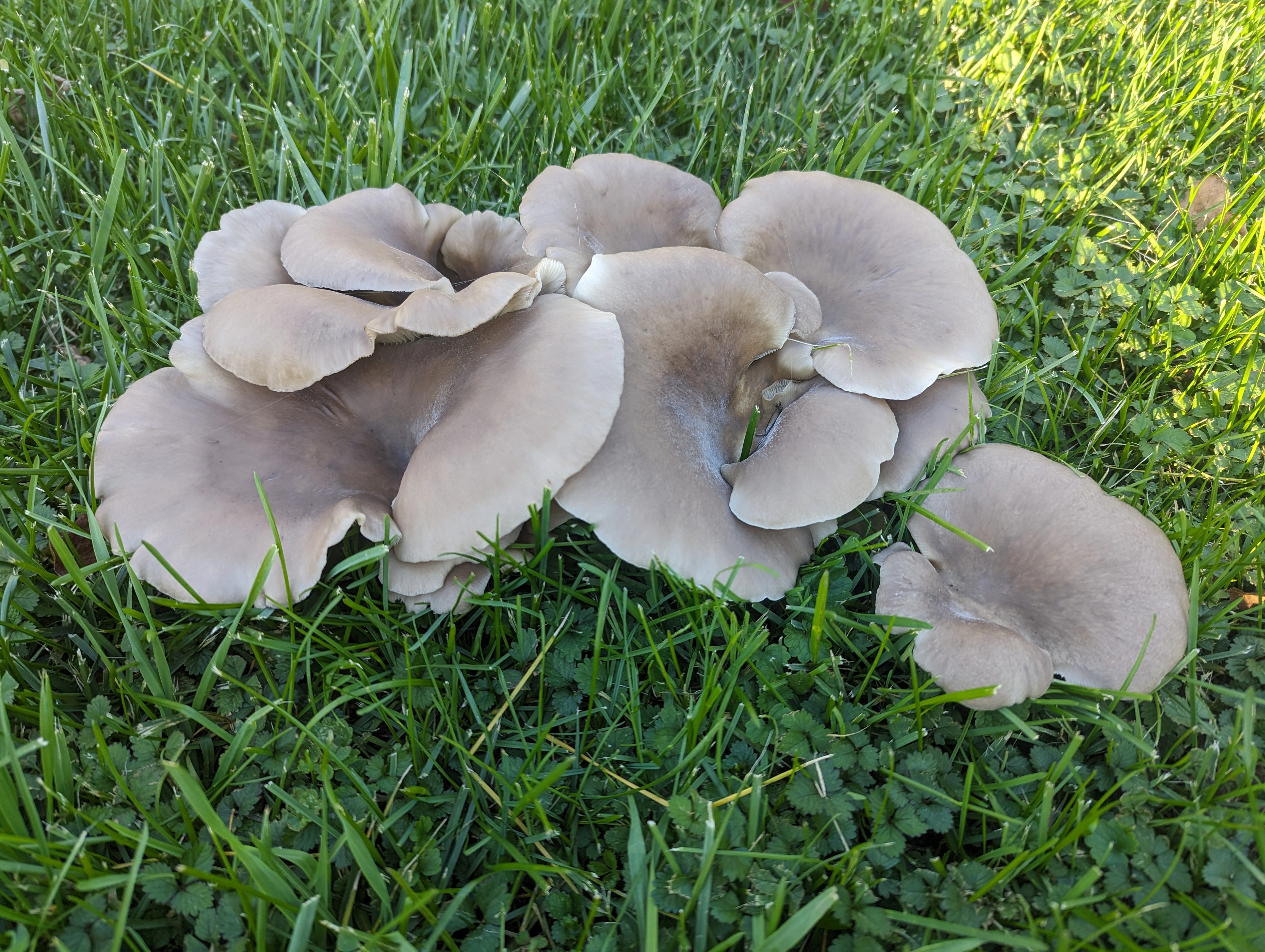
Spotted this awesome cluster on a walk today and grabbed a couple, fairly certain they are Pleurotus ostreatus.
all 11 comments

sorted by: hot top controversial new old
[–] 6 points 2 years ago (1 child)

Take this with a grain of salt obviously, but I put the image into a plant identification app and it came up with Lepista personata.

Matches the growing in grassy areas and cupping upwards properties from your picture.

  • source
  • hideshow 2 child comments
  • [–] 4 points 2 years ago* (1 child)

    Hopefully you’ll get some experts chiming in. I am not. I just found your question interesting and did some searching.

    The biggest thing I see to check is whether the gills run vertically *and extend into the stem. If the gills stop at the stem, avoid.

    https://grocycle.com/oyster-mushrooms-guide/#:~:text=They%20should%20be%20smooth%20with,white%20to%20brown%20on%20top.

    Edit: actually you may not need to avoid if the gills don’t run all the way. If they don’t, there’s a good chance they are Elm Oysters, but elm oysters are edible. I’m basing this info on the above link. It seems pretty clear that what you have aren’t the dangerous varieties listed on that page.

  • source
  • hideshow 2 child comments
  • [–] [S] 4 points 2 years ago (2 children)

    Thanks for the info! Here's a shot with the gills. Looks like the safe variety to me too!

  • source
  • parent
  • hideshow 4 child comments
  • [–] 4 points 2 years ago* (1 child)

    Not pleurotis species of any kind. It should have gill lines(don't know proper term) running all the way down the stem. They also usually grow on wood not grass

  • source
  • parent
  • hideshow 2 child comments
  • [–] 3 points 2 years ago* (last edited 2 years ago) (1 child)

    I would generally agree, but 1) there may well be dead wood just under the grass and 2) these conditions may explain the atypical stem. Never fully trust ID by pic and opinions on the internet obviously but this looks very much like Pleurotus ostreatus to me. (Also because there aren't many alternative candidates in my opinion.)

  • source
  • parent
  • hideshow 2 child comments
  • [–] 2 points 2 years ago

    I agree. These are some sort of Pleurotus but I have a rule about atypical morphology and consumption. Long story but some P. cubensis and I had a long “talk” about mushroom identification and I promised to never eat any mushroom I could not be %100 about. They were very clear on the subject. Like they knew I might fuck up one day.

  • source
  • parent
  • [–] 4 points 2 years ago

    Compare to Pleurotus, growing from buried wood. The ones to rule out here would be the worrisome Clitocybe dealbata group

  • source
  • [–] 3 points 2 years ago (1 child)

    I'm going NO. Oysters grow on dead trees almost always. They do NOT cup upwards like this. They may be edible (I wouldn't eat them), but they are not tan/white oysters in my opinion (and I've collected and eaten a LOT of white/tan and golden oysters).

  • source
  • hideshow 2 child comments
  • [–] 1 point 2 years ago*

    Oysters do cup upwards, but only when they are about sporulate and not quite as drastic as the ones in this picture. It's about the only way to tell that they are ready to harvest before they make a mess of your grow area.

  • source
  • parent