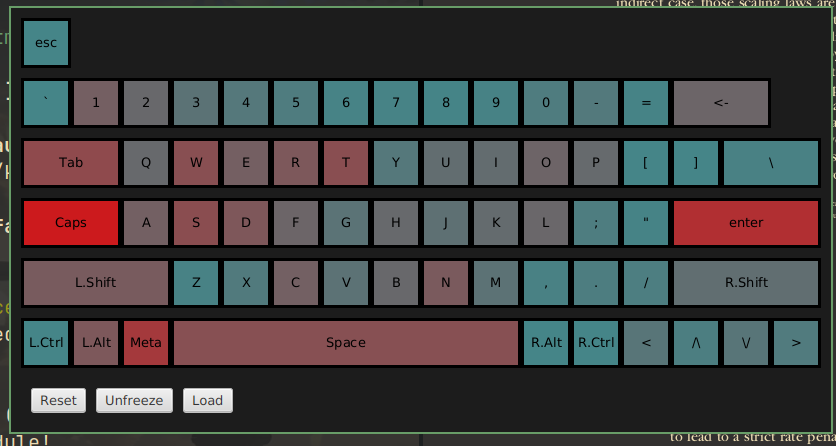
▲ 1 ▼ Keyboard shortcuts visualization (programming.dev) submitted 2 years ago by andnekon@programming.dev to c/opensource@programming.dev 6 comments fedilink hide all child comments Have you ever wondered if your keyboard shortcuts are set up optimally? Well, I did, so I decided to visualize it with a heat-map. It proved to me that I rely on my left pinky too much, so I'll try to rework my shortcuts. You can check out the project here, currently it only works on Linux.
[–] JackGreenEarth@lemm.ee 0 points 2 years ago (1 child) What's the Meta key? Is that like the Super key? permalink fedilink source hideshow 2 child comments replies: [–] andnekon@programming.dev [S] 0 points 2 years ago (1 child) I thought it meant the same, Meta/Super/Windows I saw these used in documentation interchangeably permalink fedilink source parent hideshow 2 child comments replies: [–] underscores@lemmy.dbzer0.com 1 point 2 years ago* (last edited 2 years ago) (1 child) Meta, Hyper, and Super were all originally different keys. See this lisp machine keyboard from in the 70s that had 7 modifiers, including all of those. Most of the time Hyper or Super are mapped to the Windows key. With Meta it varies more from program to program. A lot of desktop software maps it to the Windows key. In Emacs its usually mapped as Alt or the Esc key. permalink fedilink source parent hideshow 2 child comments replies: [–] andnekon@programming.dev [S] 0 points 2 years ago (1 child) Thank you for clarification! I don't really understand how can specific programs map the Meta key as something. Isn't it the job of the driver to map key-presses to input events (which are then passed to display server by evdev)? permalink fedilink source parent hideshow 2 child comments replies: [–] underscores@lemmy.dbzer0.com 1 point 2 years ago* (last edited 2 years ago) I'm not sure if it's directly mapping the input. I think it's getting the other keys input and binding it to the same commands. Also, Emacs was around even before the X windowing system, so they probably came up with the mappings before a lot of these common defaults came about. permalink fedilink source parent
[–] andnekon@programming.dev [S] 0 points 2 years ago (1 child) I thought it meant the same, Meta/Super/Windows I saw these used in documentation interchangeably permalink fedilink source parent hideshow 2 child comments replies: [–] underscores@lemmy.dbzer0.com 1 point 2 years ago* (last edited 2 years ago) (1 child) Meta, Hyper, and Super were all originally different keys. See this lisp machine keyboard from in the 70s that had 7 modifiers, including all of those. Most of the time Hyper or Super are mapped to the Windows key. With Meta it varies more from program to program. A lot of desktop software maps it to the Windows key. In Emacs its usually mapped as Alt or the Esc key. permalink fedilink source parent hideshow 2 child comments replies: [–] andnekon@programming.dev [S] 0 points 2 years ago (1 child) Thank you for clarification! I don't really understand how can specific programs map the Meta key as something. Isn't it the job of the driver to map key-presses to input events (which are then passed to display server by evdev)? permalink fedilink source parent hideshow 2 child comments replies: [–] underscores@lemmy.dbzer0.com 1 point 2 years ago* (last edited 2 years ago) I'm not sure if it's directly mapping the input. I think it's getting the other keys input and binding it to the same commands. Also, Emacs was around even before the X windowing system, so they probably came up with the mappings before a lot of these common defaults came about. permalink fedilink source parent
[–] underscores@lemmy.dbzer0.com 1 point 2 years ago* (last edited 2 years ago) (1 child) Meta, Hyper, and Super were all originally different keys. See this lisp machine keyboard from in the 70s that had 7 modifiers, including all of those. Most of the time Hyper or Super are mapped to the Windows key. With Meta it varies more from program to program. A lot of desktop software maps it to the Windows key. In Emacs its usually mapped as Alt or the Esc key. permalink fedilink source parent hideshow 2 child comments replies: [–] andnekon@programming.dev [S] 0 points 2 years ago (1 child) Thank you for clarification! I don't really understand how can specific programs map the Meta key as something. Isn't it the job of the driver to map key-presses to input events (which are then passed to display server by evdev)? permalink fedilink source parent hideshow 2 child comments replies: [–] underscores@lemmy.dbzer0.com 1 point 2 years ago* (last edited 2 years ago) I'm not sure if it's directly mapping the input. I think it's getting the other keys input and binding it to the same commands. Also, Emacs was around even before the X windowing system, so they probably came up with the mappings before a lot of these common defaults came about. permalink fedilink source parent
[–] andnekon@programming.dev [S] 0 points 2 years ago (1 child) Thank you for clarification! I don't really understand how can specific programs map the Meta key as something. Isn't it the job of the driver to map key-presses to input events (which are then passed to display server by evdev)? permalink fedilink source parent hideshow 2 child comments replies: [–] underscores@lemmy.dbzer0.com 1 point 2 years ago* (last edited 2 years ago) I'm not sure if it's directly mapping the input. I think it's getting the other keys input and binding it to the same commands. Also, Emacs was around even before the X windowing system, so they probably came up with the mappings before a lot of these common defaults came about. permalink fedilink source parent
[–] underscores@lemmy.dbzer0.com 1 point 2 years ago* (last edited 2 years ago) I'm not sure if it's directly mapping the input. I think it's getting the other keys input and binding it to the same commands. Also, Emacs was around even before the X windowing system, so they probably came up with the mappings before a lot of these common defaults came about. permalink fedilink source parent