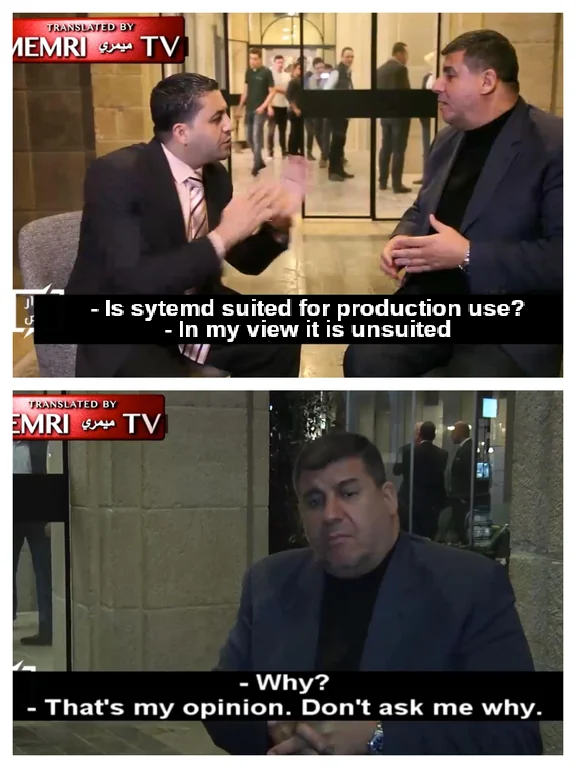
▲ 777 ▼ Average systemd debate (lemmy.world) submitted 2 years ago* by renzev@lemmy.world to c/linuxmemes@lemmy.world 124 comments fedilink hide all child comments
[+] BaumGeist@lemmy.ml 13 points 2 years ago* (last edited 1 year ago) (2 children) [deleted] permalink fedilink source parent hideshow 4 child comments replies: [–] nickwitha_k@lemmy.sdf.org 2 points 2 years ago Does indeed sound likely to be an fstab issue, unless system services are being used in a really weird way. permalink fedilink source parent [–] interdimensionalmeme@lemmy.ml 1 point 2 years ago (1 child) A typo in fstab shouldn't wreck the system. Why is that not resilient ? I added an extra mount point to an empty partition but forgot to actually create it in LVM. During boot, device not found and boot halted, on a computer with no monitor/keyboard permalink fedilink source parent hideshow 2 child comments replies: [+] BaumGeist@lemmy.ml 9 points 2 years ago* (last edited 1 year ago) (1 child) [deleted] permalink fedilink source parent hideshow 2 child comments replies: [–] interdimensionalmeme@lemmy.ml 2 points 2 years ago (1 child) Cool ! The default should smarter than bork by default. permalink fedilink source parent hideshow 2 child comments replies: [–] BCsven@lemmy.ca 5 points 2 years ago* (1 child) Its a 'failsafe' , like if part of the system depends on that drive mounting then if it fails then don't continue. Not the expected default, but probably made sense at some point. Like if brakes are broken don't allow starting truck, type failsafe. permalink fedilink source parent hideshow 2 child comments replies: [–] wormer@lemmy.ml 4 points 2 years ago (3 children) Yea like the default is smart? How is it supposed to know if that's critical or not at that point? The alternative is for it to silently fail and wait for something else to break instead of failing gracefully? I feel like I'm growing more and more petty and matching the language of systemd haters but like just think about it for a few minutes???? permalink fedilink source parent hideshow 6 child comments replies: [–] nickwitha_k@lemmy.sdf.org 2 points 2 years ago (1 child) the default is smart Looking at the systems that are supported, it makes the greatest sense to have the safest failure mode as default. If fault tolerance is available, that can be handled in the entry but, it makes sense but to assume. Having that capability built into the default adds more complexity and reduces support for systems that are not tolerant of a missing mount. permalink fedilink source parent hideshow 2 child comments replies: [–] wormer@lemmy.ml 3 points 2 years ago Sorry if it looked otherwise, I was agreeing to BCsven. I agree with you permalink fedilink source parent [–] interdimensionalmeme@lemmy.ml 2 points 2 years ago The system failed for no good reason, failing is exactly what it should never ever do. If it had just continued, everything would have been fine. permalink fedilink source parent [–] BCsven@lemmy.ca 1 point 2 years ago* Edit: just saw your other comment, so this may not apply to you now....Not that the default is smart, but the default has been set to fail a boot if parts are missing. Imagine a rocket launch system check, is temperature system online, no, fail and abort. While as users -- for convenience--we want the system to boot even though a drive went offline, that may not be best default for induatrial applications. Or where another system relylies on first one to be up and coherent. So we have to use the nofail option, to contine the boot on missing drive. permalink fedilink source parent
[–] nickwitha_k@lemmy.sdf.org 2 points 2 years ago Does indeed sound likely to be an fstab issue, unless system services are being used in a really weird way. permalink fedilink source parent
[–] interdimensionalmeme@lemmy.ml 1 point 2 years ago (1 child) A typo in fstab shouldn't wreck the system. Why is that not resilient ? I added an extra mount point to an empty partition but forgot to actually create it in LVM. During boot, device not found and boot halted, on a computer with no monitor/keyboard permalink fedilink source parent hideshow 2 child comments replies: [+] BaumGeist@lemmy.ml 9 points 2 years ago* (last edited 1 year ago) (1 child) [deleted] permalink fedilink source parent hideshow 2 child comments replies: [–] interdimensionalmeme@lemmy.ml 2 points 2 years ago (1 child) Cool ! The default should smarter than bork by default. permalink fedilink source parent hideshow 2 child comments replies: [–] BCsven@lemmy.ca 5 points 2 years ago* (1 child) Its a 'failsafe' , like if part of the system depends on that drive mounting then if it fails then don't continue. Not the expected default, but probably made sense at some point. Like if brakes are broken don't allow starting truck, type failsafe. permalink fedilink source parent hideshow 2 child comments replies: [–] wormer@lemmy.ml 4 points 2 years ago (3 children) Yea like the default is smart? How is it supposed to know if that's critical or not at that point? The alternative is for it to silently fail and wait for something else to break instead of failing gracefully? I feel like I'm growing more and more petty and matching the language of systemd haters but like just think about it for a few minutes???? permalink fedilink source parent hideshow 6 child comments replies: [–] nickwitha_k@lemmy.sdf.org 2 points 2 years ago (1 child) the default is smart Looking at the systems that are supported, it makes the greatest sense to have the safest failure mode as default. If fault tolerance is available, that can be handled in the entry but, it makes sense but to assume. Having that capability built into the default adds more complexity and reduces support for systems that are not tolerant of a missing mount. permalink fedilink source parent hideshow 2 child comments replies: [–] wormer@lemmy.ml 3 points 2 years ago Sorry if it looked otherwise, I was agreeing to BCsven. I agree with you permalink fedilink source parent [–] interdimensionalmeme@lemmy.ml 2 points 2 years ago The system failed for no good reason, failing is exactly what it should never ever do. If it had just continued, everything would have been fine. permalink fedilink source parent [–] BCsven@lemmy.ca 1 point 2 years ago* Edit: just saw your other comment, so this may not apply to you now....Not that the default is smart, but the default has been set to fail a boot if parts are missing. Imagine a rocket launch system check, is temperature system online, no, fail and abort. While as users -- for convenience--we want the system to boot even though a drive went offline, that may not be best default for induatrial applications. Or where another system relylies on first one to be up and coherent. So we have to use the nofail option, to contine the boot on missing drive. permalink fedilink source parent
[+] BaumGeist@lemmy.ml 9 points 2 years ago* (last edited 1 year ago) (1 child) [deleted] permalink fedilink source parent hideshow 2 child comments replies: [–] interdimensionalmeme@lemmy.ml 2 points 2 years ago (1 child) Cool ! The default should smarter than bork by default. permalink fedilink source parent hideshow 2 child comments replies: [–] BCsven@lemmy.ca 5 points 2 years ago* (1 child) Its a 'failsafe' , like if part of the system depends on that drive mounting then if it fails then don't continue. Not the expected default, but probably made sense at some point. Like if brakes are broken don't allow starting truck, type failsafe. permalink fedilink source parent hideshow 2 child comments replies: [–] wormer@lemmy.ml 4 points 2 years ago (3 children) Yea like the default is smart? How is it supposed to know if that's critical or not at that point? The alternative is for it to silently fail and wait for something else to break instead of failing gracefully? I feel like I'm growing more and more petty and matching the language of systemd haters but like just think about it for a few minutes???? permalink fedilink source parent hideshow 6 child comments replies: [–] nickwitha_k@lemmy.sdf.org 2 points 2 years ago (1 child) the default is smart Looking at the systems that are supported, it makes the greatest sense to have the safest failure mode as default. If fault tolerance is available, that can be handled in the entry but, it makes sense but to assume. Having that capability built into the default adds more complexity and reduces support for systems that are not tolerant of a missing mount. permalink fedilink source parent hideshow 2 child comments replies: [–] wormer@lemmy.ml 3 points 2 years ago Sorry if it looked otherwise, I was agreeing to BCsven. I agree with you permalink fedilink source parent [–] interdimensionalmeme@lemmy.ml 2 points 2 years ago The system failed for no good reason, failing is exactly what it should never ever do. If it had just continued, everything would have been fine. permalink fedilink source parent [–] BCsven@lemmy.ca 1 point 2 years ago* Edit: just saw your other comment, so this may not apply to you now....Not that the default is smart, but the default has been set to fail a boot if parts are missing. Imagine a rocket launch system check, is temperature system online, no, fail and abort. While as users -- for convenience--we want the system to boot even though a drive went offline, that may not be best default for induatrial applications. Or where another system relylies on first one to be up and coherent. So we have to use the nofail option, to contine the boot on missing drive. permalink fedilink source parent
[–] interdimensionalmeme@lemmy.ml 2 points 2 years ago (1 child) Cool ! The default should smarter than bork by default. permalink fedilink source parent hideshow 2 child comments replies: [–] BCsven@lemmy.ca 5 points 2 years ago* (1 child) Its a 'failsafe' , like if part of the system depends on that drive mounting then if it fails then don't continue. Not the expected default, but probably made sense at some point. Like if brakes are broken don't allow starting truck, type failsafe. permalink fedilink source parent hideshow 2 child comments replies: [–] wormer@lemmy.ml 4 points 2 years ago (3 children) Yea like the default is smart? How is it supposed to know if that's critical or not at that point? The alternative is for it to silently fail and wait for something else to break instead of failing gracefully? I feel like I'm growing more and more petty and matching the language of systemd haters but like just think about it for a few minutes???? permalink fedilink source parent hideshow 6 child comments replies: [–] nickwitha_k@lemmy.sdf.org 2 points 2 years ago (1 child) the default is smart Looking at the systems that are supported, it makes the greatest sense to have the safest failure mode as default. If fault tolerance is available, that can be handled in the entry but, it makes sense but to assume. Having that capability built into the default adds more complexity and reduces support for systems that are not tolerant of a missing mount. permalink fedilink source parent hideshow 2 child comments replies: [–] wormer@lemmy.ml 3 points 2 years ago Sorry if it looked otherwise, I was agreeing to BCsven. I agree with you permalink fedilink source parent [–] interdimensionalmeme@lemmy.ml 2 points 2 years ago The system failed for no good reason, failing is exactly what it should never ever do. If it had just continued, everything would have been fine. permalink fedilink source parent [–] BCsven@lemmy.ca 1 point 2 years ago* Edit: just saw your other comment, so this may not apply to you now....Not that the default is smart, but the default has been set to fail a boot if parts are missing. Imagine a rocket launch system check, is temperature system online, no, fail and abort. While as users -- for convenience--we want the system to boot even though a drive went offline, that may not be best default for induatrial applications. Or where another system relylies on first one to be up and coherent. So we have to use the nofail option, to contine the boot on missing drive. permalink fedilink source parent
[–] BCsven@lemmy.ca 5 points 2 years ago* (1 child) Its a 'failsafe' , like if part of the system depends on that drive mounting then if it fails then don't continue. Not the expected default, but probably made sense at some point. Like if brakes are broken don't allow starting truck, type failsafe. permalink fedilink source parent hideshow 2 child comments replies: [–] wormer@lemmy.ml 4 points 2 years ago (3 children) Yea like the default is smart? How is it supposed to know if that's critical or not at that point? The alternative is for it to silently fail and wait for something else to break instead of failing gracefully? I feel like I'm growing more and more petty and matching the language of systemd haters but like just think about it for a few minutes???? permalink fedilink source parent hideshow 6 child comments replies: [–] nickwitha_k@lemmy.sdf.org 2 points 2 years ago (1 child) the default is smart Looking at the systems that are supported, it makes the greatest sense to have the safest failure mode as default. If fault tolerance is available, that can be handled in the entry but, it makes sense but to assume. Having that capability built into the default adds more complexity and reduces support for systems that are not tolerant of a missing mount. permalink fedilink source parent hideshow 2 child comments replies: [–] wormer@lemmy.ml 3 points 2 years ago Sorry if it looked otherwise, I was agreeing to BCsven. I agree with you permalink fedilink source parent [–] interdimensionalmeme@lemmy.ml 2 points 2 years ago The system failed for no good reason, failing is exactly what it should never ever do. If it had just continued, everything would have been fine. permalink fedilink source parent [–] BCsven@lemmy.ca 1 point 2 years ago* Edit: just saw your other comment, so this may not apply to you now....Not that the default is smart, but the default has been set to fail a boot if parts are missing. Imagine a rocket launch system check, is temperature system online, no, fail and abort. While as users -- for convenience--we want the system to boot even though a drive went offline, that may not be best default for induatrial applications. Or where another system relylies on first one to be up and coherent. So we have to use the nofail option, to contine the boot on missing drive. permalink fedilink source parent
[–] wormer@lemmy.ml 4 points 2 years ago (3 children) Yea like the default is smart? How is it supposed to know if that's critical or not at that point? The alternative is for it to silently fail and wait for something else to break instead of failing gracefully? I feel like I'm growing more and more petty and matching the language of systemd haters but like just think about it for a few minutes???? permalink fedilink source parent hideshow 6 child comments replies: [–] nickwitha_k@lemmy.sdf.org 2 points 2 years ago (1 child) the default is smart Looking at the systems that are supported, it makes the greatest sense to have the safest failure mode as default. If fault tolerance is available, that can be handled in the entry but, it makes sense but to assume. Having that capability built into the default adds more complexity and reduces support for systems that are not tolerant of a missing mount. permalink fedilink source parent hideshow 2 child comments replies: [–] wormer@lemmy.ml 3 points 2 years ago Sorry if it looked otherwise, I was agreeing to BCsven. I agree with you permalink fedilink source parent [–] interdimensionalmeme@lemmy.ml 2 points 2 years ago The system failed for no good reason, failing is exactly what it should never ever do. If it had just continued, everything would have been fine. permalink fedilink source parent [–] BCsven@lemmy.ca 1 point 2 years ago* Edit: just saw your other comment, so this may not apply to you now....Not that the default is smart, but the default has been set to fail a boot if parts are missing. Imagine a rocket launch system check, is temperature system online, no, fail and abort. While as users -- for convenience--we want the system to boot even though a drive went offline, that may not be best default for induatrial applications. Or where another system relylies on first one to be up and coherent. So we have to use the nofail option, to contine the boot on missing drive. permalink fedilink source parent
[–] nickwitha_k@lemmy.sdf.org 2 points 2 years ago (1 child) the default is smart Looking at the systems that are supported, it makes the greatest sense to have the safest failure mode as default. If fault tolerance is available, that can be handled in the entry but, it makes sense but to assume. Having that capability built into the default adds more complexity and reduces support for systems that are not tolerant of a missing mount. permalink fedilink source parent hideshow 2 child comments replies: [–] wormer@lemmy.ml 3 points 2 years ago Sorry if it looked otherwise, I was agreeing to BCsven. I agree with you permalink fedilink source parent
[–] wormer@lemmy.ml 3 points 2 years ago Sorry if it looked otherwise, I was agreeing to BCsven. I agree with you permalink fedilink source parent
[–] interdimensionalmeme@lemmy.ml 2 points 2 years ago The system failed for no good reason, failing is exactly what it should never ever do. If it had just continued, everything would have been fine. permalink fedilink source parent
[–] BCsven@lemmy.ca 1 point 2 years ago* Edit: just saw your other comment, so this may not apply to you now....Not that the default is smart, but the default has been set to fail a boot if parts are missing. Imagine a rocket launch system check, is temperature system online, no, fail and abort. While as users -- for convenience--we want the system to boot even though a drive went offline, that may not be best default for induatrial applications. Or where another system relylies on first one to be up and coherent. So we have to use the nofail option, to contine the boot on missing drive. permalink fedilink source parent