I prefer simplicity and using the first example but I'd be happy to hear other options. Here's a few examples:

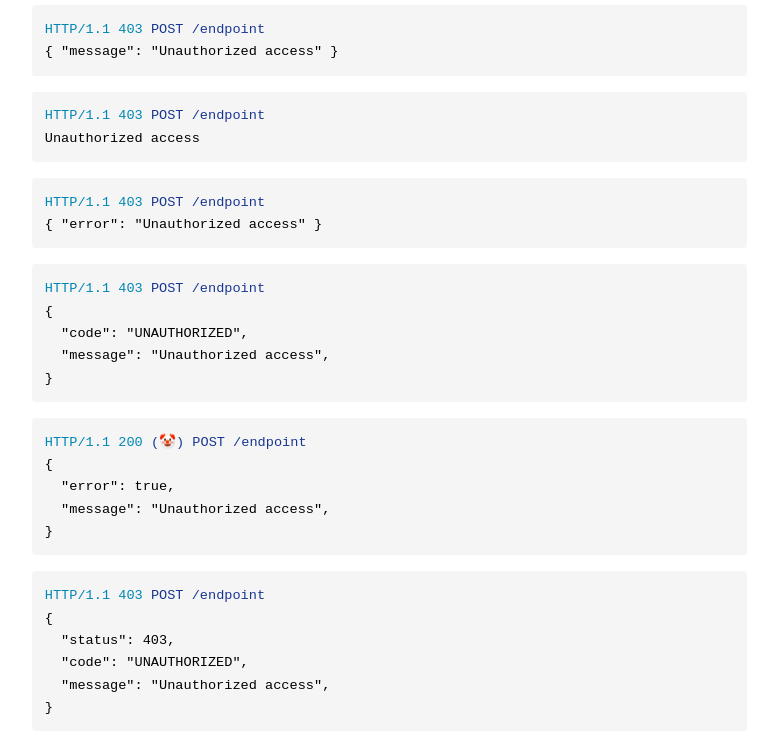
HTTP/1.1 403 POST /endpoint
{ "message": "Unauthorized access" }
HTTP/1.1 403 POST /endpoint
Unauthorized access (no json)
HTTP/1.1 403 POST /endpoint
{ "error": "Unauthorized access" }
HTTP/1.1 403 POST /endpoint
{
  "code": "UNAUTHORIZED",
  "message": "Unauthorized access",
}
HTTP/1.1 200 (🤡) POST /endpoint
{
  "error": true,
  "message": "Unauthorized access",
}
HTTP/1.1 403 POST /endpoint
{
  "status": 403,
  "code": "UNAUTHORIZED",
  "message": "Unauthorized access",
}

Or your own example.
you are viewing a single comment's thread
view the rest of the comments
[–] 17 points 2 years ago

JSON Problem Details

https://datatracker.ietf.org/doc/html/rfc9457

  • It has a specification, so a consumer of the API can immediately know what to expect.
  • It has a content type, so a client sdk can intelligently handle the response.
  • It supports commonly needed members which are a superset of all of the above JSON examples, including type for code and repeating the http status code in the body if desired.
  • It is extensible if needed.
  • It has been defined since at least 2016.

This specification's aim is to define common error formats for applications that need one so that they aren't required to define their own ...

So why aren't you using problem details?

  • source