Happy birthday 🎊🎉 GNU/Linux.

Today GNU/Linux is 32 years old.

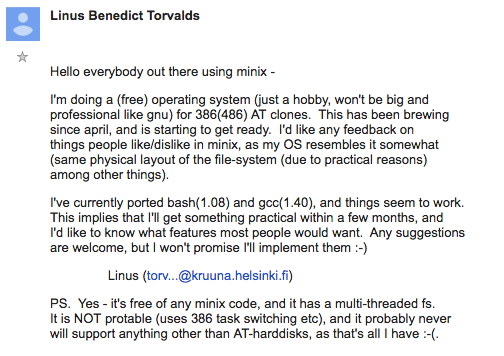
It was thankfully released to the public on August 25th, 1991 by Linus Torvalds when he was only 21 years old student.

What a lovely journey 🤍
you are viewing a single comment's thread
view the rest of the comments
[–] 1 point 2 years ago (2 children)

Something is open source or isn't. There's a set, binary definition.
I get the feeling you're implying a difference/aversion between those two terms which doesn't exist. This and the combination with a nonsensical statement about amount of GNU packages vs non-GNU packed makes it feel like you're pushing an agenda here: There's far more free software than just GNU's - that's a success for free software and the GNU project. There's no connect between the argument you're obviously implying.
Also HURD never took off - but why should it? The GNU project's goal is a fully free operating system, with Linux being persuaded to adopt a proper license there's no real need for HURD. It doesn't mean it isn't a fun project.

  • source
  • parent
  • hideshow 4 child comments
  • [–] 5 points 2 years ago (1 child)

    Which two terms? Everyone has an agenda but I am not sure what I am being accused of here. Do you mean Free Software vs Open Source? The FSF goes to great lengths to distinguish between those two terms:

    https://www.gnu.org/philosophy/open-source-misses-the-point.en.html

    I am pretty sure my usage is consistent with the owners and creators of those terms. Have I made an error?

  • source
  • parent
  • hideshow 2 child comments
  • [–] 1 point 2 years ago (1 child)

    The error is in saying something is made "more open source". The definition:
    https://opensource.org/osd/
    Does your license uphold these rules? It's open source. Does it not? It isn't.

  • source
  • parent
  • hideshow 2 child comments
  • [+] 1 point 2 years ago (1 child)
  • [–] 1 point 2 years ago (1 child)

    That is not correct. Who is this "they" you are talking about? The OSI?
    Open source is a term with a definition - which has been written by software freedom advocates by the way.
    With free software you have politics and a philosophy, in which somebody can have more freedom or less with a piece of software. I really wouldn't confuse that with the practicability of the OSI definition.
    Copyleft or push-over is a whole separate topic. Copyleft might be favoured by software freedom enthusiasts, but I disagree with your idea of separation through that. Even if you don't care about software freedom, you could like the practical effects of the AGPL.
    I feel like you're spreading at least misguiding information here.

  • source
  • parent
  • hideshow 2 child comments
  • [+] 1 point 2 years ago* (1 child)
  • These statements do not contradict anything I have said. Some people are pragmatic, some dogmatic about software freedom. So what?
    Another correction since I am on a roll: Linux can't switch from GPLv2. There are too many copyright holders, you'd never be able to contact all of them and get them to agree to a license change. Even if Linus Torvalds wanted to change, which I honestly don't think would be a sensible thing to do in his position.

  • source
  • parent