ALT TEXT:

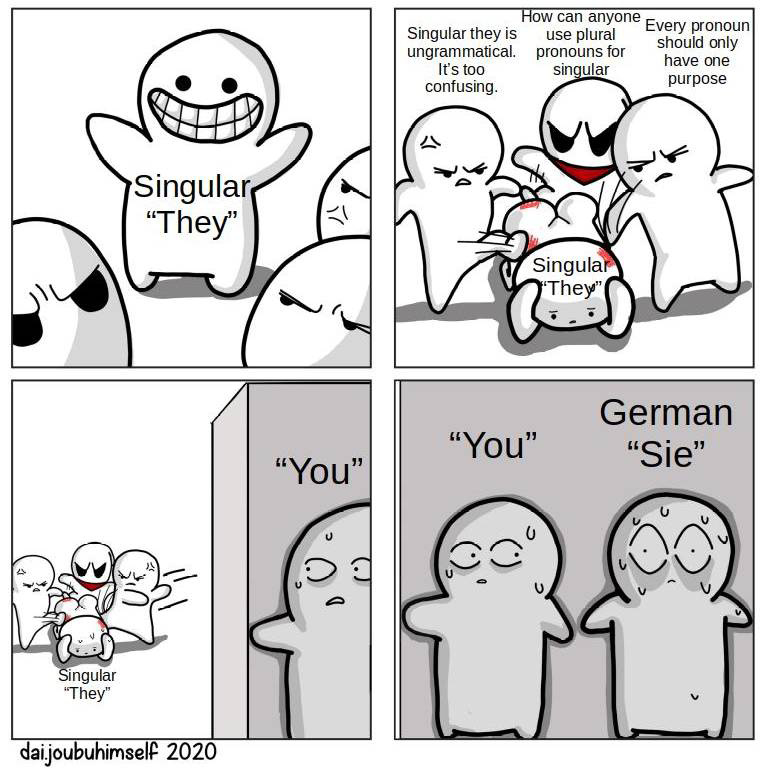
  • Panel 1: A person with the text "Singular 'they'" written on them smiling with open arms.
  • Panel 2: "Singular 'They'" beaten up by others who said, "Singular they is ungrammatical. It's too confusing," "How can anyone use plural pronouns for singular," and "Every pronoun should only have one purpose."
  • Panel 3: "You" hiding from the mob who was beating "Singular 'They'"
  • Panel 4: "German 'Sie'" hiding with even more fear next to "You"
you are viewing a single comment's thread
view the rest of the comments
[+] 0 points 3 years ago (1 child)
  • [–] 0 points 3 years ago (1 child)

    It's not change itself that I hate, it's when the change makes language less useful. Example, "literally" meaning its opposite, "figuratively," through common misuse. "It was literally the million-dollar question" used to mean that it was a question that, if answered, would actually be worth a million dollars rather than figuratively meaning it was an important one to answer. Now it's unclear.

  • source
  • parent
  • hideshow 2 child comments
  • [+] 0 points 3 years ago* (last edited 3 years ago) (1 child)
  • [–] 0 points 3 years ago (1 child)
  • [+] 0 points 3 years ago* (last edited 3 years ago) (1 child)
  • [–] 0 points 3 years ago (1 child)

    No, examples of words that mean two opposite things at the same time, since you apparently said that every single word in existence has always been that way. "Bad" comes to mind, though it's a lot easier to tell from context which meaning it has compared to "literally."

  • source
  • parent
  • hideshow 2 child comments