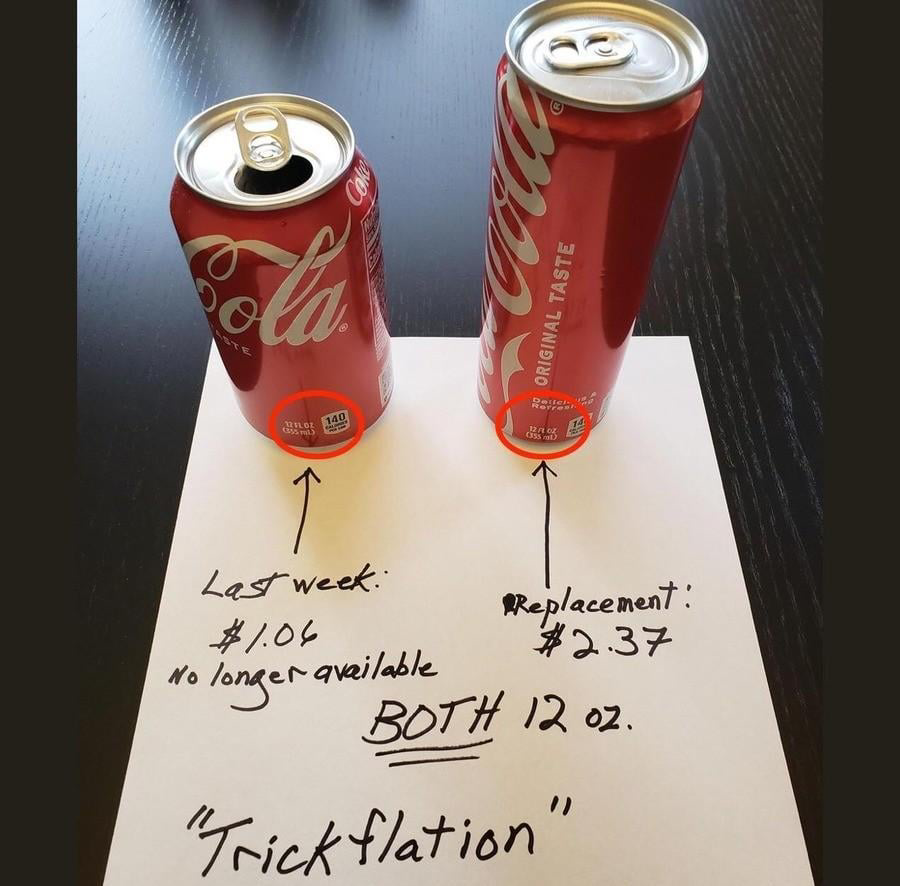
▲ 989 ▼ Trickflation (lemmy.world) submitted 2 years ago by TokenBoomer@lemmy.world to c/memes@lemmy.world 189 comments fedilink hide all child comments
[–] NiPfi@lemmy.world 15 points 2 years ago (2 children) It's usually very small, but here, prices must also show how much 100g/100ml of something costs permalink fedilink source hideshow 4 child comments replies: [–] perviouslyiner@lemmy.world 16 points 2 years ago* (1 child) Then you get shops like M&S where all the expensive varieties of (for example) tomato are £/kg and the cheap ones are £/unit so you can't see the big price gap. permalink fedilink source parent hideshow 2 child comments replies: [–] sukhmel@programming.dev 7 points 2 years ago (2 children) Nah, in places where you're obliged to put the price/kg on display that would be illegal. But writing a price per unit in LARGE font and adding a really small price per kilo would be a legal, albeit shitty, move permalink fedilink source parent hideshow 4 child comments replies: [–] perviouslyiner@lemmy.world 6 points 2 years ago FML, apparently it's optional 🙄 permalink fedilink source parent [–] aulin@lemmy.world 3 points 2 years ago* (1 child) It still happens in Scandinavia where these laws exist, with e.g. toilet paper, where some are listed per kg, some per roll, and others per meter. permalink fedilink source parent hideshow 2 child comments replies: [–] sukhmel@programming.dev 3 points 2 years ago They are missing a chance to also sell per m^2^ and per cm^3^ permalink fedilink source parent [–] ccunning@lemmy.world 5 points 2 years ago (5 children) Where is “here” approximately? In the U.S. retailers are notorious for having the “unit” price of similar items being listed as (for example) $1.57/oz in one case and $2.23/count in another. permalink fedilink source parent hideshow 10 child comments replies: [–] bstix@feddit.dk 8 points 2 years ago (1 child) EU has a directive about it. Prices must be shown in the proper unit, including all taxes and any "before" price if it's on "sale". permalink fedilink source parent hideshow 2 child comments replies: [–] sukhmel@programming.dev 4 points 2 years ago (1 child) Do they happen to make this kind of sales, too? I once had a chance to tell our local pub that their Chinese New Year sale sign is incorrect. They decided to put the sign in Chinese but got confused over how the discount is written in Chinese, so they wrote a price of +50% instead of -15%. but why?In Chinese the sale price is stated as the remaining part of the original, and it is written in tens of percents (折), so the full price is 10折, and 15% discount is 8.5折, but they had a sign of 15折. Google translate seems to think 15折 = 8.5折 but I would guess that it's just AI outsmarting itself again. Now, a real person would probably be able to guess what was meant anyway, but it's nice to write things correctly and not rely on guesswork permalink fedilink source parent hideshow 2 child comments replies: [–] bstix@feddit.dk 3 points 2 years ago (1 child) The specific rules are implemented in local laws, so it probably varies a bit from country to country, but generally it's illegal to market something as a special offer unless it actually is cheaper than before. The sign says "save more", which would be misleading marketing. There are other ways to work around it though. For instance by alternating between two similar products biweekly, or simply by not having that specific product before Black Friday, making it appear like a special offer even if it's sold at full price. permalink fedilink source parent hideshow 2 child comments replies: [–] sukhmel@programming.dev 1 point 2 years ago Thanks for the info, I will now know of more schemes to try to avoid. permalink fedilink source parent [–] ghoscht@feddit.de 4 points 2 years ago Not sure where that commenter is from, but it's the case for Germany. Pretty useful to compare permalink fedilink source parent [–] fidodo@lemmy.world 4 points 2 years ago (1 child) At least in California in grocery stores they always have a per weight tag too. Problem is that it's not always the same weight... permalink fedilink source parent hideshow 2 child comments replies: [–] sukhmel@programming.dev 2 points 2 years ago California also has the benefit of being able to choose the more confusing convenient unit, i.e. showing price in $/ounce, $/lb, $/kg, k$/stone, ounces of gold/handful, etc. permalink fedilink source parent [–] ChihuahuaOfDoom@lemmy.world 3 points 2 years ago Exactly this, they will put $/oz next to $/unit next to $/lb. It's infuriating but I still take the time to do the math. permalink fedilink source parent [–] NiPfi@lemmy.world 1 point 2 years ago Well, since my instance is local I can just as well say that it's Switzerland. Apparently it's mandatory to label proces in a specific way. So far, I've never encountered the case that I wasn't able to compare those prices between products of the same category. permalink fedilink source parent
[–] perviouslyiner@lemmy.world 16 points 2 years ago* (1 child) Then you get shops like M&S where all the expensive varieties of (for example) tomato are £/kg and the cheap ones are £/unit so you can't see the big price gap. permalink fedilink source parent hideshow 2 child comments replies: [–] sukhmel@programming.dev 7 points 2 years ago (2 children) Nah, in places where you're obliged to put the price/kg on display that would be illegal. But writing a price per unit in LARGE font and adding a really small price per kilo would be a legal, albeit shitty, move permalink fedilink source parent hideshow 4 child comments replies: [–] perviouslyiner@lemmy.world 6 points 2 years ago FML, apparently it's optional 🙄 permalink fedilink source parent [–] aulin@lemmy.world 3 points 2 years ago* (1 child) It still happens in Scandinavia where these laws exist, with e.g. toilet paper, where some are listed per kg, some per roll, and others per meter. permalink fedilink source parent hideshow 2 child comments replies: [–] sukhmel@programming.dev 3 points 2 years ago They are missing a chance to also sell per m^2^ and per cm^3^ permalink fedilink source parent
[–] sukhmel@programming.dev 7 points 2 years ago (2 children) Nah, in places where you're obliged to put the price/kg on display that would be illegal. But writing a price per unit in LARGE font and adding a really small price per kilo would be a legal, albeit shitty, move permalink fedilink source parent hideshow 4 child comments replies: [–] perviouslyiner@lemmy.world 6 points 2 years ago FML, apparently it's optional 🙄 permalink fedilink source parent [–] aulin@lemmy.world 3 points 2 years ago* (1 child) It still happens in Scandinavia where these laws exist, with e.g. toilet paper, where some are listed per kg, some per roll, and others per meter. permalink fedilink source parent hideshow 2 child comments replies: [–] sukhmel@programming.dev 3 points 2 years ago They are missing a chance to also sell per m^2^ and per cm^3^ permalink fedilink source parent
[–] perviouslyiner@lemmy.world 6 points 2 years ago FML, apparently it's optional 🙄 permalink fedilink source parent
[–] aulin@lemmy.world 3 points 2 years ago* (1 child) It still happens in Scandinavia where these laws exist, with e.g. toilet paper, where some are listed per kg, some per roll, and others per meter. permalink fedilink source parent hideshow 2 child comments replies: [–] sukhmel@programming.dev 3 points 2 years ago They are missing a chance to also sell per m^2^ and per cm^3^ permalink fedilink source parent
[–] sukhmel@programming.dev 3 points 2 years ago They are missing a chance to also sell per m^2^ and per cm^3^ permalink fedilink source parent
[–] ccunning@lemmy.world 5 points 2 years ago (5 children) Where is “here” approximately? In the U.S. retailers are notorious for having the “unit” price of similar items being listed as (for example) $1.57/oz in one case and $2.23/count in another. permalink fedilink source parent hideshow 10 child comments replies: [–] bstix@feddit.dk 8 points 2 years ago (1 child) EU has a directive about it. Prices must be shown in the proper unit, including all taxes and any "before" price if it's on "sale". permalink fedilink source parent hideshow 2 child comments replies: [–] sukhmel@programming.dev 4 points 2 years ago (1 child) Do they happen to make this kind of sales, too? I once had a chance to tell our local pub that their Chinese New Year sale sign is incorrect. They decided to put the sign in Chinese but got confused over how the discount is written in Chinese, so they wrote a price of +50% instead of -15%. but why?In Chinese the sale price is stated as the remaining part of the original, and it is written in tens of percents (折), so the full price is 10折, and 15% discount is 8.5折, but they had a sign of 15折. Google translate seems to think 15折 = 8.5折 but I would guess that it's just AI outsmarting itself again. Now, a real person would probably be able to guess what was meant anyway, but it's nice to write things correctly and not rely on guesswork permalink fedilink source parent hideshow 2 child comments replies: [–] bstix@feddit.dk 3 points 2 years ago (1 child) The specific rules are implemented in local laws, so it probably varies a bit from country to country, but generally it's illegal to market something as a special offer unless it actually is cheaper than before. The sign says "save more", which would be misleading marketing. There are other ways to work around it though. For instance by alternating between two similar products biweekly, or simply by not having that specific product before Black Friday, making it appear like a special offer even if it's sold at full price. permalink fedilink source parent hideshow 2 child comments replies: [–] sukhmel@programming.dev 1 point 2 years ago Thanks for the info, I will now know of more schemes to try to avoid. permalink fedilink source parent [–] ghoscht@feddit.de 4 points 2 years ago Not sure where that commenter is from, but it's the case for Germany. Pretty useful to compare permalink fedilink source parent [–] fidodo@lemmy.world 4 points 2 years ago (1 child) At least in California in grocery stores they always have a per weight tag too. Problem is that it's not always the same weight... permalink fedilink source parent hideshow 2 child comments replies: [–] sukhmel@programming.dev 2 points 2 years ago California also has the benefit of being able to choose the more confusing convenient unit, i.e. showing price in $/ounce, $/lb, $/kg, k$/stone, ounces of gold/handful, etc. permalink fedilink source parent [–] ChihuahuaOfDoom@lemmy.world 3 points 2 years ago Exactly this, they will put $/oz next to $/unit next to $/lb. It's infuriating but I still take the time to do the math. permalink fedilink source parent [–] NiPfi@lemmy.world 1 point 2 years ago Well, since my instance is local I can just as well say that it's Switzerland. Apparently it's mandatory to label proces in a specific way. So far, I've never encountered the case that I wasn't able to compare those prices between products of the same category. permalink fedilink source parent
[–] bstix@feddit.dk 8 points 2 years ago (1 child) EU has a directive about it. Prices must be shown in the proper unit, including all taxes and any "before" price if it's on "sale". permalink fedilink source parent hideshow 2 child comments replies: [–] sukhmel@programming.dev 4 points 2 years ago (1 child) Do they happen to make this kind of sales, too? I once had a chance to tell our local pub that their Chinese New Year sale sign is incorrect. They decided to put the sign in Chinese but got confused over how the discount is written in Chinese, so they wrote a price of +50% instead of -15%. but why?In Chinese the sale price is stated as the remaining part of the original, and it is written in tens of percents (折), so the full price is 10折, and 15% discount is 8.5折, but they had a sign of 15折. Google translate seems to think 15折 = 8.5折 but I would guess that it's just AI outsmarting itself again. Now, a real person would probably be able to guess what was meant anyway, but it's nice to write things correctly and not rely on guesswork permalink fedilink source parent hideshow 2 child comments replies: [–] bstix@feddit.dk 3 points 2 years ago (1 child) The specific rules are implemented in local laws, so it probably varies a bit from country to country, but generally it's illegal to market something as a special offer unless it actually is cheaper than before. The sign says "save more", which would be misleading marketing. There are other ways to work around it though. For instance by alternating between two similar products biweekly, or simply by not having that specific product before Black Friday, making it appear like a special offer even if it's sold at full price. permalink fedilink source parent hideshow 2 child comments replies: [–] sukhmel@programming.dev 1 point 2 years ago Thanks for the info, I will now know of more schemes to try to avoid. permalink fedilink source parent
[–] sukhmel@programming.dev 4 points 2 years ago (1 child) Do they happen to make this kind of sales, too? I once had a chance to tell our local pub that their Chinese New Year sale sign is incorrect. They decided to put the sign in Chinese but got confused over how the discount is written in Chinese, so they wrote a price of +50% instead of -15%. but why?In Chinese the sale price is stated as the remaining part of the original, and it is written in tens of percents (折), so the full price is 10折, and 15% discount is 8.5折, but they had a sign of 15折. Google translate seems to think 15折 = 8.5折 but I would guess that it's just AI outsmarting itself again. Now, a real person would probably be able to guess what was meant anyway, but it's nice to write things correctly and not rely on guesswork permalink fedilink source parent hideshow 2 child comments replies: [–] bstix@feddit.dk 3 points 2 years ago (1 child) The specific rules are implemented in local laws, so it probably varies a bit from country to country, but generally it's illegal to market something as a special offer unless it actually is cheaper than before. The sign says "save more", which would be misleading marketing. There are other ways to work around it though. For instance by alternating between two similar products biweekly, or simply by not having that specific product before Black Friday, making it appear like a special offer even if it's sold at full price. permalink fedilink source parent hideshow 2 child comments replies: [–] sukhmel@programming.dev 1 point 2 years ago Thanks for the info, I will now know of more schemes to try to avoid. permalink fedilink source parent
[–] bstix@feddit.dk 3 points 2 years ago (1 child) The specific rules are implemented in local laws, so it probably varies a bit from country to country, but generally it's illegal to market something as a special offer unless it actually is cheaper than before. The sign says "save more", which would be misleading marketing. There are other ways to work around it though. For instance by alternating between two similar products biweekly, or simply by not having that specific product before Black Friday, making it appear like a special offer even if it's sold at full price. permalink fedilink source parent hideshow 2 child comments replies: [–] sukhmel@programming.dev 1 point 2 years ago Thanks for the info, I will now know of more schemes to try to avoid. permalink fedilink source parent
[–] sukhmel@programming.dev 1 point 2 years ago Thanks for the info, I will now know of more schemes to try to avoid. permalink fedilink source parent
[–] ghoscht@feddit.de 4 points 2 years ago Not sure where that commenter is from, but it's the case for Germany. Pretty useful to compare permalink fedilink source parent
[–] fidodo@lemmy.world 4 points 2 years ago (1 child) At least in California in grocery stores they always have a per weight tag too. Problem is that it's not always the same weight... permalink fedilink source parent hideshow 2 child comments replies: [–] sukhmel@programming.dev 2 points 2 years ago California also has the benefit of being able to choose the more confusing convenient unit, i.e. showing price in $/ounce, $/lb, $/kg, k$/stone, ounces of gold/handful, etc. permalink fedilink source parent
[–] sukhmel@programming.dev 2 points 2 years ago California also has the benefit of being able to choose the more confusing convenient unit, i.e. showing price in $/ounce, $/lb, $/kg, k$/stone, ounces of gold/handful, etc. permalink fedilink source parent
[–] ChihuahuaOfDoom@lemmy.world 3 points 2 years ago Exactly this, they will put $/oz next to $/unit next to $/lb. It's infuriating but I still take the time to do the math. permalink fedilink source parent
[–] NiPfi@lemmy.world 1 point 2 years ago Well, since my instance is local I can just as well say that it's Switzerland. Apparently it's mandatory to label proces in a specific way. So far, I've never encountered the case that I wasn't able to compare those prices between products of the same category. permalink fedilink source parent