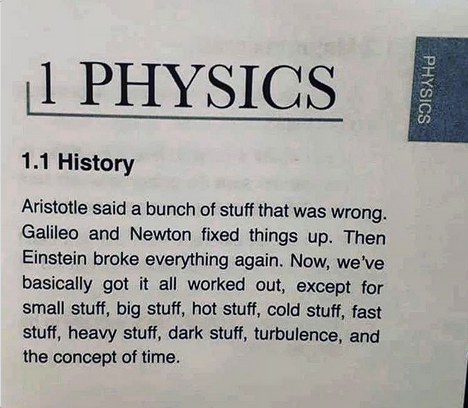
▲ 1454 ▼ 1.1 History (lemmy.world) submitted 2 years ago by TheOneWithTheHair@lemmy.world to c/lemmyshitpost@lemmy.world 145 comments fedilink hide all child comments
[–] qyron@sopuli.xyz 89 points 2 years ago (15 children) So, basically, we don't know that much on anything besides understanding it's really complex and difficult to figure out. permalink fedilink source hideshow 18 child comments replies: [–] FlyingSquid@lemmy.world 40 points 2 years ago (31 children) This has always been true. permalink fedilink source parent hideshow 33 child comments replies: [–] qyron@sopuli.xyz 79 points 2 years ago (2 children) To quote someone a lot wiser than myself: It's a shame stupid people carry themselves through life full of certainty while the wise ones suffer a life of doubt. permalink fedilink source parent hideshow 4 child comments replies: [–] TheSanSabaSongbird@lemdro.id 6 points 2 years ago That's a paraphrase of a famous Bertrand Russell quote. The original is as follows; "The trouble with the world is that the stupid are cocksure and the intelligent are full of doubt." There's also the William Butler Yeats corollary; "The best lack all conviction, while the worst are full of passionate intensity." permalink fedilink source parent [–] anonymouse@lemmings.world 3 points 2 years ago "Ignorance is bliss." permalink fedilink source parent [–] Sternout@feddit.de 4 points 2 years ago* (2 children) No, before the scientific method was invented, the religious consensus was that "All is known". permalink fedilink source parent hideshow 4 child comments replies: [–] veroxii@aussie.zone 4 points 2 years ago "It's all written down in this here book." permalink fedilink source parent [–] Buddahriffic@lemmy.world 3 points 2 years ago And Aristotle was worshipped to the point where if people knew from personal experience that something he said was wrong, they'd assume their own experience was what was mistaken. And this despite him not having any connection to their religion at all. One example is that they used to think that objects could only have one force acting on it at a time. This could be the "natural force", which is what makes objects fall when you drop them, or forces resulting from an action being performed on it. As a result, projectiles would travel straight in the direction they were thrown until the natural force took over, at which point they would fall vertically. Somehow this was still popularly believed (by academics at least) well after the catapult had been invented and used in sieges for centuries. It was believed by people who could throw things and observe how they moved with their own eyes. permalink fedilink source parent load more comments (29 replies) [–] theneverfox@pawb.social 11 points 2 years ago (1 child) Not really. It's all about models - we have for normal stuff, but it breaks apart in extreme situations So clearly the model is fundamentally wrong... Which is pretty cool, because it means FTL travel, antigravity, or travel between dimensions could be possible But we know now normal shit acts - we have models that work perfectly for 99% of all situations, and we're probably not going to stop using them. We understand what happens when you throw an object, and it's a basic equation up until like mock-2 or 3, where our models stop working and we have to switch them out completely Can you build a model that works for both? Absolutely. It'll be closer to the truth even. But it'll be way more complicated for nearly all practical, human scale situations At the end of the day, a model that describes reality exactly is almost useless... Without simplifications to ignore everything not relevant, just trying shit live would be easier than calculating the prediction permalink fedilink source parent hideshow 2 child comments replies: [–] Corkyskog@sh.itjust.works 1 point 2 years ago (1 child) What I don't understand is if the goal is to eventually be able to model everything perfectly, if we achieve that goal, doesn't that just mean entropy is a lie? permalink fedilink source parent hideshow 2 child comments replies: [–] hydrospanner@lemmy.world 1 point 2 years ago (1 child) Please expound on that. permalink fedilink source parent hideshow 2 child comments replies: [–] Corkyskog@sh.itjust.works 1 point 2 years ago (3 children) Maybe it's not a well thought out idea... But to me, if you can accurately model to predict everything down to the subatomic levels then where is the entropy? Maybe I don't understand the basis of entropy. permalink fedilink source parent hideshow 6 child comments replies: [–] Natanael@slrpnk.net 2 points 2 years ago* The trick is that the more closely you model things the more energy you need to expend to compute the model, and a computer can not perfectly model itself (it's a data compression limit + zeno-like process overhead), so therefore you still increase unmodeled unknown entropy somewhere even if you have one closed system carefully controlled permalink fedilink source parent [–] theneverfox@pawb.social 2 points 2 years ago I'm not sure how to answer exactly, so here's a brain dump of my understanding of entropy Entropy is basically the tendency of energy to equalize into a lower energy state, converting a portion of the difference into heat, a portion of which escapes into the universe. It's a statistical thing - it's a general tendency that becomes predictable at the huge number of particles involved in anything near the human scale. Like compressed air - every atom is moving at a certain speed in a random direction (we model this with temperature) If you pop a balloon, the air rushes out because there's more stuff to bounce off in the area of the balloon being popped, and less in the less dense surroundings. So, on average, the air bounces outwards, and the pressure (another model describing density + kinetic energy) equalizes. Now, if you have liquid air that is being actively cooled, air molecules bouncing in are going to transfer energy into the liquid, and be captured. The liquid is also going to heat up a bit, and the hotter it is, the more molecules are going to fly out. We usually model this with temperature + pressure, but gravity plays a big role too. So normally, entropy likes to average things out and prefers randomness - it applies to all sorts of things, like how potential chemical energy likes to be released into kinetic energy over time. But then look at the Earth - we have pressure waves in the air constantly. We say that's because energy is being added to the system via heat from the sun, and it can even create these systems that turn these pressure waves into vortexes that can make ice in a hot place And then you look at stars - diffusion finally clicked for me after I sat in on a physics class explaining pulsars. They pulse out through this random diffusion, then pulse in due to gravity pulling them back in. Then we can look even further - stars pour out energy through fusion, and scatter themselves far and wide, seeding the next generation of stars. We thought that was just the initial energy of the big bang converting to lower energy states, but then you have dark matter and energy that we invented to explain the gap in the models... Now we think maybe the laws of physics might be less universal than we thought, or maybe higher dimensions are interacting with the universe Entropy is just another model - things generally transition to lower energy states, and convert their energy to heat... But there's endless cycles that do the opposite. Entropy is a pretty compelling tendency in a closed system, but those don't actually exist - it could be that there're larger and larger cycles that oscillate between local entropy and the generation of local regions of higher energy Entropy doesn't disappear if we can nail it down the subatomic - it's just statistical behavior of. It might disappear if we go the other direction - what if every black hole spawns a new universe? Can you just go down the rabbit hole infinitely, creating smaller and smaller energy differentials through new universes? Maybe if we get deeper into quantum mechanics we'll find that infrared energy spontaneously transitions into hydrogen, which forms into new stars, keeping the cycle going forever Entropy is a very useful model though, maybe it disappears over large enough scales, but ultimately it most certainly exists on a local level - complex, dynamic things will break down to form simpler things, and energy temporarily reverses this process, but in doing so a portion is converted to heat, and a differential is required to turn heat energy into something more complex like electricity or chemical energy So practically, I'd say the answer to your question is no, entropy is a very useful model regardless of what more we might learn, but in a truer sense who knows? We don't understand physics nearly as well as we think. I think there's a new wave of physics that will break a lot of our assumptions over the coming decades - we're finding more and more gaps in our models, which is a very exciting thing permalink fedilink source parent [+] icydefiance@lemm.ee 1 point 2 years ago [deleted] permalink fedilink source parent [–] YoorWeb@lemmy.world 5 points 2 years ago* Not really, OP's image is somewhat misleading. The truth is that we're constantly trying to improve our understanding of physics and some theories are not completely correct but they often provide a way for future scientists to dig deeper and figure it out. Then with new knowledge, new hypothesis can be suggested creating a gateway to deeper understanding of some concepts further down the timeline. permalink fedilink source parent load more comments (12 replies)
[–] FlyingSquid@lemmy.world 40 points 2 years ago (31 children) This has always been true. permalink fedilink source parent hideshow 33 child comments replies: [–] qyron@sopuli.xyz 79 points 2 years ago (2 children) To quote someone a lot wiser than myself: It's a shame stupid people carry themselves through life full of certainty while the wise ones suffer a life of doubt. permalink fedilink source parent hideshow 4 child comments replies: [–] TheSanSabaSongbird@lemdro.id 6 points 2 years ago That's a paraphrase of a famous Bertrand Russell quote. The original is as follows; "The trouble with the world is that the stupid are cocksure and the intelligent are full of doubt." There's also the William Butler Yeats corollary; "The best lack all conviction, while the worst are full of passionate intensity." permalink fedilink source parent [–] anonymouse@lemmings.world 3 points 2 years ago "Ignorance is bliss." permalink fedilink source parent [–] Sternout@feddit.de 4 points 2 years ago* (2 children) No, before the scientific method was invented, the religious consensus was that "All is known". permalink fedilink source parent hideshow 4 child comments replies: [–] veroxii@aussie.zone 4 points 2 years ago "It's all written down in this here book." permalink fedilink source parent [–] Buddahriffic@lemmy.world 3 points 2 years ago And Aristotle was worshipped to the point where if people knew from personal experience that something he said was wrong, they'd assume their own experience was what was mistaken. And this despite him not having any connection to their religion at all. One example is that they used to think that objects could only have one force acting on it at a time. This could be the "natural force", which is what makes objects fall when you drop them, or forces resulting from an action being performed on it. As a result, projectiles would travel straight in the direction they were thrown until the natural force took over, at which point they would fall vertically. Somehow this was still popularly believed (by academics at least) well after the catapult had been invented and used in sieges for centuries. It was believed by people who could throw things and observe how they moved with their own eyes. permalink fedilink source parent load more comments (29 replies)
[–] qyron@sopuli.xyz 79 points 2 years ago (2 children) To quote someone a lot wiser than myself: It's a shame stupid people carry themselves through life full of certainty while the wise ones suffer a life of doubt. permalink fedilink source parent hideshow 4 child comments replies: [–] TheSanSabaSongbird@lemdro.id 6 points 2 years ago That's a paraphrase of a famous Bertrand Russell quote. The original is as follows; "The trouble with the world is that the stupid are cocksure and the intelligent are full of doubt." There's also the William Butler Yeats corollary; "The best lack all conviction, while the worst are full of passionate intensity." permalink fedilink source parent [–] anonymouse@lemmings.world 3 points 2 years ago "Ignorance is bliss." permalink fedilink source parent
[–] TheSanSabaSongbird@lemdro.id 6 points 2 years ago That's a paraphrase of a famous Bertrand Russell quote. The original is as follows; "The trouble with the world is that the stupid are cocksure and the intelligent are full of doubt." There's also the William Butler Yeats corollary; "The best lack all conviction, while the worst are full of passionate intensity." permalink fedilink source parent
[–] anonymouse@lemmings.world 3 points 2 years ago "Ignorance is bliss." permalink fedilink source parent
[–] Sternout@feddit.de 4 points 2 years ago* (2 children) No, before the scientific method was invented, the religious consensus was that "All is known". permalink fedilink source parent hideshow 4 child comments replies: [–] veroxii@aussie.zone 4 points 2 years ago "It's all written down in this here book." permalink fedilink source parent [–] Buddahriffic@lemmy.world 3 points 2 years ago And Aristotle was worshipped to the point where if people knew from personal experience that something he said was wrong, they'd assume their own experience was what was mistaken. And this despite him not having any connection to their religion at all. One example is that they used to think that objects could only have one force acting on it at a time. This could be the "natural force", which is what makes objects fall when you drop them, or forces resulting from an action being performed on it. As a result, projectiles would travel straight in the direction they were thrown until the natural force took over, at which point they would fall vertically. Somehow this was still popularly believed (by academics at least) well after the catapult had been invented and used in sieges for centuries. It was believed by people who could throw things and observe how they moved with their own eyes. permalink fedilink source parent
[–] veroxii@aussie.zone 4 points 2 years ago "It's all written down in this here book." permalink fedilink source parent
[–] Buddahriffic@lemmy.world 3 points 2 years ago And Aristotle was worshipped to the point where if people knew from personal experience that something he said was wrong, they'd assume their own experience was what was mistaken. And this despite him not having any connection to their religion at all. One example is that they used to think that objects could only have one force acting on it at a time. This could be the "natural force", which is what makes objects fall when you drop them, or forces resulting from an action being performed on it. As a result, projectiles would travel straight in the direction they were thrown until the natural force took over, at which point they would fall vertically. Somehow this was still popularly believed (by academics at least) well after the catapult had been invented and used in sieges for centuries. It was believed by people who could throw things and observe how they moved with their own eyes. permalink fedilink source parent
[–] theneverfox@pawb.social 11 points 2 years ago (1 child) Not really. It's all about models - we have for normal stuff, but it breaks apart in extreme situations So clearly the model is fundamentally wrong... Which is pretty cool, because it means FTL travel, antigravity, or travel between dimensions could be possible But we know now normal shit acts - we have models that work perfectly for 99% of all situations, and we're probably not going to stop using them. We understand what happens when you throw an object, and it's a basic equation up until like mock-2 or 3, where our models stop working and we have to switch them out completely Can you build a model that works for both? Absolutely. It'll be closer to the truth even. But it'll be way more complicated for nearly all practical, human scale situations At the end of the day, a model that describes reality exactly is almost useless... Without simplifications to ignore everything not relevant, just trying shit live would be easier than calculating the prediction permalink fedilink source parent hideshow 2 child comments replies: [–] Corkyskog@sh.itjust.works 1 point 2 years ago (1 child) What I don't understand is if the goal is to eventually be able to model everything perfectly, if we achieve that goal, doesn't that just mean entropy is a lie? permalink fedilink source parent hideshow 2 child comments replies: [–] hydrospanner@lemmy.world 1 point 2 years ago (1 child) Please expound on that. permalink fedilink source parent hideshow 2 child comments replies: [–] Corkyskog@sh.itjust.works 1 point 2 years ago (3 children) Maybe it's not a well thought out idea... But to me, if you can accurately model to predict everything down to the subatomic levels then where is the entropy? Maybe I don't understand the basis of entropy. permalink fedilink source parent hideshow 6 child comments replies: [–] Natanael@slrpnk.net 2 points 2 years ago* The trick is that the more closely you model things the more energy you need to expend to compute the model, and a computer can not perfectly model itself (it's a data compression limit + zeno-like process overhead), so therefore you still increase unmodeled unknown entropy somewhere even if you have one closed system carefully controlled permalink fedilink source parent [–] theneverfox@pawb.social 2 points 2 years ago I'm not sure how to answer exactly, so here's a brain dump of my understanding of entropy Entropy is basically the tendency of energy to equalize into a lower energy state, converting a portion of the difference into heat, a portion of which escapes into the universe. It's a statistical thing - it's a general tendency that becomes predictable at the huge number of particles involved in anything near the human scale. Like compressed air - every atom is moving at a certain speed in a random direction (we model this with temperature) If you pop a balloon, the air rushes out because there's more stuff to bounce off in the area of the balloon being popped, and less in the less dense surroundings. So, on average, the air bounces outwards, and the pressure (another model describing density + kinetic energy) equalizes. Now, if you have liquid air that is being actively cooled, air molecules bouncing in are going to transfer energy into the liquid, and be captured. The liquid is also going to heat up a bit, and the hotter it is, the more molecules are going to fly out. We usually model this with temperature + pressure, but gravity plays a big role too. So normally, entropy likes to average things out and prefers randomness - it applies to all sorts of things, like how potential chemical energy likes to be released into kinetic energy over time. But then look at the Earth - we have pressure waves in the air constantly. We say that's because energy is being added to the system via heat from the sun, and it can even create these systems that turn these pressure waves into vortexes that can make ice in a hot place And then you look at stars - diffusion finally clicked for me after I sat in on a physics class explaining pulsars. They pulse out through this random diffusion, then pulse in due to gravity pulling them back in. Then we can look even further - stars pour out energy through fusion, and scatter themselves far and wide, seeding the next generation of stars. We thought that was just the initial energy of the big bang converting to lower energy states, but then you have dark matter and energy that we invented to explain the gap in the models... Now we think maybe the laws of physics might be less universal than we thought, or maybe higher dimensions are interacting with the universe Entropy is just another model - things generally transition to lower energy states, and convert their energy to heat... But there's endless cycles that do the opposite. Entropy is a pretty compelling tendency in a closed system, but those don't actually exist - it could be that there're larger and larger cycles that oscillate between local entropy and the generation of local regions of higher energy Entropy doesn't disappear if we can nail it down the subatomic - it's just statistical behavior of. It might disappear if we go the other direction - what if every black hole spawns a new universe? Can you just go down the rabbit hole infinitely, creating smaller and smaller energy differentials through new universes? Maybe if we get deeper into quantum mechanics we'll find that infrared energy spontaneously transitions into hydrogen, which forms into new stars, keeping the cycle going forever Entropy is a very useful model though, maybe it disappears over large enough scales, but ultimately it most certainly exists on a local level - complex, dynamic things will break down to form simpler things, and energy temporarily reverses this process, but in doing so a portion is converted to heat, and a differential is required to turn heat energy into something more complex like electricity or chemical energy So practically, I'd say the answer to your question is no, entropy is a very useful model regardless of what more we might learn, but in a truer sense who knows? We don't understand physics nearly as well as we think. I think there's a new wave of physics that will break a lot of our assumptions over the coming decades - we're finding more and more gaps in our models, which is a very exciting thing permalink fedilink source parent [+] icydefiance@lemm.ee 1 point 2 years ago [deleted] permalink fedilink source parent
[–] Corkyskog@sh.itjust.works 1 point 2 years ago (1 child) What I don't understand is if the goal is to eventually be able to model everything perfectly, if we achieve that goal, doesn't that just mean entropy is a lie? permalink fedilink source parent hideshow 2 child comments replies: [–] hydrospanner@lemmy.world 1 point 2 years ago (1 child) Please expound on that. permalink fedilink source parent hideshow 2 child comments replies: [–] Corkyskog@sh.itjust.works 1 point 2 years ago (3 children) Maybe it's not a well thought out idea... But to me, if you can accurately model to predict everything down to the subatomic levels then where is the entropy? Maybe I don't understand the basis of entropy. permalink fedilink source parent hideshow 6 child comments replies: [–] Natanael@slrpnk.net 2 points 2 years ago* The trick is that the more closely you model things the more energy you need to expend to compute the model, and a computer can not perfectly model itself (it's a data compression limit + zeno-like process overhead), so therefore you still increase unmodeled unknown entropy somewhere even if you have one closed system carefully controlled permalink fedilink source parent [–] theneverfox@pawb.social 2 points 2 years ago I'm not sure how to answer exactly, so here's a brain dump of my understanding of entropy Entropy is basically the tendency of energy to equalize into a lower energy state, converting a portion of the difference into heat, a portion of which escapes into the universe. It's a statistical thing - it's a general tendency that becomes predictable at the huge number of particles involved in anything near the human scale. Like compressed air - every atom is moving at a certain speed in a random direction (we model this with temperature) If you pop a balloon, the air rushes out because there's more stuff to bounce off in the area of the balloon being popped, and less in the less dense surroundings. So, on average, the air bounces outwards, and the pressure (another model describing density + kinetic energy) equalizes. Now, if you have liquid air that is being actively cooled, air molecules bouncing in are going to transfer energy into the liquid, and be captured. The liquid is also going to heat up a bit, and the hotter it is, the more molecules are going to fly out. We usually model this with temperature + pressure, but gravity plays a big role too. So normally, entropy likes to average things out and prefers randomness - it applies to all sorts of things, like how potential chemical energy likes to be released into kinetic energy over time. But then look at the Earth - we have pressure waves in the air constantly. We say that's because energy is being added to the system via heat from the sun, and it can even create these systems that turn these pressure waves into vortexes that can make ice in a hot place And then you look at stars - diffusion finally clicked for me after I sat in on a physics class explaining pulsars. They pulse out through this random diffusion, then pulse in due to gravity pulling them back in. Then we can look even further - stars pour out energy through fusion, and scatter themselves far and wide, seeding the next generation of stars. We thought that was just the initial energy of the big bang converting to lower energy states, but then you have dark matter and energy that we invented to explain the gap in the models... Now we think maybe the laws of physics might be less universal than we thought, or maybe higher dimensions are interacting with the universe Entropy is just another model - things generally transition to lower energy states, and convert their energy to heat... But there's endless cycles that do the opposite. Entropy is a pretty compelling tendency in a closed system, but those don't actually exist - it could be that there're larger and larger cycles that oscillate between local entropy and the generation of local regions of higher energy Entropy doesn't disappear if we can nail it down the subatomic - it's just statistical behavior of. It might disappear if we go the other direction - what if every black hole spawns a new universe? Can you just go down the rabbit hole infinitely, creating smaller and smaller energy differentials through new universes? Maybe if we get deeper into quantum mechanics we'll find that infrared energy spontaneously transitions into hydrogen, which forms into new stars, keeping the cycle going forever Entropy is a very useful model though, maybe it disappears over large enough scales, but ultimately it most certainly exists on a local level - complex, dynamic things will break down to form simpler things, and energy temporarily reverses this process, but in doing so a portion is converted to heat, and a differential is required to turn heat energy into something more complex like electricity or chemical energy So practically, I'd say the answer to your question is no, entropy is a very useful model regardless of what more we might learn, but in a truer sense who knows? We don't understand physics nearly as well as we think. I think there's a new wave of physics that will break a lot of our assumptions over the coming decades - we're finding more and more gaps in our models, which is a very exciting thing permalink fedilink source parent [+] icydefiance@lemm.ee 1 point 2 years ago [deleted] permalink fedilink source parent
[–] hydrospanner@lemmy.world 1 point 2 years ago (1 child) Please expound on that. permalink fedilink source parent hideshow 2 child comments replies: [–] Corkyskog@sh.itjust.works 1 point 2 years ago (3 children) Maybe it's not a well thought out idea... But to me, if you can accurately model to predict everything down to the subatomic levels then where is the entropy? Maybe I don't understand the basis of entropy. permalink fedilink source parent hideshow 6 child comments replies: [–] Natanael@slrpnk.net 2 points 2 years ago* The trick is that the more closely you model things the more energy you need to expend to compute the model, and a computer can not perfectly model itself (it's a data compression limit + zeno-like process overhead), so therefore you still increase unmodeled unknown entropy somewhere even if you have one closed system carefully controlled permalink fedilink source parent [–] theneverfox@pawb.social 2 points 2 years ago I'm not sure how to answer exactly, so here's a brain dump of my understanding of entropy Entropy is basically the tendency of energy to equalize into a lower energy state, converting a portion of the difference into heat, a portion of which escapes into the universe. It's a statistical thing - it's a general tendency that becomes predictable at the huge number of particles involved in anything near the human scale. Like compressed air - every atom is moving at a certain speed in a random direction (we model this with temperature) If you pop a balloon, the air rushes out because there's more stuff to bounce off in the area of the balloon being popped, and less in the less dense surroundings. So, on average, the air bounces outwards, and the pressure (another model describing density + kinetic energy) equalizes. Now, if you have liquid air that is being actively cooled, air molecules bouncing in are going to transfer energy into the liquid, and be captured. The liquid is also going to heat up a bit, and the hotter it is, the more molecules are going to fly out. We usually model this with temperature + pressure, but gravity plays a big role too. So normally, entropy likes to average things out and prefers randomness - it applies to all sorts of things, like how potential chemical energy likes to be released into kinetic energy over time. But then look at the Earth - we have pressure waves in the air constantly. We say that's because energy is being added to the system via heat from the sun, and it can even create these systems that turn these pressure waves into vortexes that can make ice in a hot place And then you look at stars - diffusion finally clicked for me after I sat in on a physics class explaining pulsars. They pulse out through this random diffusion, then pulse in due to gravity pulling them back in. Then we can look even further - stars pour out energy through fusion, and scatter themselves far and wide, seeding the next generation of stars. We thought that was just the initial energy of the big bang converting to lower energy states, but then you have dark matter and energy that we invented to explain the gap in the models... Now we think maybe the laws of physics might be less universal than we thought, or maybe higher dimensions are interacting with the universe Entropy is just another model - things generally transition to lower energy states, and convert their energy to heat... But there's endless cycles that do the opposite. Entropy is a pretty compelling tendency in a closed system, but those don't actually exist - it could be that there're larger and larger cycles that oscillate between local entropy and the generation of local regions of higher energy Entropy doesn't disappear if we can nail it down the subatomic - it's just statistical behavior of. It might disappear if we go the other direction - what if every black hole spawns a new universe? Can you just go down the rabbit hole infinitely, creating smaller and smaller energy differentials through new universes? Maybe if we get deeper into quantum mechanics we'll find that infrared energy spontaneously transitions into hydrogen, which forms into new stars, keeping the cycle going forever Entropy is a very useful model though, maybe it disappears over large enough scales, but ultimately it most certainly exists on a local level - complex, dynamic things will break down to form simpler things, and energy temporarily reverses this process, but in doing so a portion is converted to heat, and a differential is required to turn heat energy into something more complex like electricity or chemical energy So practically, I'd say the answer to your question is no, entropy is a very useful model regardless of what more we might learn, but in a truer sense who knows? We don't understand physics nearly as well as we think. I think there's a new wave of physics that will break a lot of our assumptions over the coming decades - we're finding more and more gaps in our models, which is a very exciting thing permalink fedilink source parent [+] icydefiance@lemm.ee 1 point 2 years ago [deleted] permalink fedilink source parent
[–] Corkyskog@sh.itjust.works 1 point 2 years ago (3 children) Maybe it's not a well thought out idea... But to me, if you can accurately model to predict everything down to the subatomic levels then where is the entropy? Maybe I don't understand the basis of entropy. permalink fedilink source parent hideshow 6 child comments replies: [–] Natanael@slrpnk.net 2 points 2 years ago* The trick is that the more closely you model things the more energy you need to expend to compute the model, and a computer can not perfectly model itself (it's a data compression limit + zeno-like process overhead), so therefore you still increase unmodeled unknown entropy somewhere even if you have one closed system carefully controlled permalink fedilink source parent [–] theneverfox@pawb.social 2 points 2 years ago I'm not sure how to answer exactly, so here's a brain dump of my understanding of entropy Entropy is basically the tendency of energy to equalize into a lower energy state, converting a portion of the difference into heat, a portion of which escapes into the universe. It's a statistical thing - it's a general tendency that becomes predictable at the huge number of particles involved in anything near the human scale. Like compressed air - every atom is moving at a certain speed in a random direction (we model this with temperature) If you pop a balloon, the air rushes out because there's more stuff to bounce off in the area of the balloon being popped, and less in the less dense surroundings. So, on average, the air bounces outwards, and the pressure (another model describing density + kinetic energy) equalizes. Now, if you have liquid air that is being actively cooled, air molecules bouncing in are going to transfer energy into the liquid, and be captured. The liquid is also going to heat up a bit, and the hotter it is, the more molecules are going to fly out. We usually model this with temperature + pressure, but gravity plays a big role too. So normally, entropy likes to average things out and prefers randomness - it applies to all sorts of things, like how potential chemical energy likes to be released into kinetic energy over time. But then look at the Earth - we have pressure waves in the air constantly. We say that's because energy is being added to the system via heat from the sun, and it can even create these systems that turn these pressure waves into vortexes that can make ice in a hot place And then you look at stars - diffusion finally clicked for me after I sat in on a physics class explaining pulsars. They pulse out through this random diffusion, then pulse in due to gravity pulling them back in. Then we can look even further - stars pour out energy through fusion, and scatter themselves far and wide, seeding the next generation of stars. We thought that was just the initial energy of the big bang converting to lower energy states, but then you have dark matter and energy that we invented to explain the gap in the models... Now we think maybe the laws of physics might be less universal than we thought, or maybe higher dimensions are interacting with the universe Entropy is just another model - things generally transition to lower energy states, and convert their energy to heat... But there's endless cycles that do the opposite. Entropy is a pretty compelling tendency in a closed system, but those don't actually exist - it could be that there're larger and larger cycles that oscillate between local entropy and the generation of local regions of higher energy Entropy doesn't disappear if we can nail it down the subatomic - it's just statistical behavior of. It might disappear if we go the other direction - what if every black hole spawns a new universe? Can you just go down the rabbit hole infinitely, creating smaller and smaller energy differentials through new universes? Maybe if we get deeper into quantum mechanics we'll find that infrared energy spontaneously transitions into hydrogen, which forms into new stars, keeping the cycle going forever Entropy is a very useful model though, maybe it disappears over large enough scales, but ultimately it most certainly exists on a local level - complex, dynamic things will break down to form simpler things, and energy temporarily reverses this process, but in doing so a portion is converted to heat, and a differential is required to turn heat energy into something more complex like electricity or chemical energy So practically, I'd say the answer to your question is no, entropy is a very useful model regardless of what more we might learn, but in a truer sense who knows? We don't understand physics nearly as well as we think. I think there's a new wave of physics that will break a lot of our assumptions over the coming decades - we're finding more and more gaps in our models, which is a very exciting thing permalink fedilink source parent [+] icydefiance@lemm.ee 1 point 2 years ago [deleted] permalink fedilink source parent
[–] Natanael@slrpnk.net 2 points 2 years ago* The trick is that the more closely you model things the more energy you need to expend to compute the model, and a computer can not perfectly model itself (it's a data compression limit + zeno-like process overhead), so therefore you still increase unmodeled unknown entropy somewhere even if you have one closed system carefully controlled permalink fedilink source parent
[–] theneverfox@pawb.social 2 points 2 years ago I'm not sure how to answer exactly, so here's a brain dump of my understanding of entropy Entropy is basically the tendency of energy to equalize into a lower energy state, converting a portion of the difference into heat, a portion of which escapes into the universe. It's a statistical thing - it's a general tendency that becomes predictable at the huge number of particles involved in anything near the human scale. Like compressed air - every atom is moving at a certain speed in a random direction (we model this with temperature) If you pop a balloon, the air rushes out because there's more stuff to bounce off in the area of the balloon being popped, and less in the less dense surroundings. So, on average, the air bounces outwards, and the pressure (another model describing density + kinetic energy) equalizes. Now, if you have liquid air that is being actively cooled, air molecules bouncing in are going to transfer energy into the liquid, and be captured. The liquid is also going to heat up a bit, and the hotter it is, the more molecules are going to fly out. We usually model this with temperature + pressure, but gravity plays a big role too. So normally, entropy likes to average things out and prefers randomness - it applies to all sorts of things, like how potential chemical energy likes to be released into kinetic energy over time. But then look at the Earth - we have pressure waves in the air constantly. We say that's because energy is being added to the system via heat from the sun, and it can even create these systems that turn these pressure waves into vortexes that can make ice in a hot place And then you look at stars - diffusion finally clicked for me after I sat in on a physics class explaining pulsars. They pulse out through this random diffusion, then pulse in due to gravity pulling them back in. Then we can look even further - stars pour out energy through fusion, and scatter themselves far and wide, seeding the next generation of stars. We thought that was just the initial energy of the big bang converting to lower energy states, but then you have dark matter and energy that we invented to explain the gap in the models... Now we think maybe the laws of physics might be less universal than we thought, or maybe higher dimensions are interacting with the universe Entropy is just another model - things generally transition to lower energy states, and convert their energy to heat... But there's endless cycles that do the opposite. Entropy is a pretty compelling tendency in a closed system, but those don't actually exist - it could be that there're larger and larger cycles that oscillate between local entropy and the generation of local regions of higher energy Entropy doesn't disappear if we can nail it down the subatomic - it's just statistical behavior of. It might disappear if we go the other direction - what if every black hole spawns a new universe? Can you just go down the rabbit hole infinitely, creating smaller and smaller energy differentials through new universes? Maybe if we get deeper into quantum mechanics we'll find that infrared energy spontaneously transitions into hydrogen, which forms into new stars, keeping the cycle going forever Entropy is a very useful model though, maybe it disappears over large enough scales, but ultimately it most certainly exists on a local level - complex, dynamic things will break down to form simpler things, and energy temporarily reverses this process, but in doing so a portion is converted to heat, and a differential is required to turn heat energy into something more complex like electricity or chemical energy So practically, I'd say the answer to your question is no, entropy is a very useful model regardless of what more we might learn, but in a truer sense who knows? We don't understand physics nearly as well as we think. I think there's a new wave of physics that will break a lot of our assumptions over the coming decades - we're finding more and more gaps in our models, which is a very exciting thing permalink fedilink source parent
[–] YoorWeb@lemmy.world 5 points 2 years ago* Not really, OP's image is somewhat misleading. The truth is that we're constantly trying to improve our understanding of physics and some theories are not completely correct but they often provide a way for future scientists to dig deeper and figure it out. Then with new knowledge, new hypothesis can be suggested creating a gateway to deeper understanding of some concepts further down the timeline. permalink fedilink source parent