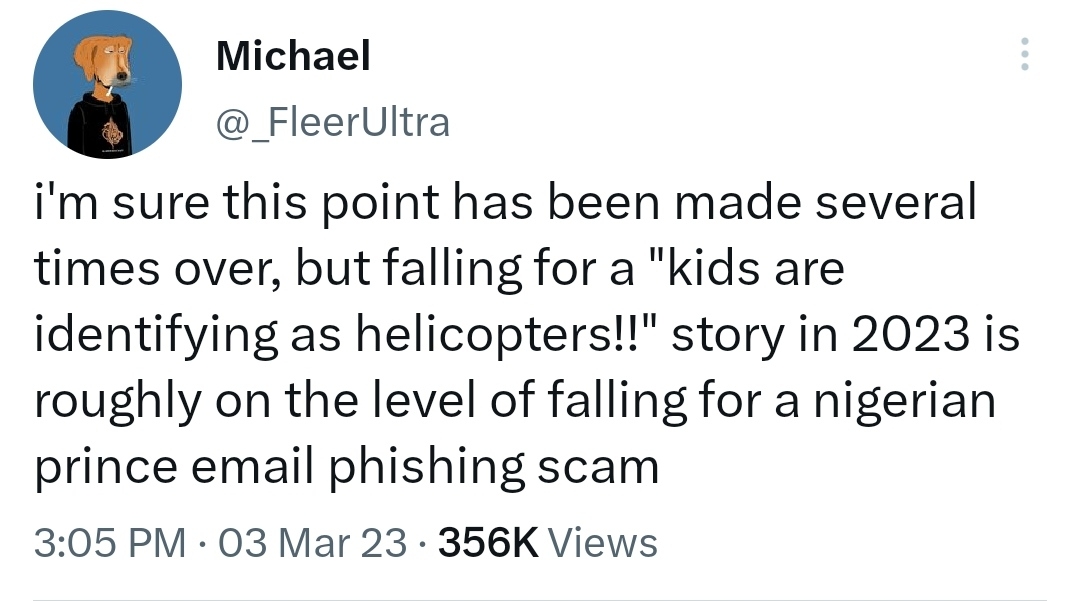
We always work with incomplete information. We know nothing for certain. It seems to me like you're essentially arguing to just throw our hands up in uncertainty and say "we can't know so nothing we can do".
But even with incomplete, weak, non-95%-statistically-significant data we can make better decisions than without any data. If there is a 51% chance for the one thing being right instead of 49% chance for the other thing, it makes rational sense to act 51% like the one thing is true and 49% like the other thing is true, so in other words, lean towards the 51% thing. On average, you're going to make better decisions this way. You should look into Bayesian epistemology if you want to know more.
I obviously don't know the exact percentages for the things I claimed. But there is decent evidence for gender dysphoria not being entirely environmentally (still acting on our genes of course) caused, but relatively independent of the environment.
One, of course, is the mass of reports of transsexuals that they've "always in some way felt like this". While not being scientific data, as a rational person you should not ignore this evidence. Of course you don't weigh it as heavily as a peer-reviewed scientific study with proper methods, but it should still have some weight.
Then there are a few studies that have found differences in genes responsible for sex hormones, specifically androgen which seems to reduce its effectiveness in binding testosterone. I've heard of other such studies on sex hormones.
There are also twin studies done. They have found that identical twins have a much higher likelihood to both be trans than dizygotic (non-identical, i.e. different genes) twins, further pointing towards significant innate genetic predisposition towards gender dysphoria.
Of course, the topic of identifying as a fox has not been studied this deeply. However, based on all I know on human behavior, it is extremely likely that this condition has nothing really to do with foxes or fox-based genes somehow causing this behavior. From the way I talked to the person that identified as a fox, if I were to take it seriously, I would say that they have a deep feeling of not belonging anywhere and having found companionship with other people of similar interests. But I would be pretty sure that this interest could have been something else, filling the same need for companionship, without much friction, thus my claim that it is solely culturally/environmentally-based.