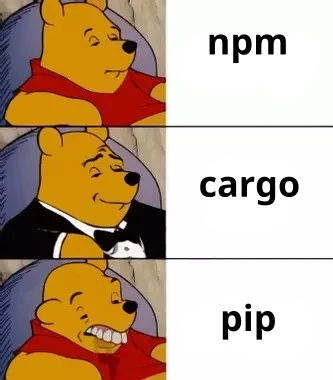
▲ 319 ▼ Package managers be like (linux.community) submitted 2 years ago by ExLisper@linux.community to c/programmerhumor@lemmy.ml 156 comments fedilink hide all child comments Sorry Python but it is what it is.
[+] skullgiver@popplesburger.hilciferous.nl 53 points 2 years ago* (last edited 2 years ago) (3 children) [deleted] permalink fedilink source hideshow 6 child comments replies: [–] barsoap@lemm.ee 10 points 2 years ago (1 child) cached copies of crates that you downloaded Meh, what else is it supposed to do, delete sources all the time? Then people with slow connections will complain. Also size-wise that's actually not even much (though they could take the care to compress it), what actually takes up space with rust is compile artifacts, per workspace. Have you heard of kondo? permalink fedilink source parent hideshow 2 child comments replies: [–] someacnt@sopuli.xyz 1 point 2 years ago (1 child) Idk, maybe you can share the common packages across projects. (That can never go wrong, right? /s) permalink fedilink source parent hideshow 2 child comments replies: [–] barsoap@lemm.ee 1 point 2 years ago (1 child) Sources are shared, sharing compile-time artefacts is done within workspaces. permalink fedilink source parent hideshow 2 child comments replies: [–] someacnt@sopuli.xyz 2 points 2 years ago (1 child) Oh.. I did mean sharing comptime artifacts permalink fedilink source parent hideshow 2 child comments replies: [–] Anafabula@discuss.tchncs.de 2 points 2 years ago You can globally share compile artifacts by setting a global target directory in the global Cargo config. In $HOME/.cargo/config.toml: [build] target-dir = "/path/to/dir" The only problems I had when I did it where some cargo plugins and some dependencies with build.rs files that expected the target folder in it's usual location. permalink fedilink source parent [–] hatchet@sh.itjust.works 6 points 2 years ago (1 child) I actually vastly prefer this behavior. It allows me to jump to (readable) source in library code easily in my editor, as well as experiment with different package versions without having to redownload, and (sort of) work offline too. I guess, I don't really know what it would do otherwise. I think Rust requires you to have the complete library source code for everything you're using regardless. I suppose it could act like NPM, and keep a separate copy of every library for every single project on my system, but that's even less efficient. Yes, I think NPM only downloads the "built" files (if the package uses a build system & is properly configured), but it's still just minified JS source code most of the time. permalink fedilink source parent hideshow 2 child comments replies: [–] Espi@lemmy.world 5 points 2 years ago With python and virtualenv you can also keep the entire source of your libraries in your project. permalink fedilink source parent [–] Pipoca@lemmy.world 4 points 2 years ago Python virtual environments feel really archaic. It's by far the worst user experience I've had with any kind of modern build system. Even a decade ago in Haskell, you only had to type cabal sandbox init only once, rather than source virtualenv/bin/activate.sh every time you cd to the project dir. I'm not really a python guy, but having to start touching a python project at work was a really unpleasant surprise. permalink fedilink source parent
[–] barsoap@lemm.ee 10 points 2 years ago (1 child) cached copies of crates that you downloaded Meh, what else is it supposed to do, delete sources all the time? Then people with slow connections will complain. Also size-wise that's actually not even much (though they could take the care to compress it), what actually takes up space with rust is compile artifacts, per workspace. Have you heard of kondo? permalink fedilink source parent hideshow 2 child comments replies: [–] someacnt@sopuli.xyz 1 point 2 years ago (1 child) Idk, maybe you can share the common packages across projects. (That can never go wrong, right? /s) permalink fedilink source parent hideshow 2 child comments replies: [–] barsoap@lemm.ee 1 point 2 years ago (1 child) Sources are shared, sharing compile-time artefacts is done within workspaces. permalink fedilink source parent hideshow 2 child comments replies: [–] someacnt@sopuli.xyz 2 points 2 years ago (1 child) Oh.. I did mean sharing comptime artifacts permalink fedilink source parent hideshow 2 child comments replies: [–] Anafabula@discuss.tchncs.de 2 points 2 years ago You can globally share compile artifacts by setting a global target directory in the global Cargo config. In $HOME/.cargo/config.toml: [build] target-dir = "/path/to/dir" The only problems I had when I did it where some cargo plugins and some dependencies with build.rs files that expected the target folder in it's usual location. permalink fedilink source parent
[–] someacnt@sopuli.xyz 1 point 2 years ago (1 child) Idk, maybe you can share the common packages across projects. (That can never go wrong, right? /s) permalink fedilink source parent hideshow 2 child comments replies: [–] barsoap@lemm.ee 1 point 2 years ago (1 child) Sources are shared, sharing compile-time artefacts is done within workspaces. permalink fedilink source parent hideshow 2 child comments replies: [–] someacnt@sopuli.xyz 2 points 2 years ago (1 child) Oh.. I did mean sharing comptime artifacts permalink fedilink source parent hideshow 2 child comments replies: [–] Anafabula@discuss.tchncs.de 2 points 2 years ago You can globally share compile artifacts by setting a global target directory in the global Cargo config. In $HOME/.cargo/config.toml: [build] target-dir = "/path/to/dir" The only problems I had when I did it where some cargo plugins and some dependencies with build.rs files that expected the target folder in it's usual location. permalink fedilink source parent
[–] barsoap@lemm.ee 1 point 2 years ago (1 child) Sources are shared, sharing compile-time artefacts is done within workspaces. permalink fedilink source parent hideshow 2 child comments replies: [–] someacnt@sopuli.xyz 2 points 2 years ago (1 child) Oh.. I did mean sharing comptime artifacts permalink fedilink source parent hideshow 2 child comments replies: [–] Anafabula@discuss.tchncs.de 2 points 2 years ago You can globally share compile artifacts by setting a global target directory in the global Cargo config. In $HOME/.cargo/config.toml: [build] target-dir = "/path/to/dir" The only problems I had when I did it where some cargo plugins and some dependencies with build.rs files that expected the target folder in it's usual location. permalink fedilink source parent
[–] someacnt@sopuli.xyz 2 points 2 years ago (1 child) Oh.. I did mean sharing comptime artifacts permalink fedilink source parent hideshow 2 child comments replies: [–] Anafabula@discuss.tchncs.de 2 points 2 years ago You can globally share compile artifacts by setting a global target directory in the global Cargo config. In $HOME/.cargo/config.toml: [build] target-dir = "/path/to/dir" The only problems I had when I did it where some cargo plugins and some dependencies with build.rs files that expected the target folder in it's usual location. permalink fedilink source parent
[–] Anafabula@discuss.tchncs.de 2 points 2 years ago You can globally share compile artifacts by setting a global target directory in the global Cargo config. In $HOME/.cargo/config.toml: [build] target-dir = "/path/to/dir" The only problems I had when I did it where some cargo plugins and some dependencies with build.rs files that expected the target folder in it's usual location. permalink fedilink source parent
[–] hatchet@sh.itjust.works 6 points 2 years ago (1 child) I actually vastly prefer this behavior. It allows me to jump to (readable) source in library code easily in my editor, as well as experiment with different package versions without having to redownload, and (sort of) work offline too. I guess, I don't really know what it would do otherwise. I think Rust requires you to have the complete library source code for everything you're using regardless. I suppose it could act like NPM, and keep a separate copy of every library for every single project on my system, but that's even less efficient. Yes, I think NPM only downloads the "built" files (if the package uses a build system & is properly configured), but it's still just minified JS source code most of the time. permalink fedilink source parent hideshow 2 child comments replies: [–] Espi@lemmy.world 5 points 2 years ago With python and virtualenv you can also keep the entire source of your libraries in your project. permalink fedilink source parent
[–] Espi@lemmy.world 5 points 2 years ago With python and virtualenv you can also keep the entire source of your libraries in your project. permalink fedilink source parent
[–] Pipoca@lemmy.world 4 points 2 years ago Python virtual environments feel really archaic. It's by far the worst user experience I've had with any kind of modern build system. Even a decade ago in Haskell, you only had to type cabal sandbox init only once, rather than source virtualenv/bin/activate.sh every time you cd to the project dir. I'm not really a python guy, but having to start touching a python project at work was a really unpleasant surprise. permalink fedilink source parent