▲ 431 ▼ Probability (reddthat.com) submitted 4 days ago by DrBanjo@reddthat.com to c/mathmemes@lemmy.blahaj.zone 117 comments fedilink hide all child comments
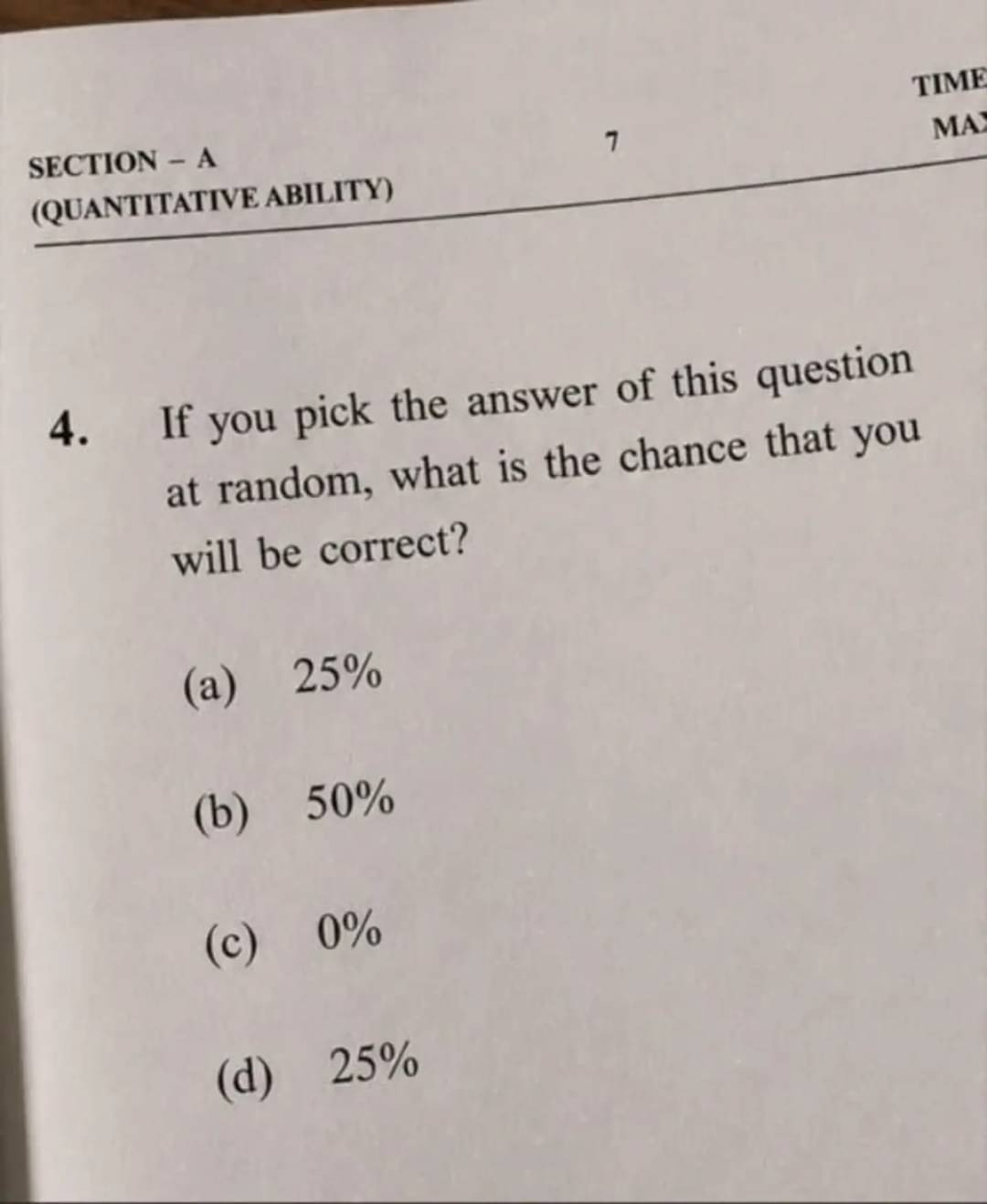
[–] Tidesphere@lemmy.world 2 points 2 days ago (1 child) The answer is null because the question references information that we don't have. It can't be answered. permalink fedilink source hideshow 2 child comments replies: [–] KairuByte@lemmy.dbzer0.com 3 points 2 days ago (1 child) Not quite. All information is present, but the answer changes in a way that makes this unanswerable. permalink fedilink source parent hideshow 2 child comments replies: [–] Tidesphere@lemmy.world 2 points 2 days ago (1 child) The question asks "What is the likelihood that you will give the correct answer to this question?" But does not detail the question that it is asking. As a hypothetical, if I came up to you and said "What is the answer to my question?" There are a number of ways you could answer, such as saying "What question?" Or even just "I don't know". But the fact of the matter is that you cannot give a knowledgeable answer in earnest because the question I gave you is malformed and lacking information. Like, I get the point of the question pictures, it's a very funny "haha look at this mathematical conundrum, isn't that pretty funny guys?" And it's a good question for that But I guess I'm just being a buzzkill by saying that technically none of these answers is correct because the premise of the question itself relies on a language error. Idk permalink fedilink source parent hideshow 2 child comments replies: [–] KairuByte@lemmy.dbzer0.com 1 point 2 days ago* (1 child) “This question” means “the current question being g asked” and trying to argue otherwise is just silly. The only way you could be confused in that is if you’re not a native English speaker (and if you’re not, fair enough). My point being, you are given the full question, the question being referenced, and the possible answers. It’s unanswerable not because of a language error, it’s because the second 25% makes it impossible to correctly answer as the answer is essentially a mathematical paradox. All answers are simultaneously correct and incorrect. permalink fedilink source parent hideshow 2 child comments replies: [–] Tidesphere@lemmy.world 1 point 2 days ago (1 child) I am a native English speaker with a very good comprehension of the language. So let's walk through the logic then, follow me on this one. I walk up to you and ask "What is the answer to my question?" I claim you have been given full information as to what the question is, and you are able to knowingly answer it without saying "I don't know" or "What question?" How do you answer? permalink fedilink source parent hideshow 2 child comments replies: [–] KairuByte@lemmy.dbzer0.com 1 point 2 days ago (1 child) The question pictured is not “my question” it is “this question” you can’t change the language of the question then complain it means something it doesn’t. permalink fedilink source parent hideshow 2 child comments replies: [–] Tidesphere@lemmy.world 1 point 2 days ago (1 child) So, syntactically speaking "My" question vs "this" question doesn't actually change anything about the example that I'm making. If making my example analogy closer to the question in the picture will help you understand the point, I can do that too, no worries. So, let us word it like this then "Is the answer to this question a bear, a moose, a lion, or a tiger?" The question fails before it reaches the stage where an answer is chosen, because the question is not formatted correctly. It is nonsensical to attempt to determine which of the four animals is the answer to the question, because the question is a nonsense question. In the same way, while it is a clever way to set up a question to imply a paradox, while it is a very fun way to contemplate how the answer might change given how the 'correct' answer changes based on which answer you choose; the reality of the situation is that the question actually fails before reaching the 'choose an answer' stage of the problem, because the self-referential language makes the question itself nonsensical. Is that clearer? permalink fedilink source parent hideshow 2 child comments replies: [–] KairuByte@lemmy.dbzer0.com 1 point 2 days ago (2 children) 🤦♂️ You’re telling me that if the answer choices were 0%, 25%, 50% and 100% this question would be impossible to answer because it was formatted incorrectly? permalink fedilink source parent hideshow 4 child comments replies: [–] Tidesphere@lemmy.world 1 point 1 day ago Oh and happy cake day btw permalink fedilink source parent [–] Tidesphere@lemmy.world 1 point 1 day ago Syntactically speaking yes, exactly. But we would likely infer what the answer is because we can see what the person means for us to read, just like we can see from the original question that the person writing it means for it to be a set up to show this fun little paradox that we all enjoy. Then we get into language as presented and language as intended and concepts around communication having the purpose of conveying an idea and all of that fun linguistic conversation! permalink fedilink source parent
[–] KairuByte@lemmy.dbzer0.com 3 points 2 days ago (1 child) Not quite. All information is present, but the answer changes in a way that makes this unanswerable. permalink fedilink source parent hideshow 2 child comments replies: [–] Tidesphere@lemmy.world 2 points 2 days ago (1 child) The question asks "What is the likelihood that you will give the correct answer to this question?" But does not detail the question that it is asking. As a hypothetical, if I came up to you and said "What is the answer to my question?" There are a number of ways you could answer, such as saying "What question?" Or even just "I don't know". But the fact of the matter is that you cannot give a knowledgeable answer in earnest because the question I gave you is malformed and lacking information. Like, I get the point of the question pictures, it's a very funny "haha look at this mathematical conundrum, isn't that pretty funny guys?" And it's a good question for that But I guess I'm just being a buzzkill by saying that technically none of these answers is correct because the premise of the question itself relies on a language error. Idk permalink fedilink source parent hideshow 2 child comments replies: [–] KairuByte@lemmy.dbzer0.com 1 point 2 days ago* (1 child) “This question” means “the current question being g asked” and trying to argue otherwise is just silly. The only way you could be confused in that is if you’re not a native English speaker (and if you’re not, fair enough). My point being, you are given the full question, the question being referenced, and the possible answers. It’s unanswerable not because of a language error, it’s because the second 25% makes it impossible to correctly answer as the answer is essentially a mathematical paradox. All answers are simultaneously correct and incorrect. permalink fedilink source parent hideshow 2 child comments replies: [–] Tidesphere@lemmy.world 1 point 2 days ago (1 child) I am a native English speaker with a very good comprehension of the language. So let's walk through the logic then, follow me on this one. I walk up to you and ask "What is the answer to my question?" I claim you have been given full information as to what the question is, and you are able to knowingly answer it without saying "I don't know" or "What question?" How do you answer? permalink fedilink source parent hideshow 2 child comments replies: [–] KairuByte@lemmy.dbzer0.com 1 point 2 days ago (1 child) The question pictured is not “my question” it is “this question” you can’t change the language of the question then complain it means something it doesn’t. permalink fedilink source parent hideshow 2 child comments replies: [–] Tidesphere@lemmy.world 1 point 2 days ago (1 child) So, syntactically speaking "My" question vs "this" question doesn't actually change anything about the example that I'm making. If making my example analogy closer to the question in the picture will help you understand the point, I can do that too, no worries. So, let us word it like this then "Is the answer to this question a bear, a moose, a lion, or a tiger?" The question fails before it reaches the stage where an answer is chosen, because the question is not formatted correctly. It is nonsensical to attempt to determine which of the four animals is the answer to the question, because the question is a nonsense question. In the same way, while it is a clever way to set up a question to imply a paradox, while it is a very fun way to contemplate how the answer might change given how the 'correct' answer changes based on which answer you choose; the reality of the situation is that the question actually fails before reaching the 'choose an answer' stage of the problem, because the self-referential language makes the question itself nonsensical. Is that clearer? permalink fedilink source parent hideshow 2 child comments replies: [–] KairuByte@lemmy.dbzer0.com 1 point 2 days ago (2 children) 🤦♂️ You’re telling me that if the answer choices were 0%, 25%, 50% and 100% this question would be impossible to answer because it was formatted incorrectly? permalink fedilink source parent hideshow 4 child comments replies: [–] Tidesphere@lemmy.world 1 point 1 day ago Oh and happy cake day btw permalink fedilink source parent [–] Tidesphere@lemmy.world 1 point 1 day ago Syntactically speaking yes, exactly. But we would likely infer what the answer is because we can see what the person means for us to read, just like we can see from the original question that the person writing it means for it to be a set up to show this fun little paradox that we all enjoy. Then we get into language as presented and language as intended and concepts around communication having the purpose of conveying an idea and all of that fun linguistic conversation! permalink fedilink source parent
[–] Tidesphere@lemmy.world 2 points 2 days ago (1 child) The question asks "What is the likelihood that you will give the correct answer to this question?" But does not detail the question that it is asking. As a hypothetical, if I came up to you and said "What is the answer to my question?" There are a number of ways you could answer, such as saying "What question?" Or even just "I don't know". But the fact of the matter is that you cannot give a knowledgeable answer in earnest because the question I gave you is malformed and lacking information. Like, I get the point of the question pictures, it's a very funny "haha look at this mathematical conundrum, isn't that pretty funny guys?" And it's a good question for that But I guess I'm just being a buzzkill by saying that technically none of these answers is correct because the premise of the question itself relies on a language error. Idk permalink fedilink source parent hideshow 2 child comments replies: [–] KairuByte@lemmy.dbzer0.com 1 point 2 days ago* (1 child) “This question” means “the current question being g asked” and trying to argue otherwise is just silly. The only way you could be confused in that is if you’re not a native English speaker (and if you’re not, fair enough). My point being, you are given the full question, the question being referenced, and the possible answers. It’s unanswerable not because of a language error, it’s because the second 25% makes it impossible to correctly answer as the answer is essentially a mathematical paradox. All answers are simultaneously correct and incorrect. permalink fedilink source parent hideshow 2 child comments replies: [–] Tidesphere@lemmy.world 1 point 2 days ago (1 child) I am a native English speaker with a very good comprehension of the language. So let's walk through the logic then, follow me on this one. I walk up to you and ask "What is the answer to my question?" I claim you have been given full information as to what the question is, and you are able to knowingly answer it without saying "I don't know" or "What question?" How do you answer? permalink fedilink source parent hideshow 2 child comments replies: [–] KairuByte@lemmy.dbzer0.com 1 point 2 days ago (1 child) The question pictured is not “my question” it is “this question” you can’t change the language of the question then complain it means something it doesn’t. permalink fedilink source parent hideshow 2 child comments replies: [–] Tidesphere@lemmy.world 1 point 2 days ago (1 child) So, syntactically speaking "My" question vs "this" question doesn't actually change anything about the example that I'm making. If making my example analogy closer to the question in the picture will help you understand the point, I can do that too, no worries. So, let us word it like this then "Is the answer to this question a bear, a moose, a lion, or a tiger?" The question fails before it reaches the stage where an answer is chosen, because the question is not formatted correctly. It is nonsensical to attempt to determine which of the four animals is the answer to the question, because the question is a nonsense question. In the same way, while it is a clever way to set up a question to imply a paradox, while it is a very fun way to contemplate how the answer might change given how the 'correct' answer changes based on which answer you choose; the reality of the situation is that the question actually fails before reaching the 'choose an answer' stage of the problem, because the self-referential language makes the question itself nonsensical. Is that clearer? permalink fedilink source parent hideshow 2 child comments replies: [–] KairuByte@lemmy.dbzer0.com 1 point 2 days ago (2 children) 🤦♂️ You’re telling me that if the answer choices were 0%, 25%, 50% and 100% this question would be impossible to answer because it was formatted incorrectly? permalink fedilink source parent hideshow 4 child comments replies: [–] Tidesphere@lemmy.world 1 point 1 day ago Oh and happy cake day btw permalink fedilink source parent [–] Tidesphere@lemmy.world 1 point 1 day ago Syntactically speaking yes, exactly. But we would likely infer what the answer is because we can see what the person means for us to read, just like we can see from the original question that the person writing it means for it to be a set up to show this fun little paradox that we all enjoy. Then we get into language as presented and language as intended and concepts around communication having the purpose of conveying an idea and all of that fun linguistic conversation! permalink fedilink source parent
[–] KairuByte@lemmy.dbzer0.com 1 point 2 days ago* (1 child) “This question” means “the current question being g asked” and trying to argue otherwise is just silly. The only way you could be confused in that is if you’re not a native English speaker (and if you’re not, fair enough). My point being, you are given the full question, the question being referenced, and the possible answers. It’s unanswerable not because of a language error, it’s because the second 25% makes it impossible to correctly answer as the answer is essentially a mathematical paradox. All answers are simultaneously correct and incorrect. permalink fedilink source parent hideshow 2 child comments replies: [–] Tidesphere@lemmy.world 1 point 2 days ago (1 child) I am a native English speaker with a very good comprehension of the language. So let's walk through the logic then, follow me on this one. I walk up to you and ask "What is the answer to my question?" I claim you have been given full information as to what the question is, and you are able to knowingly answer it without saying "I don't know" or "What question?" How do you answer? permalink fedilink source parent hideshow 2 child comments replies: [–] KairuByte@lemmy.dbzer0.com 1 point 2 days ago (1 child) The question pictured is not “my question” it is “this question” you can’t change the language of the question then complain it means something it doesn’t. permalink fedilink source parent hideshow 2 child comments replies: [–] Tidesphere@lemmy.world 1 point 2 days ago (1 child) So, syntactically speaking "My" question vs "this" question doesn't actually change anything about the example that I'm making. If making my example analogy closer to the question in the picture will help you understand the point, I can do that too, no worries. So, let us word it like this then "Is the answer to this question a bear, a moose, a lion, or a tiger?" The question fails before it reaches the stage where an answer is chosen, because the question is not formatted correctly. It is nonsensical to attempt to determine which of the four animals is the answer to the question, because the question is a nonsense question. In the same way, while it is a clever way to set up a question to imply a paradox, while it is a very fun way to contemplate how the answer might change given how the 'correct' answer changes based on which answer you choose; the reality of the situation is that the question actually fails before reaching the 'choose an answer' stage of the problem, because the self-referential language makes the question itself nonsensical. Is that clearer? permalink fedilink source parent hideshow 2 child comments replies: [–] KairuByte@lemmy.dbzer0.com 1 point 2 days ago (2 children) 🤦♂️ You’re telling me that if the answer choices were 0%, 25%, 50% and 100% this question would be impossible to answer because it was formatted incorrectly? permalink fedilink source parent hideshow 4 child comments replies: [–] Tidesphere@lemmy.world 1 point 1 day ago Oh and happy cake day btw permalink fedilink source parent [–] Tidesphere@lemmy.world 1 point 1 day ago Syntactically speaking yes, exactly. But we would likely infer what the answer is because we can see what the person means for us to read, just like we can see from the original question that the person writing it means for it to be a set up to show this fun little paradox that we all enjoy. Then we get into language as presented and language as intended and concepts around communication having the purpose of conveying an idea and all of that fun linguistic conversation! permalink fedilink source parent
[–] Tidesphere@lemmy.world 1 point 2 days ago (1 child) I am a native English speaker with a very good comprehension of the language. So let's walk through the logic then, follow me on this one. I walk up to you and ask "What is the answer to my question?" I claim you have been given full information as to what the question is, and you are able to knowingly answer it without saying "I don't know" or "What question?" How do you answer? permalink fedilink source parent hideshow 2 child comments replies: [–] KairuByte@lemmy.dbzer0.com 1 point 2 days ago (1 child) The question pictured is not “my question” it is “this question” you can’t change the language of the question then complain it means something it doesn’t. permalink fedilink source parent hideshow 2 child comments replies: [–] Tidesphere@lemmy.world 1 point 2 days ago (1 child) So, syntactically speaking "My" question vs "this" question doesn't actually change anything about the example that I'm making. If making my example analogy closer to the question in the picture will help you understand the point, I can do that too, no worries. So, let us word it like this then "Is the answer to this question a bear, a moose, a lion, or a tiger?" The question fails before it reaches the stage where an answer is chosen, because the question is not formatted correctly. It is nonsensical to attempt to determine which of the four animals is the answer to the question, because the question is a nonsense question. In the same way, while it is a clever way to set up a question to imply a paradox, while it is a very fun way to contemplate how the answer might change given how the 'correct' answer changes based on which answer you choose; the reality of the situation is that the question actually fails before reaching the 'choose an answer' stage of the problem, because the self-referential language makes the question itself nonsensical. Is that clearer? permalink fedilink source parent hideshow 2 child comments replies: [–] KairuByte@lemmy.dbzer0.com 1 point 2 days ago (2 children) 🤦♂️ You’re telling me that if the answer choices were 0%, 25%, 50% and 100% this question would be impossible to answer because it was formatted incorrectly? permalink fedilink source parent hideshow 4 child comments replies: [–] Tidesphere@lemmy.world 1 point 1 day ago Oh and happy cake day btw permalink fedilink source parent [–] Tidesphere@lemmy.world 1 point 1 day ago Syntactically speaking yes, exactly. But we would likely infer what the answer is because we can see what the person means for us to read, just like we can see from the original question that the person writing it means for it to be a set up to show this fun little paradox that we all enjoy. Then we get into language as presented and language as intended and concepts around communication having the purpose of conveying an idea and all of that fun linguistic conversation! permalink fedilink source parent
[–] KairuByte@lemmy.dbzer0.com 1 point 2 days ago (1 child) The question pictured is not “my question” it is “this question” you can’t change the language of the question then complain it means something it doesn’t. permalink fedilink source parent hideshow 2 child comments replies: [–] Tidesphere@lemmy.world 1 point 2 days ago (1 child) So, syntactically speaking "My" question vs "this" question doesn't actually change anything about the example that I'm making. If making my example analogy closer to the question in the picture will help you understand the point, I can do that too, no worries. So, let us word it like this then "Is the answer to this question a bear, a moose, a lion, or a tiger?" The question fails before it reaches the stage where an answer is chosen, because the question is not formatted correctly. It is nonsensical to attempt to determine which of the four animals is the answer to the question, because the question is a nonsense question. In the same way, while it is a clever way to set up a question to imply a paradox, while it is a very fun way to contemplate how the answer might change given how the 'correct' answer changes based on which answer you choose; the reality of the situation is that the question actually fails before reaching the 'choose an answer' stage of the problem, because the self-referential language makes the question itself nonsensical. Is that clearer? permalink fedilink source parent hideshow 2 child comments replies: [–] KairuByte@lemmy.dbzer0.com 1 point 2 days ago (2 children) 🤦♂️ You’re telling me that if the answer choices were 0%, 25%, 50% and 100% this question would be impossible to answer because it was formatted incorrectly? permalink fedilink source parent hideshow 4 child comments replies: [–] Tidesphere@lemmy.world 1 point 1 day ago Oh and happy cake day btw permalink fedilink source parent [–] Tidesphere@lemmy.world 1 point 1 day ago Syntactically speaking yes, exactly. But we would likely infer what the answer is because we can see what the person means for us to read, just like we can see from the original question that the person writing it means for it to be a set up to show this fun little paradox that we all enjoy. Then we get into language as presented and language as intended and concepts around communication having the purpose of conveying an idea and all of that fun linguistic conversation! permalink fedilink source parent
[–] Tidesphere@lemmy.world 1 point 2 days ago (1 child) So, syntactically speaking "My" question vs "this" question doesn't actually change anything about the example that I'm making. If making my example analogy closer to the question in the picture will help you understand the point, I can do that too, no worries. So, let us word it like this then "Is the answer to this question a bear, a moose, a lion, or a tiger?" The question fails before it reaches the stage where an answer is chosen, because the question is not formatted correctly. It is nonsensical to attempt to determine which of the four animals is the answer to the question, because the question is a nonsense question. In the same way, while it is a clever way to set up a question to imply a paradox, while it is a very fun way to contemplate how the answer might change given how the 'correct' answer changes based on which answer you choose; the reality of the situation is that the question actually fails before reaching the 'choose an answer' stage of the problem, because the self-referential language makes the question itself nonsensical. Is that clearer? permalink fedilink source parent hideshow 2 child comments replies: [–] KairuByte@lemmy.dbzer0.com 1 point 2 days ago (2 children) 🤦♂️ You’re telling me that if the answer choices were 0%, 25%, 50% and 100% this question would be impossible to answer because it was formatted incorrectly? permalink fedilink source parent hideshow 4 child comments replies: [–] Tidesphere@lemmy.world 1 point 1 day ago Oh and happy cake day btw permalink fedilink source parent [–] Tidesphere@lemmy.world 1 point 1 day ago Syntactically speaking yes, exactly. But we would likely infer what the answer is because we can see what the person means for us to read, just like we can see from the original question that the person writing it means for it to be a set up to show this fun little paradox that we all enjoy. Then we get into language as presented and language as intended and concepts around communication having the purpose of conveying an idea and all of that fun linguistic conversation! permalink fedilink source parent
[–] KairuByte@lemmy.dbzer0.com 1 point 2 days ago (2 children) 🤦♂️ You’re telling me that if the answer choices were 0%, 25%, 50% and 100% this question would be impossible to answer because it was formatted incorrectly? permalink fedilink source parent hideshow 4 child comments replies: [–] Tidesphere@lemmy.world 1 point 1 day ago Oh and happy cake day btw permalink fedilink source parent [–] Tidesphere@lemmy.world 1 point 1 day ago Syntactically speaking yes, exactly. But we would likely infer what the answer is because we can see what the person means for us to read, just like we can see from the original question that the person writing it means for it to be a set up to show this fun little paradox that we all enjoy. Then we get into language as presented and language as intended and concepts around communication having the purpose of conveying an idea and all of that fun linguistic conversation! permalink fedilink source parent
[–] Tidesphere@lemmy.world 1 point 1 day ago Oh and happy cake day btw permalink fedilink source parent
[–] Tidesphere@lemmy.world 1 point 1 day ago Syntactically speaking yes, exactly. But we would likely infer what the answer is because we can see what the person means for us to read, just like we can see from the original question that the person writing it means for it to be a set up to show this fun little paradox that we all enjoy. Then we get into language as presented and language as intended and concepts around communication having the purpose of conveying an idea and all of that fun linguistic conversation! permalink fedilink source parent