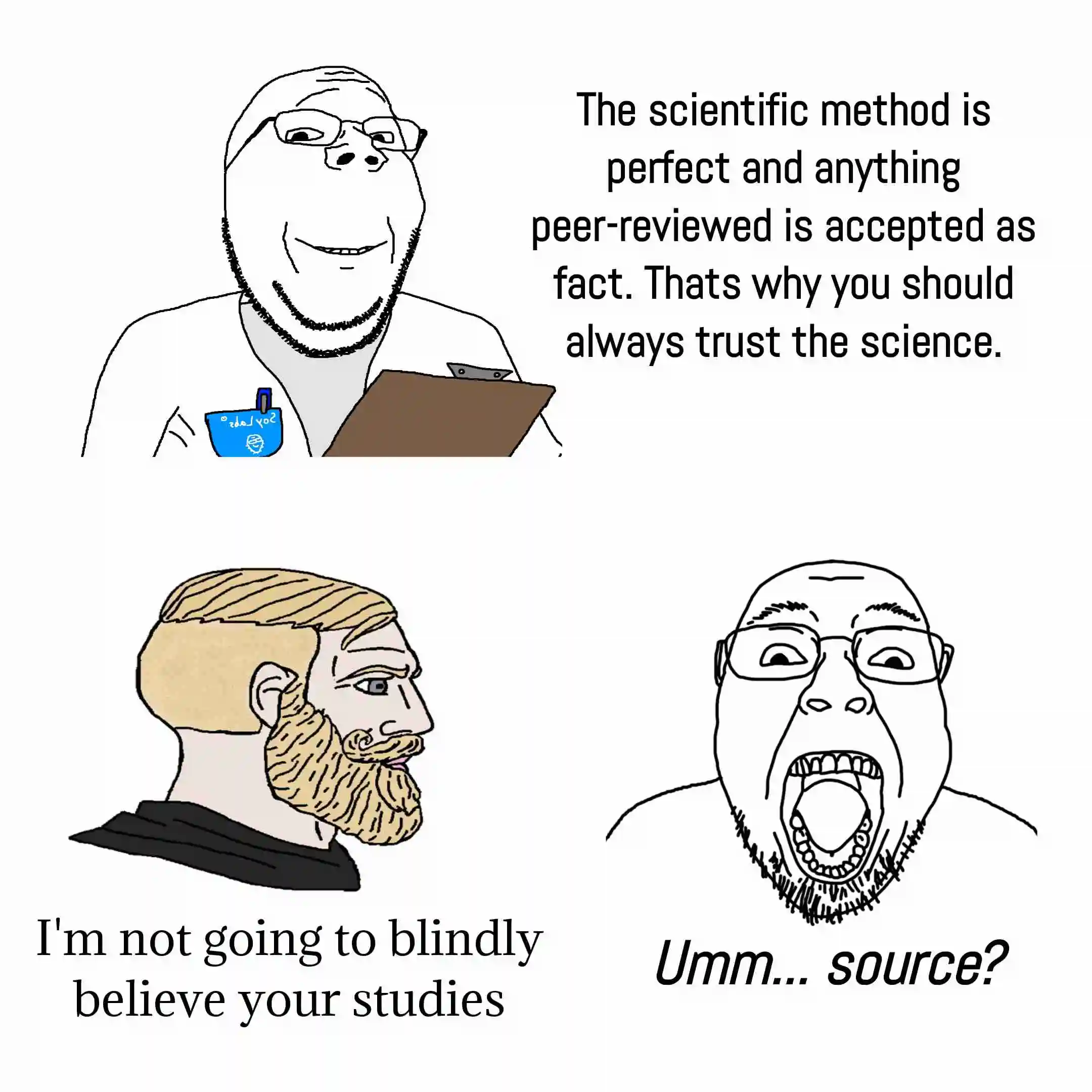
▲ -149 ▼ im not anti-science im pro diversity of ideas (sh.itjust.works) submitted 2 years ago by darcy@sh.itjust.works to c/memes@lemmy.ml 61 comments fedilink hide all child comments
[+] ryathal@sh.itjust.works -25 points 2 years ago (3 children) Computers are feats of engineering, which is related but distinct from science and the scientific method. Vastly overstating what the scientific method is for isn't helpful. permalink fedilink source parent hideshow 6 child comments replies: [–] CosmicSploogeDrizzle@lemmy.world 25 points 2 years ago (2 children) Engineering is a branch of Science. Specifically, Engineering is applied science. For example, scientists discovered that microwaves existed. Engineers made them heat up your food. How did we make safer and better microwaves appliances? Engineers applied the scientific method and iterated on the design and performed tests. To say engineering is separate from the science is incorrect. permalink fedilink source parent hideshow 4 child comments replies: [–] Count042@lemmy.ml 3 points 2 years ago* (last edited 2 years ago) (1 child) It was actually a scientist who made the first microwave. They were doing experiments with hamsters with cryogenics, and warming up the frozen hamsters with hot paddles. It didn't work that well, and the scientist felt bad for the hamsters. So, he built the first microwave to warm the hamsters more evenly and 'humanely'. That's right. The first thing cooked in a microwave was literally a hamster. EDIT: First Desktop microwave that matches what we consider a microwave today, I should have said. My apologies. References: A Smith, J Lovelock, A Parkes, 1954: Resuscitation of Hamsters after Supercooling or Partial Crystallization at Body Temperatures Below 0° C.. Nature 173, 1136–1137 R K Andjus, J E Lovelock, 1955: Reanimation of rats from body temperatures between 0 and 1° C by microwave diathermy. The Journal of Physiology, 128. Lovelock, J E, Smith A U, 1959, Heat transfer from and to animals in experimental hypothermia and freezing. Annals of the New York Academy of Sciences, 80: 487-499. permalink fedilink source parent hideshow 2 child comments replies: [–] CosmicSploogeDrizzle@lemmy.world 8 points 2 years ago (2 children) The sources on wikipedia say it was Percy Spencer, an American self-taught engineer. He noticed a Mr. Goodbar candy bar he had in his pocket started to melt from microwaves from an active radar set he was working on. The first food deliberately cooked was popcorn, and the second was an egg, which exploded. Here are the direct sources: https://web.archive.org/web/20110709081022/http://www.gallawa.com/microtech/history.html https://www.youtube.com/watch?v=4h1ESUz2H3E If you have a link to the hamster experiment I would love to read more. I might dive into a microwave research hole today! lol permalink fedilink source parent hideshow 4 child comments replies: [–] Count042@lemmy.ml 2 points 2 years ago (2 children) https://www.youtube.com/watch?v=2tdiKTSdE9Y Video has links to references and actual interview with the scientist. It wasn't sold or marketed, but it was a microwave. permalink fedilink source parent hideshow 4 child comments replies: [–] CosmicSploogeDrizzle@lemmy.world 2 points 2 years ago Very cool! I'll check it out! Thanks permalink fedilink source parent [–] PipedLinkBot@feddit.rocks [B] 0 points 2 years ago Here is an alternative Piped link(s): https://www.youtube.com/watch?v=2tdiKTSdE9Y Piped is a privacy-respecting open-source alternative frontend to YouTube. I'm open-source, check me out at GitHub. permalink fedilink source parent [–] PipedLinkBot@feddit.rocks [B] 0 points 2 years ago (1 child) Here is an alternative Piped link(s): https://www.youtube.com/watch?v=4h1ESUz2H3E Piped is a privacy-respecting open-source alternative frontend to YouTube. I'm open-source, check me out at GitHub. permalink fedilink source parent hideshow 2 child comments replies: [–] Count042@lemmy.ml 2 points 2 years ago Go home, bot. You're drunk. permalink fedilink source parent [+] ryathal@sh.itjust.works -7 points 2 years ago Engineering and science are separate though. They may share many characteristics and share knowledge between them, but the focus and results are fundamentally different. Engineering is quite different from science. Scientists try to understand nature. Engineers try to make things that do not exist in nature. https://en.m.wikipedia.org/wiki/Engineering#Science permalink fedilink source parent [–] ElPussyKangaroo@lemmy.world 11 points 2 years ago (1 child) Engineering is applied science. It's literally an entire community of people who volunteered to test Science. And then apply it. And everything that came out of it is evidence that science works. permalink fedilink source parent hideshow 2 child comments replies: [+] ryathal@sh.itjust.works -8 points 2 years ago (2 children) Except that's not actually how it worked. We didn't always have solid scientific models before things happened. Bicycles are the more famous example of something that existed for years before science could explain why it works, it's still not perfectly explained. Flight is also somewhat week in the scientific model for lift, but we can still make planes. While there have been instances where scientists have theorized/discovered X is possible and then a way to do X was built, it's not required. permalink fedilink source parent hideshow 4 child comments replies: [–] conneru64@lemmy.blahaj.zone 5 points 2 years ago (1 child) Hypothesis: adding this part or doing that thing will make it do what I want. Experiment: do that change and see if it does the thing you want. If it doesn't do what you want, go back to hypothesis step. If that's not science, idk what is. permalink fedilink source parent hideshow 2 child comments replies: [–] ryathal@sh.itjust.works -4 points 2 years ago (1 child) You don't know what is. Science isn't do something and see if it works, it's about explaining why something works. Scientific experiments only disprove a hypothesis or can't disprove. Eventually a collection of results can be evidence of proof, but it's not actually proof. You're more in engineering of wanting to do a thing and finding a way to accomplish that thing based on the current understanding of the relative science. permalink fedilink source parent hideshow 2 child comments replies: [–] conneru64@lemmy.blahaj.zone 3 points 2 years ago I literally just described the scientific method. Sure, it's not the kind of question most scientists would ask, but it's the same scientific method. permalink fedilink source parent [–] ElPussyKangaroo@lemmy.world 3 points 2 years ago Just because the theoretical was finalized after the practical, doesn't mean that it isn't applied science. We made wheels. We didn't know why it made sense for them to be circular, but we knew it was easier to load them. Later on, we learnt about catenary tracks and how circular wheels are great for reducing friction by reducing the contact surface area, as well as the fact that rolling is easier compared to pushing or pulling. All of these are things that we instinctually understood but didn't know how to explain. This was, is and will be how science works. You see something happen, and you try to understand the how and why. All of theoretical science comes from experimentation, which means on some level, you will require engineering. Similarly, all of engineering comes from the gradual process of perfecting how things works (or can work), which is science. permalink fedilink source parent [–] TokyoMonsterTrucker@lemmy.dbzer0.com 5 points 2 years ago* (1 child) Ah, yes, I was waiting for you, Well Ackshually It's Engineering Man. Nothing else. Nice to see you again. permalink fedilink source parent hideshow 2 child comments replies: [–] ryathal@sh.itjust.works 0 points 2 years ago (1 child) Is the dean of engineering at Boston University also a well Ackshuslly guy? https://www.bu.edu/eng/about-eng/meet-the-dean/engineering-is-not-science/ permalink fedilink source parent hideshow 2 child comments replies: [–] TokyoMonsterTrucker@lemmy.dbzer0.com 5 points 2 years ago I dunno man, I'm going to have to check in with the aliens and JFK Jr. on Telegram. Let's just wait for another Q-drop to lead the way. It's been a while since the last one, I'm hoping Fauci hasn't slurped Ron's brains out through his eye sockets. permalink fedilink source parent
[–] CosmicSploogeDrizzle@lemmy.world 25 points 2 years ago (2 children) Engineering is a branch of Science. Specifically, Engineering is applied science. For example, scientists discovered that microwaves existed. Engineers made them heat up your food. How did we make safer and better microwaves appliances? Engineers applied the scientific method and iterated on the design and performed tests. To say engineering is separate from the science is incorrect. permalink fedilink source parent hideshow 4 child comments replies: [–] Count042@lemmy.ml 3 points 2 years ago* (last edited 2 years ago) (1 child) It was actually a scientist who made the first microwave. They were doing experiments with hamsters with cryogenics, and warming up the frozen hamsters with hot paddles. It didn't work that well, and the scientist felt bad for the hamsters. So, he built the first microwave to warm the hamsters more evenly and 'humanely'. That's right. The first thing cooked in a microwave was literally a hamster. EDIT: First Desktop microwave that matches what we consider a microwave today, I should have said. My apologies. References: A Smith, J Lovelock, A Parkes, 1954: Resuscitation of Hamsters after Supercooling or Partial Crystallization at Body Temperatures Below 0° C.. Nature 173, 1136–1137 R K Andjus, J E Lovelock, 1955: Reanimation of rats from body temperatures between 0 and 1° C by microwave diathermy. The Journal of Physiology, 128. Lovelock, J E, Smith A U, 1959, Heat transfer from and to animals in experimental hypothermia and freezing. Annals of the New York Academy of Sciences, 80: 487-499. permalink fedilink source parent hideshow 2 child comments replies: [–] CosmicSploogeDrizzle@lemmy.world 8 points 2 years ago (2 children) The sources on wikipedia say it was Percy Spencer, an American self-taught engineer. He noticed a Mr. Goodbar candy bar he had in his pocket started to melt from microwaves from an active radar set he was working on. The first food deliberately cooked was popcorn, and the second was an egg, which exploded. Here are the direct sources: https://web.archive.org/web/20110709081022/http://www.gallawa.com/microtech/history.html https://www.youtube.com/watch?v=4h1ESUz2H3E If you have a link to the hamster experiment I would love to read more. I might dive into a microwave research hole today! lol permalink fedilink source parent hideshow 4 child comments replies: [–] Count042@lemmy.ml 2 points 2 years ago (2 children) https://www.youtube.com/watch?v=2tdiKTSdE9Y Video has links to references and actual interview with the scientist. It wasn't sold or marketed, but it was a microwave. permalink fedilink source parent hideshow 4 child comments replies: [–] CosmicSploogeDrizzle@lemmy.world 2 points 2 years ago Very cool! I'll check it out! Thanks permalink fedilink source parent [–] PipedLinkBot@feddit.rocks [B] 0 points 2 years ago Here is an alternative Piped link(s): https://www.youtube.com/watch?v=2tdiKTSdE9Y Piped is a privacy-respecting open-source alternative frontend to YouTube. I'm open-source, check me out at GitHub. permalink fedilink source parent [–] PipedLinkBot@feddit.rocks [B] 0 points 2 years ago (1 child) Here is an alternative Piped link(s): https://www.youtube.com/watch?v=4h1ESUz2H3E Piped is a privacy-respecting open-source alternative frontend to YouTube. I'm open-source, check me out at GitHub. permalink fedilink source parent hideshow 2 child comments replies: [–] Count042@lemmy.ml 2 points 2 years ago Go home, bot. You're drunk. permalink fedilink source parent [+] ryathal@sh.itjust.works -7 points 2 years ago Engineering and science are separate though. They may share many characteristics and share knowledge between them, but the focus and results are fundamentally different. Engineering is quite different from science. Scientists try to understand nature. Engineers try to make things that do not exist in nature. https://en.m.wikipedia.org/wiki/Engineering#Science permalink fedilink source parent
[–] Count042@lemmy.ml 3 points 2 years ago* (last edited 2 years ago) (1 child) It was actually a scientist who made the first microwave. They were doing experiments with hamsters with cryogenics, and warming up the frozen hamsters with hot paddles. It didn't work that well, and the scientist felt bad for the hamsters. So, he built the first microwave to warm the hamsters more evenly and 'humanely'. That's right. The first thing cooked in a microwave was literally a hamster. EDIT: First Desktop microwave that matches what we consider a microwave today, I should have said. My apologies. References: A Smith, J Lovelock, A Parkes, 1954: Resuscitation of Hamsters after Supercooling or Partial Crystallization at Body Temperatures Below 0° C.. Nature 173, 1136–1137 R K Andjus, J E Lovelock, 1955: Reanimation of rats from body temperatures between 0 and 1° C by microwave diathermy. The Journal of Physiology, 128. Lovelock, J E, Smith A U, 1959, Heat transfer from and to animals in experimental hypothermia and freezing. Annals of the New York Academy of Sciences, 80: 487-499. permalink fedilink source parent hideshow 2 child comments replies: [–] CosmicSploogeDrizzle@lemmy.world 8 points 2 years ago (2 children) The sources on wikipedia say it was Percy Spencer, an American self-taught engineer. He noticed a Mr. Goodbar candy bar he had in his pocket started to melt from microwaves from an active radar set he was working on. The first food deliberately cooked was popcorn, and the second was an egg, which exploded. Here are the direct sources: https://web.archive.org/web/20110709081022/http://www.gallawa.com/microtech/history.html https://www.youtube.com/watch?v=4h1ESUz2H3E If you have a link to the hamster experiment I would love to read more. I might dive into a microwave research hole today! lol permalink fedilink source parent hideshow 4 child comments replies: [–] Count042@lemmy.ml 2 points 2 years ago (2 children) https://www.youtube.com/watch?v=2tdiKTSdE9Y Video has links to references and actual interview with the scientist. It wasn't sold or marketed, but it was a microwave. permalink fedilink source parent hideshow 4 child comments replies: [–] CosmicSploogeDrizzle@lemmy.world 2 points 2 years ago Very cool! I'll check it out! Thanks permalink fedilink source parent [–] PipedLinkBot@feddit.rocks [B] 0 points 2 years ago Here is an alternative Piped link(s): https://www.youtube.com/watch?v=2tdiKTSdE9Y Piped is a privacy-respecting open-source alternative frontend to YouTube. I'm open-source, check me out at GitHub. permalink fedilink source parent [–] PipedLinkBot@feddit.rocks [B] 0 points 2 years ago (1 child) Here is an alternative Piped link(s): https://www.youtube.com/watch?v=4h1ESUz2H3E Piped is a privacy-respecting open-source alternative frontend to YouTube. I'm open-source, check me out at GitHub. permalink fedilink source parent hideshow 2 child comments replies: [–] Count042@lemmy.ml 2 points 2 years ago Go home, bot. You're drunk. permalink fedilink source parent
[–] CosmicSploogeDrizzle@lemmy.world 8 points 2 years ago (2 children) The sources on wikipedia say it was Percy Spencer, an American self-taught engineer. He noticed a Mr. Goodbar candy bar he had in his pocket started to melt from microwaves from an active radar set he was working on. The first food deliberately cooked was popcorn, and the second was an egg, which exploded. Here are the direct sources: https://web.archive.org/web/20110709081022/http://www.gallawa.com/microtech/history.html https://www.youtube.com/watch?v=4h1ESUz2H3E If you have a link to the hamster experiment I would love to read more. I might dive into a microwave research hole today! lol permalink fedilink source parent hideshow 4 child comments replies: [–] Count042@lemmy.ml 2 points 2 years ago (2 children) https://www.youtube.com/watch?v=2tdiKTSdE9Y Video has links to references and actual interview with the scientist. It wasn't sold or marketed, but it was a microwave. permalink fedilink source parent hideshow 4 child comments replies: [–] CosmicSploogeDrizzle@lemmy.world 2 points 2 years ago Very cool! I'll check it out! Thanks permalink fedilink source parent [–] PipedLinkBot@feddit.rocks [B] 0 points 2 years ago Here is an alternative Piped link(s): https://www.youtube.com/watch?v=2tdiKTSdE9Y Piped is a privacy-respecting open-source alternative frontend to YouTube. I'm open-source, check me out at GitHub. permalink fedilink source parent [–] PipedLinkBot@feddit.rocks [B] 0 points 2 years ago (1 child) Here is an alternative Piped link(s): https://www.youtube.com/watch?v=4h1ESUz2H3E Piped is a privacy-respecting open-source alternative frontend to YouTube. I'm open-source, check me out at GitHub. permalink fedilink source parent hideshow 2 child comments replies: [–] Count042@lemmy.ml 2 points 2 years ago Go home, bot. You're drunk. permalink fedilink source parent
[–] Count042@lemmy.ml 2 points 2 years ago (2 children) https://www.youtube.com/watch?v=2tdiKTSdE9Y Video has links to references and actual interview with the scientist. It wasn't sold or marketed, but it was a microwave. permalink fedilink source parent hideshow 4 child comments replies: [–] CosmicSploogeDrizzle@lemmy.world 2 points 2 years ago Very cool! I'll check it out! Thanks permalink fedilink source parent [–] PipedLinkBot@feddit.rocks [B] 0 points 2 years ago Here is an alternative Piped link(s): https://www.youtube.com/watch?v=2tdiKTSdE9Y Piped is a privacy-respecting open-source alternative frontend to YouTube. I'm open-source, check me out at GitHub. permalink fedilink source parent
[–] CosmicSploogeDrizzle@lemmy.world 2 points 2 years ago Very cool! I'll check it out! Thanks permalink fedilink source parent
[–] PipedLinkBot@feddit.rocks [B] 0 points 2 years ago Here is an alternative Piped link(s): https://www.youtube.com/watch?v=2tdiKTSdE9Y Piped is a privacy-respecting open-source alternative frontend to YouTube. I'm open-source, check me out at GitHub. permalink fedilink source parent
[–] PipedLinkBot@feddit.rocks [B] 0 points 2 years ago (1 child) Here is an alternative Piped link(s): https://www.youtube.com/watch?v=4h1ESUz2H3E Piped is a privacy-respecting open-source alternative frontend to YouTube. I'm open-source, check me out at GitHub. permalink fedilink source parent hideshow 2 child comments replies: [–] Count042@lemmy.ml 2 points 2 years ago Go home, bot. You're drunk. permalink fedilink source parent
[–] Count042@lemmy.ml 2 points 2 years ago Go home, bot. You're drunk. permalink fedilink source parent
[+] ryathal@sh.itjust.works -7 points 2 years ago Engineering and science are separate though. They may share many characteristics and share knowledge between them, but the focus and results are fundamentally different. Engineering is quite different from science. Scientists try to understand nature. Engineers try to make things that do not exist in nature. https://en.m.wikipedia.org/wiki/Engineering#Science permalink fedilink source parent
[–] ElPussyKangaroo@lemmy.world 11 points 2 years ago (1 child) Engineering is applied science. It's literally an entire community of people who volunteered to test Science. And then apply it. And everything that came out of it is evidence that science works. permalink fedilink source parent hideshow 2 child comments replies: [+] ryathal@sh.itjust.works -8 points 2 years ago (2 children) Except that's not actually how it worked. We didn't always have solid scientific models before things happened. Bicycles are the more famous example of something that existed for years before science could explain why it works, it's still not perfectly explained. Flight is also somewhat week in the scientific model for lift, but we can still make planes. While there have been instances where scientists have theorized/discovered X is possible and then a way to do X was built, it's not required. permalink fedilink source parent hideshow 4 child comments replies: [–] conneru64@lemmy.blahaj.zone 5 points 2 years ago (1 child) Hypothesis: adding this part or doing that thing will make it do what I want. Experiment: do that change and see if it does the thing you want. If it doesn't do what you want, go back to hypothesis step. If that's not science, idk what is. permalink fedilink source parent hideshow 2 child comments replies: [–] ryathal@sh.itjust.works -4 points 2 years ago (1 child) You don't know what is. Science isn't do something and see if it works, it's about explaining why something works. Scientific experiments only disprove a hypothesis or can't disprove. Eventually a collection of results can be evidence of proof, but it's not actually proof. You're more in engineering of wanting to do a thing and finding a way to accomplish that thing based on the current understanding of the relative science. permalink fedilink source parent hideshow 2 child comments replies: [–] conneru64@lemmy.blahaj.zone 3 points 2 years ago I literally just described the scientific method. Sure, it's not the kind of question most scientists would ask, but it's the same scientific method. permalink fedilink source parent [–] ElPussyKangaroo@lemmy.world 3 points 2 years ago Just because the theoretical was finalized after the practical, doesn't mean that it isn't applied science. We made wheels. We didn't know why it made sense for them to be circular, but we knew it was easier to load them. Later on, we learnt about catenary tracks and how circular wheels are great for reducing friction by reducing the contact surface area, as well as the fact that rolling is easier compared to pushing or pulling. All of these are things that we instinctually understood but didn't know how to explain. This was, is and will be how science works. You see something happen, and you try to understand the how and why. All of theoretical science comes from experimentation, which means on some level, you will require engineering. Similarly, all of engineering comes from the gradual process of perfecting how things works (or can work), which is science. permalink fedilink source parent
[+] ryathal@sh.itjust.works -8 points 2 years ago (2 children) Except that's not actually how it worked. We didn't always have solid scientific models before things happened. Bicycles are the more famous example of something that existed for years before science could explain why it works, it's still not perfectly explained. Flight is also somewhat week in the scientific model for lift, but we can still make planes. While there have been instances where scientists have theorized/discovered X is possible and then a way to do X was built, it's not required. permalink fedilink source parent hideshow 4 child comments replies: [–] conneru64@lemmy.blahaj.zone 5 points 2 years ago (1 child) Hypothesis: adding this part or doing that thing will make it do what I want. Experiment: do that change and see if it does the thing you want. If it doesn't do what you want, go back to hypothesis step. If that's not science, idk what is. permalink fedilink source parent hideshow 2 child comments replies: [–] ryathal@sh.itjust.works -4 points 2 years ago (1 child) You don't know what is. Science isn't do something and see if it works, it's about explaining why something works. Scientific experiments only disprove a hypothesis or can't disprove. Eventually a collection of results can be evidence of proof, but it's not actually proof. You're more in engineering of wanting to do a thing and finding a way to accomplish that thing based on the current understanding of the relative science. permalink fedilink source parent hideshow 2 child comments replies: [–] conneru64@lemmy.blahaj.zone 3 points 2 years ago I literally just described the scientific method. Sure, it's not the kind of question most scientists would ask, but it's the same scientific method. permalink fedilink source parent [–] ElPussyKangaroo@lemmy.world 3 points 2 years ago Just because the theoretical was finalized after the practical, doesn't mean that it isn't applied science. We made wheels. We didn't know why it made sense for them to be circular, but we knew it was easier to load them. Later on, we learnt about catenary tracks and how circular wheels are great for reducing friction by reducing the contact surface area, as well as the fact that rolling is easier compared to pushing or pulling. All of these are things that we instinctually understood but didn't know how to explain. This was, is and will be how science works. You see something happen, and you try to understand the how and why. All of theoretical science comes from experimentation, which means on some level, you will require engineering. Similarly, all of engineering comes from the gradual process of perfecting how things works (or can work), which is science. permalink fedilink source parent
[–] conneru64@lemmy.blahaj.zone 5 points 2 years ago (1 child) Hypothesis: adding this part or doing that thing will make it do what I want. Experiment: do that change and see if it does the thing you want. If it doesn't do what you want, go back to hypothesis step. If that's not science, idk what is. permalink fedilink source parent hideshow 2 child comments replies: [–] ryathal@sh.itjust.works -4 points 2 years ago (1 child) You don't know what is. Science isn't do something and see if it works, it's about explaining why something works. Scientific experiments only disprove a hypothesis or can't disprove. Eventually a collection of results can be evidence of proof, but it's not actually proof. You're more in engineering of wanting to do a thing and finding a way to accomplish that thing based on the current understanding of the relative science. permalink fedilink source parent hideshow 2 child comments replies: [–] conneru64@lemmy.blahaj.zone 3 points 2 years ago I literally just described the scientific method. Sure, it's not the kind of question most scientists would ask, but it's the same scientific method. permalink fedilink source parent
[–] ryathal@sh.itjust.works -4 points 2 years ago (1 child) You don't know what is. Science isn't do something and see if it works, it's about explaining why something works. Scientific experiments only disprove a hypothesis or can't disprove. Eventually a collection of results can be evidence of proof, but it's not actually proof. You're more in engineering of wanting to do a thing and finding a way to accomplish that thing based on the current understanding of the relative science. permalink fedilink source parent hideshow 2 child comments replies: [–] conneru64@lemmy.blahaj.zone 3 points 2 years ago I literally just described the scientific method. Sure, it's not the kind of question most scientists would ask, but it's the same scientific method. permalink fedilink source parent
[–] conneru64@lemmy.blahaj.zone 3 points 2 years ago I literally just described the scientific method. Sure, it's not the kind of question most scientists would ask, but it's the same scientific method. permalink fedilink source parent
[–] ElPussyKangaroo@lemmy.world 3 points 2 years ago Just because the theoretical was finalized after the practical, doesn't mean that it isn't applied science. We made wheels. We didn't know why it made sense for them to be circular, but we knew it was easier to load them. Later on, we learnt about catenary tracks and how circular wheels are great for reducing friction by reducing the contact surface area, as well as the fact that rolling is easier compared to pushing or pulling. All of these are things that we instinctually understood but didn't know how to explain. This was, is and will be how science works. You see something happen, and you try to understand the how and why. All of theoretical science comes from experimentation, which means on some level, you will require engineering. Similarly, all of engineering comes from the gradual process of perfecting how things works (or can work), which is science. permalink fedilink source parent
[–] TokyoMonsterTrucker@lemmy.dbzer0.com 5 points 2 years ago* (1 child) Ah, yes, I was waiting for you, Well Ackshually It's Engineering Man. Nothing else. Nice to see you again. permalink fedilink source parent hideshow 2 child comments replies: [–] ryathal@sh.itjust.works 0 points 2 years ago (1 child) Is the dean of engineering at Boston University also a well Ackshuslly guy? https://www.bu.edu/eng/about-eng/meet-the-dean/engineering-is-not-science/ permalink fedilink source parent hideshow 2 child comments replies: [–] TokyoMonsterTrucker@lemmy.dbzer0.com 5 points 2 years ago I dunno man, I'm going to have to check in with the aliens and JFK Jr. on Telegram. Let's just wait for another Q-drop to lead the way. It's been a while since the last one, I'm hoping Fauci hasn't slurped Ron's brains out through his eye sockets. permalink fedilink source parent
[–] ryathal@sh.itjust.works 0 points 2 years ago (1 child) Is the dean of engineering at Boston University also a well Ackshuslly guy? https://www.bu.edu/eng/about-eng/meet-the-dean/engineering-is-not-science/ permalink fedilink source parent hideshow 2 child comments replies: [–] TokyoMonsterTrucker@lemmy.dbzer0.com 5 points 2 years ago I dunno man, I'm going to have to check in with the aliens and JFK Jr. on Telegram. Let's just wait for another Q-drop to lead the way. It's been a while since the last one, I'm hoping Fauci hasn't slurped Ron's brains out through his eye sockets. permalink fedilink source parent
[–] TokyoMonsterTrucker@lemmy.dbzer0.com 5 points 2 years ago I dunno man, I'm going to have to check in with the aliens and JFK Jr. on Telegram. Let's just wait for another Q-drop to lead the way. It's been a while since the last one, I'm hoping Fauci hasn't slurped Ron's brains out through his eye sockets. permalink fedilink source parent