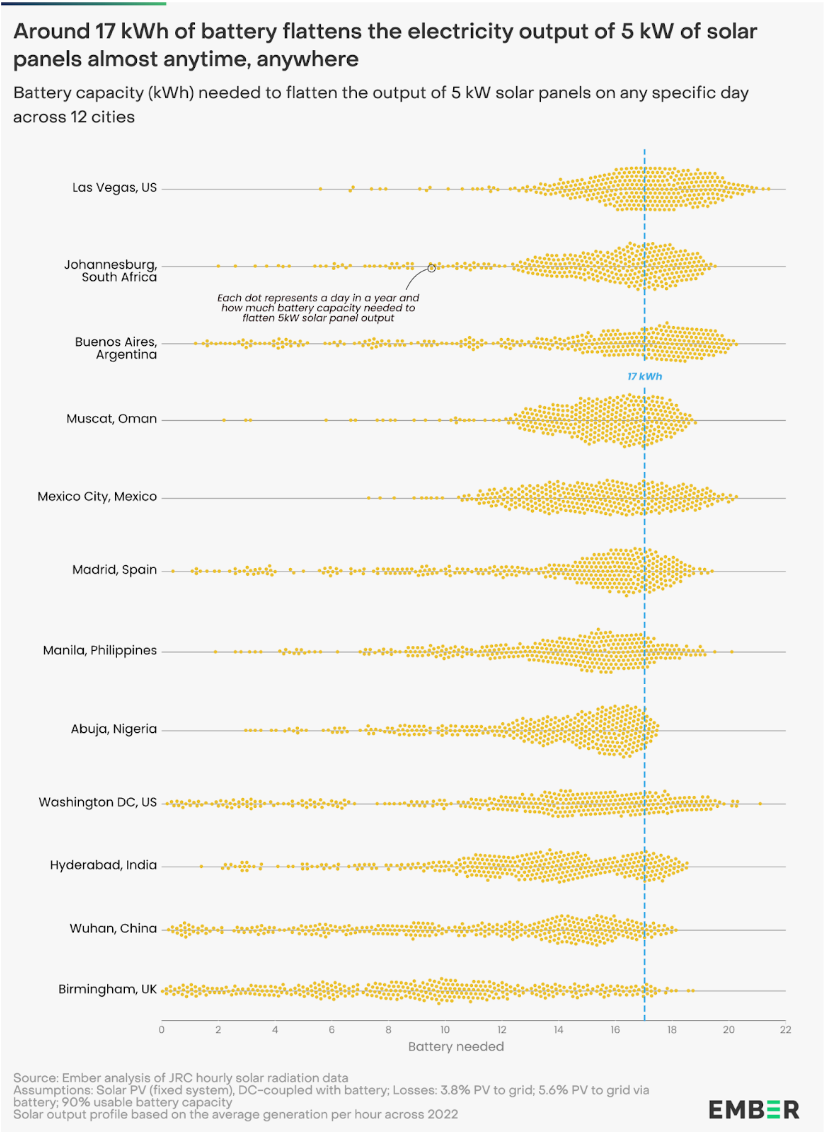
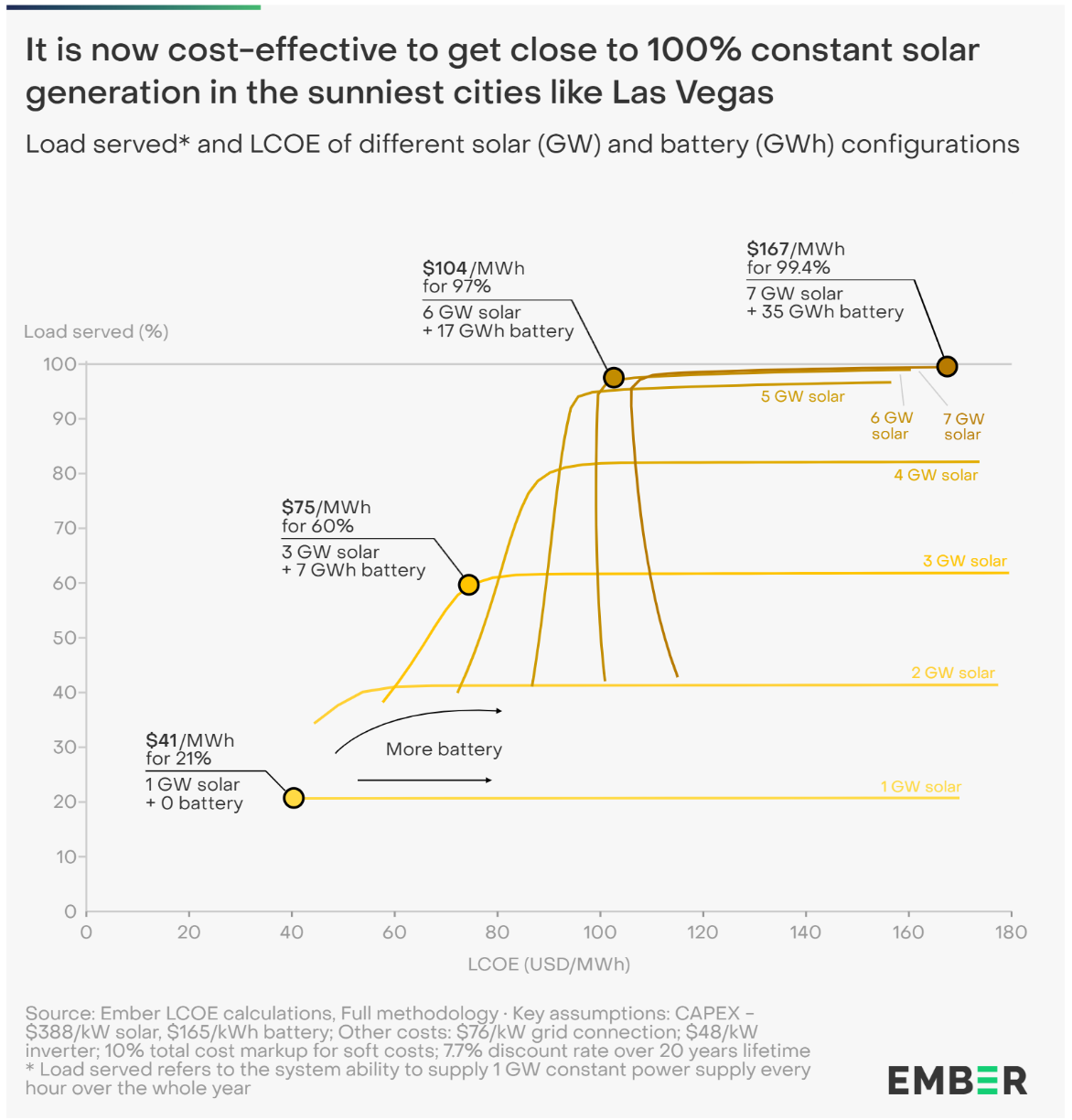
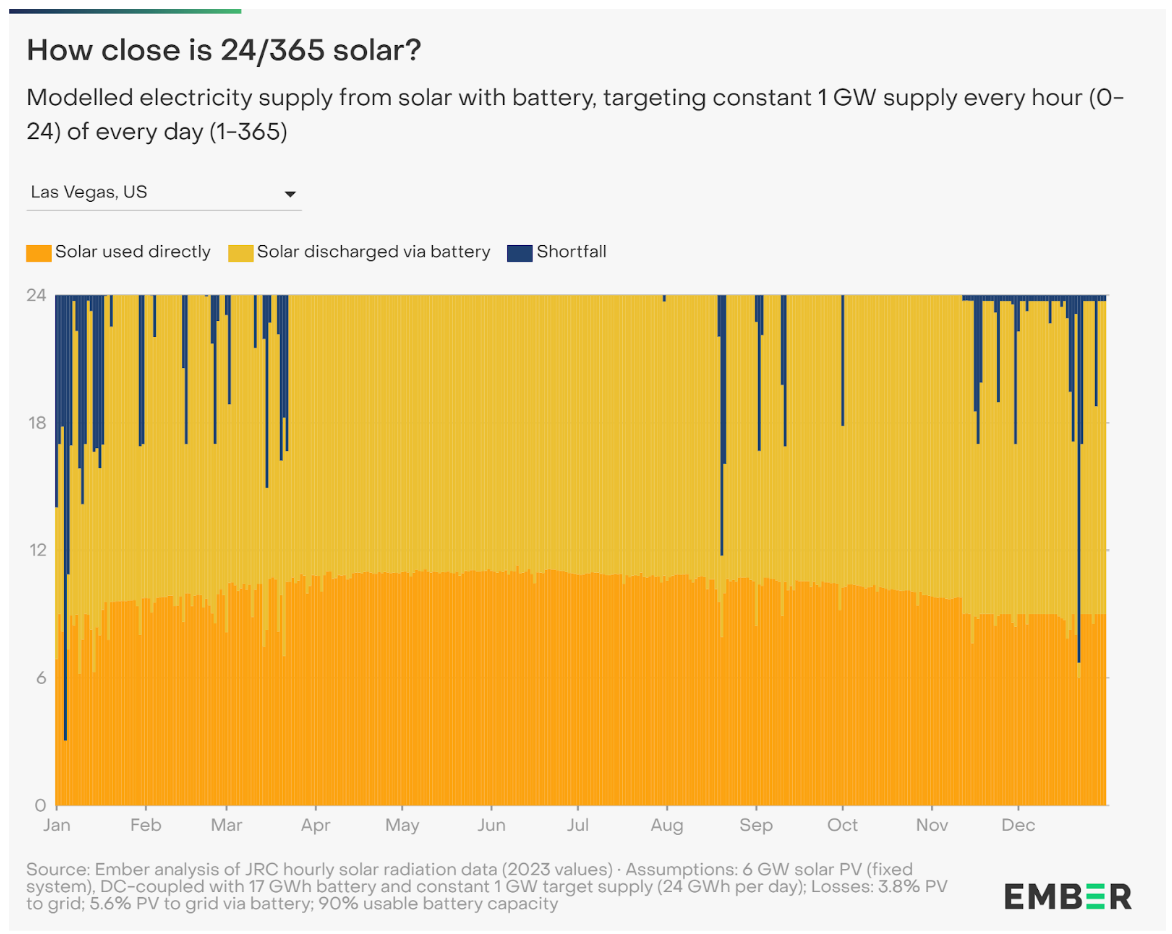
Some key insights from the article:
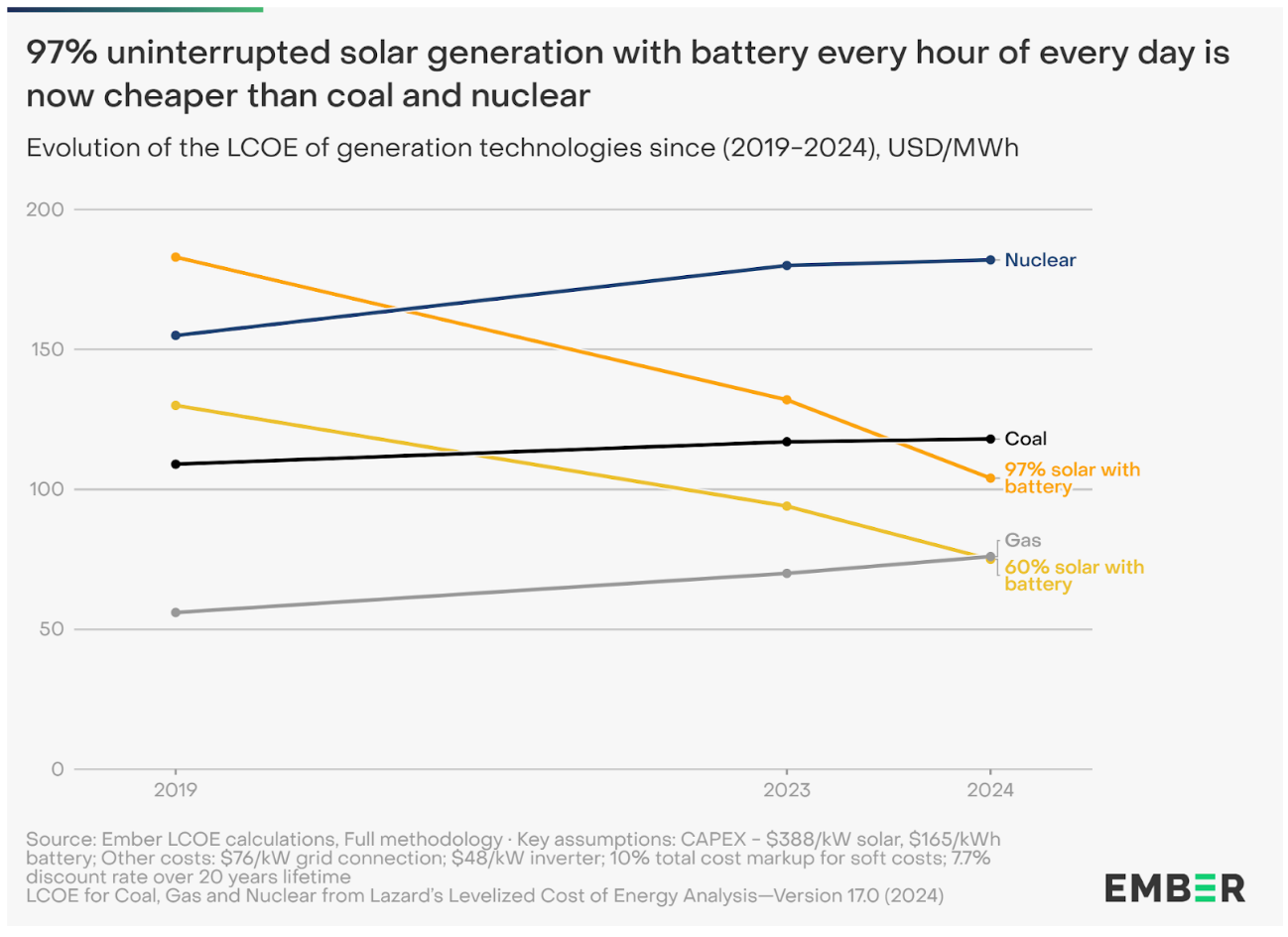
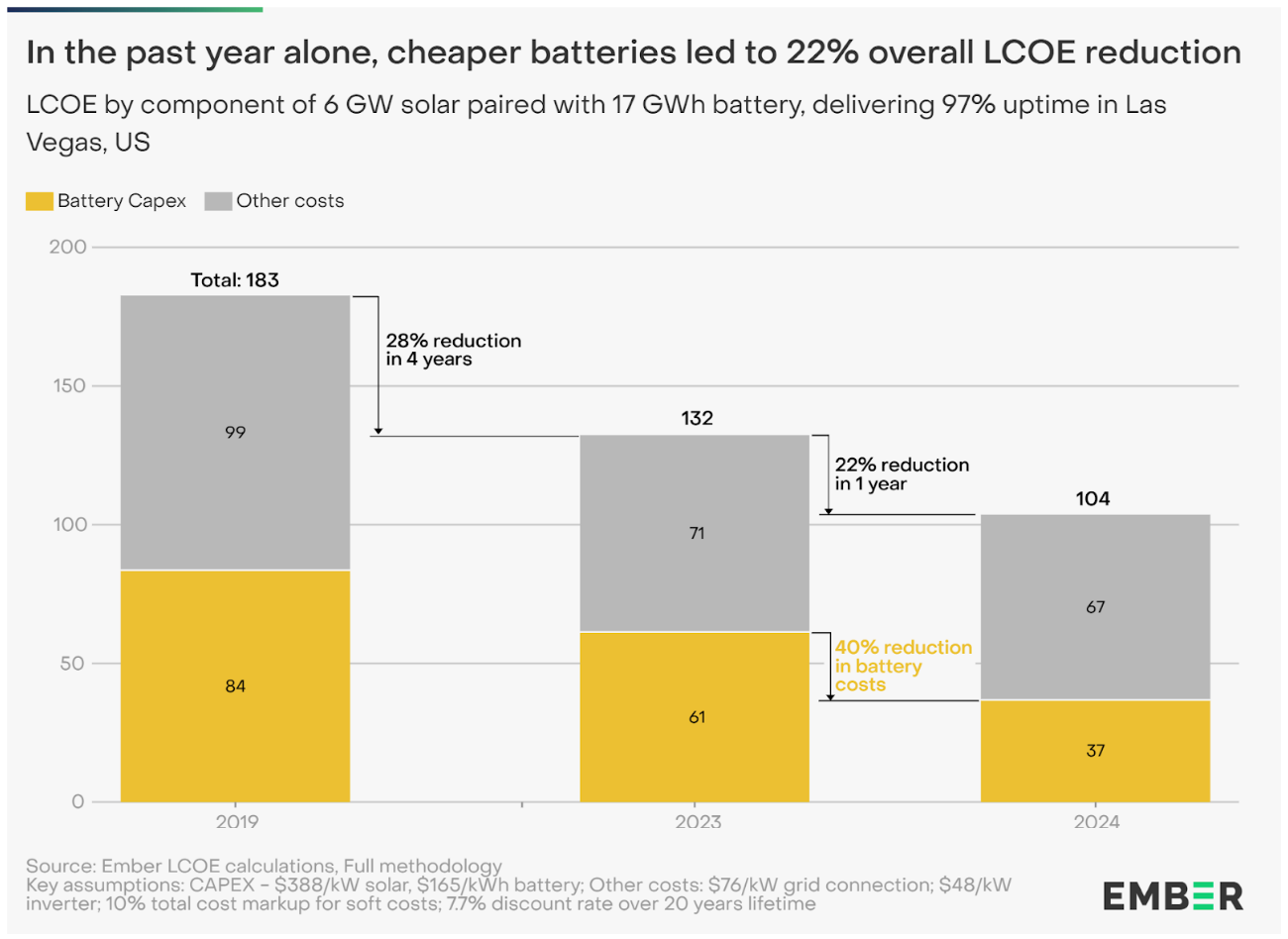
Basically, what they did was to look at how much batteries would be needed in a given area to provide constant power supply at least 97% of the time, and the calculate the costs of that solar+battery setup compared to coal and nuclear.

you are viewing a single comment's thread
view the rest of the comments
[–] 25 points 1 year ago (5 children)

As others have said this is for Las Vegas which receives wayyy more sun than the average place. But the other misleading part is they looked at 20 years which is close to the life cycle for solar/batteries and not even half the life of nuclear

  • source
  • hideshow 10 child comments
  • [–] 14 points 1 year ago* (last edited 1 year ago) (3 children)

    But the other misleading part is they looked at 20 years which is close to the life cycle for solar/batteries and not even half the life of nuclear

    I think Lazard's LCOE methodology looks at the entire life cycle of the power plant, specific to that power plant. So they amortize solar startup/decommissioning costs across the 20 year life cycle of solar, but when calculating LCOE for nuclear, they spread the costs across the 80 year life cycle of a nuclear plant.

    Nuclear is just really, really expensive. Even if plants required no operating costs, the up front costs are so high that it represents a significant portion of the overall operating costs for any given year.

    The Vogtle debacle in Georgia cost $35 billion to add 2 MW 2GW (edit to fix error) of capacity. They're now projecting that over the entire 75 year lifespan the cost of the electricity will come out to be about $0.17 to $0.18 per kilowatt hour.

  • source
  • parent
  • hideshow 6 child comments
  • [–] 4 points 1 year ago (1 child)

    Vogtle’s numbers are incredibly biased considering they made an entire design and then had to redo it halfway through that’s not a realistic cost that can be expected for future projects. We also have vogtles design be approved now so that new plants can be built for a fraction of the cost. Also where did you see they did amortization of solar?

  • source
  • parent
  • hideshow 2 child comments
  • [–] 4 points 1 year ago

    Also where did you see they did amortization of solar?

    I'm just familiar with Lazard's LCOE methodology. The linked paper talks about LCOE, so that's just how that particular cost analysis works.

  • source
  • parent
  • [–] 4 points 1 year ago (1 child)

    Fair point but nuclear will probably always have the disadvantage of initial cost and time to market. It's a huge risk for investors and public officials.

  • source
  • parent
  • hideshow 2 child comments
  • [–] 2 points 1 year ago (1 child)

    That is the main criticism of nuclear, it should hopefully get better with Westinghouse’s AP1000 receiving full approval and being built all across China so as long as we continue to use the same design it can start to be mass produced instead of making all the parts as one offs that are much more expensive and time consuming

  • source
  • parent
  • hideshow 2 child comments
  • [–] 2 points 1 year ago (1 child)

    Vogtle added 2 AP1000 reactors for $35 billion. Future deployments might be cheaper, but there's a long way to go before it can compete with pretty much any other type of power generation.

  • source
  • parent
  • hideshow 2 child comments
  • [–] 2 points 1 year ago (1 child)

    They had to switch halfway through which is what added the cost that’s not a realistic cost per reactor

  • source
  • parent
  • hideshow 2 child comments
  • [–] 1 point 1 year ago (1 child)

    Ok, current projections are still for the next two AP1000s at Vogtle to be something like $10 billion. That's just not cost competitive with solar/wind. And it's also not very realistic to assume that there won't be cost overruns on the next one, either. Complex engineering projects tend to run over.

  • source
  • parent
  • hideshow 2 child comments
  • [–] 1 point 1 year ago (1 child)

    Next two? After you mentioned it I tried googling and can’t find anything about current projections for new AP1000s at vogtle.

  • source
  • parent
  • hideshow 2 child comments
  • [–] 1 point 1 year ago (1 child)

    This paper lays out the cost projections that one could expect with the lessons learned from Vogtle Units 3 & 4, with the tax credits and government guarantees available as of 2024:

    https://web.mit.edu/kshirvan/www/research/ANP201%20TR%20CANES.pdf

  • source
  • parent
  • hideshow 2 child comments
  • [–] 1 point 1 year ago (1 child)

    According to the link you listed an AP1000 costs $66/MWh where as from the ember report that’s linked in this article solar plus storage for 97% uptime cost $104/MWh in a sunny city. In Washington DC it would cost $124 and only be able to maintain 81%. I still stand by even with the higher cost that solar + storage is a better option in places like Arizona, Nevada, Southern California ,etc. but nuclear is not as much of the high cost boogeyman as you are making it out to be

    https://ember-energy.org/latest-insights/solar-electricity-every-hour-of-every-day-is-here-and-it-changes-everything/

  • source
  • parent
  • hideshow 2 child comments
  • [–] 1 point 1 year ago (1 child)

    My problem with nuclear is both the high cost and, somewhat counterintuitively, the very long life cycles to spread that high cost. The economics only make sense if the plant runs for 75 years, which represents an opportunity cost of displacing whatever might be available in 25 or 50 years.

    A solar plant planned in 2025 might be online in 2027, and decommissioned in 2047, replaced with whatever technology/economics are available then. But a new nuclear reactor bakes in the costs for 80+ years, to be paid by ratepayers who haven't been born yet.

    So if in 2050 a 2030-constructed nuclear plant is still imposing costs of $66/MWh on ratepayers, to finance the interest and construction costs from 25 years earlier, will that be competitive with the state of solar/wind/batteries/hydrothermal at that time? Given the past trend lines, it seems economically foolish to lock in today's prices for the next 80 years.

  • source
  • parent
  • hideshow 2 child comments
  • [–] 1 point 1 year ago (1 child)

    Except there is also inflation that in the U.S. for the past 75 years has been 3.8% so the cost of $66 per MWh would be the equivalent purchasing power cost of about $4.85 by the end of the plant life. The long lifecycle is good for environmental purposes as well as you don’t need to do constant construction and constantly dispose of rare earth metals and concrete

  • source
  • parent
  • hideshow 2 child comments
  • [–] 1 point 1 year ago

    No, LCOE is an aggregated sum of all the cash flows, with the proper discount rates applied based on when that cash flow happens, complete with the cost of borrowing (that is, interest) and the changes in prices (that is, inflation). The rates charged to the ratepayers (approved by state PUCs) are going to go up over time, with inflation, but the effect of that on the overall economics will also be blunted by the time value of money and the interest paid on the up-front costs in the meantime.

    When you have to pay up front for the construction of a power plant, you have to pay interest on those borrowed funds for the entire life cycle, so that steadily increasing prices over time is part of the overall cost modeling.

  • source
  • parent
  • [–] 3 points 1 year ago (1 child)

    From the dot graph, it implies that las Vegas is one of the worse options? And Birmingham is somehow best?

    Not sure I'm reading that right?

  • source
  • parent
  • hideshow 2 child comments
  • [–] 5 points 1 year ago

    My understanding of that graph is how do you flatten peak energy demands, Birmingham is flat and throughout the year because you have some parts of the year where you need very little battery capacity and other parts where you need a lot. Las Vegas basically always needs a lot because of how hot it gets they end up with huge amounts of peak energy usage

  • source
  • parent
  • [–] 3 points 1 year ago (1 child)

    they looked at 20 years which is close to the life cycle for solar/batteries and not even half the life of nuclear

    Brother, with some luck a nuclear plant is in construction stage after those 20 years

  • source
  • parent
  • hideshow 2 child comments
  • [–] 6 points 1 year ago

    China has been doing them in around 7 years from groundbreaking to grid connection and is trying to get that down to 5 years with their bailong power plant as they are developing an experienced work force and actually have experience making the parts

  • source
  • parent
  • [–] 0 points 1 year ago (1 child)

    solar today is warranteed for 30 years. No reason to replace before 60 years compared to adding more beside it.

  • source
  • parent
  • hideshow 2 child comments
  • [–] 1 point 1 year ago (1 child)

    Batteries and panels degrade over time. So if you are trying to maintain a specific amount of power you would need to keep investing in order to maintain the same amount of power generation

  • source
  • parent
  • hideshow 2 child comments
  • [–] 1 point 1 year ago (1 child)

    I mean there are ongoing costs with any form of power generation. Obviously there's fuel costs for most, but even other renewables have maintenance costs. You'll also need to keep investing anyway as power demands increase over time. So newer solar installations eventually replace the old.

  • source
  • parent
  • hideshow 2 child comments
  • [–] 2 points 1 year ago

    Yes, what I am saying is that cost is being shown for nuclear and not shown for solar due to using an intentionally small window of time. It’s like comparing an ICE to an EV and talking about the refueling costs of gas and treating electricity like it’s free.

  • source
  • parent