you are viewing a single comment's thread
view the rest of the comments
[+] [S] -7 points 1 year ago (5 children)

Yes and no. Imperial measurements that are not integers are displayed in fractions. Hence quarterpounders and thirpounders. In metrics, fractions are rarely used. Because the scales are more granular and because non-integers are usually displayed in decimals.

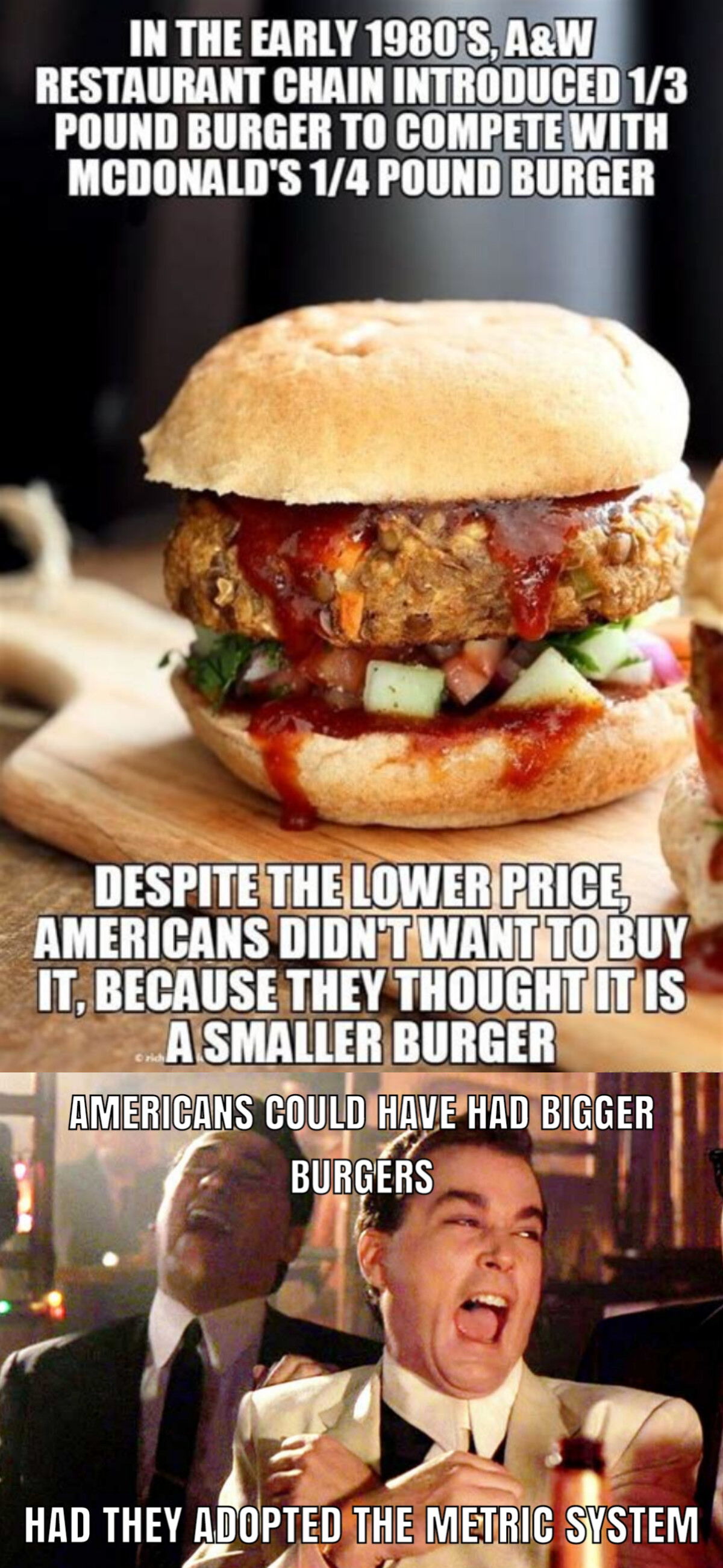
People thinking a third-pound-burger being smaller than a quarterpounder could not have happened with metrics, because, well, look at the title.

  • source
  • parent
  • hideshow 10 child comments
  • [–] 7 points 1 year ago (1 child)

    I’m from a country where we use metric and can’t think of anything that would normally be displayed as a fraction. Sure we know what half and third are, but they’re not used officially for anything

  • source
  • parent
  • hideshow 2 child comments
  • [+] -12 points 1 year ago (2 children)

    You've never had to halve a recipe before? Which is easier to do in your head, half of 78.862 milliliters or half of 1/3 cup?

  • source
  • parent
  • hideshow 4 child comments
  • [–] 20 points 1 year ago

    No recipe lists 78.862 mm of anything.

    A recipe with metric units will default to gram amounts that are divisible by ten and thus infinitely easier to halve than "5/8 of your grandmother's good cake spoon" or any such folksy nonsense.

  • source
  • parent
  • [–] 3 points 1 year ago

    I would round it to 40ml. I have no idea how much 1/6th of a cup would be. Most of my cups are different sizes too so I wouldn’t know which on to trust. Also they are oddly shaped and not transparent making it a real challenge all and all.

  • source
  • parent
  • [–] 0 points 1 year ago (2 children)

    Imperial measurements that are not integers are displayed in fractions.

    Often, they're not: look at packaging labels especially in grocery stores. Engineers use decimals regardless of unit.

    Weight scales in the US don't mark 1⁄3.

    Quarter & third likely show up for verbal ease/brevity of naming: saying 250 grams is a bit of mouthful & unlikely for naming anything. I suspect if Americans used metric, they might still use fractions to refer to burgers by weight/mass in kg (like drugs!).

    In metrics, fractions are rarely used.

    Also convention. Nothing prevents 1⁄3 kg, 1⁄4 kg, and I'd expect to see 1⁄3 kg more often than 0.3̅ kg if rounding were avoided.

    In metric, Americans still would get this wrong, because they don't understand fractions despite using them. Or are you suggesting everyone would get the order of 1⁄3 kg & 1⁄4 kg wrong?

  • source
  • parent
  • hideshow 4 child comments
  • [–] -3 points 1 year ago* (last edited 1 year ago) (2 children)

    Are Europeans afraid of fractions or something? It's way quicker to mentally add 9/16 and 3/8 compared to 0.5625 and 0.3750...

    Like I get that metric is better but "metric is when no fractions" make 0/1 sense.

    Edit - tfw you get ratiod by "9+6 is hard" in a thread about people not understanding basic arithmetic

  • source
  • parent
  • hideshow 4 child comments
  • [–] 10 points 1 year ago

    I’m a lifelong American and neither of these are easy, but the decimals are much more like real numbers to me.

    I encounter decimal points in my day to day interactions with numbers. Not so with fractions.

    I will start learning fractions when restaurants put them in their prices.

    “That will be $4 and 3/4,” said no one ever, thank gob.

  • source
  • parent
  • [+] -9 points 1 year ago (2 children)

    Fractions are more accurate. You can't display 1/3 as a decimal. Americans are dumb, but this isn't an imperial versus metric thing.

  • source
  • parent
  • hideshow 4 child comments
  • [–] 2 points 1 year ago (1 child)

    Your accuracy goes out of the window when you are actually measuring things though. The error is as significant as rounding 1/3 to 0.33

  • source
  • parent
  • hideshow 2 child comments
  • [+] 2 points 1 year ago* (last edited 1 year ago) (1 child)
  • [–] 4 points 1 year ago* (last edited 1 year ago)

    I know that. But practically, if you are trying to measure 1/3 of an arbitrary distance, or 1/3 of an arbitrary weight, you are not going to be able to hit the exact, precise measurement using normal household or kitchen tools. Therefore your origin assertion that 1/3 as a fraction is more accurate than decimal is meaningless, as you can't actually utilise that extra precision.

  • source
  • parent