you are viewing a single comment's thread
view the rest of the comments
[–] 1 point 3 years ago* (5 children)

I find these discussions seem to be dominated by young urbanites. People who don't need a car to get around as opposed to the huge number of people who live in areas that require a car to function. They are also physically able to bike many miles every day in any weather.

I took public transportation when I lived in a big city and was glad to have it but anytime I needed to go beyond a limited area in the city I needed a car. Now I live in an area with very limited public transportation and very very little is in walking distance and biking for my needs is not an alternative. Frequently using 100% public transportation routes would increase your travel time by a large amount, time you may not have or want to sacrifice. If you live in country like France it seems like the transit unions have a stranglehold on the nation as they can shut down everyone at will, if you have a car you at least have an alternative. There are also breakdown issues, maintenance shutdowns, etc. You also run into the last mile issue a lot. Where you need to go is frequently not a reasonable distance from the stop. I usually needed a car to get to the train stations for instance.

  • source
  • hideshow 10 child comments
  • [–] 2 points 3 years ago (1 child)

    huge number of people who live in areas that require a car to function

    That is exactly the problem. Areas that require a car to function shouldn't exist. That's what those "young urbanites" are arguing for.

  • source
  • parent
  • hideshow 2 child comments
  • [–] 1 point 3 years ago

    And there are a lot of great point there about mixed zoning, but nuance is important. Should small towns with nearly nothing available locally, where you have to travel outside of town for most things just not exist? Even if they do have train connections (as they often do where I live, in Europe), you usually only have one train every 1-2 hours unless there's some specific significance to your town.

    Improving things is a nice goal, but it often feels like here that people just want to eliminate anything that doesn't conform to their ideals of how the world should be like.

  • source
  • parent
  • [–] 0 points 3 years ago (1 child)

    yeah I think its aimed to help fix the high traffic areas, for me when I was able to take the train from near my home to near my work it was amazing, it went pretty much parallel to the highways so you could drive and maybe get there a little faster but riding the train made it so you had time to play game boy or read a book instead of staring at the bumper in front of you in traffic. more trains and public transportation for commuting and cars for leisure like going on a road trip to go camping

  • source
  • parent
  • hideshow 2 child comments
  • [–] 0 points 3 years ago (1 child)

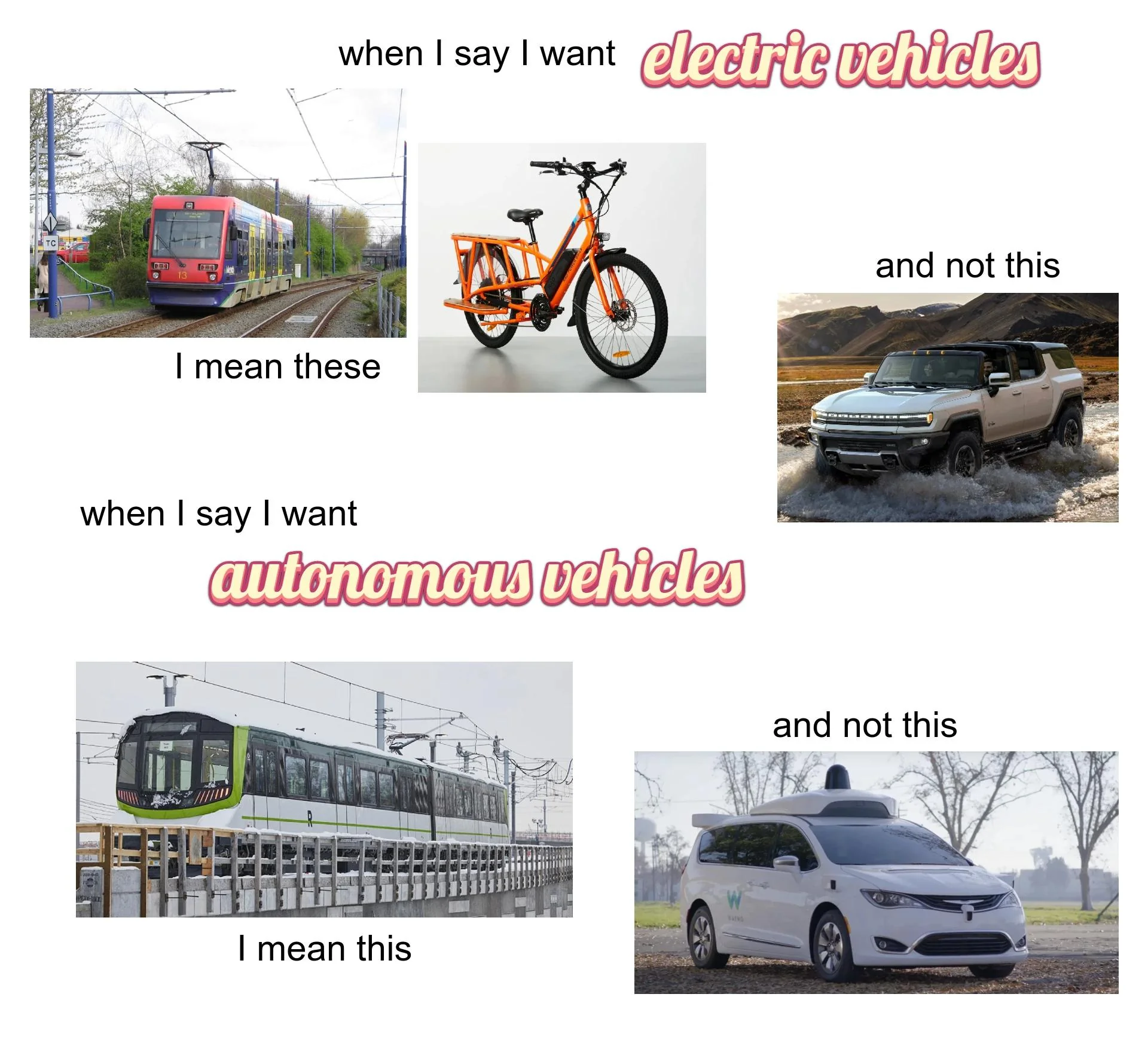
    All we honestly need is a few community shared self driving cars in each neighborhood to fix the last mile issue with mass transit, but the fuck cars absolutists often would rather have trains built to every houses doorstep than admit cars could still hold a purpose.

  • source
  • parent
  • hideshow 2 child comments
  • [–] -1 points 3 years ago (1 child)

    Young people often have the tendency to be both ageist and ableist at times.

  • source
  • parent
  • hideshow 2 child comments
  • [–] -2 points 3 years ago (1 child)

    Hi, I'm disabled and I can't drive. Stop fucking calling the transit and walkability movement ableist. The transit and walkability movement has been life-saving to people like me.

  • source
  • parent
  • hideshow 2 child comments
  • [–] -1 points 3 years ago (1 child)

    I understand and I’m glad you’ve benefitted from it, but you’re ignoring the large number of people with disabilities that cannot walk any significant distance, while they can still drive. Old people also have an easier time driving than they do walking long distances and using public transit. Hell, I personally know plenty of people who choose to drive because they can’t walk for long without someone actively assisting them, even though they can still drive. My sibling, in fact, is one of them; the ‘transit and walkability’ movement doesn’t give two shits about them, however.

    I’m not against more public transport and foot access; in fact, as an able-bodied young male who doesn’t want unnecessary debt or to be stuck in traffic, I’d prefer it. However, let’s not pretend that a lot of people haven’t been completely forgotten by the ‘lul fuck cars’ crowd.

  • source
  • parent
  • hideshow 2 child comments
  • [–] -5 points 3 years ago (1 child)

    Dutch style microcars are a greener and safer solution to physical disability and aging than full size full speed cars. Especially when you're talking about elderly people with deteriorating eyesight and slower reactions. Car dependency helps a precious few disabled people while leaving the rest of us up shit creek and contributing to the extinction of the human species. The transit and walkability movement has a solution for everyone.

  • source
  • parent
  • hideshow 2 child comments
  • [–] 0 points 3 years ago (1 child)

    Yeah, cuz people don’t need to shop. Also, I’m sorry if people like my sibling fall into a ‘precious few’ but you’re gonna need to get everyone on board if you’re selling accessibility.

    The transit and walkability movement has a solution for everyone.

    Clearly.

  • source
  • parent
  • hideshow 2 child comments
  • [–] -1 points 3 years ago (1 child)

    I don't know who told you that you couldn't, but you can park a microcar at a shop.

  • source
  • parent
  • hideshow 2 child comments
  • [–] 0 points 3 years ago (1 child)

    People need space to put stuff, and there’s only so much that can be put into a dinky-ass microcar’s boot. Not to mention, people travel in groups too.

  • source
  • parent
  • hideshow 2 child comments
  • [–] -2 points 3 years ago (1 child)

    I'm guessing it's about the same amount of space as in the rear basket of a bicycle? Because that's plenty of space if the shops are accessible to visit on a daily basis, which is the case in walkable neighbourhoods.

  • source
  • parent
  • hideshow 2 child comments