1


Here's something I haven't done yet surprisingly enough. This is the word for the Commonthroat language in Commonthroat itself.

It's romanized rJhqjHcMr which is pronounced /chuff, late falling strengthening growl; huff, early falling strengthening growl; short low strong whine; long low strong grunt, chuff/

It's a compound word that consists of the roots rJhg meaning throat or language and qjHc, which is the adjective universal or standard. gjHc in turn consists of the adjective qjH whole and the suffix -c meaning related to or associated with (compare English -y or -ish). Etymologically it means pertaining to the whole. -Mr is the 3rd person proximal noun suffix, roughly meaning this or this thing here. The dictionary form of a word is usually the indefinite 3rd person form ending in -g, but Commonthroat is a proper noun, so it can't really be indefinite.

Commonthroat is read right to left. The blue glyphs are vowels and the red diacritics (and the red glyph at the end) are consonants. If a consonant begins a syllable it's written as a diacritic. If it ends a syllable it uses a full letter.

2


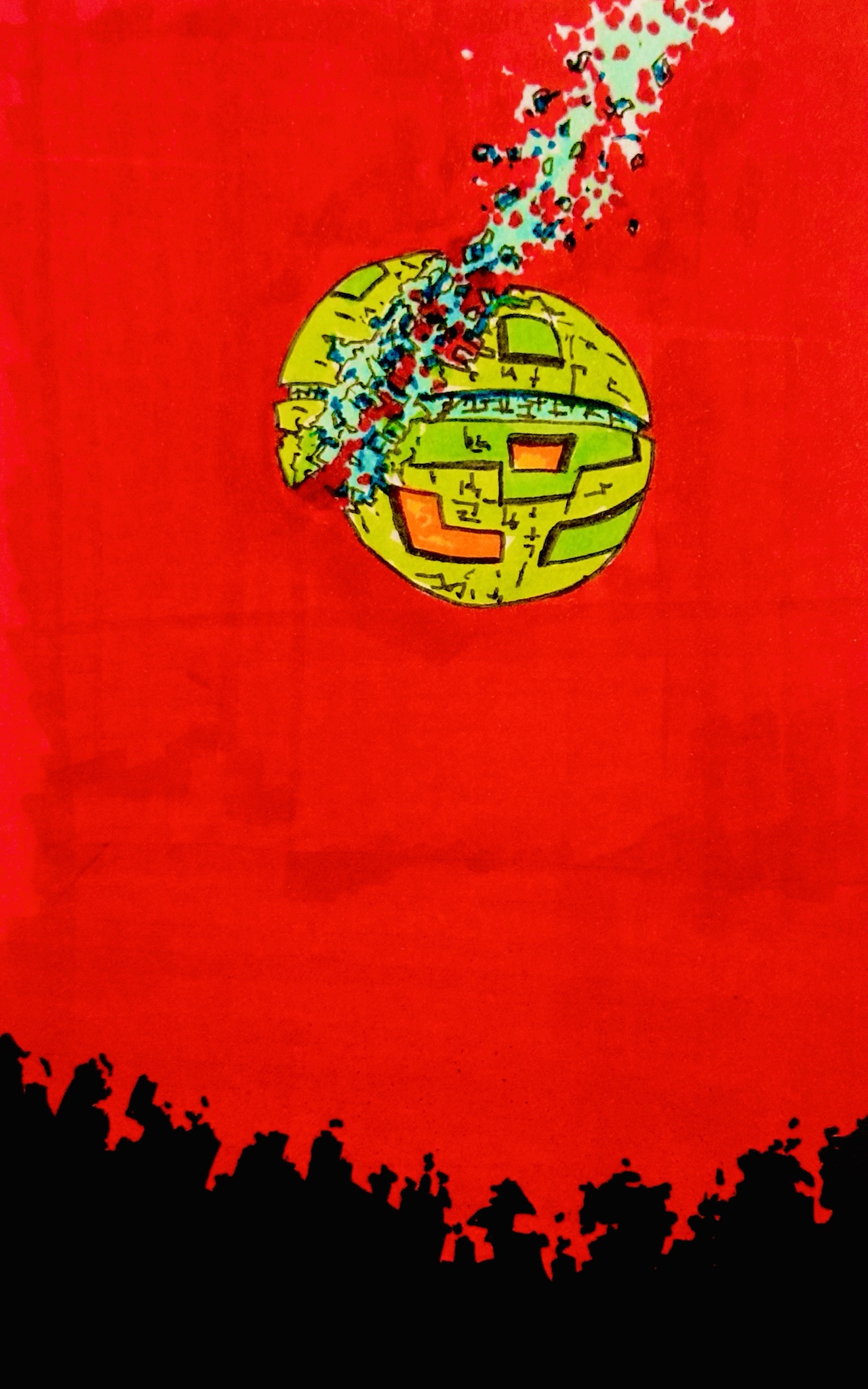
The planet Neu Valais was a command hub for the human colonial militia during the war. As human territories were lost to the Cyborg Collective, FTL travel paths to the planet opened up and a CYCOL nodesphere, a massive command ship took a position over the planet. In a desperate attempt to destroy it, and experimental one shot cannon on the ground fired. It hit and damaged but did not destroy the nodesphere.

The fight in orbit and on the ground was brutal, with CYCOL attacks creating holes in air defenses to land ground troops to further destroy the air defenses and command centers.

Corporate military forces which had been assigned to protect corporate material on loan to the colonial forces and to protect VIPs were ordered to pull out. The corporations saw the fight as a loss.

The corporate forces eventually pulled completely off the surface and CYCOL focused on assaulting the deeply entrenched colonial military command centers.

But that all happened back in '73 and the war ended not soon after that.

Everyone knows the ending of the war, so I won't retell it. The surface of Neu Valais an urban wasteland, the nodesphere above it derelict. Some crazies out there looking for scraps. Even some CYCOL out there that were never quite right after they lost the nodesphere.

Nowadays, VB-Sierra is the planet that's the big last hub for humans heading out past the stable areas. The corporations even made nice with the Arweli, which rubs some people the wrong way given how the war went, but I guess it's easier to forgive frogs than tin heads.

But profit potential is enough to keep the peace, more or less. VB-Sierra's infrastructure is growing every year. Which is amazing for a planet with mutomorph infestation.

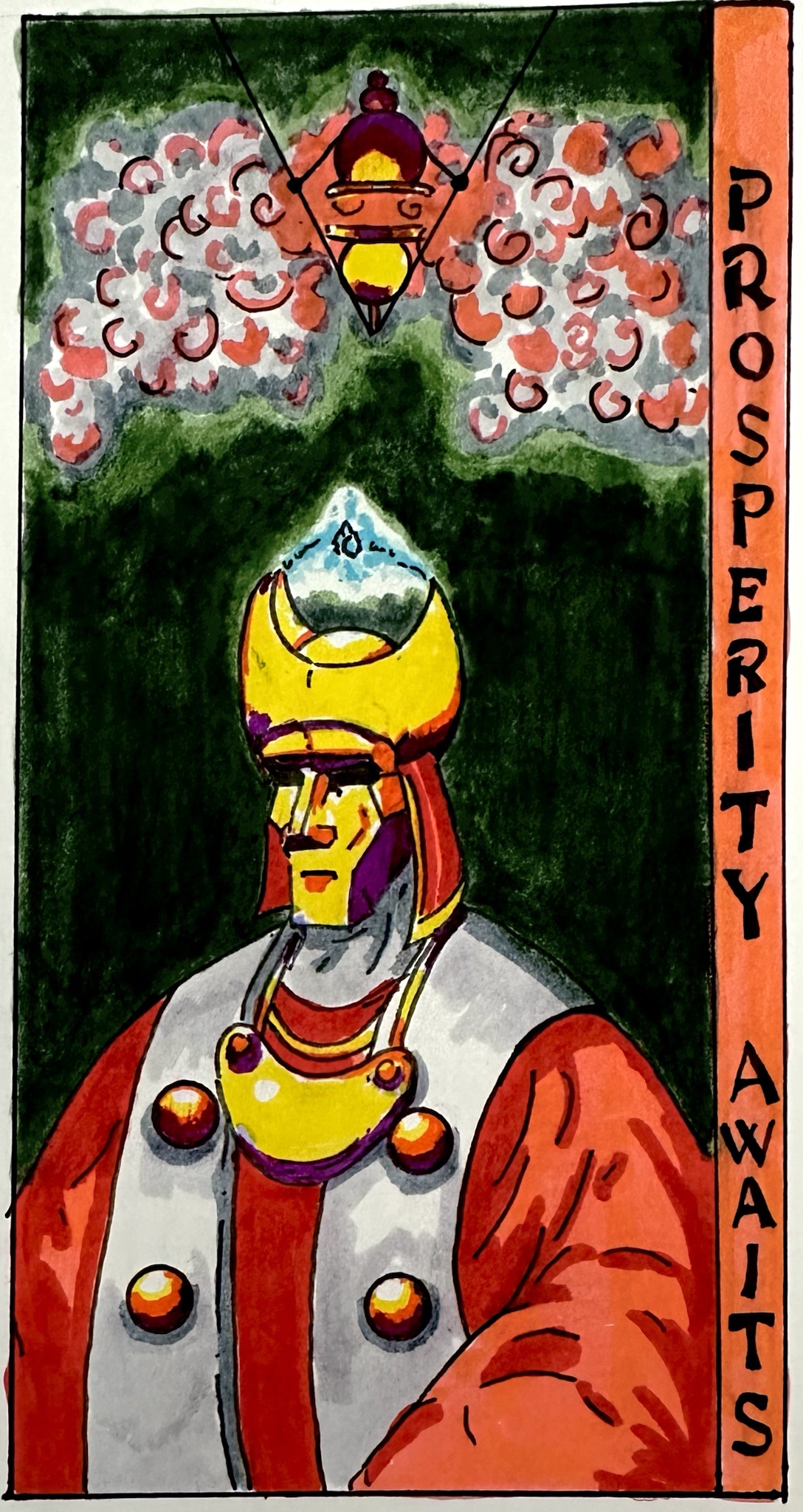
When the Universal Corporate Council reorganized in '75, the Prosperity Church gained a primary seat as a recognized corporate power.

By then, there was a lot of religion going around.

But '75 into '76 was a lot of rumbling in the corporate controlled spaces. The colonies had collapsed during the war, leading to their populations flooding into corporate space. Many of them had been put to work, but it was clearly an unsustainable situation. Some groups of displaced colonists had gone on a one way trip to earth, but the results of those trips was yet unknown. Many other colonists, especially military veterans or those with special expertise looked to go back out into the old warzone, what was now thought of as a frontier to make profits in salvaging valuables or surveying for the rebuilding of colonies.

What is out in the frontier are a great deal of unknown unknowns. Teams that head out into the frontier are not just seeing what has become of human colonies, but venturing into what used to be Arweli or CYCOL territory and seeing things never before seen by humans.

The Universal Corporate Council, UCC, was a collective entity representing the interests of the major corporations. Before the war it was powerful but balanced by the combined powers of the colonies. After the war, it is the only central human political entity remaining. At least aside from possibly earth, but no one really knows what it is like anymore.

The UCC wants to expand its tendrils into the frontier by directly controlling the new colonies that will be rebuilt. Of course now that there is little external opposition, the infighting among UCC members and executives is in full swing.

3


This might be an interesting read for those considering an apocalyptic world and is a revised memory log of a discussion on an discord channel, content is 60% by me, 30% by Chili the Sheep and 10% other people.


What is the minimum requirement to put a civilization like ours back into stone age?

To fully analyze the minimum requirements to push a civilization like our current one back into the stone age, it is helpful to first consider what scenarios would likely not achieve that outcome. Scientific analysis indicates that the following events, though catastrophic, would likely still leave remnants of our modern knowledge and technologies intact.

A limited nuclear war, even with 1000 to 2000 nuclear bombs detonating and killing approximately 10% of the human population while destroying major cities, would probably not be sufficient. Isolated small towns with populations of around 10,000 people would likely still retain early 20th century technology. They possess libraries, manufacturing tools, metalworkers, mechanics and teachers.

Asteroids impacting the Earth below the level needed to devastate the entire planet, the Yellowstone supervolcano erupting, and other potential natural catastrophes would also fail to reduce human civilization to stone age levels. While the local effects would be disastrous, an estimated 90% of the world's population and infrastructure would likely remain mostly untouched.

Region-wide famines, though kill many people until food supplies become less scarce, generally do not cause the loss of an entire civilization. With appropriate measures, modern civilization could likely recover within one to five years. Even if famines killed 90% of the population, there would still exist millions of educated people such as mechanics, teachers, etc who could help rebuild.

My personal estimate indicates that to completely reset human civilization to stone age conditions would require the death of at least 99.9% of the human population, the total elimination of all evidence of our past knowledge, and ensuring that nobody reinvents basic technologies for at least 4 generations. Such an extremely brutal break in civilization approaching 100% mortality would be a miracle if any humans survived at all. I call this the "99.9% dilemma": if an event can kill 99.9% of humans, it could feasibly kill 100%. In that case, we would all be dead and no stone age would exist.

So there isn’t a way to reset our civilization back to stone age?

Yes, there are combinations of events which could theoretically remove knowledge from past ages and push human civilization back into the stone or early bronze age.

A catastrophic event followed by a primitivistic-luddite religion could achieve this. For example, if a global nuclear war occurred where only 20% of humanity survived, and afterward a primitivistic-luddite religion spread around the world eliminating traces of past knowledge. If integrated deeply into society, that luddite religion could simply suppress the delivery of past achievements.

However, even then it would be extremely implausible. If even a single small nation or mediocre-sized city somewhere survived with knowledge of the old civilization, they would quickly surpass the luddite nations. Remnants of modern technology would dominate a world of "cavemen" with ease, likely without needing nuclear weapons. A few assault rifles and aerial reconnaissance would be enough. The European conquest of the Americas would pale in comparison

In conclusion, the requirements for a "decline to stone age" are very stringent. You would need an extreme event leaving no town of 10,000 people alive. But it cannot be so extreme that it kills 100% of humans instead of 99.9%. This scenario walks a razor's edge.

A decline to more modern civilizations though is easier, but still difficult. Even if only a small African village survived, they likely possess the knowledge to restart an early industrial civilization with farming, mining, and manufacturing on medieval levels if they utilize their entire labor force. A larger community, for example New Zealand or Island, could theoretically even sustain an mid-to-late 20th century civilization without help.

Given division of labor and education, humans are remarkably adaptable.

The most common counter-argument is that humans are "too stupid" to survive without modern civilization. However, most humans are not stupid. We are remarkably adaptable. If after an apocalypse power is down and farming machines do not work, most people are not "too stupid" to plant or pick potatoes under supervision of an experienced farmer. After harvest, engineers among them could build a wood-fueled generator and fix farming engines so next year labor is not by hand. Humans would improve rapidly where it matters and progress faster than before.

The only thing which could slow rebuilding civilization is not utilizing every able worker. For example, what still holds back Arab civilization? Not fully using females in the workforce. Maximum resource utilization, though sounding cold, provides huge gains. In a typical civilization without females working, income per worker may equalize a fully integrated workforce. However, only half of possible workers labor. And expenses depend on total citizens, not workforce.

A nation of 1 million people not utilizing women (or men) might produce 33 million wealth units per year, while a nation utilizing all workers might produce 65 million. Sounds twice as rich? No, it is much worse. Expenses remain around 25 million wealth units. The patriarchal nation retains 8 million wealth units, while the equal nation retains 57 million. The equal nation is seven times more productive. Oh, I just solved the third world problem.

4


I feel like maybe these people are lacking in cultural and interpersonal depth. I set out to play with certain tropes in ways that amuse me (and I know I got that right), but as a culture they seem rather plain.

5


Have you given thought to how international law might shape your world? Even having notes on which nations subscribe to a body of international law standards can be a fun way to add depth to the political landscape.

Legal systems can be interesting (no really!) Americans and Britons are used to a common law, where legal precedents form the basis for future rulings, but there are other forms as well - the Roman system of civil law, and the Muslim system of Sharia law also exist.

In my setting, a fallen empire's legal system formed the basis for a loose international treaty for the kingdoms that arose in its place - thus, the Pandect, a series of codes and standards to which today's kingdoms and republics all either flout, follow, or attempt to follow in various ways.

https://kanka.io/en/campaign/7004/notes/4851

Have you ever tried making your own legal code? You are hereby sentenced to share.

6


I'm a bit of a Michael Kirkbride fan, and a bit of a Tolkien fan (same as everyone). MK's work on the Elder Scrolls series sets the bar for how original, offbeat, and deep I want my work to be. I want to be able to say I wrote a world from the ground up and filled it with dynamism, surprise, mystery, and drama. Unlike Tolkien, I'll never be one for conlangs. I wouldn't know where to start, but more importantly I wouldn't know why to start. Tolkien came to storytelling via conlangs, and that's just not me, so I tend to imitate MK instead.

You're writing a world. Did you set out with a scope in mind? What sparked the desire? Are you, like me, writing lore instead of constructing an actual narrative because it's just more fun (at least for now)? Who/what do you admire for worldbuilding?

7


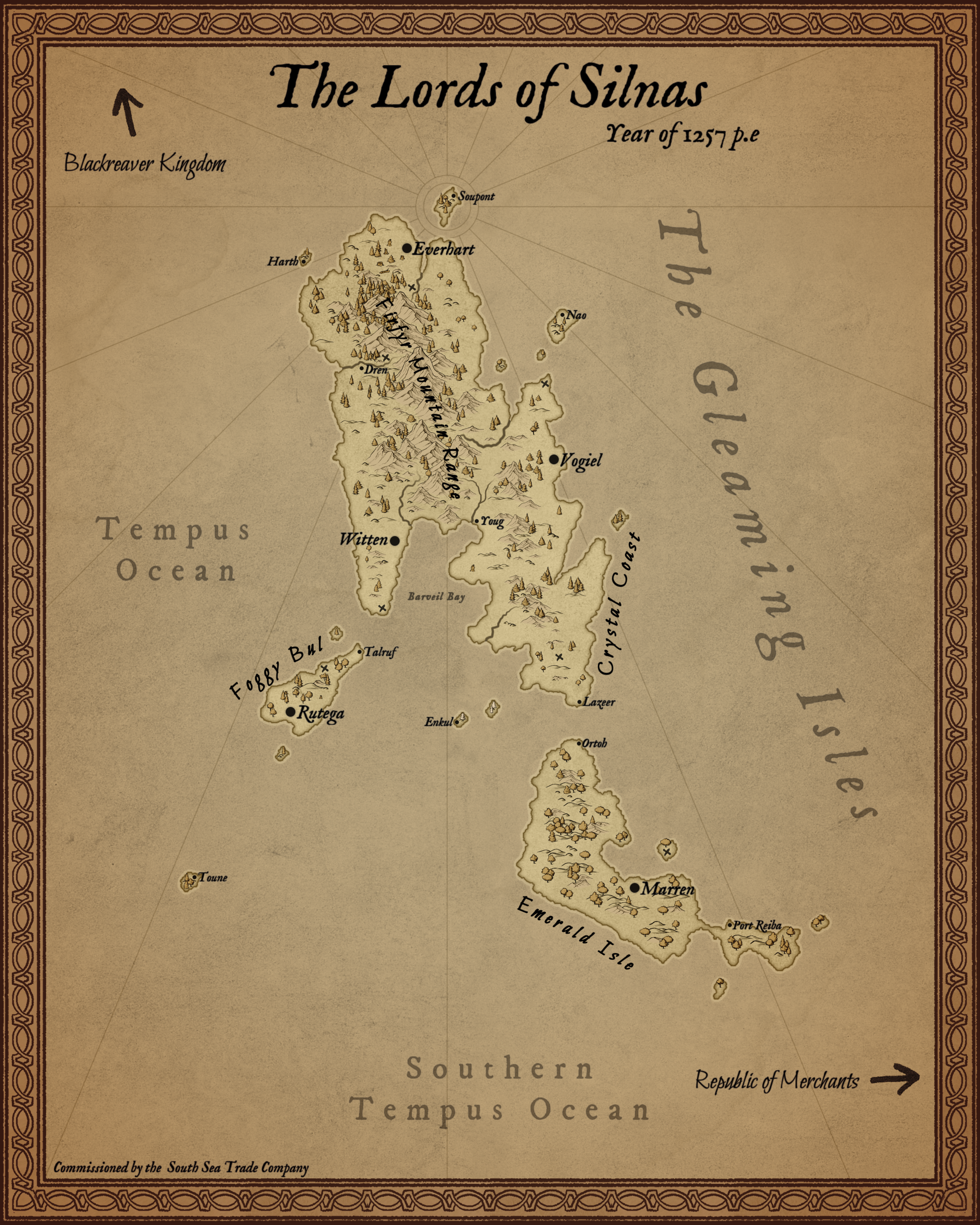
The Lords of Silnas, also known as the Gleaming Isles, are an island chain out in the Tempus Ocean to the west of the Aquarius Continent. These isles contain the largest natural supply of Gleamstones on Arius. These magic prone gems are used to create magical catalysts which can be used to enhance magical and physical abilities and as such have created a wide range of demand globally for their constant supply. The 5 Lordships of these Isles are backed by larger countries and their governments to allow for the largest supplies possible and many wars have been and will continue to be fought over the isles.

The Everhart Lordship has been backed by the Blackreaver Kingdom since the claim was established in the early 600's P.E. They dawn their fabulous Blue and Steel garments resembling that of another noteworthy country to the furthest Northern parts of the world. They control the entire Northern part of isle where their territory is split in half with Firfyr Mountains making it appear much like a crooked horseshoe. Their wealth is only guaranteed so long as Blackreaver receives its regular shipments lest they force the hands of the territory with trade and military action.

The Vogiel Family is backed by by the Imperium of Rekkaku. Notably the family was installed through revolution at the height of the Sunless Sea War which had briefly reached the isles between the Republic of Merchants and Al'Modian Empire. A small gambit had a big payoff as the family managed to secure power over the south-eastern territory of the isle. The shift in power caused Blackreaver to further arm their respective side which has left a sour taste in both sides mouth.

The Witten Lordship is backed by the Al'Modian Empire. The Empire managed to buy their way into the isles not long after Blackreaver aided in establishing the claim which divided the isles into North and South. When civil unrest broke out in the southern stretch of the main island the territory once controlled by Al'Mod was shattered and it left much of the land up for claim. Witten would remain backed by Al'Mod til the end of the war and managed to succeed in keeping control of their territory. Though the war was over, it would not last as further tensions between the Lordships would force internal conflicts.

The Marren State is an independent island controlled and backed by the Republic of Merchants. The island itself gaining the name Emerald Isle is notable because of its green-tinted Gleamstones that are said to offer a more potent effect than that of the ones found on the main island. The Marren State is probably the one that has shifted the most over the years with it originally being Blackreaver before being sold to an Al'Modian Prince before then being sold to the Empire directly then eventually joining the Republic of Merchants during the Sunless Sea War. Its history is mired in war and economics that its alignment with the Republic of Merchants makes the most sense.

The House of Rutega is the only independent and neutral faction within the isles, they were able to break free from the shackles of Blackreaver's control on the isles after a short-lived revolution proved to be costly for Blackreaver. In just 8 weeks Blackreaver managed to lose 20,000 soldiers at sea after it was deemed far too difficult to take the island under the conditions that they accidentally created with the large amount of wealth on the island alone as well as unfavorable weather conditions which resulted in many ships crashing on the rocky coasts. A deal would be worked out between them that trade with the Lordship would continue as the Golden Gleamstones were seen as the most valuable among those found on the isles.

To this day, these territories continue their conflicts with one another in the hopes of one day conquering the wealth and power contained in the politics of this island nation yet history has proven no victors last forever.

8


So this topic seems to be on the brain lately, actually been meaning to do a prompt like this for a while because I’m very much a stupid name enjoyer, but this seems like the right time. What are some organization names, or names in general, in your world that your characters think is stupid? Do people still actually use the name or do they have an informal substitute?

9


Worldbuilding is hard when it feels like you're trying to turn yourself inside out and create a whole world from what you know. Just to get me out of my own head I like to use Wikipedia's random page function, and see if I can write my own version of what turns up. Today I got:

https://en.wikipedia.org/wiki/Ahnapee_Brewery

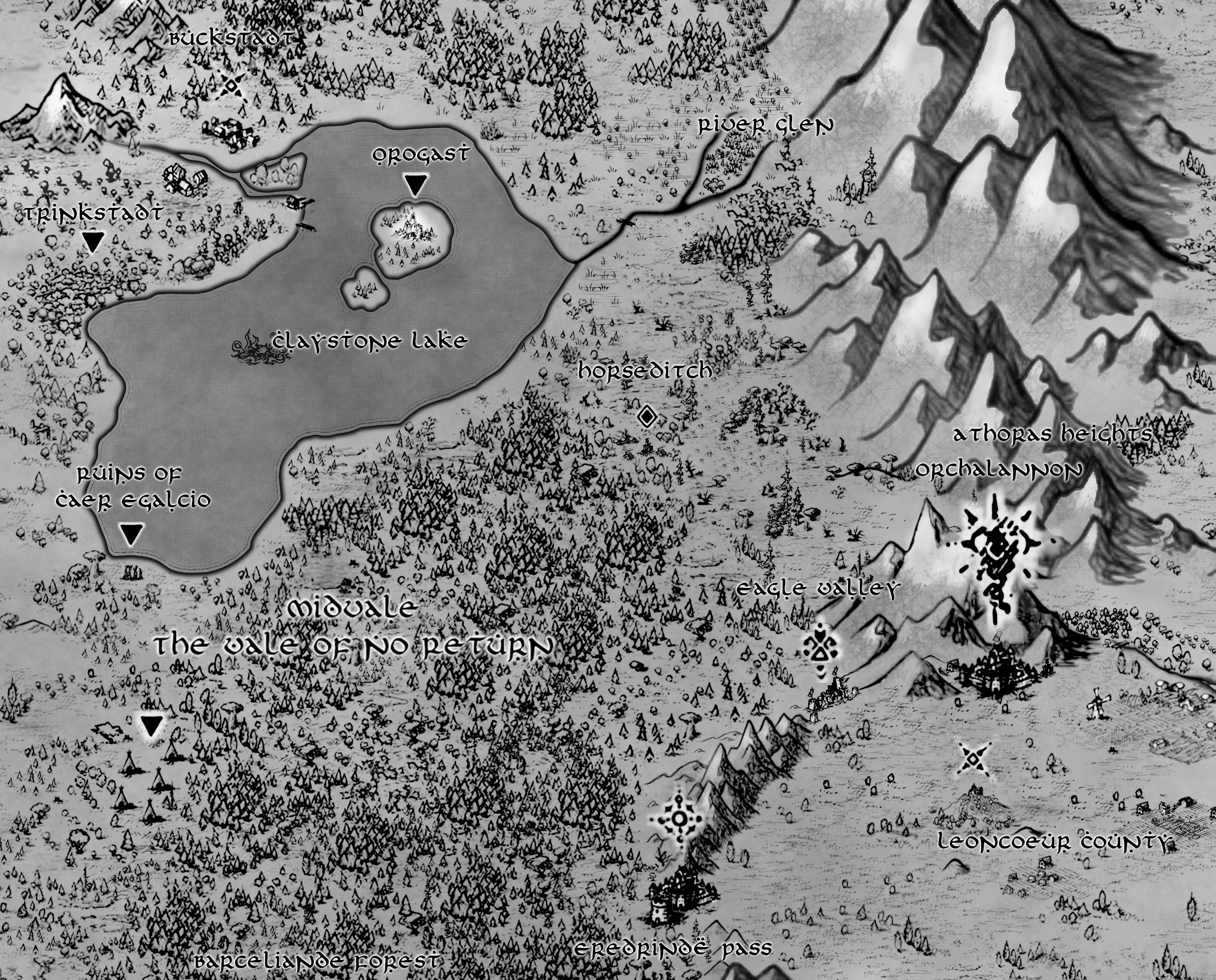
It's a brewhouse that spent some time as a net factory during prohibition. That makes me think about how laws affect businesses and real estate. For instance, in Orchalannon there is a law against the use of magic which has existed for several hundred years in order to suppress certain state secrets. Maybe there is a building that used to be a magical institution, which has now been repurposed...

Bartolo Mews

Once a country club for gentleman sorcerers, Bartolo was a genteel resort for a particular sort of leisurely scholarship. Though no formal schooling took place, it hosted the leading exponents of magical thought in the country during a time of expansion and wealth. It was unseemly to appear to seek riches or political power overtly, so these distinguished men and women affected the practice of magic as a hobby, though they did so at a professional level. The cellar was filled with unmarked potions, the stableyard hosted a rotating menagerie of wild chimerae, and the parlours were abuzz with smoke, brandy, and vituperous yet exacting theoretical debates.

When the Department of Occult Licensure came into effect following the Squash Plague of RP 124, Bartolo was decommissioned after so many of its patrons declined to seek licensure. Maerlyn D'Ambrosio knew that merely requiring an official application from such august personages would be too much for their dignity to bear, and the open study of magic largely went out of fashion in the years that followed.

The stables remained however, as some of the phasic abominations that lived there had certain abilities that made it impractical to force eviction; the stables would occasionally blink in and out of existence. Twice the landlord felt sure that the stables were gone for good after months and years of their absence, but both times proved catastrophic, resulting in the loss of a brewery and a net factory. Nowadays the stables are used as a sort of absentee oubliette, a long-term storage unit that is infrequently accessible. In vaults that were installed there during a 'blink-in', the crown has stored some of its gold reserves. Whenever Bartolo Mews is blinked in, it is guarded. When it is blinked out, long expiry treasury bills are sold against the value of the bullion within.

10


Kind of a weird question I know, but let me explain. I'm not talking about your themes or messages, but the general feeling someone looking into your world or imagining themselves in it might get about the situation, when the world is not in conflict. Basically, you know how when you watch a franchise like Star Trek, it has certain recurrent moods and feelings, like the tranquility of flying through space, the bittersweet isolation of being on a ship in deep space, where you are close to your crewmates but far from everything else you know, and the general professional but still sufficiently jovial atmosphere that they seem to go for? Or with Pokemon when it's very adventure driven and based around meeting everyone you come across and making friends both with other humans and also with these magical creatures! I'm sure you can think of descriptions like these for your favourite franchises. We've all imagined ourselves in these worlds or imagined ourselves as characters in these worlds right? What were some of the vibes or feelings you imagined when you imagined your world? Or I guess another way of putting it is what would a slice of life exploration of your world be like?

11


This is a world I have created for roleplaying and storywriting. The formal description is still a work in progress. I would love some feedback on this long writeup!

Millions of years after humanity disappeared from Earth, animals have evolved to take their place. Technology is rediscovered from the ruins of the former human civilization, societies form and fall. There is chaos at first as different species fight for the dominance over the natural world that humans once enjoyed, but also because it was in the law of nature. The closest to achieve this was not a single species however, but the Unified Territories, an alliance of many member species from across the food web. Charters were established to abandon the barbaric rules of nature, allowing once natural enemies to live in peace.

Basic Information

The Unified Territories covers just under half of the Earth's land area, and controls at least one major splotch of land on every continent, and in every major biome. As the name suggests, it consists of land jointly owned by seven member taxonomic groups, which are in the order of joining, the vulpines (foxes), avians, rodents, dogs, mustelids (weasels, badgers, etc), leporids (rabbits). Feline territory is next door and is allied with the UT, but not formally apart of it.

Each taxonomic group has its own government, but must abide by two main treaties: the Interspecies Peace Agreement (ISPA), whose most famous term is the agreement to not eat or kill any other animal, UT citizens or otherwise, intelligent or otherwise; and the Unified Territories Charter (UTC), which is the actual treaty that signifies membership in the Unified Territories. Non-UT territories must sign the ISPA to engage in trade and formal relations with the Unified Territories, and the terms of the UTC require that joining territories sign and fully implement the ISPA before a request to join the UT is even considered.

Historical & Ideological Context

As animal societies evolved, different intelligent species began dividing up land area, forming boundaries and pushing out animals that were not allied with them. This resulted in areas ruled by animals belonging only one or two taxonomic groups. Alliances and rivalries quickly formed, followed by conflict, invasion, betrayal, annexation, and all the other trappings of emerging societies, rinsed and repeated for many a generation. All the while, technology and science is both being independently developed by the animals and unearthed from the ruins that the humans left behind.

This cascade of events arguably started when some groups of predator animals started to make alliances with what would have been their natural prey for their mutual benefit, which was often cooperation in battle, exchange of technology, or even trading of resources. While massively unpopular at first among both predators and prey, with time, the benefits of cooperation in a world with rapidly advancing technology would become more and more apparent, leading to wider acceptance of the practice. These alliances almost always included the stipulation that the predator animal would at least not eat the members the territory that allied with them, but sometimes the stipulation would extend to entire species or groups of species. In extraordionarily rare circumstances, predator animals would even agree to abandon eating animals altogether, in what can be thought of as a precursor to the Interspecies Peace Agreement. In these types of societies, predator animals gradually grew more accustomed to eating less meat, or even eating no meat at all, and began to see what once were prey species as allies that benefited them in ways other than being prey, maybe even collegues or friends. Some of these alliances became so strong that eventually borders between territories blurred and dissolved, and other species joined in the alliance, meaning even less animals that the predators were allowed to eat, but this supposed drawback faded in importance as the broader quality of life improved through the cooperative advancement of technology.

However, relationships between predators and prey at this point were such that if your species were in a formal alliance, they can't eat you. If you weren't, it was fair game. The threat of eating a prey species was often used as leverage by predators, basically comply with our demands or we'll start hunting you again.

This hypocracy was pointed out by scholars and philosophers on both the predator and prey sides, but for a long time not much changed because of the mostly monarchist empires that dotted the world that left no room for questioning the king's decisions. And even if there were, technology that can allow predator animals to subsist entirely on plant-based food simply did not exist yet. Some predator animals tried to get around the moral issues by eating only prey that have died of an unrelated cause, and this was quite controversial among prey species, with some figuring that it was better than living members of their species getting eaten, but others objected to the idea of the tomb of their beloved relatives being the belly of a predator (not the best material to make a casket with if you want to memorialize and preserve the departed). Nevertheless, access to freshly dead prey was mixed at best, and even if you swallowed the prey moments after they drew their last breath, the risk of food-borne infection was still much higher than live prey because most un-eaten prey animals died of disease, and this was still a pre-antibiotic era.

This is also when many species and taxonomic groups became one government, as it was advantageous to have a united, consistent front when negotiating or generally interacting with other species. Say you're a mouse. You see a cat, you know what to expect because who they can and can't hunt is strictly enforced by their empire, so if the empire promises they won't eat you then you can be reasonably sure every cat won't eat you. This makes you more likely to engage in trade with cats and generally benefit both parties. This idea of species and taxonomic governments survive to their modern age, but now serve the purpose of better representing common interests, needs, and opinions of similar animals, though even this is challenged and many believe that it's better in the long term to change to a single government for all Unitist animals, and abandon drawn borders and territories as well. Debates about this in modern times is as spicy as back then when they were discussing the idea of "If you ally with us we won't eat you," with most believing that while a full dissolution of territories and separate taxonomic governments is inevitable as animals commingle more and more, but their society of predator and prey is simply not mature enough for this to happen tomorrow.

Meanwhile, technology for processing plant matter to be more compatible with carnivores, as well as attempts to synthesize nutrients only found in meat were happening at a breakneck pace. Starting with various methods of cooking and fermentation, but slowly progressing to proper bio- and organic chemistry as the field became ever more advanced. At a certain inflection point, when technology for this had advanced far enough to completely replace animal meat for some predator species (omnivores first, the tech to convert an obligate carnivore to plant based food came much later), a new ideology began to crop up: Unitism, based on the word unity, specifically the motto "Unity Among Animals." The idea was that if your species was able to subsist entirely on plants, the eating your fellow animals was obsolete. That if, instead of worrying oneself with hunting or avoiding being hunted, if we all just came together and pooled our resources and knowledge, everyone taking care of everyone else and operating as a collective where things were jointly owned and animals' needs were provided for, we can all but eliminate suffering and make life better for every animal: big or small, predator or prey, furred, scaled, or feathered. The flagship treaty developed under this new ideology is called the Interspecies Peace Agreement, which, among many other protections and rights granted, forbids any animal, species, taxon, or other entity signatory to it from eating prey, with no distinction between if you have an alliance with them or not, and the treaty explicitly states that you cannot rescind it once signed. This is the founding document for two of the three major world powers in the modern day.

This is contrasted with Trophism, which says to eat prey and take care of no one but yourself. Based on the word... trophism, which is a biology word that refers to the process of organisms deriving energy and nutrients. The super technical way of saying eating food basically.

History of the Unified Territories

Arguably the first organized movement to abandon the food chain was jumpstarted by a red fox by the name of Akko. He lived in a territory with multiple predator-prey alliances, and one of the more powerful territories at the time. In his young adult life, he studied politics in hopes of becoming a general for the territory leader, but in doing so, he began to see the political dynamic as one that was, quote, "built on hypocrisy, unfair distribution of power, and injustice". He took exception to the notion of predator-prey alliances often being decided by heriditary territory leaders, sometimes "based on nothing but their personal preference". He thought it hypocritical for predator animals to decide who to eat and not eat based purely on their territory's political alignment, where were often unstable, and despised the fact that not preying upon a particular group was being used as a political bargaining tool. Furthermore, Akko saw a major problem in the ways that societies where very different animals coexist are set up. Smaller animals would often have an easier time affording living expenses, simply because the prices of food and other resources were consistent for everyone, but physically smaller animals required less resources. In response, tensions would still be present between even allied species, and descrimination would result. He also noted the inequalities stemming from class and lineage. In his many writings, speeches, and public demostrations, he advocated for a society where all intelligent animals had the same opportunities, and could live without fear that shifting politics would suddenly cause them to fall prey to their former allies. Akko referred his idea of animals living in harmony as "unity", and reasoned that the only way to achieve this would be to unite all territories, pooling their resources and providing to individual animals not equally in amount, but equally in the sense of satisfying their needs and giving them the same opportunity to thrive. He also believed that animals should not only refrain from killing or eating allied animals, but all animals, as the endgame of his ideology is to create a world where every animal lives in unity with one another.

The Unity Revolution was the period of time between the rise in popularity of the ideas presented by Akko and the formation of the Unified Territories. It consisted of many species and territory specific revolutions of varying degrees of peacefulness. Of note is the fact that the felines played an especially antagonistic role in many of the revolutions as they resisted the movement. The times where it seemed that the Unity Revolution would fail were almost all caused or contributed to by the felines, so needless to say, it would have come as a great surprise to anyone living at the time if they learned that the felines are now also Unitist and allied with the UT. Despite pushback from multiple fronts, the Unity Revolution eventually succeeded, forming the Unified Territories first between the vulpines, avians and rodents, and eventually more taxonomic groups, comprising just over a majority of the worlds's intelligent animal population.

Political Structure

As mentioned, each taxonomic group has its own separate government, which has the authority to make some taxonomy specific civil laws and regulations and provide taxonomy specific services with the most important one being healthcare. There are also regional governments for each geographic location that work with the taxonomic governments. However, most of the power is held by the UT central government that is comprised of all the taxonomic and regional governments collaborating with each other. The UT government, among other roles, owns all the land, controls most of the resources, and handles all taxonomy agnostic legislation, including criminal law and foreign policy. It also has the authority to overrule any taxonomic or regional government. Any citizens of species not apart of the seven taxonomies has no taxonomic government and only falls under the authority of the UT government and their regional government, but due to the UT's heavy emphasis on equality, their lives are not much different than those who also have a taxonomic government. The purpose for the taxonomic governments are to efficiently address the needs of individual species, which can vary greatly due to their physiological differences. With the amount of diversity in the UT, it would simply be too much for a monolithic government to manage effectively. However, most of this occurs in the background, and most services are provided simply under the name of the Unified Territories itself.

The UT government's main branch consists of the Unity Council, which consists of seats allocated both for each taxonomic group and by region, as well as representatives of non-native citizens. By design, every citizen receives equal representation through voting for council members as well as frequent referendoms and opinion polls.

Various ministries, such as the Ministry of Security, the Ministry of Resources and the Ministry of Housing exist as part of the UT government, and are the entities that allow UT society to function.

Society

UT citizens have public ownership of everything in their lives as it is all government run, and there are no private companies. Again, this is in order to ensure equality between animals and to place the citizens first. Essential aspects of life like food, housing and healthcare are rationed to each animal based on their needs both as a memebr of a species and as an individual, while credits are given in exchange for working in a job, which can be exchanged for luxury or otherwise non-essential items. Healthcare is always free, as is education as long as the animal meets the admission requirements. This also means that animals can study to work in a field that they have a genuine interest for instead of simply working to cover their living expenses. Science and technology are very popular fields for this reason, allowing for rapid technological advancement.

The Unified Territories recently reached a milestone where they, by some metrics, surpassed the technological prowess of humanity during their golden age, but one wouldn't be able to tell by looking at the surface of their society. There is a great emphasis on not making cities look too artificial, instead relying heavily on natural elements and the landscape itself, and even Central Valley, the capital city, looks more like a forest with technology and infrastructure peppered about as opposed to a human metropolis.

12


When you think about scenes playing out in your world, what is the visual medium? Is it the same as the real world? Is it some form of cartoon or anime? 3D renders like a Pixar movie? Something else?

13


I recently fleshed out some details on dragons as they exist in my world. I jotted down some ways in which they differ from typical fantasy dragons - and then was immediately confronted with the realization that, well, "typical" fantasy dragons don't really exist, do they?

You have the classic, four or two legged, winged reptiles that breathe fire. Even those can differ in many ways - the ones of Tolkien's legendarium were very highly intelligent, while those in ASoIaF are rather smart beasts, but beasts nonetheless.

Another often-seen type of dragon, the so called "eastern" dragon that can fly without wings, also almost never breathes fire. We can narrow down their similarities to the aforementioned type by the fact that both are reptilian, and both can fly - but then you have various mythological wyrms and drakes, which are very often considered dragons (such as Fáfnir or the Colchian Dragon) while not being described as able to fly at all.

This leaves us with the vague commonality of a large reptilian creature. I assume this makes sense, as the actual animal often brought up as a real-life dragon is, in essence, simply a very big lizard.

Of course, you have outlying cases like the Wheel of Time series, where Dragon refers to a specific human being. He isn't a large reptile, and at least as far as I have gotten in the series, he can neither fly nor breathe fire. Nor does he hoard gold.

To arrive at the point, then I'd like to posit a question - what's the furthest you feel you could stretch the word "dragon" in a fantasy setting? Is it fair to simply place Komodos in your setting and call them dragons? Are more mammalian dragons, like the Neverending Story's Falkor, stretching the line, or could it be stretched to include even more blatantly mammalian creatures? If so, can you have fish dragons? Amphibian dragons? Crustacean dragons? Jellyfish dragons???

Where does "dragon" end?

14
submitted 3 years ago* (last edited 3 years ago) by [M] to c/worldbuilding@lemmy.world


Just wanted to share a thing. Though intended for use with Reign and the ORE, their main value is in generating ideas you might never have come up with on your own. Just roll a few dice and make sense of the results. That's the fun bit - give it a try!

http://www.gregstolze.com/1RollMonsters.pdf

http://www.gregstolze.com/1RollSpells.pdf

15


I imagine we all have at least one original race that we know no sane player would touch, but really wish they would.

Tell me what you love about yours, and why no TPK-fearing player would go near it.

Mine is mothfolk. They're gifted magic users with flight and natural armor, and half of them are badass demon-worshippers who teach magic to skeletons for fun.

No player would ever touch them though, because they're 3.5 feet tall, only live a bit overa decade, can't talk, and have no natural healing capacity.

https://kanka.io/en/campaign/7004/races/56094

16


Cat: So, we're making a setting for a slightly home-brewed Pathfinder 1e campaign. We want guns in the campaign, but the official firearms rules are irksome.

Cat: Anyway, as one of the changes we've made, we've switched propellants to a technically magical explosive called Force Powder. Force powder is smokeless, does not foul the workings of a gun, operates just fine in water, and can only be set off with a sharp percussive force; examples include smashing it against a metal surface with a hammer, or an explosive shockwave.

Cat; Among other things, we've figured that this will probably make rifled firearms a fair bit more popular early on than in real life; one of the big reasons they weren't widely adopted for military use is because all the smoke quickly nullified their range and accuracy advantages. It also means that matchlocks, wheel locks, and flint locks basically don't exist, with only percussive ignition being feasible.

Cat: So, are there any other things we should be aware of?

Lucifer: We're uncertain of the effects on breech-loading firearm adoption. It seems like it should help?

17


Pasted here for the click-averse.

1. What is the physical geography of your world like? Are there mountains, forests, deserts, oceans, or other natural features that are particularly important?
2. What is the climate like in your world? Is it hot or cold, wet or dry? How does this affect the people who live there?
3. What kind of plants and animals are found in your world? Are there any unique creatures or species that stand out?
4. Who are the principal inhabitants of your world, and how do they interact with each other? Do they live in cities or villages, or are they spread across wide open landscapes?
5. How has technology advanced in your world over time? Are there any particular inventions or discoveries that have changed the course of history for its inhabitants?
6. What political systems exist in your world, and how do these systems shape societies and cultures? Are there any major conflicts going on right now or historical events that have left deep scars on society as a whole?
7. How does religion play a role in your world? Do different religions coexist harmoniously, or do they clash and compete for power and influence among the people living there?
8. How does trade work in your fictional world; what kinds of goods are produced and consumed, and how do these items make their way from one place to another?
9. In what ways are social attitudes shaped by culture and traditions within your fictional world? What values do people hold most dear, and how do they treat others who differ from the consensus?
10. Are there any places of historical importance in your world? What events took place there, and what kinds of legacies do these places hold for the people who live there?
11. What are your world’s governing bodies, and what challenges do these responsibilities create for the people working there?
12. What kinds of unique flora and fauna exist in your world? Are there any unusual species of plants or animals that are particularly important?
13. What weapons are used in your world, and how are they acquired by those fighting on the front lines?
14. How does your world influence the way its people think, act, and feel? What problems might arise based on these cultural norms and values?
15. Who are the main allies and enemies within your world, and how have they affected the history of your fictional realm?
16. What kinds of laws exist within your world, and how do these laws shape the behaviors of its residents? What types of punishments are doled out to those who commit crimes, and how effective are they?
17. What kinds of sports are popular in your world, and what roles do they play in its society?
18. Which forms of entertainment are most popular in your world? What kinds of activities do people enjoy for leisure, and what forms of entertainment do they find the most entertaining?
19. What kinds of music are prevalent in your world, and where do people go to listen to it?
20. Which forms of art are most popular in your world? What do people most enjoy looking at or experiencing with art?
21. In what ways do the people of your world express themselves creatively? What kinds of art are most popular, and what differences in style and form exist between various regions and cultures?
22. What kinds of sports and games are popular in your world?
23. What kinds of foods are most popular in your world?
24. What are some of the most popular drugs in your world? What are the effects of these drugs?
25. How are people educated in your world?
26. What kinds of recreational activities do people get involved in?
27. What kinds of laws exist within your world?
28. What kinds of laws, traditions, and customs are repealed or upheld in your world, and how do these laws, traditions, and customs shape the behaviors of your characters?
29. How do your characters cope with losing basic needs or disrupting their daily routines?
30. Which historical figures from your world stand out the most, and why are they significant?
31. How do your characters deal with the inevitability of death? Which rituals and traditions have they developed to comfort themselves in the face of such a blatant reminder of their mortality?
32. What are some of the most common traditions in your world, and why are they so significant to those who practice them?
33. What are some of the most elaborate festivals in your world?
34. What do your characters say when they want to express their gratitude towards someone? What sorts of gifts do they usually give, and what are their symbolic meanings?
35. What historical events do people generally not discuss, and why is it taboo to discuss?
36. Which types of people and institutions in your world are considered the most trustworthy and reliable, and why are they so loyal?
37. Which types of people and institutions in your world are the most corrupt and exposed to greed and avarice?
38. Does your world have any major traditions that hold deep religious significance?
39. Which kinds of people and institutions in your world are considered the most selfless and noble, and why are these people so opposed to greed and avarice?
40. In what ways do your characters fight against corruption and greed?
41. In what ways is your world similar to our own?
42. In what ways is your world different from our own?
43. How does the rule of law and order play a role in your world?
44. How does your world encourage people to live morally?
45. How are young people in your world encouraged to pursue meaningful and fulfilling careers?
46. How do your people celebrate their values and priorities?
47. What do your characters do to stay focused and motivated to achieve their goals?
48. How do your characters deal with the interruption of their plans and goals?
49. Who are the people that your characters turn to for help?
50. In what ways do your characters struggle to reach their goals?
51. In what ways do your characters find it easy to achieve their goals?
52. What were some of the biggest milestones in the history of your world?
53. What are some of the most significant events in your world during the last 200 years?
54. How does your world deal with poverty and homelessness, and how does this affect the lifestyles of your characters?
55. What are some of the most famous superstitions in your world, and how do these affect the behaviors of your characters?
18


Basically title. I'm creating a binary planet system and am trying to figure out the impact that being tidally locked and having 6-8 day-long days would have.

I know gravity would be a bit less and the planet would be more spherical. I also know day and night temps would vary a lot more (kudos if someone can point me to how much), and there'd be a single-cell global circulation pattern. Plants would have to have evolved to survive darkness for longer periods. And obviously there are far-reaching implications for intelligent beings eg sleep cycle, etc.

Anything else I'm missing? Any detail anyone can add? Thanks a lot!

Edit: to clarify, I mean two planets orbiting each other and one star, not a binary star system.

19
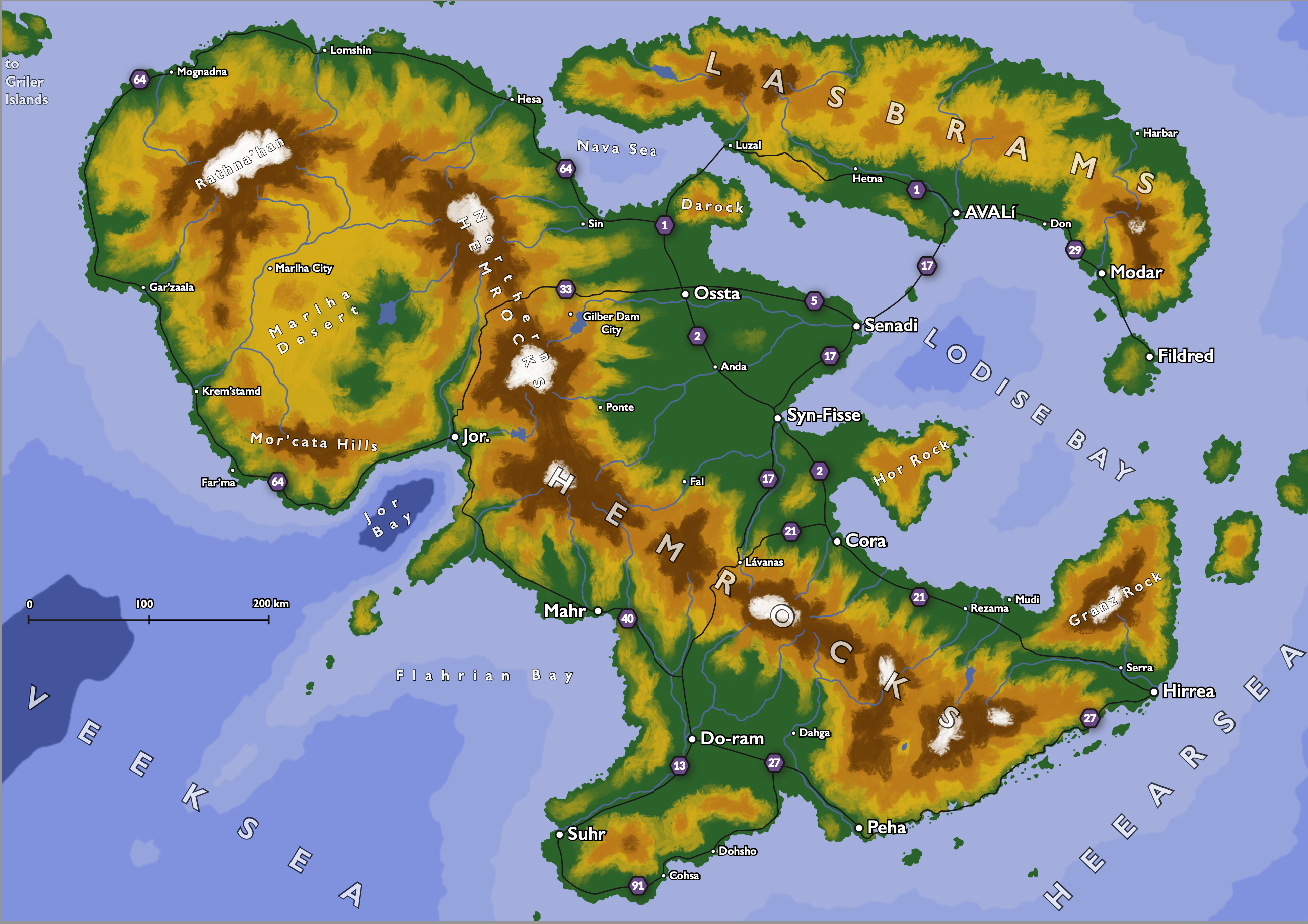
Map of Ava-Lodise (lemmy.world)
submitted 3 years ago by to c/worldbuilding@lemmy.world


Hi! This is the map for the island country of Ava-Lodise. It is a modern country, with similar levels of technology to our world. The largest cities are Avalí (the capital), Suhr, Senadi and Hirrea. There are several different ethnic groups in the country, from Avalonian (from Ava, the smaller island where Avalí is), East Lodisean (the east coast of the large island), Flahrian (south west of Lodise), Veeker (west of the desert) and Senmi (north of the desert).

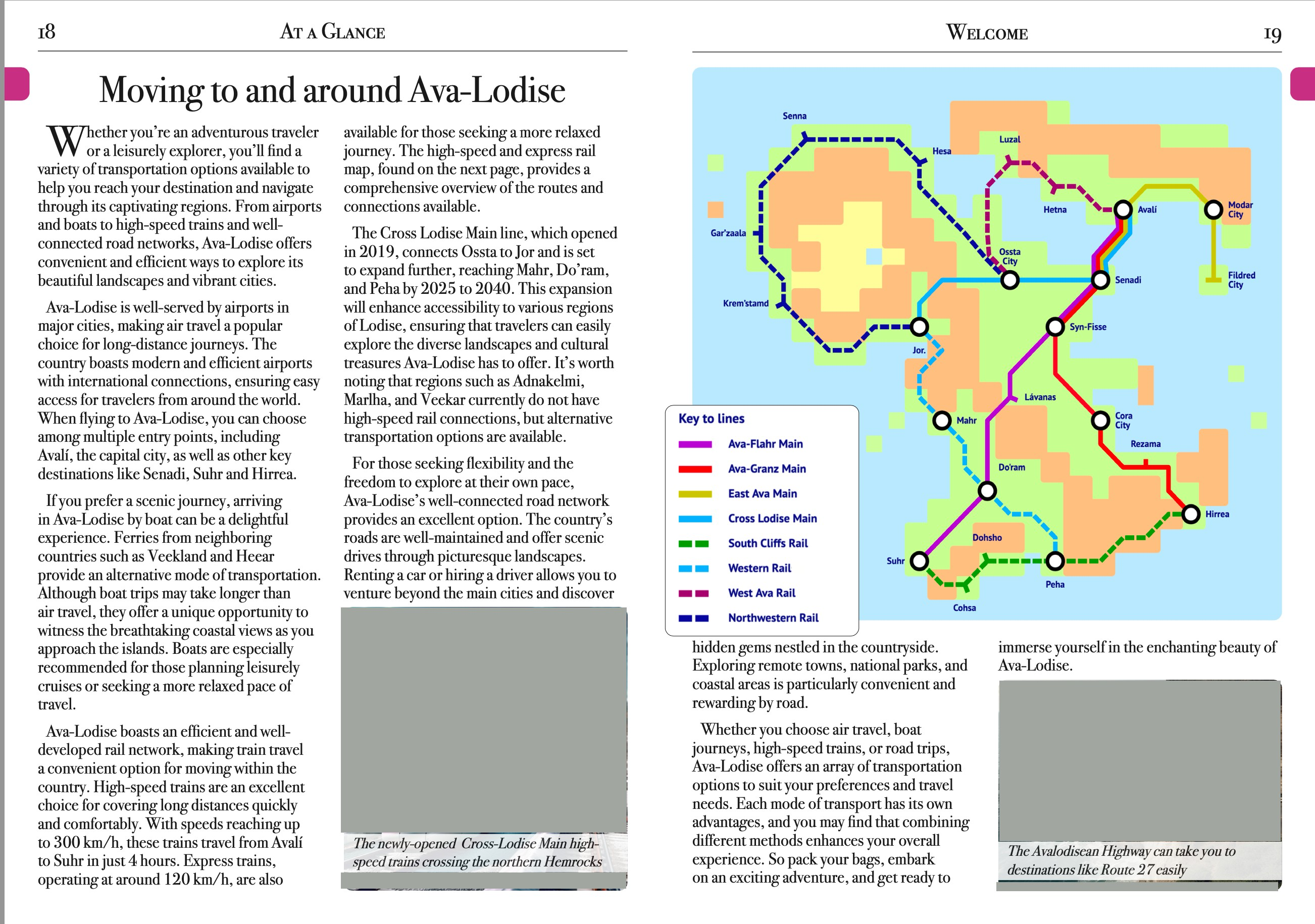
I made it for a project that I am really proud of how it looks, but I can't share it here because for that one I used a lot of AI generated images: A Travel Guide to Ava-Lodise.

here is one example page of that project (i removed the AI-generated images):

20


Finally scratched my cartography itch with this brush pack. Here's a sample of my own usage. Well worth the few bucks.

https://joelpigou.gumroad.com/l/fantasycartography

21


Do you use an online campaign manager? If so, which? I only know of Kanka so far, and am pretty happy with it. Edit to add: Obviously there are self-hosted wikis and other sites you could use, but this is the only purpose-built one I've used.

22


How much (or little) information do you need to tell your story? I have a hard time reaching a stopping point, and when I do, I often get the urge to start changing things again.

23


I used the wizardawn random generators to generate a lot of random stuff, small NPCs, shops and their inventories, the contents of various city vaults, et cetera. Nowadays, you can run all that locally instead, if you want some pre-AI stuff to bulk out your world.

24


Ritual meets perception meets reality; let's talk magic. What's your favorite original magic effect, and/or what's one that you might want help with?

25


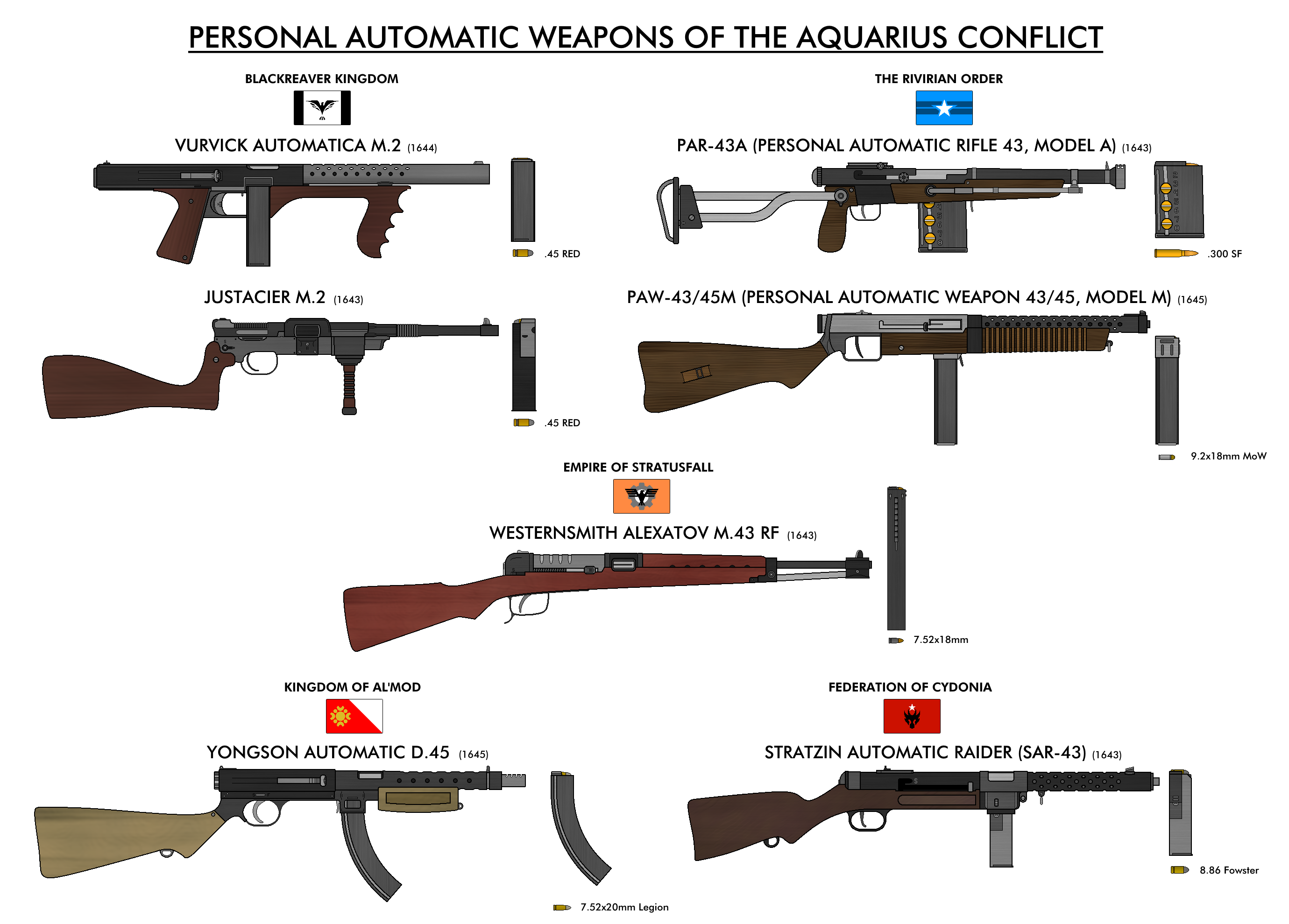
The years of 1640 to 1648 are most notably remembered for years of meaningless bloodshed, loss of life, and destruction of thousands of miles of land by chemical weapons, artillery, and powerful magical spells. All nations involved in the infamous war, now called the Aquarius Conflict, sought to break the front lines of the other side that bound them to the trenches for years on end. Technology had to advance to break the stalemate and over the course of the war each nation would develop new automatic weapons for fighting in close quarters combat.

Blackreaver Kingdom:

Justacier M.2: The Justacier M.2 was an early attempt at Blackreaver trying to refine the Rivirian Order's PAR-43A which could only fire 8 rifle rounds before needing to reload. The Justacier reduced the ammo size and weight of the weapon, going for a more sleek look such as that of a Revolver. Its downside though was that it it only held 20(+1) rounds that would be fired at upwards of 1300 rounds per minute, leading to issues of ammo consumption and requiring the user reload often.

Vurvick Automatica M.2: The Vurvick Automatica was developed by the Vurvick Arm's Company who handled the manufacturing of Blackreaver's standard issue rifle. Firing at 450 RPM, the weapon, while lacking a stock, was a moderately controllable firearm in close-quarters combat due to its heavier barrel. The M.2 Model would eventually receive an attachable stock but not before it had been used by thousands of soldiers jumping into enemy trenches.

The Rivirian Order:

PAR-43A: The first ever militarized attempt at a compact automatic weapon. With the design philosophy of dropping a soldier directly into a trench and something compact to fight with, the PAR-43A set the gears in motion of what was to come from the future of the war. It would also begin the Rivirian Ministry of War's project to actively upgrade and make changes to the weapon as results came in from the frontline in which a large list of nearly 18 different models total by the end of the war.

PAW-43/45M: While the weapon would see continued upgrades from the Rivirian Ministry of War until the war's end in 1648, the design that would see the most use was the 43/35 M Model. The weapon fired at 600 RPM and was featured prominently in Rivirian Shock Squadrons that would actively attack Cydonian trenches at given opportunities. Post-war, this weapon would become a favorite of local militias around the Aquarius Continent in the rebuilding era.

Empire of Stratusfall:

Westernsmith Alexatov M.43 RF: Using parts from existing Spader M.95 Rifles, the Alexatov M.63 was originally built as a semi-automatic rifle for airship raids and downed pilots. Eventually, the receiver would be altered slightly to allow for automatic weapon fire as well as having the barrel reduced in sized by several centimeters. It would also be given a 25-round stick magazine that would be mounted to the left of the rifle. For the remainder of the war, this would be the chosen use of compact automatic weapons by Stratusfall even as more designs would come out and be used on the Airbourne Front.

Kingdom of Al'Mod:

Yongson Automatic D.45: Developed as a late-war weapon, the YongSon D.45 was supposed to be the answer to rival Blackreaver's Vurvick Automatica that was being used to great effect in the Southern Front. The weapon itself would see a plethora of developmental issues, and only a batch of less than 1,000 would ever get deployed before the surrender of Al'Modian Kingdom in 1645. A modified version would come out several years later and be actively used in the military of other Southern Aquarius armies.

Federation of Cydonia:

Stratzin Automatic Raider A mass developmental and manufacturing job created by the Cidon Government, the weapon was sped through the developmental period in the summer of 1642 and was finalized that winter. Once approved, it was thrown into mass-manufacturing and only accomplished 14,000 of the 20,000 needed by the Spring of 1643 in order to prepare for the massive offensive that was to take place. It would cement the designs of the future weapons on the battlefield after the Cydonians managed to push the entire Northern Front hundreds of miles North. It would be the inspiration for the Yongson, the Vurvick, and the PAW collection.

view more: next ›