1
posts
2
3
4

5
6
7
name a more cursed  cars x carnism combo
This story was co-published with Popular Science.
Electric vehicles are becoming more and more commonplace on the nation’s roadways.
The federal government wants nearly two-thirds of all cars in the United States to be EVs within the next decade. All the while, EVs are breaking sales records, and manufacturers are building charging stations and production plants to incentivize a shift away from fossil fuels in the transportation sector.
With EVs taking the streets by storm, an unlikely industry now wants a piece of the pie.
Trade associations, fuel producers, and bipartisan lawmakers are pushing for biogas, fuel made from animal and food waste, to start receiving federal credits meant for powering electric vehicles.
The push for biogas-powered EVs would be a boon for the energy sector, according to biogas industry leaders. Environmental groups and researchers, however, say the fuel has yet to prove itself as a truly clean energy source. Biogas created from agriculture has been linked to an increase in waterway pollution and public health concerns that have disproportionately exposed low-income communities and communities of color to toxic byproducts of animal waste.
With the nation needing more ways to power fleets of Teslas and Chevy Bolts, the use of livestock manure to power EVs is still in limbo.
For biogas, there are, broadly speaking, three sources of waste from which to produce fuel: human waste, animal waste, and food waste. The source of this fuel input can be found at wastewater treatment plants, farms, and landfills.
At these locations, organic waste is deprived of oxygen, and a natural process known as anaerobic digestion occurs. Bacteria consume the waste products and eventually release methane, the main ingredient of natural gas. The gas is then captured, piped to a utility, turned into electricity, and distributed to customers.
Fuel created from animal waste isn’t a new concept. Farms around the country have been cashing in on biogas for decades, with a boom in production facilities known as anaerobic digesters expected after funding for their construction made it into the Inflation Reduction Act.
At the end of June, the Environmental Protection Agency finalized its Renewable Fuel Standard, or RFS, which outlines how much renewable fuels — products like corn-based ethanol, manure-based biogas, and wood pellets — are used to cut greenhouse gas emissions, as well as reduce the use of petroleum-based transportation fuel, heating oil, or jet fuel.
Under this program, petroleum-based fuels must blend renewable fuels into their supply. For example, each time the RFS is updated, a new goal for how much corn-based ethanol is mixed into the nation’s fuel supply is set. This prediction is based on gas and renewable-fuel-industry market projections.
These gas companies and refineries purchase credits from renewable-fuel makers to comply with the mandated amount of renewable fuel that needs to be mixed into their supply.
A currency system tracks which renewable fuels are being produced and where they end up under the RFS. This system uses credits known as RINs, or Renewable Identification Numbers. According to the EPA, a single RIN is the energy equivalent of one gallon of ethanol, and the prices of the credits will fluctuate over time, just as gas prices do.
Oil companies and refineries purchase credits from renewable-fuel makers to comply with the mandated amount of renewable fuel that needs to be mixed into their supply. The unique RIN credit proves that an oil seller has purchased, blended, and sold renewable fuel.
Currently, the biogas industry can only use its RIN credits when the fuel source is blended with ethanol or a particular type of diesel fuel. Outside of the federal program, biogas producers have been cashing in on low-carbon fuel programs in both California and Oregon.
With the boom in demand for renewable electricity, biogas producers want more opportunities to sell their waste-based fuels. EVs might get them there.
During recent RFS negotiations, the biogas industry urged the EPA to create a pathway for a new type of credit known as eRINs, or electric RINs. This pathway would allow the biogas and biomass industry to power the nation’s EVs directly. While the industry applauded the recent expansion of mandatory volumes of renewable fuels, the EPA did not decide on finalizing eRIN credits.
Patrick Serfass is the executive director of the American Biogas Council. He said the EPA could approve projects that would support eRINs for years, but has yet to approve the pathway for biogas-fuel producers.
“It doesn’t matter which administration,” Serfass said. “The Obama administration didn’t do it. The Trump administration didn’t do it. The Biden administration so far hasn’t done it. EPA, do your job.”
Late last year, the EPA initially included approval of eRINs in the RFS proposal. Republican members of Congress who sit on the Energy & Commerce Committee sent a letter to the EPA, saying that the RFS is not meant to be a tool to electrify transportation.
“Our goal is to ensure that all Americans have access to affordable, available, reliable, and secure energy,” the committee members wrote. “The final design of the eRINs program under the RFS inserts uncertainty into the transportation fuels market.”
The RFS has traditionally supported liquid fuels that the EPA considers renewable, the main of which is ethanol. Stakeholders in ethanol production see the inclusion of eRINs as an overstep.
In May, Chuck Grassley, a Republican senator from Iowa, introduced legislation that would outlaw EVs from getting credits from the renewable-fuels program. Grassley has been a longtime supporter of the ethanol industry; Iowa alone makes up nearly a third of the nation’s ethanol production, according to the economic growth organization Iowa Area Development Group.
Serfass said biogas is a way to offset the nation’s waste and make small and midsize farms economically sustainable, as well as local governments operating waste treatment plants and landfills. When it comes to animal waste, he said the eRIN program would allow farmers to make money off their waste by selling captured biogas to the grid to power EVs.
“There’s a lot of folks that don’t like large farms, and the reason that large farms exist is that as a society, we’re not always willing to pay $6 to $9 for a gallon of milk,” Serfass said. “You have farm consolidation so that farmers can just make a living.”
Initially, digesters were thought of as a climate solution and an economic boon for farmers, but in recent years, farms have stopped digester operations because of the hefty price tag to run them and their modest revenue. Biogas digesters are still operated by large operations, often with the help of fossil fuel companies, such as BP.
In addition to farms, Serfass said biogas production from food waste and municipal wastewater treatment plants would also be able to cash in on the eRIN program.
Dodge City, Kansas, a city of 30,000 in the western part of the state, is an example of a local government using biogas as a source of revenue. In 2018, the city began capturing methane from its sewage treatment and has since been able to generate an estimated $3 million a year by selling the fuel to the transportation sector.
Serfass said the city would be able to sell the fuel to power the nation’s EV charging grid if the eRIN program was approved.
The EPA’s decision-making will direct the next three years of renewable-fuel production in the country. The program is often a battleground for different industry groups, from biogas producers to ethanol refineries, as they fight over their fuel’s market share.
Of note, the biomass industry, which creates fuel from wood pellets, forestry waste, and other detritus of the nation’s lumber supply and forests, also wants to be approved for future eRIN opportunities.
This fuel source has a questionable track record of being a climate solution: The industry has been linked to deforestation in the American South, and has falsely claimed they don’t use whole trees to produce electricity, according to a industry whistleblower.
The EPA did not answer questions from Grist as to why eRINs were not approved in its recent announcement.
“The EPA will continue to work on potential paths forward for the eRIN program, while further reviewing the comments received on the proposal and seeking additional input from stakeholders to inform potential next steps on the eRIN program,” the agency wrote in a statement.
Ben Lilliston is the director of rural strategies and climate change at the Institute for Agriculture and Trade Policy. He said he supported the EPA’s decision to not approve biogas-created electricity for EVs.
“I think the jury is still out around biogas from large-scale animal operations about how effective they are,” Lilliston said.
He wants more independent studies to determine what a growing biogas sector under the eRIN program would mean for the rural areas and communities of color that surround these facilities.
Predominantly Black and low-income communities in southeastern North Carolina have been exposed to decades of polluted waters and increased respiratory and heart disease rates related to the state’s hog industry, which has recently cashed in on the biogas sector.
In Delaware, residents of the largely rural Delmarva peninsula have become accustomed to the stench of the region’s massive poultry farms. These operations now want to cash in on their waste with the implementation of more biogas systems in a community where many residents are Black or immigrants from Haiti and Latin America who speak limited English, according to the Guardian.
“I think that our concern, and many others’, is that this is actually going to increase emissions and waste and pollution,” Lilliston said.
Aaron Smith, a professor of agricultural economics at the University of California, Davis, said electricity produced from biogas could be a red herring when it comes to cheap, clean energy.
“There’s often a tendency to say, ‘We have this pollutant like methane gas that escapes from a landfill or a dairy manure lagoon, and if we can capture that and stop it from escaping into the atmosphere, that’s a win for the climate,'” Smith said. “But once we’ve captured it, should we do something useful with it? And the answer is maybe, but sometimes it’s more expensive to do something useful with it than it would be to go and generate that energy from a different source.”
Smith’s past research has found that the revenue procured by digesters has not been equal to the amount of methane captured by these systems. In a blog post earlier this year, Smith wrote that taxpayers and consumers are overpaying for the price of methane reduction. He found that the gasoline producers have essentially subsidized digester operations by way of the state’s low-carbon transportation standards. To pay for this, the gasoline industry offloads its increased costs by raising the price of gas for consumers.
“I think we do need to be wary about over-incentivizing these very expensive sources of electricity generation under the guise of climate games,” Smith told Grist.
8

9
10
11
12
13
14
15
16
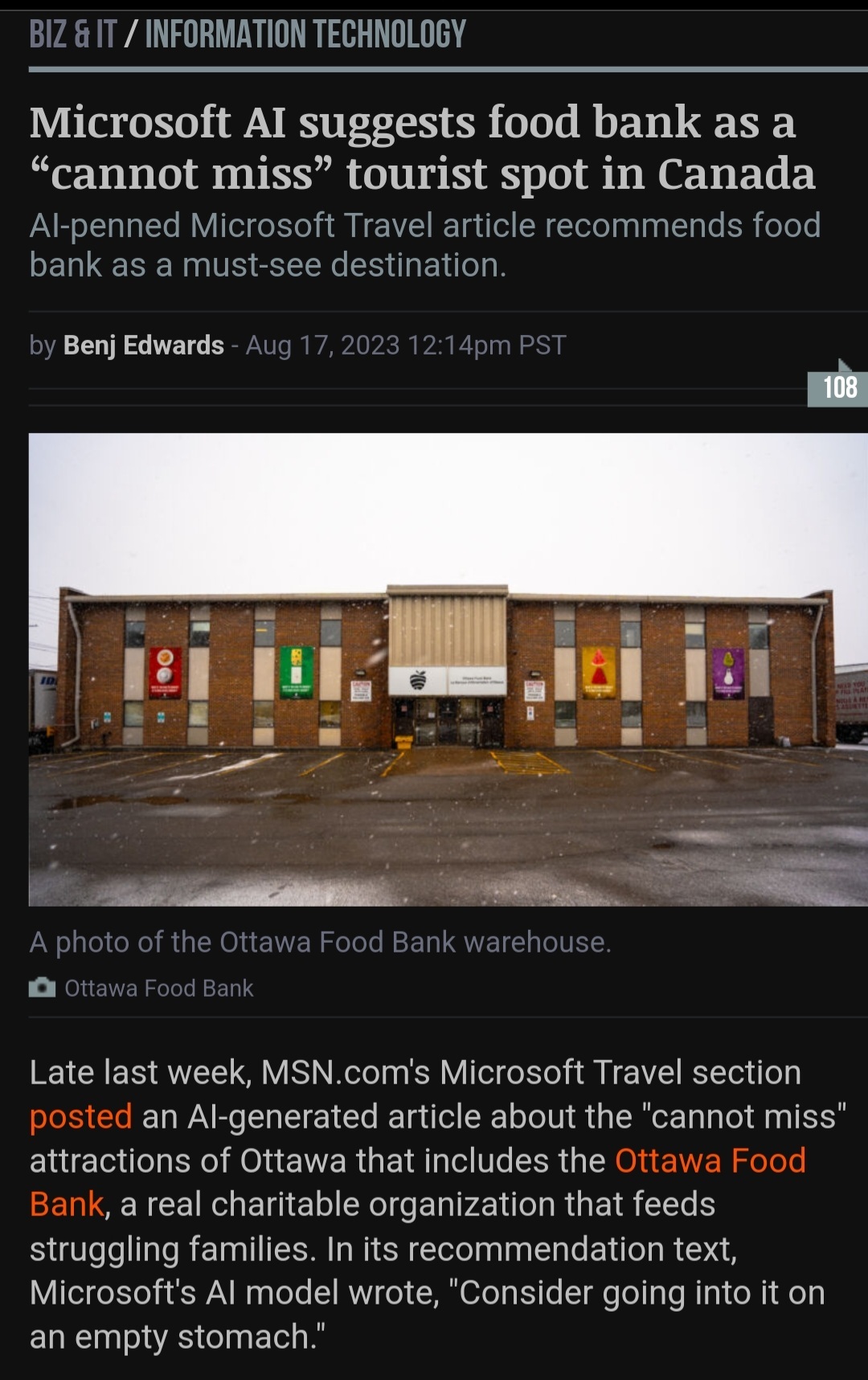
Mfw Libs like to pretend everything is fine while AI shows more solidarity with meat-bags.
(hexbear.net)
The organization has been collecting, purchasing, producing, and delivering food to needy people and families in the Ottawa area since 1984. We observe how hunger impacts men, women, and children on a daily basis, and how it may be a barrier to achievement. People who come to us have jobs and families to support, as well as expenses to pay. Life is already difficult enough. Consider going into it on an empty stomach.
17
18
19
20
Holy shit. It's so much worse than I originally thought, especially the allegations of employee abuse and sexual harassment.
EDIT: Here's a secret recording of the company meeting that happened after Madison left due to harassment: https://old.reddit.com/r/LinusTechTips/comments/15t1mzn/mandatory_meeting_the_after_madisons_departure/ One of the top guys makes a sex joke... At a work meeting on sexual harassment.

21
22
23
24
25
Spoiler
1938
The Radio Nurse was the first electronic baby monitor. Manufactured by the Zenith Radio Corporation, it went on sale in 1938. The product was developed by Zenith executive Eugene F. McDonald, and designed by Japanese-American sculptor and product designer Isamu Noguchi.
Although the product was manufactured for only a few years, it has been acclaimed for its design. It is still in demand as a collectible and is in many museum collections.
Noguchi also designed the Noguchi table.
.jpg)

view more:
next ›