276
277


I proposed this project to improve on Radicle's p2p model by using Tor for universal, straightforward seeding of git repos.

Original discussion thread - https://bounties.monero.social/posts/207/

One of the project's git repos linked in that thread - https://radicle.network/nodes/iris.radicle.network/rad:z2ydYmUCJvDfNFTVTpEbQmm55EPt1/history

Project website - https://cradicle.xyz/

The dev who took the project also expanded it into a project to reimplement Radicle in C.

Since I'm not a coder and I don't have any git repos of my own, I can only test from the viewpoint of an average layman using the GUI app to seed repos.

It's impossible for me to properly gauge how the project is progressing without engagement from coders who try using it for their git repos.

If the project doesn't currently interest you, your suggestions on how to start getting users on board would also be welcome.

Edit - bear in mind that because decentralized discussion platforms like this are currently quite broken, there are comments showing up in the thread when I'm not signed in that don't show up for me when I'm signed in. Here's a screenshot of all the comments showing up for me right now where I'm signed in and able to reply, as of UNIX time 1779670288
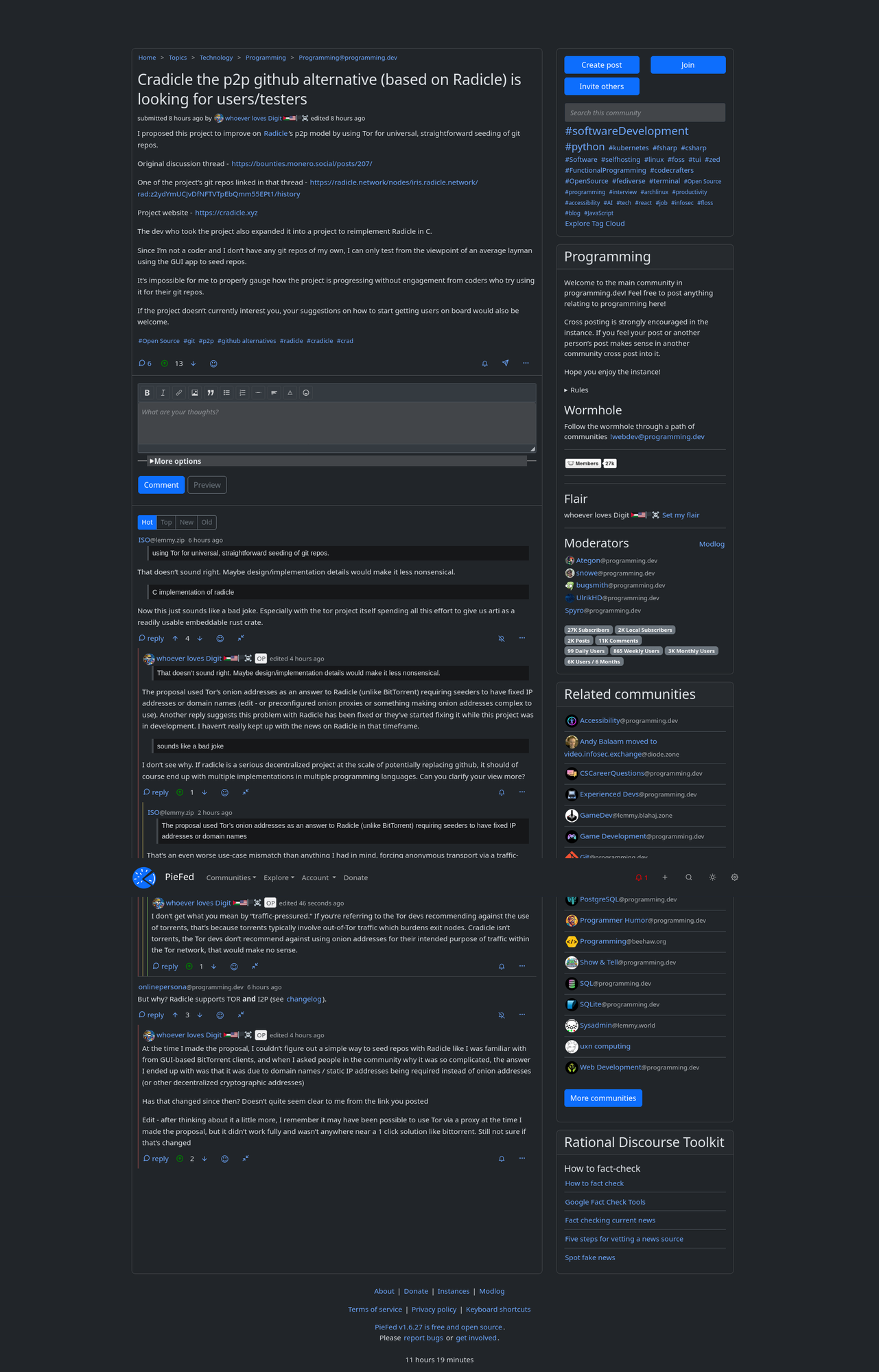
aqhH5rVg9opRagM.png

I'd encourage discussion of this project moreso on nostr (equally broken but my preferred platform) or the discussion thread linked above (seemingly more functional)

278
279


A lot of work in this release was related to porting to other platforms. We did a large number of refactorings to put ELF-specific behaviour behind traits. We've also started work on porting to Mach-O and WebAssembly. These aren't yet ready for use, but if you'd like to help out with porting, get in touch.

Wild now supports the linker plugin API that was originally part of the Gold linker, but which is also supported by GNU ld and Mold. This lets us do linker-plugin LTO (link time optimisation). There are still a few known issues, but it's already working on a good range of programs. Pure Rust projects generally don't use linker plugins, since Rust can do LTO within the compiler, so this is mostly helpful for C, C++ or mixed language projects. Note that when using a linker plugin, link times will be very slow.

Lots more linker-script features were implemented during this release.

[...]

280
wake up! 16b (hellmood.111mb.de)
281
282
283
284
The elephant in the room (www.joshwcomeau.com)
285
Stop Using Pull Requests (a4al6a.substack.com)
submitted 2 months ago* (last edited 2 months ago) by to c/programming@programming.dev


TL;DR

  • Pull requests were designed for open source contributions from untrusted strangers. Applying them to trusted teams is a category error.
  • Peer-reviewed research shows code review’s primary value is knowledge transfer, not bug detection. Less than 15% of review comments relate to actual bugs.
  • Async PR workflows mean your code spends 86-99% of its lead time waiting. One organisation spent 130,000 hours in a single year waiting on PRs that received zero comments.
  • DORA research across 36,000+ professionals shows trunk-based development correlates with dramatically higher software delivery performance, and faster code reviews alone improve performance by 50%.
  • The alternative is T*D: Test-Driven Development (build quality in), Trunk-Based Development (integrate continuously), and Team-focused Development (review during creation, not after).
  • The transition is gradual: optimise PRs first, adopt Ship/Show/Ask, then move to pairing and trunk-based development as trust and automation mature.-
286
287
288
289
290


In April 2000, Stack Overflow founder Joel Spolsky published an essay titled “Things You Should Never Do, Part I”. The occasion was Netscape's decision to rewrite the code of its then-browser from scratch instead of further developing the existing disciplin

Spolsky's thesis: This decision was the worst strategic mistake a software company could make. It was based on a fundamental misunderstanding of what programming work actually is. Programmers prefer to rewrite because reading foreign code is tedious and writing feels productive. But this impression is deceptive. The temptation to start over is one of the most expensive temptations in the industry.

More than 25 years later, this text has lost none of its relevance. On the contrary. With the advent of Large Language Models (LLM), the asymmetry between writing and reading has shifted to such an extent that the question becomes acute whether we are systematically underestimating the true senior discipline of software development. Typing is not what will keep teams breathless in the coming years. Reading is. In this article, I want to show why this is the case, where the asymmetry comes from, how it is exacerbated by generative AI, and how a casual accompanying skill must become an independent discipline.

291
Gallery of Computation (www.complexification.net)
submitted 2 months ago by to c/programming@programming.dev
292
293


Hello everyone

We released iceoryx2 v0.9 tonight. With the release, we are pushing more and more iceoryx2 into the embedded world. We have written a test runner that runs on std and no_std environments, stabilized the decentralized recovery, and added a ton of quality of life improvements.

For those who haven’t heard of it yet: iceoryx2 is a zero-copy inter-process communication library.

The basic idea is: instead of serializing data, copying it through sockets, pipes, message queues, or some broker process, iceoryx2 lets processes communicate via shared memory. That makes it useful when you care about latency, throughput, or moving large amounts of data between processes without wasting CPU cycles on copies.

It supports C, C++, Python, Rust, and C#, and runs on Linux, macOS, Windows, FreeBSD, and QNX, with experimental support for Android and VxWorks.

It is not limited to plain pub/sub either. iceoryx2 supports publish-subscribe, events, request-response streams, and a blackboard pattern, which is basically a key-value repository directly in shared memory.

The architecture is fully decentralized: no central broker, no daemon that everything depends on, and no single process that becomes the obvious bottleneck or failure point.

Happy to answer questions about the release, the no_std work, or zero-copy IPC in general.

294
295
296
297


Good morning 👾

I'd like to fetch data via BLE (Python or Swift) from a cheap smart ring that can be reverse engineered or that is already RE'd. Pulse, oxygen levels, gyroscope, button would be very useful. I'd like to build a python or swift library.

Thank you for any input =)

298


cross-posted from: https://lemmy.ml/post/47339272

Finally I can stay forever on lemmy even not opening the browser! 😂

Thinking of using it as a mod tool to see new posts in communities I moderate.

Sharing it early, maybe get some ideas on how to make it better.

https://github.com/tracyspacy/lemmy-tray

299
300
view more: ‹ prev next ›