1
A man can not remake himself without suffering for he is both the marble and the sculptor.
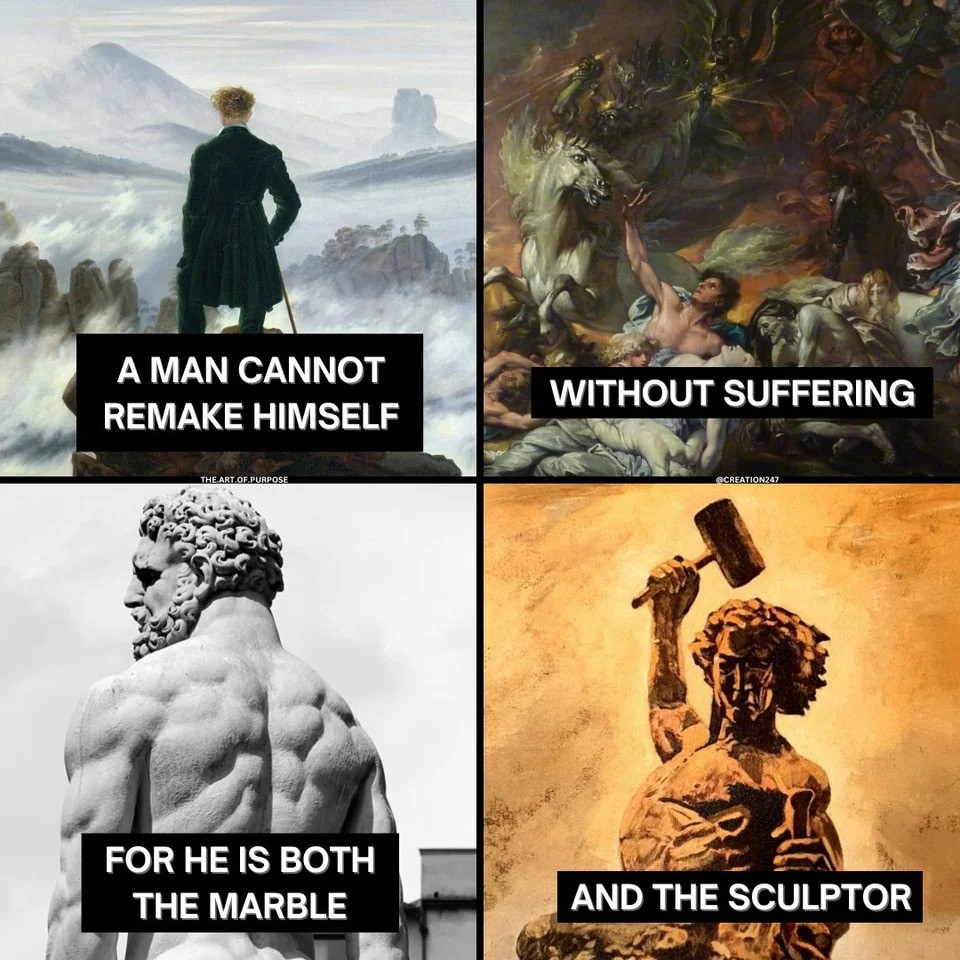
A man can not remake himself without suffering for he is both the marble and the sculptor.
Just as we've been able to find degrees of objectivity within our knowledge of mathematics or science, we can indeed find degrees of objectivity within the most subjective knowledge that humans have ever revealed: morality.
All knowledge holds or has held some degree of subjectivity. At one point in time there very well may have been large amounts of people that were convinced that two plus two equals three or five, just as we see with flat earthers today, revolving their entire lives around it. But ultimately, objectively, it's four. I'm personally not a fan of math but it's impossible not to appreciate its infallibility. Math is hard evidence that absolute, incontrovertible, inerrant, unquestionable truth does indeed exist and humans are capable of revealing it.
Math is the clear winner when it comes to the most objective knowledge. It's subjective until someone comes along and reveals the truth via reason, that of course when we take two things and add two more things to them, we will always, absolutely be left with four things, and there couldn't possibly be any other solution. My focus here however isn't to rank every knowledge and to determine which is more or less subjective than another specifically, but to point out some of the degrees of objectivity we've found so far within the sea of subjectivity that lies within our knowledge of anything. Science: The laws of physics; language and literature: That the shapes we call letters that make up the word we're presently using to connote the word, "word," is "word;" history: How Hitler died — most major historical events; time: it's presently 7:19a for me (it's the year 2018 for anyone living in Ethiopia) or we gained our independence here in America on July 4th, 1776; the experience: We can't breathe under water without the proper equipment to do so or it's more efficient to run with our shoes tied separately rather than tied together.
As we move away from math and into other knowledge things become nothing but more and more subjective; if math is on one side of the spectrum, holding the highest degrees of objectivity within its puny sea of subjectivity, then what would be on the opposite end of this spectrum, as the most subjective knowledge? I've concluded that it's either our knowledge of the divine or of morality, provided of course one believes in the divine, if not, then please kindly disregard it. I say the divine is the most subjective considering its metaphysics, and morality a very close second because at least morality is something we know for a fact exists by the extent we give life to it and keep it living, so to speak, and are the most capable of applying it to our environment in contrast to any other species here on Earth; the knowledge of the divine consists of things no human is capable of producing any degree of objective proof of.
But if morality is, by a landslide, the second (or first if you're not a believer) most subjective knowledge that humans have ever revealed and are capable of producing, then how are we to find any degree of objectivity within what seems to be a veritable ocean of subjectivity? I know it's a stretch, and I'm not saying I'm absolutely correct, it's just a theory, and I know this is going to get a lot more push back due to the stigma of the source of this knowledge compared to if I were to quote an ancient Greek philosopher, but one must understand that knowledge is just that: knowledge, no matter its source and no matter what we've rendered it ever since it's been revealed and labeled; Jesus — his knowledge and what men ever before and ever since have called "Judaism" or "Christianity" are two very different things. It's what Jesus — who I equate as a profound moral philosopher/activist/gadfly — thought "the law and the prophets hang to" (Matt 22:40), or, the law and the prophets as a whole: "love thy neighbor as thyself." - Leviticus 19:18
"All things, therefore, whatever ye may will that men may be doing to you, so also do to them, for this is the law and the prophets." - Matt 7:12
Within the midst of this ocean of subjectivity that is our knowledge of morality, we can indeed find degrees of objectivity within it using this as our tool of measurement, as our most efficient, though far from perfect means of measurement: Our unique and profound ability as humans for empathy. To be capable of using our imaginations to imagine the perspective and subsequently the potential thoughts and feelings of anything, even inanimate objects if you remember your favorite toy or stuffed animal as a child, for example. It's the most accurate means for us humans to objectively determine what is right or wrong, good or evil, true or false when it comes to our knowledge of morality. This precept falls apart however if one doesn't love themself; it's dependent upon it. The more one loves themself therefore, the more capable and even willing they will be to love anything else.
Here's a great example of the whole law and the prophets at work: Imagine you're standing within a large group of people that's facing a puny little girl who's standing next to a very large, strong grown man. Now let's say the grown man wound up to strike the little girl across the face, and did so, and the little girl let out a yelp as she collapsed to the ground, motionless. Out of inherency, at this point in time with Jesus' teaching well assimilated within the hearts and minds of men, whether they know it or not or would like to admit to it or not, I think we can all assume with certainty how the group of people would react.
However, let's try this experiment with a group of wildly uneducated, remote indigenous people, or a group of people from even just two millenniums ago. I'd like to think the reaction would be similar or even the same, and I'm not saying there wasn't and isn't any capacity for compassion and empathy where knowledge at least akin to this precept hasn't become subconscious common knowledge, but unfortunately, prior to the influence of this knowledge, the Romans, for example, would practice things like infanticide regularly. Why? Which knowledge hasn't made its way to become subconscious common knowledge at that point in time? And what knowledge led to such a dramatic social change for the better? Why even consider the abolishment of infanticide as a good thing today? Because how would you like it if you were a baby with a "deformity" of some kind and you were thrown on to the street — the equivalent of garbage? Yes, some people may desire this, as morality is indeed wildly subjective, just as some people would even be willing to kill and die themselves for the idea that two plus two equals three or five due to the "oaths" that they've taken via the overwhelming influence of their contemporaries. But objectively, the vast majority of people, especially children who haven't been destroyed yet by the world's ugly hands getting a hold of them, would absolutely not want to be thrown on to the street to die.
There's good reason why the foundation of laws today are built upon this now kindergarten precept, one that we take wildly for granted, because that's just what it is: reason. And the only thing that's rendered it anything else both ever before and ever since Jesus is exactly what rendered it any different in Jesus' time as well: The stigma of what we now call "religion" or "God's Law" that smothers it and gives anyone any reason to consider it as anything else but what it would be otherwise if it wasn't for this Everest sized stigma that's always surrounded it: knowledge.
I'd like to end with a couple verses that I think shine a good light on the alternative perspective Jesus had on "scripture," that God wants love or "mercy" as Jesus specifies in Matt 9:13 and 12:7 when he references Hosea 6:6, not useless external worship.
"For kindness I desired, and not [animal] sacrifice, And a knowledge of God above burnt-offerings." - Hosea 6:6
“ 'With what shall I come before the Lord, and bow myself before God on high? Shall I come before him with burnt offerings, with calves a year old? Will the Lord be pleased with thousands of rams, with ten thousands of rivers of oil? Shall I give my firstborn for my transgression, the fruit of my body for the sin of my soul?' He has told you, O man, what is good [love thy neighbor as thyself]; and what does the Lord require of you but to do justice, and to love kindness, and to walk humbly with your God?" - Micah 6:6

This is a direct continuation of Tolstoy's "A Letter to a Hindu": The Subjection of India — Its Cause and Cure (Part One of Two): https://lemmy.world/post/48753854
IV. 'Children, do you want to know by what your hearts should be guided? Throw aside your longings and strivings after that which is null and void; get rid of your erroneous thoughts about happiness and wisdom, and your empty and insincere desires. Dispense with these and you will know Love.' KRISHNA.
'Be not the destroyers of yourselves. Arise to your true Being, and then you will have nothing to fear.' KRISHNA.
New justifications have now appeared in place of the antiquated, obsolete, religious ones. These new justifications are just as inadequate as the old ones, but as they are new their futility cannot immediately be recognized by the majority of men. Besides this, those who enjoy power propagate these new sophistries and support them so skilfully that they seem irrefutable even to many of those who suffer from the oppression these theories seek to justify. These new justifications are termed 'scientific'. But by the term 'scientific' is understood just what was formerly understood by the term 'religious': just as formerly everything called 'religious' was held to be unquestionable simply because it was called religious, so now all that is called 'scientific' is held to be unquestionable. In the present case the obsolete religious justification of violence which consisted in the recognition of the supernatural personality of the God-ordained ruler ('there is no power but of God') has been superseded by the 'scientific' justification which puts forward, first, the assertion that because the coercion of man by man has existed in all ages, it follows that such coercion must continue to exist. This assertion that people should continue to live as they have done throughout past ages rather than as their reason and conscience indicate, is what 'science' calls 'the historic law'. A further 'scientific' justification lies in the statement that as among plants and wild beasts there is a constant struggle for existence which always results in the survival of the fittest, a similar struggle should be carried on among human beings — beings, that is, who are gifted with intelligence and love; faculties lacking in the creatures subject to the struggle for existence and survival of the fittest. Such is the second 'scientific' justification.
The third, most important, and unfortunately most widespread justification is, at bottom, the age-old religious one just a little altered: that in public life the suppression of some for the protection of the majority cannot be avoided — so that coercion is unavoidable however desirable reliance on love alone might be in human intercourse. The only difference in this justification by pseudo-science consists in the fact that, to the question why such and such people and not others have the right to decide against whom violence may and must be used, pseudo-science now gives a different reply to that given by religion — which declared that the right to decide was valid because it was pronounced by persons possessed of divine power. 'Science' says that these decisions represent the will of the people, which under a constitutional form of government is supposed to find expression in all the decisions and actions of those who are at the helm at the moment.
Such are the scientific justifications of the principle of coercion. They are not merely weak but absolutely invalid, yet they are so much needed by those who occupy privileged positions that they believe in them as blindly as they formerly believed in the immaculate conception, and propagate them just as confidently. And the unfortunate majority of men bound to toil is so dazzled by the pomp with which these 'scientific truths' are presented, that under this new influence it accepts these scientific stupidities for holy truth, just as it formerly accepted the pseudo-religious justifications; and it continues to submit to the present holders of power who are just as hard-hearted but rather more numerous than before.
V. 'Who am I? I am that which thou hast searched for since thy baby eyes gazed wonderingly upon the world, whose horizon hides this real life from thee. I am that which in thy heart thou hast prayed for, demanded as thy birthright, although thou hast not known what it was. I am that which has lain in thy soul for hundreds and thousands of years. Sometimes I lay in thee grieving because thou didst not recognize me; sometimes I raised my head, opened my eyes, and extended my arms calling thee either tenderly and quietly, or strenuously, demanding that thou shouldst rebel against the iron chains which bound thee to the earth.' KRISHNA.
So matters went on, and still go on, in the Christian world. But we might have hope that in the immense Brahman, Buddhist, and Confucian worlds this new scientific superstition would not establish itself, and that the Chinese, Japanese, and Hindus, once their eyes were opened to the religious fraud justifying violence, would advance directly to a recognition of the law of love inherent in humanity, and which had been so forcibly enunciated by the great Eastern teachers. But what has happened is that the scientific superstition replacing the religious one has been accepted and secured a stronger and stronger hold in the East.
In your periodical you set out as the basic principle which should guide the actions of your people the maxim that: 'Resistance to aggression is not simply justifiable but imperative, nonresistance hurts both Altruism and Egotism.' Love is the only way to rescue humanity from all ills, and in it you too have the only method of saving your people from enslavement. In very ancient times love was proclaimed with special strength and clearness among your people to be the religious basis of human life. Love, and forcible resistance to evil-doers, involve such a mutual contradiction as to destroy utterly the whole sense and meaning of the conception of love. And what follows? With a light heart and in the twentieth century you, an adherent of a religious people, deny their law, feeling convinced of your scientific enlightenment and your right to do so, and you repeat (do not take this amiss) the amazing stupidity indoctrinated in you by the advocates of the use of violence — the enemies of truth, the servants first of theology and then of science — your European teachers.
You say that the English have enslaved your people and hold them in subjection because the latter have not resisted resolutely enough and have not met force by force. But the case is just the opposite. If the English have enslaved the people of India it is just because the latter recognized, and still recognize, force as the fundamental principle of the social order. In accord with that principle they submitted to their little rajahs, and on their behalf struggled against one another, fought the Europeans, the English, and are now trying to fight with them again.
A commercial company enslaved a nation comprising two hundred millions. Tell this to a man free from superstition and he will fail to grasp what these words mean. What does it mean that thirty thousand men, not athletes but rather weak and ordinary people, have subdued two hundred million vigorous, clever, capable, and freedom-loving people? Do not the figures make it clear that it is not the English who have enslaved the Indians, but the Indians who have enslaved themselves? When the Indians complain that the English have enslaved them it is as if drunkards complained that the spirit-dealers who have settled among them have enslaved them. You tell them that they might give up drinking, but they reply that they are so accustomed to it that they cannot abstain, and that they must have alcohol to keep up their energy. Is it not the same thing with the millions of people who submit to thousands' or even to hundreds, of others — of their own or other nations? If the people of India are enslaved by violence it is only because they themselves live and have lived by violence, and do not recognize the eternal law of love inherent in humanity.
'Pitiful and foolish is the man who seeks what he already has, and does not know that he has it. Yes, Pitiful and foolish is he who does not know the bliss of love which surrounds him and which I have given him.' KRISHNA.
As soon as men live entirely in accord with the law of love natural to their hearts and now revealed to them, which excludes all resistance by violence, and therefore hold aloof from all participation in violence — as soon as this happens, not only will hundreds be unable to enslave millions, but not even millions will be able to enslave a single individual. Do not resist the evil-doer and take no part in doing so, either in the violent deeds of the administration, in the law courts, the collection of taxes, or above all in soldiering, and no one in the world will be able to enslave you.
VI. 'O ye who sit in bondage and continually seek and pant for freedom, seek only for love. Love is peace in itself and peace which gives complete satisfaction. I am the key that opens the portal to the rarely discovered land where contentment alone is found.' KRISHNA.
What is now happening to the people of the East as of the West is like what happens to every individual when he passes from childhood to adolescence and from youth to manhood. He loses what had hitherto guided his life and lives without direction, not having found a new standard suitable to his age, and so he invents all sorts of occupations, cares, distractions, and stupefactions to divert his attention from the misery and senselessness of his life. Such a condition may last a long time.
When an individual passes from one period of life to another a time comes when he cannot go on in senseless activity and excitement as before, but has to understand that although he has outgrown what before used to direct him, this does not mean that he must live without any reasonable guidance, but rather that he must formulate for himself an understanding of life corresponding to his age, and having elucidated it must be guided by it. And in the same way a similar time must come in the growth and development of humanity. I believe that such a time has now arrived — not in the sense that it has come in the year 1908, but that the inherent contradiction of human life has now reached an extreme degree of tension: on the one side there is the consciousness of the beneficence of the law of love, and on the other the existing order of life which has for centuries occasioned an empty, anxious, restless, and troubled mode of life, conflicting as it does with the law of love and built on the use of violence. This contradiction must be faced, and the solution will evidently not be favourable to the outlived law of violence, but to the truth which has dwelt in the hearts of men from remote antiquity: the truth that the law of love is in accord with the nature of man.
But men can only recognize this truth to its full extent when they have completely freed themselves from all religious and scientific superstitions and from all the consequent misrepresentations and sophistical distortions by which its recognition has been hindered for centuries. To save a sinking ship it is necessary to throw overboard the ballast, which though it may once have been needed would now cause the ship to sink. And so it is with the scientific superstition which hides the truth of their welfare from mankind. In order that men should embrace the truth — not in the vague way they did in childhood, nor in the one-sided and perverted way presented to them by their religious and scientific teachers, but embrace it as their highest law — the complete liberation of this truth from all and every superstition (both pseudo-religious and pseudo-scientific) by which it is still obscured is essential: not a partial, timid attempt, reckoning with traditions sanctified by age and with the habits of the people — not such as was effected in the religious sphere by Guru-Nanak, the founder of the sect of the Sikhs, and in the Christian world by Luther, and by similar reformers in other religions — but a fundamental cleansing of religious consciousness from all ancient religious and modern scientific superstitions.
If only people freed themselves from their beliefs in all kinds of Ormuzds, Brahmas, Sabbaoths, and their incarnation as Krishnas and Christs, from beliefs in Paradises and Hells, in reincarnations and resurrections, from belief in the interference of the Gods in the external affairs of the universe, and above all, if they freed themselves from belief in the infallibility of all the various Vedas, Bibles, Gospels, Tripitakas, Korans, and the like, and also freed themselves from blind belief in a variety of scientific teachings about infinitely small atoms and molecules and in all the infinitely great and infinitely remote worlds, their movements and origin, as well as from faith in the infallibility of the scientific law to which humanity is at present subjected: the historic law, the economic laws, the law of struggle and survival, and so on — if people only freed themselves from this terrible accumulation of futile exercises of our lower capacities of mind and memory called the 'Sciences', and from the innumerable divisions of all sorts of histories, anthropologies, homiletics, bacteriologics, jurisprudences, cosmographies, strategies — their name is legion — and freed themselves from all this harmful, stupifying ballast — the simple law of love, natural to man, accessible to all and solving all questions and perplexities, would of itself become clear and obligatory.
VII. 'Children, look at the flowers at your feet; do not trample upon them. Look at the love in your midst and do not repudiate it.' KRISHNA.
'There is a higher reason which transcends all human minds. It is far and near. It permeates all the worlds and at the same time is infinitely higher than they. A man who sees that all things are contained in the higher spirit cannot treat any being with contempt.
For him to whom all spiritual beings are equal to the highest there can be no room for deception or grief. Those who are ignorant and are devoted to the religious rites only, are in a deep gloom, but those who are given up to fruitless meditations are in a still greater darkness.' UPANISHADS, FROM VEDAS.
Yes, in our time all these things must be cleared away in order that mankind may escape from self-inflicted calamities that have reached an extreme intensity. Whether an Indian seeks liberation from subjection to the English, or anyone else struggles with an oppressor either of his own nationality or of another — whether it be a Negro defending himself against the North Americans; or Persians, Russians, or Turks against the Persian, Russian, or Turkish governments, or any man seeking the greatest welfare for himself and for everybody else — they do not need explanations and justifications of old religious superstitions such as have been formulated by your Vivekanandas, Baba Bharatis, and others, or in the Christian world by a number of similar interpreters and exponents of things that nobody needs; nor the innumerable scientific theories about matters not only unnecessary but for the most part harmful. (In the spiritual realm nothing is indifferent: what is not useful is harmful.) What are wanted for the Indian as for the Englishman, the Frenchman, the German, and the Russian, are not Constitutions and Revolutions, nor all sorts of Conferences and Congresses, nor the many ingenious devices for submarine navigation and aerial navigation, nor powerful explosives, nor all sorts of conveniences to add to the enjoyment of the rich, ruling classes; nor new schools and universities with innumerable faculties of science, nor an augmentation of papers and books, nor gramophones and cinematographs, nor those childish and for the most part corrupt stupidities termed art — but one thing only is needful: the knowledge of the simple and clear truth which finds place in every soul that is not stupefied by religious and scientific superstitions — the truth that for our life one law is valid — the law of love, which brings the highest happiness to every individual as well as to all mankind. Free your minds from those overgrown, mountainous imbecilities which hinder your recognition of it, and at once the truth will emerge from amid the pseudo-religious nonsense that has been smothering it: the indubitable, eternal truth inherent in man, which is one and the same in all the great religions of the world. It will in due time emerge and make its way to general recognition, and the nonsense that has obscured it will disappear of itself, and with it will go the evil from which humanity now suffers.
'Children, look upwards with your beclouded eyes, and a world full of joy and love will disclose itself to you, a rational world made by My wisdom, the only real world. Then you will know what love has done with you, what love has bestowed upon you, what love demands from you.' KRISHNA.
YASNAYA POLYANA. December 14th, 1908.

Ahimsa: Respect for all living things and avoidance of violence towards others.
Gandhi participated in war as medical support. He raised and organized 1,100 volunteers to serve in the Natal Indian Ambulance Corps.
"As soon as the news reached South Africa that I along with other Indians had offered my services in the war, I received two cables. One of these was from Mr. Polak who questioned the consistency of my action with my profession of ahimsa. I had to a certain extent anticipated this objection, for I had discussed the question in my Hind Swaraj or Indian Home Rule, and used to discuss it day in and day out with friends in South Africa. All of us recognized the immorality of war. If I was not prepared to prosecute my assailant, much less should I be willing to participate in a war, especially when I knew nothing of the justice or otherwise of the cause of the combatants. Friends of course knew that I had previously served in the Boer War, but they assumed that my views had since undergone a change.
As a matter of fact the very same line of argument that persuaded me to take part in the Boer War had weighed with me on this occasion. It was quite clear to me that participation in war could never be consistent with ahimsa. But it is not always given to one to be equally clear about one's duty. A votary [a devoted follower, adherent, or advocate of someone or something] of truth is often obliged to grope in the dark.
Ahimsa is a comprehensive principle. We are helpless mortals caught in the conflagration of himsa [to injure or harm]. The saying that life lives on life has a deep meaning in it. Man cannot for a moment live without consciously or unconsciously committing outward himsa. The fact of his living — eating, drinking and moving about — necessarily involves some himsa, destruction of life, be it ever so minute. A votary of ahimsa therefore remains true to his faith if the spring of all his actions is compassion, if he shuns to the best of his ability the destruction of the tiniest creature, tries to save it, and thus incessantly strives to be free from the deadly coil of himsa. He will be constantly growing in self-restraint and compassion, but he can never become entirely free from outward himsa.
Then again, because underlying ahimsa is the unity of all life, the error of one cannot but affect all, and hence man cannot be wholly free from himsa. So long as he continues to be a social being, he cannot but participate in the himsa that the very existence of society involves. When two nations are fighting, the duty of a votary ahimsa is to stop the war. He who is not equal to that duty, he who has no power of resisting war, he who is not qualified to resist war, may take part in war, and yet wholeheartedly try to free himself, his nation and the world from war." - Mahatma Gandhi, The Story of My Experiments With Truth, Part Four, Chapter Thirty-Nine, "A Spiritual Dilemma"

Introduction by M.K. Gandhi
"The letter printed below is a translation of Tolstoy's letter written in Russian in reply to one from the Editor of Free Hindustan. After having passed from hand to hand, this letter at last came into my possession through a friend who asked me, as one much interested in Tolstoy's writings, whether I thought it worth publishing. I at once replied in the affirmative, and told him I should translate it myself into Gujarati and induce others' to translate and publish it in various Indian vernaculars. The letter as received by me was a type-written copy. It was therefore referred to the author, who confirmed it as his and kindly granted me permission to print it.
To me, as a humble follower of that great teacher whom I have long looked upon as one of my guides, it is a matter of honour to be connected with the publication of his letter, such especially as the one which is now being given to the world. It is a mere statement of fact to say that every Indian, whether he owns up to it or not, has national aspirations. But there are as many opinions as there are Indian nationalists as to the exact meaning of that aspiration, and more especially as to the methods to be used to attain the end. One of the accepted and 'time-honoured' methods to attain the end is that of violence. The assassination of Sir Curzon Wylie was an illustration of that method in its worst and most detestable form. Tolstoy's life has been devoted to replacing the method of violence for removing tyranny or securing reform by the method of non-resistance to evil. He would meet hatred expressed in violence by love expressed in self-suffering. He admits of no exception to whittle down this great and divine law of love. He applies it to all the problems that trouble mankind.
When a man like Tolstoy, one of the clearest thinkers in the western world, one of the greatest writers, one who as a soldier has known what violence is and what it can do, condemns Japan for having blindly followed the law of modern science, falsely so-called, and fears for that country 'the greatest calamities', it is for us to pause and consider whether, in our impatience of English rule, we do not want to replace one evil by another and a worse. India, which is the nursery of the great faiths of the world, will cease to be nationalist India, whatever else she may become, when she goes through the process of civilization in the shape of reproduction on that sacred soil of gun factories and the hateful industrialism which has reduced the people of Europe to a state of slavery, and all but stifled among them the best instincts which are the heritage of the human family.
If we do not want the English in India we must pay the price. Tolstoy indicates it. 'Do not resist evil, but also do not yourselves participate in evil — in the violent deeds of the administration of the law courts, the collection of taxes and, what is more important, of the soldiers, and no one in the world will enslave you', passionately declares the sage of Yasnaya Polyana. Who can question the truth of what he says in the following: 'A commercial company enslaved a nation comprising two hundred millions. Tell this to a man free from superstition and he will fail to grasp what these words mean. What does it mean that thirty thousand people, not athletes, but rather weak and ordinary people, have enslaved two hundred millions of vigorous, clever, capable, freedom-loving people? Do not the figures make it clear that not the English, but the Indians, have enslaved themselves?'
One need not accept all that Tolstoy says — some of his facts are not accurately stated — to realize the central truth of his indictment of the present system, which is to understand and act upon the irresistible power of the soul over the body, of love, which is an attribute of the soul, over the brute or body force generated by the stirring in us of evil passions. There is no doubt that there is nothing new in what Tolstoy preaches. But his presentation of the old truth is refreshingly forceful. His logic is unassailable. And above all he endeavours to practise what he preaches. He preaches to convince. He is sincere and in earnest. He commands attention." [19th November, 1909] M. K. GANDHI
A Letter to a Hindu
I. 'All that exists is One. People only call this One by different names.' THE VEDAS.
'God is love, and he that abideth in love abideth in God, and God abideth in him.' I JOHN iv. 16.
'God is one whole; we are the parts.' EXPOSITION OF THE TEACHING OF THE VEDAS BY VIVEKANANDA.
'Do not seek quiet and rest in those earthly realms where delusions and desires are engendered, for if thou dost, thou wilt be dragged through the rough wilderness of life, which is far from Me. Whenever thou feelest that thy feet are becoming entangled in the interlaced roots of life, know that thou has strayed from the path to which I beckon thee: for I have placed thee in broad, smooth paths, which are strewn with flowers. I have put a light before thee, which thou canst follow and thus run without stumbling.' KRISHNA.
"I have received your letter and two numbers of your periodical, both of which interest me extremely. The oppression of a majority by a minority, and the demoralization inevitably resulting from it, is a phenomenon that has always occupied me and has done so most particularly of late. I will try to explain to you what I think about that subject in general, and particularly about the cause from which the dreadful evils of which you write in your letter, and in the Hindu periodical you have sent me, have arisen and continue to arise. The reason for the astonishing fact that a majority of working people submit to a handful of idlers who control their labour and their very lives is always and everywhere the same — whether the oppressors and oppressed are of one race or whether, as in India and elsewhere, the oppressors are of a different nation.
This phenomenon seems particularly strange in India, for there more than two hundred million people, highly gifted both physically and mentally, find themselves in the power of a small group of people quite alien to them in thought, and immeasurably inferior to them in religious morality. From your letter and the articles in Free Hindustan as well as from the very interesting writings of the Hindu Swami Vivekananda and others, it appears that, as is the case in our time with the ills of all nations, the reason lies in the lack of a reasonable religious teaching which by explaining the meaning of life would supply a supreme law for the guidance of conduct and would replace the more than dubious precepts of pseudo-religion and pseudo-science with the immoral conclusions deduced from them and commonly called 'civilization'.
Your letter, as well as the articles in Free Hindustan and Indian political literature generally, shows that most of the leaders of public opinion among your people no longer attach any significance to the religious teachings that were and are professed by the peoples of India, and recognize no possibility of freeing the people from the oppression they endure except by adopting the irreligious and profoundly immoral social arrangements under which the English and other pseudo-Christian nations live to-day. And yet the chief if not the sole cause of the enslavement of the Indian peoples by the English lies in this very absence of a religious consciousness and of the guidance for conduct which should flow from it — a lack common in our day to all nations East and West, from Japan to England and America alike.
II. 'O ye, who see perplexities over your heads, beneath your feet, and to the right and left of you; you will be an eternal enigma unto yourselves until ye become humble and joyful as children. Then will ye find Me, and having found Me in yourselves, you will rule over worlds, and looking out from the great world within to the little world without, you will bless everything that is, and find all is well with time and with you.' KRISHNA.
To make my thoughts clear to you I must go farther back. We do not, cannot, and I venture to say need not, know how men lived millions of years ago or even ten thousand years ago, but we do know positively that, as far back as we have any knowledge of mankind, it has always lived in special groups of families, tribes, and nations in which the majority, in the conviction that it must be so, submissively and willingly bowed to the rule of one or more persons — that is to a very small minority. Despite all varieties of circumstances and personalities these relations manifested themselves among the various peoples of whose origin we have any knowledge; and the farther back we go the more absolutely necessary did this arrangement appear, both to the rulers and the ruled, to make it possible for people to live peacefully together.
So it was everywhere. But though this external form of life existed for centuries and still exists, very early — thousands of years before our time — amid this life based on coercion, one and the same thought constantly emerged among different nations, namely, that in every individual a spiritual element is manifested that gives life to all that exists, and that this spiritual element strives to unite with everything of a like nature to itself, and attains this aim through love. This thought appeared in most various forms at different times and places, with varying completeness and clarity. It found expression in Brahmanism, Judaism, Mazdaism (the teachings of Zoroaster), in Buddhism, Taoism, Confucianism, and in the writings of the Greek and Roman sages, as well as in Christianity and Mohammedanism. The mere fact that this thought has sprung up among different nations and at different times indicates that it is inherent in human nature and contains the truth. But this truth was made known to people who considered that a community could only be kept together if some of them restrained others, and so it appeared quite irreconcilable with the existing order of society. Moreover it was at first expressed only fragmentarily, and so obscurely that though people admitted its theoretic truth they could not entirely accept it as guidance for their conduct. Then, too, the dissemination of the truth in a society based on coercion was always hindered in one and the same manner, namely, those in power, feeling that the recognition of this truth would undermine their position, consciously or sometimes unconsciously perverted it by explanations and additions quite foreign to it, and also opposed it by open violence. Thus the truth — that his life should be directed by the spiritual element which is its basis, which manifests itself as love, and which is so natural to man — this truth, in order to force a way to man's consciousness, had to struggle not merely against the obscurity with which it was expressed and the intentional and unintentional distortions surrounding it, but also against deliberate violence, which by means of persecutions and punishments sought to compel men to accept religious laws authorized by the rulers and conflicting with the truth. Such a hindrance and misrepresentation of the truth — which had not yet achieved complete clarity — occurred everywhere: in Confucianism and Taoism, in Buddhism and in Christianity, in Mohammedanism and in your Brahmanism.
III. 'My hand has sowed love everywhere, giving unto all that will receive. Blessings are offered unto all My children, but many times in their blindness they fail to see them. How few there are who gather the gifts which lie in profusion at their feet: how many there are, who, in wilful waywardness, turn their eyes away from them and complain with a wail that they have not that which I have given them; many of them defiantly repudiate not only My gifts, but Me also, Me, the Source of all blessings and the Author of their being.' KRISHNA.
'I tarry awhile from the turmoil and strife of the world. I will beautify and quicken thy life with love and with joy, for the light of the soul is Love. Where Love is, there is contentment and peace, and where there is contentment and peace, there am I, also, in their midst.' KRISHNA.
'The aim of the sinless One consists in acting without causing sorrow to others, although he could attain to great power by ignoring their feelings. The aim of the sinless One lies in not doing evil unto those who have done evil unto him. If a man causes suffering even to those who hate him without any reason, he will ultimately have grief not to be overcome.
The punishment of evil doers consists in making them feel ashamed of themselves by doing them a great kindness. Of what use is superior knowledge in the one, if he does not endeavour to relieve his neighbour's want as much as his own? If, in the morning, a man wishes to do evil unto another, in the evening the evil will return to him.' THE HINDU KURAL.
Thus it went on everywhere. The recognition that love represents the highest morality was nowhere denied or contradicted, but this truth was so interwoven everywhere with all kinds of falsehoods which distorted it, that finally nothing of it remained but words. It was taught that this highest morality was only applicable to private life — for home use, as it were — but that in public life all forms of violence — such as imprisonment, executions, and wars — might be used for the protection of the majority against a minority of evildoers, though such means were diametrically opposed to any vestige of love. And though common sense indicated that if some men claim to decide who is to be subjected to violence of all kinds for the benefit of others, these men to whom violence is applied may, in turn, arrive at a similar conclusion with regard to those who have employed violence to them, and though the great religious teachers of Brahmanism, Buddhism, and above all of Christianity, foreseeing such a perversion of the law of love, have constantly drawn attention to the one invariable condition of love (namely, the enduring of injuries, insults, and violence of all kinds without resisting evil by evil) people continued — regardless of all that leads man forward — to try to unite the incompatibles: the virtue of love, and what is opposed to love, namely, the restraining of evil by violence. And such a teaching, despite its inner contradiction, was so firmly established that the very people who recognize love as a virtue accept as lawful at the same time an order of life based on violence and allowing men not merely to torture but even to kill one another.
For a long time people lived in this obvious contradiction without noticing it. But a time arrived when this contradiction became more and more evident to thinkers of various nations. And the old and simple truth that it is natural for men to help and to love one another, but not to torture and to kill one another, became ever clearer, so that fewer and fewer people were able to believe the sophistries by which the distortion of the truth had been made so plausible.
In former times the chief method of justifying the use of violence and thereby infringing the law of love was by claiming a divine right for the rulers: the Tsars, Sultans, Rajahs, Shahs, and other heads of states. But the longer humanity lived the weaker grew the belief in this peculiar, God — given right of the ruler. That belief withered in the same way and almost simultaneously in the Christian and the Brahman world, as well as in Buddhist and Confucian spheres, and in recent times it has so faded away as to prevail no longer against man's reasonable understanding and the true religious feeling. People saw more and more clearly, and now the majority see quite clearly, the senselessness and immorality of subordinating their wills to those of other people just like themselves, when they are bidden to do what is contrary not only to their interests but also to their moral sense. And so one might suppose that having lost confidence in any religious authority for a belief in the divinity of potentates of various kinds, people would try to free themselves from subjection to it. But unfortunately not only were the rulers, who were considered supernatural beings, benefited by having the peoples in subjection, but as a result of the belief in, and during the rule of, these pseudodivine beings, ever larger and larger circles of people grouped and established themselves around them, and under an appearance of governing took advantage of the people. And when the old deception of a supernatural and God-appointed authority had dwindled away these men were only concerned to devise a new one which like its predecessor should make it possible to hold the people in bondage to a limited number of rulers." - Leo Tolstoy, A Letter to a Hindu, Chapters 1-3

"Before this century, virtually all revolutions have been based on hope and hate. The hope was expressed in the rising expectation of freedom and justice. What was new about Mahatma Gandhi's movement in India was that he mounted a revolution on hope and love, hope and nonviolence. This same new emphasis characterized the civil rights movement in our country dating from the Montgomery bus boycott of 1956 to the Selma movement of 1965. We maintained the hope while transforming the hate of traditional revolutions into positive nonviolent power. As long as the hope was fulfilled there was little questioning of nonviolence. But when the hopes were blasted, when people came to see that in spite of progress their conditions were still insufferable, when they looked out and saw more poverty, more school segregation, and more slums, despair began to set in.
But revolution, though born of despair, cannot long be sustained by despair. This was the ultimate contradiction of the Black Power movement. It claimed to be the most revolutionary wing of the social revolution taking place in the United States. Yet it rejected the one thing that keeps the fire of revolutions burning: the ever-present flame of hope. When hope dies, a revolution degenerates into an undiscriminating catchall for evanescent and futile gestures. The Negro cannot entrust his destiny to a philosophy nourished solely on despair, to a slogan that cannot be implemented into a program.
Over cups of coffee in my home in Atlanta and my apartment in Chicago [located within the "ghetto"], I often talked late at night and over into the small hours of the morning with proponents of Black Power who argued passionately about the validity of violence and riots. They didn't quote Gandhi or Tolstoy. Their Bible was Frantz Fanon's The Wretched of the Earth. This black psychiatrist from Martinique, who went to Algeria to work with the National Liberation Front in its fight against the French, argued in his book — a well-written book, incidentally, with many penetrating insights — that violence is a psychologically healthy and tactically sound method for the oppressed. And so, realizing that they are a part of that vast company of the "wretched of the earth," young American Negroes, who were involved in the Black Power movement, often quoted Fanon's belief that violence is the only thing that will bring about liberation.
The plain, inexorable fact was that any attempt of the American Negro to overthrow his oppressor with violence would not work. We did not need President Johnson to tell us this by reminding Negro rioters that they were outnumbered ten to one. The courageous efforts of our own insurrectionist brothers, such as Denmark Vesey and Nat Turner, should be eternal reminders to us that violent rebellion is doomed from the start. Anyone leading a violent rebellion must be willing to make an honest assessment regarding the possible casualties to a minority population confronting a well armed, wealthy majority with a fanatical right wing that would delight in exterminating thousands of black men, women, and children." - Martin Luther King Jr., The Autobiography of Martin Luther King, Jr., Chapter Twenty-Nine, "Black Power"
"God has the light that can shine through all the darkness. We have experiences when the light of day vanishes, leaving us in some dark and desolate midnight — moments when our highest hopes are turned into shambles of despair or when we are victims of some tragic injustice and some terrible exploitation. During such moments our spirits are almost overcome by gloom and despair, and we feel that there is no light anywhere. But ever and again, we look toward the east and discover that there is another light which shines even in the darkness, and the 'spear of frustration' is transformed 'into a shaft of light.' " - Martin Luther King Jr., The Autobiography of Martin Luther King, Jr., Chapter Thirteen, "Pilgrimage to Nonviolence"

Leo Tolstoy: https://en.m.wikipedia.org/wiki/Leo_Tolstoy
"One thing only is needful: the knowledge of the simple and clear truth which finds place in every soul that is not stupefied by religious and scientific superstitions — the truth that for our life one law is valid — the law of love [seen in the sense of things like the laws of physics], which brings the highest happiness to every individual as well as to all mankind. Free your minds from those overgrown, mountainous imbecilities which hinder your recognition of it, and at once the truth will emerge from amid the pseudo-religious nonsense that has been smothering it." - Leo Tolstoy, A Letter to a Hindu, December of 1908 (roughly two years before his death)

"I was listening to an illiterate peasant pilgrim talking about God, about faith, about life, about salvation, and knowledge of the truth was revealed to me. I became close to the people as I listened to his views on life and faith, and more and more I came to understand the truth. The same happened to me during a reading of Chetyi-Minei and the Prologues; this became my favorite reading. Apart from miracles, which I regarded as fables to express thoughts, this reading revealed to me the meaning of life." - Leo Tolstoy, Confession, Chapter Fourteen
The Kingdom of God Is Within You

Tolstoy Wasn't What We Now Call "Religious," He Believed in the Value and Potential of the Knowledge Within Religion, Not Dogma or "Miracles": https://lemmy.world/post/44866402
Tolstoy's Personal, Social, and Divine Conceptions of Life: https://lemmy.world/post/44903802
Ludwig Wittgenstein: https://en.m.wikipedia.org/wiki/Ludwig_Wittgenstein

"Are you acquainted with Tolstoy's The Gospel in Brief? At its time, this book virtually kept me alive... If you are not acquainted with it, then you cannot imagine what an effect it can have upon a person." - Ludwig Wittgenstein https://newhumanist.org.uk/articles/the-logical-mystic
"Tolstoy's religious writings, such as the Gospel in Brief and A Confession, clearly had an enormous influence on Wittgenstein especially at the time he was writing the Tractatus. Strange then that so few commentators have even acknowledged, let alone attempted to account for, Tolstoy's influence on Wittgenstein's philosophy. It is therefore especially worth considering the extent to which the Gospel in Brief specifically influenced the outlook of the Tractatus. Indeed, as his friend and correspondent, Paul Engelmann put it, out of all Tolstoy's writings Wittgenstein had an especially high regard for the Gospel in Brief. Yet it often appears to be simply assumed that the Gospel in Brief had a profound effect on Wittgenstein. Why this might be so is never clearly explained. That the book does not seem to be readily available or very well known in the English-speaking world may partly explain why its influence on Wittgenstein may have been neglected. But in this article we attempt to explain the impact of the Gospel in Brief upon Wittgenstein's philosophy (especially the later passages of the Tractatus Logico-Philosophicus), and his general view of ethics." - http://www.the-philosopher.co.uk/2001/04/wittgenstein-tolstoy-and-the-gospel-in.html?m=1

Tractatus Logico-Philosophicus
Mahatma Gandhi: https://en.m.wikipedia.org/wiki/Mahatma_Gandhi

"Tolstoy's The Kingdom of God Is Within You overwhelmed me. It left an abiding impression on me. Before the independent thinking, profound morality, and the truthfulness of this book, all the books given me by Mr. Coates seemed to pale into insignificance." - Mahatma Gandhi, The Story of My Experiments With Truth, Part Two, Chapter Thirteen
"His logic is unassailable. And above all he endeavours to practise what he preaches. He preaches to convince. He is sincere and in earnest. He commands attention." - Mahatma Gandhi, A Letter to a Hindu

The Story of My Experiments With Truth
Martin Luther King Jr.: https://en.m.wikipedia.org/wiki/Martin_Luther_King_Jr.

"Over cups of coffee in my home in Atlanta and my apartment in Chicago [located within the "ghetto"], I often talked late at night and over into the small hours of the morning with proponents of Black Power who argued passionately about the validity of violence and riots. They didn't quote Gandhi or Tolstoy." - Martin Luther King Jr., The Autobiography of Martin Luther King, Jr., Chapter Twenty-Nine, "Black Power"
King graduated high school at fifteen, earned a Bachelor of Arts degree in Sociology from Morehouse college at nineteen, and went on to earn his Bachelor of Divinity from Crozier Theological Seminary and a Doctorate of philosophy from Boston University. He read Plato, Hegel, Nietzsche, Kant, Aristotle, Rousseau, Hobbes, Bentham, Mill, Locke and even Marx, to "better understand the appeal of communism for many people," along with many others.
"The measured words of Leo Tolstoi’s confession in My Religion [that's a mistranslation of the American edition of the book, it's really What I Believe] _reflect an experience many have shared: ‘Five years ago faith came to me; I believed in the doctrine of Jesus, and my whole life underwent a sudden transformation. What I had once wished for I wished for no longer, and I began to desire what I had never desired before. What had once appeared to me right now became wrong, and the wrong of the past I beheld as right… My life and my desires were completely changed; good and evil interchanged meanings.' " - _ Martin Luther King, Jr., Strength to Love, Chapter Thirteen, "The Answer to a Perplexing Question"

"We must, say the believers, study the three persons of the Trinity; we must know the nature of each of these persons, and what sacraments we ought or ought not to perform, for our salvation depends, not on our own efforts, but on the Trinity and the regular performance of the sacraments.
We must, say the sceptics, know the laws by which this infinitesimal [extremely small] particle of matter was evolved in infinite space and infinite time; but it is absurd to believe that by reason alone we can secure true well-being, because the amelioration [make something bad, better] of man's condition does not depend upon man himself, but upon the laws that we are trying to discover.
I firmly believe that, a few centuries hence, the history of what we call the scientific activity of this age will be a prolific subject for the hilarity and pity of future generations. For a number of centuries, they will say, the scholars of the western portion of a great continent were the victims of epidemic insanity; they imagined themselves to be the possessors of a life of eternal beatitude, and they busied themselves with diverse lucubrations [laborious or intensive study] in which they sought to determine in what way this life could be realized, without doing anything themselves, or even concerning themselves with what they ought to do to ameliorate the life which they already had." - Leo Tolstoy, What I Believe, Chapter Seven
There's not knowing things, and then there's not knowing that you don't know things; not knowing things is an inevitability, like the knowledge of the understanding that of course you don't know everything there's to know about anything, or anyone. Tolstoy's trying to say here, in my opinion, that regardless your perspective, either is just as vulnerable to the closed mindedness that comes with convincing yourself that what you currently know regarding anything is no longer up for questioning, leading you into divison or iniquity to some degree otherwise; and that our inherent ability to reason that's at the basis of our ability to empathize and love, would be a significantly superior means for man to "ameliorate" its "condition."

"From my sixth or seventh year up to my sixteenth I was at school, being taught all sorts of things except religion. I may say that I failed to get from the teachers what they could have given me without any effort on their part. And yet I kept on picking up things here and there from my surroundings. The term 'religion' I am using in its broadest sense, meaning thereby self-realization or knowledge of self. Being born in the Vaishnava faith, I had often to go to the Haveli [extravagant mansions or townhouses] but it never appealed to me. I did not like its glitter and pomp. Also I heard rumours of immorality being practised there, and lost all interest in it. Hence I could gain nothing from the Haveli. But what I failed to get there I obtained from my nurse, an old servant of the family, whose affection for me I still recall. I have said before that there was in me a fear of ghosts and spirits. Rambha, for that was her name, suggested, as a remedy for this fear, the repetition of Ramanama. I had more faith in her than in her remedy, and so at a tender age I began repeating Ramanama to cure my fear of ghosts and spirits. This was of course, short-lived, but the good seed sown in childhood was not sown in vain. I think it is due to the seed sown by that good woman Rambha that today Ramanama is an infallible remedy for me.
Just about this time, a cousin of mine who was a devotee of the Ramayana arranged for my second brother and me to learn Rama Raksha. We got it by heart, and made it a rule to recite it every morning after the bath. The practice was kept up as long as we were in Porbandar. As soon as we reached Rajkot, it was forgotten. For I had not much belief in it. I recited it partly because of my pride in being able to recite Rama Raksha with correct pronunciation. What, however, left a deep impression on me was the reading of the Ramayana before my father. During part of his illness my father was in Porbandar. There every evening he used to listen to the Ramayana. The reader was a great devotee of Rama—Ladha Maharaj of Bileshvar. It was said of him that he cured himself of his leprosy not by any medicine, but by applying to the affected parts bilva leaves which had been cast away after being offered to the image of Mahadev in Bileshvar temple, and by the regular repetition of Ramanama. His faith, it was said, had made him whole. This may or may not be true. We at any rate believed the story. And it is a fact that when Ladha Maharaj began his reading of the Ramayana his body was entirely free from leprosy. He had a melodious voice. He would sing the Dohas (couplets) and Chopais (quatrains), and explain them, losing himself in the discourse and carrying his listeners along with him. I must have been thirteen at that time, but I quite remember being enraptured by his reading. That laid the foundation of my deep devotion to the Ramayana. Today I regard the Ramayana of Tulasidas as the greatest book in all devotional literature.
A few months after this we came to Rajkot. There was no Ramayana reading there. The Bhagavat, however, used to be read on every Ekadashi day (eleventh day of the bright and the dark half of a lunar month). Sometimes I attended the reading, but the reciter was uninspiring. Today I see that the Bhagavat is a book which can evoke religious fervour. I have read it in Gujarati with intense interest. But when I heard portions of the original read by Pandit Madan Mohan Malaviya during my twenty-one days' fast, I wished I had heard it in my childhood from such a devotee as he is, so that I could have formed a liking for it at an early age. Impressions formed at that age strike roots deep down into one's nature, and it is my perpetual regret that I was not fortunate enough to hear more good books of this kind read during that period. In Rajkot, however, I got an early grounding in toleration for all branches of Hinduism and sister religions. For my father and mother would visit the Haveli as also Shiva's and Rama's temples, and would take or send us youngsters there. Jain monks also would pay frequent visits to my father, and would even go out of their way to accept food from us — non-Jains. They would have talks with my father on subjects religious and mundane. He had, besides, Musalman and Parsi friends, who would talk to him about their own faiths, and he would listen to them always with respect, and often with interest. Being his nurse, I often had a chance to be present at these talks. These many things combined to inculcate in me a toleration for all faiths.
Only Christianity was at the time an exception. I developed a sort of dislike for it. And for a reason. In those days Christian missionaries used to stand in a corner near the high school and hold forth, pouring abuse on Hindus and their gods. I could not endure this. I must have stood there to hear them once only, but that was enough to dissuade me from repeating the experiment [Gandhi might of even hated what they were doing, but that didn’t stop him from being open minded enough to at least consider them]. About the same time, I heard of a well-known Hindu having been converted to Christianity. It was the talk of the town that, when he was baptized, he had to eat beef and drink liquor, that he also had to change his clothes, and that thenceforth he began to go about in European costume including a hat. These things got on my nerves. Surely, thought I, a religion that compelled one to eat beef, drink liquor, and change one's own clothes did not deserve the name. I also heard that the new convert had already begun abusing the religion of his ancestors, their customs and their country. All these things created in me a dislike for Christianity. But the fact that I had learnt to be tolerant of other religions did not mean that I had any living faith in God. I happened, about this time, to come across Manusmriti which was amongst my father's collection. The story of the creation and similar things in it did not impress me very much, but on the contrary made me incline somewhat towards atheism.
There was a cousin of mine, still alive, for whose intellect I had great regard. To him I turned with my doubts. But he could not resolve them. He sent me away with this answer: 'When you grow up, you will be able to solve these doubts yourself. These questions ought not to be raised at your age.' I was silenced, but was not comforted. Chapters about diet and the like in Manusmriti seemed to me to run contrary to daily practice. To my doubts as to this also, I got the same answer. 'With intellect more developed and with more reading I shall understand it better,' I said to myself. Manusmriti at any rate did not then teach me Ahimsa. I have told the story of my meat-eating. Manusmriti seemed to support it. I also felt that it was quite moral to kill serpents, bugs and the like. I remember to have killed at that age bugs and such other insects, regarding it as a duty [holding the opposite perspective when he became older and wiser as he mentions in a later chapter].
But one thing took deep root in me — the conviction that morality is the basis of things, and that truth is the substance of all morality. Truth became my sole objective. It began to grow in magnitude every day, and my definition of it also has been ever widening. A Gujarati didactic stanza likewise gripped my mind and heart. Its precept — return good for evil — [Matt 5:38] became my guiding principle. It became such a passion with me that I began numerous experiments in it. Here are those (for me) wonderful lines:"
— Mahatma Gandhi, The Story of My Experiments With Truth, Part One, Chapter Ten: "Glimpses of Religion"

"One thing only is needful: the knowledge of the simple and clear truth which finds place in every soul that is not stupefied by religious and scientific superstitions — the truth that for our life one law is valid — the law of love [seen in the sense of things like the laws of physics], which brings the highest happiness to every individual as well as to all mankind. Free your minds from those overgrown, mountainous imbecilities which hinder your recognition of it, and at once the truth will emerge from amid the pseudo-religious nonsense that has been smothering it." - Leo Tolstoy, A Letter to a Hindu, December of 1908 (roughly two years before his death)
"I was listening to an illiterate peasant pilgrim talking about God, about faith, about life, about salvation, and knowledge of the truth was revealed to me. I became close to the people as I listened to his views on life and faith, and more and more I came to understand the truth. The same happened to me during a reading of Chetyi-Minei and the Prologues; this became my favorite reading. Apart from miracles, which I regarded as fables to express thoughts, this reading revealed to me the meaning of life." - Leo Tolstoy, Confession, Chapter Fourteen
The Kingdom of God Is Within You
To Tolstoy, knowledge is knowledge no matter its source and no matter what we've rendered it ever since its been revealed and labeled. He ultimately believed that a more objective interpretation of the Sermon on the Mount - Matt 5-7 and its precepts, including to "not take an oath at all" (promising to believe things as unquestionably or absolutely true would be an example of an oath), holds the potential of becoming a kind of constitution for our conscience so to speak — for our hearts, as a species; but without the power or authority aspect.
There's believing in a God, and then there's what we now call "religion." A religion isn't necessary to hold the belief in the idea of an unimaginable God(s) or creator(s) of some kind — in fact, it was science that led me back to the idea of a God(s), after 15 years of the Sahara that is atheism, one that wants you to do good, even suffer for it, if one's willing; not only for the sake of yourself, ultimately — in this life, but especially for the sake of everything else. By good, I mean doing things to others that you would want done to you. Would you want to be considered an "abomination" for being sexually attracted to the opposite sex? Of course not. How would you feel if a bunch of men or women told you, you couldn't do something because of your sex? Case closed.
The Unnecessary Seperation of Our Knowledge of Morality
"And no one pours new wine into old wineskins. Otherwise, the wine will burst the skins, and both the wine and the wineskins will be ruined. No, they pour new wine into new wineskins.” - Mark 2:22
What would be the "wineskin" we use to hold the wine of the knowledge of everything we've ever presently known as a species? Observation. If we look at our world around us, we can plainly see a collection of capable, conscious beings on a planet, presently holding the most potential to not only imagine selflessness to the extent we can, but act upon this imagining, and the extent we can apply it to our environment, in contrast to anything — as far as we know — that's ever existed; God or not.
What would happen if the wine of our knowledge of morality was no longer kept separate from the skin we use to hold our knowledge of everything else: observation, and poured purely from the perspective of this skin? Rather than poured into the one that it's always been poured into, and that kept it separate at all in the first place: a religion. There's so much logic within religion that's not being seen as such because of the appearance it's given when it's taught and advocated, being an entire concept on what exactly life is, and what the influences of a God or afterlife consist of exactly, our failure to make them credible enough only potentially drawing people away from the value of the extremes of our sense of selflessness — even the relevance of the idea of an unimaginable God(s) or creator(s) of some kind; only stigmatizing it in some way or another in the process.

"Whenever you set out to build a creative temple, whatever it may be, you must face the fact that there is a tension at the heart of the universe between good and evil. Hinduism refers to this as a struggle between illusion and reality. Platonic philosophy used to refer to it as a tension between body and soul. Zoroastrianism, a religion of old, used to refer to it as a tension between the god of light and the god of darkness. Traditional Judaism and Christianity refer to it as a tension between God and Satan. Whatever you call it, there is a struggle in the universe between good and evil.
Now not only is that struggle structured out somewhere in the external forces of the universe, it's structured in our own lives. Psychologists have tried to grapple with it in their way, and so they say various things. Sigmund Freud used to say that this tension is a tension between what he called the id and the superego. Some of us feel that it's a tension between God and man. And in every one of us, there's a war going on. It's a civil war. I don't care who you are, I don't care where you live, there is a civil war going on in your life. And every time you set out to be good, there's something pulling on you, telling you to be evil. It's going on in your life. Every time you set out to love, something keeps pulling on you, trying to get you to hate. Every time you set out to be kind and say nice things about people, something is pulling on you to be jealous and envious and to spread evil gossip about them. There's a civil war going on.
There is a schizophrenia, as the psychologists or the psychiatrists would call it, going on within all of us. And there are times that all of us know somehow that there is a Mr. Hyde and a Dr. Jekyll in us. And we end up having to cry out with Ovid, the Latin poet, 'I see and approve the better things of life, but the evil things I do.' We end up having to agree with Plato that the human personality is like a charioteer with two headstrong horses, wanting to go in different directions. Or sometimes we even have to end up crying out with Saint Augustine as he said in his Confessions, 'Lord, make me pure, but not yet.' We end up crying out with the Apostle Paul, 'The good that I would I do not: And the evil that I would not, that I do.' Or we end up having to say with Goethe that 'there's enough stuff in me to make both a gentleman and a rogue.' There's a tension at the heart of human nature. And whenever we set out to dream our dreams and to build our temples, we must be honest enough to recognize it.
In the final analysis, God does not judge us by the separate incidents or the separate mistakes that we make, but by the total bent of our lives. In the final analysis, God knows that his children are weak and they are frail. In the final analysis, what God requires is that your heart is right." - Martin Luther King Jr., The Autobiography of Martin Luther King, Jr., Chapter Thirty-two, "Unfulfilled Dreams"
King's Thoughts on Nietzsche, Gandhi, and the Fundamental and Liberal Interpretations of Christianity: https://lemmy.world/post/43175486

"In my search for the answers to the question of life ["I am a human, therefore, how should I live? What do I do?"] I had exactly the same feeling as a man who has lost his way in a forest. He has come out into a clearing, climbed a tree, and has a clear view of limitless space, but he sees that there is no house there and that there cannot be one; he goes into the trees, into the darkness, and sees darkness, and there too there is no house. In the same way I wandered in this forest of human knowledge between the rays of light of the mathematical and experimental sciences, which opened up clear horizons to me but in a direction where there could be no house, and into the darkness of the speculative sciences, where I was plunged into further darkness the further I moved on, and finally I was convinced that there was not and could not be any way out.
As I gave myself up to the brighter side of the sciences, I understood that I was only taking my eyes off the question. However enticing and clear the horizons opening upon before me, however enticing it was to plunge myself into the infinity of these sciences were, the less they served me, the less they answered my question. "Well, I know everything that science so insistently wants to know," I said to myself, "but on this path there is no answer to the question of the meaning of my life." In the speculative sphere I understood that although, or precisely because, sciences aim was directed straight at the answer than the one I was giving myself: "What is the meaning of my life?" "None." Or: "What will come out of my life?" "Nothing." Or: "Why does everything exist that exists, and why do I exist?" "Because it exists."
Asking questions on one side of human science, I received a countless quantity of precise answers to questions I wasn't asking: about the chemical composition of the stars; the movement of the sun toward the constellation Hercules; the origin of species and of man; the forms of infinitely small atoms; the vibration of infinitely small, weightless particles of ether — but there was only one answer in this area of science to my question, "In what is the meaning of my life?": "You are what you call your life; but you are an ephemeral, casual connection of particles. The interaction, the change of these particles produces in you what you call your life. This connection will last some time; then the interaction of these particles will stop — and what you call your life will stop and all your questions will stop too. You are a lump of something stuck together by chance. The lump decays. The lump calls this decay its life. The lump will disintegrate and the decay and all its questions will come to an end." That is the answer given by the bright side of science, and it cannot give any other if it just strictly follows its principles. With such an answer it turns out the answer doesn't answer my question. I need to know the meaning of my life, but it's being a particle of the infinite not only gives it no meaning but destroys any possible meaning.
The other side of science, the speculative, when it strictly adheres to its principles in answering the question directly, gives and has given the same answer everywhere and in all ages: "The world is something infinte and unintelligible. Human life is an incomprehensible piece of this incomprehensible 'whole'." Again I exclude all the compromises between speculative and experimental sciences that constitute the whole ballast of the semi-sciences, the so-called jurisprudential, political, and historical. Into these sciences again one finds wrongly introduced the notions of development, of perfection, with the difference only that there it was the development of the whole whereas here it is of the life of people. What is wrong is the same: development and perfection in the infinite can have neither aim nor direction and in relation to my question give no answer.
Where speculative science is exact, namely in true philosophy — not in what Shopenhauer called "professorial philosophy" which only serves to distribute all existing phenomena in neat philosophical tables and gives them new names — there where a philosopher doesn't lose sight of the essential question, the answer, always one and the same, is the answer given by Socrates, Solomon, Buddha...
And what these powerful intellects said was said and thought and felt by millions and millions of people like them. And I too thought and felt that. So that my wanderings in science not only did not take me out of despair but only increased it. One science did not answer the question of life; another science did answer, directly confirming my despair and showing that the view I had reached wasn't the result of my delusion, of the morbid state of mind — on the contrary, it confirmed for me what I truly thought and agreed with the conclusions of the powerful intellects of mankind. It's no good deceiving oneself. All is vanity. Happy is he who was not born; death is better than life; one needs to be rid of life." - Leo Tolstoy, Confession, Chapter Six
The simple yet profound meaning Tolstoy found within the many sources of our knowledge of morality: https://lemmy.world/post/44903802
Tolstoy wasn't what we now call "religious," however: https://lemmy.world/post/44866402

"I must skip many of the recollections of South Africa. At the conclusion of the Satyagraha struggle in 1914, I received Gokhale's instructions to return home via London. So in July Kasturbai [Gandhi's wife], Kallenbach and I sailed for England. During Satyagraha I had begun travelling third class. I therefore took third class passages for this voyage. But there was a good deal of difference between third class accommodation on the boat on this route and that provided on Indian coastal boats or railway trains. There is hardly sufficient sitting, much less sleeping, accommodation in the Indian service, and little cleanliness. During the voyage to London, on the other hand, there was enough room and cleanliness, and the steamship company had provided special facilities for us. The company had had provided reserved closet accommodation for us, and as we were fruitarians, the steward had orders to supply us with fruits and nuts. As a rule third class passengers get little fruit or nuts. These facilities made our eighteen days on the boat quite comfortable.
Some of the incidents during the voyage are well worth recording. Mr. Kallenbach was very fond of binoculars, and had one or two costly pairs. We had daily discussions over one of these. I tried to impress on him that this possession was not in keeping with the ideal of simplicity that we aspired to reach. Our discussions came to a head one day, as we were standing near the porthole of our cabin. 'Rather than allow these to be a bone of contention between us, why not throw them into the sea, and be done with them?' said I.
'Certainly throw the wretched things away,' said Mr Kallenbach.
'I mean it,' said I.
'So do I,' quickly came the reply. And forthwith I flung them into the sea. They were worth some £7, but their value lay less in their price than in Mr. Kallenbach's infatuation for them. However, having got rid of them, he never regretted it. This is but one out of the many incidents that happened between Mr. Kallenbach and me.
Every day we had to learn something new in this way, for both of us were trying to tread the path of Truth. In the march towards Truth, anger, selfishness, hatred, etc., naturally give way, for otherwise Truth would be impossible to attain. A man who is swayed by passions may have good enough intentions, may be truthful in word, but he will never find the Truth. A successful search for Truth means complete deliverance from the dual throng such as of love and hate, happiness and misery." - Mahatma Gandhi, The Story of My Experiments With Truth, Part Four, Chapter Thirty-Seven, "To Meet Gokhale"
"To attain to perfect purity one has to become absolutely passion-free in thought, speech and action; to rise above the opposing currents of love and hatred, attachment and repulsion." - Mahatma Gandhi
Gandhi's "Acquaintance With Religions:" https://lemmy.world/post/44944407
