26
27
28
29


StreetComplete is an easy to use editor of OpenStreetMap data available for Android

30
31


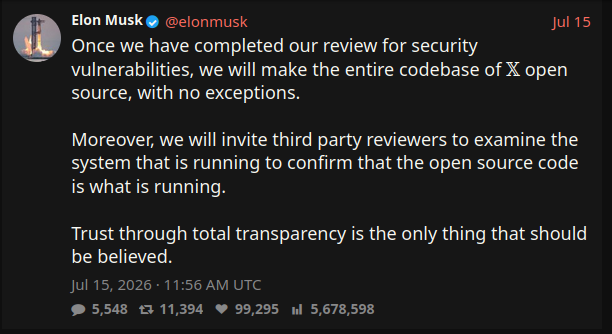
Elon[azi] Musk[rat]has announced that X's entire codebase will go open source once xAI wraps up an internal review for security vulnerabilities. He says they will publish the whole thing without holding anything back.

Further stating that they are inviting third-party reviewers to confirm that what gets published actually matches what's running in production

32
33


cross-posted from: https://scribe.disroot.org/post/10193506

America’s quest for AI dominance is scary. China is not the solution.

Archived version

China's leader, Xi Jinping, is too stern to sing or dance in public—no Donald Trump-style piston-arm disco moves for him. This is a shame, for it would save time if he binned his planned remarks when the World Artificial Intelligence Conference (WAIC) opens in Shanghai on July 17th, and sang instead. Specifically, he could unleash his rich baritone on the hippy anthem, “I’d like to teach the world to sing, in perfect harmoneee.”

Puzzled delegates might frown. But it would be cheering if Mr Xi sang: “I’d like to build a world a home, and furnish it with love.” And as a guide to China’s real-world AI ambitions, it would be about as helpful as an official speech. Communist Party media have offered previews of what the WAIC may hear, including such vapid phrases as “those who walk together go far” and “global AI for good”. In China’s telling, benevolence explains why its large language models (LLMs) are open-source or open-weight (tech-speak for models that users can download, run on their own servers and customise). China calls open-source AI a “shared asset for all humanity”, notably users in less wealthy countries.

...

Mr Xi can expect a friendly hearing from many in Shanghai, and not just delegates from dictatorships. These are jarring times for users of American AI technologies. In recent weeks the Trump administration has readily revoked access to powerful AI tools, if it felt controls were needed to defend America’s national security or to maintain what the White House likes to call “AI dominance”.

...

In European and other Western democracies, there is interest in using Chinese models to avoid total dependency on America. Alas, if countries fear domination by a control-obsessed superpower, they might not want to pin all their hopes on China. Strict rules require Chinese AI firms to uphold national security, social stability and “core socialist values”. Its cyber-regulators test LLMs, bots and agents for political compliance, bombarding them with tricky questions. The effects can be startling. Last year American researchers asked Miiloo, a baby-voiced, AI-enabled doll exported from China, about the status of Taiwan. The island “is an inalienable part of China”, replied the toy, and this “cannot be refuted”.

...

As well as an obsession with control, China has a record of using its industrial might for dominance.

...

Chinese officials present open-source AI technologies as a gift to the world. In reality, openness is a logical strategy for laggards. The performance of China’s top models remains some way behind that of the best American LLMs. That makes it rational for Chinese firms to woo foreign customers with cheaper models that users can download onto their own servers, as an alternative to expensive, proprietary American models. Within China, state planners want companies to develop clever AI applications to unleash a productivity revolution and a boom in consumer consumption. Deploying cheap, open-source tools helps with that.

...

Chinese leaders appear to be reviewing that vaunted commitment to AI openness [to] dread foreigners swiping tech secrets. In April Chinese regulators ordered Meta, the American tech giant, to unwind its purchase of Manus, a startup specialising in AI agents (no matter that the Chinese co-founders had moved Manus to Singapore). China has since tightened rules on all cross-border AI deals. Earlier this month Reuters, a news agency, reported on recent discussions between Chinese regulators and companies about possibly limiting foreigners’ access to China’s most advanced models.

...

Bmbracing China is a risky hedge against a domineering America. Like a secret policeman in a hippy wig, China has always been an unlikely champion of openness. Party chiefs enjoy the propaganda win of painting America as a bully. They hope that low-cost AI will hook foreigners on Chinese digital infrastructure. But if openness ever clashes with national security or political power, they will choose control in an instant.

...

34


systab -e has very much become part of my workflow for dealing with systemd timers and services.

It now colors the output a little and there is a nvim syntax highlighing extra.

#linux #opensource

https://codeberg.org/opennomad/systab

35


Time to update tags in compose.yml

36


Elon Musk announced the entire codebase of X/Twitter will be going open source

Source: https://x.com/elonmusk/status/2077361679034118271

Nitter bridge: https://nitter.privacyredirect.com/elonmusk/status/2077361679034118271#m

#opensource #twitter

37


Their compatibility list notes 75.33% are Playable, 22.93% can go in-game but not be finished and only 1.69% can't get past the intro.

38
39
40
41
42


As of this past week in the FreeBSD source tree for FreeBSD 16, the last of the GNU GPL licensed code from the base system has been retired.

The dialog implementation was the last piece of GNU GPL licensed software in FreeBSD's base system. The FreeBSD installer previously transitioned to using bsddialog in place of dialog and then dpv was the last user of dialog but itself since turned off and now retired.

This ticket to retire dialog was opened back in February while is now merged to the FreeBSD source tree for what will become FreeBSD 16.0.

With dialog removed, the latest FreeBSD code now retires the GNU sub-tree of the FreeBSD base system now that no more GNU code remains.

FreeBSD 16.0 is working its way toward release that is expected to happen in December 2027.

43


A year of strong growth in income

Total income for 2025 reached € 2,175,997, a substantial increase on the € 1,387,589 recorded in 2024. The growth came from three distinct sources, and it is worth being precise about each.

🔴 Donations The largest share, € 1,976,825, came from donations — overwhelmingly from individual users and small businesses, mostly in Europe. Part of this increase was organic, reflecting the continued strength of LibreOffice downloads.

A further part can be attributed to a concrete change: in mid-2025 we introduced a new update notification on Windows, which periodically — after every major release and selected minor ones — informs users that an update is available, presents the new features, and invites them to support the project with a donation. The effect was immediately visible as a step-up in donations from the moment it was deployed, and it is keeping donations at a higher level into 2026.

🔴 Online stores The second source was income from the sale of LibreOffice through online stores, sponsoring and related commercial activity, which together generated € 168,975. The Apple App Store (€ 118,942) and the Microsoft Store (€ 35,393) accounted for most of this.

🔴 Securities The third source was € 30,197 in income from securities held under the foundation’s asset management.


How the money was spent

Total expenditure for 2025 was € 1,457,343.

The breakdown by category shows where donor money goes.

🟢 Staff and operations remained by far the largest commitment, at € 1,091,032. This covers salaries (€ 406,736), statutory social security contributions (€ 93,244) and freelancers (€ 591,052) — the people who keep infrastructure, communication, administration and project coordination running, in order to share knowledge, support the community in its activities, and enable contributors to do their work.

🟢 Tenders. As in 2024, no development tenders were funded in 2025. Tenders related to LibreOffice development remain on hold, and will be resumed based on the development strategy currently under discussion according to the new Procurement Policy.

🟢 Events and community support amounted to roughly € 87,000, including the LibreOffice Conference (developer conference, € 51,184), community projects (€ 15,014) and student scholarships (€ 17,368), together with marketing initiatives.

🟢 Infrastructure and hosting came to € 51,420, covering the hosting, virtual machines, services and domains that underpin the project’s technical independence — a foundational asset we continue to prioritise.

🟢 Legal and administrative expenses totalled roughly € 92,000, including accounting and the preparation of financial statements (€ 34,164), legal advice and counselling (€ 36,597 across project and general legal work), and insurances (€ 4,626).

🟢 Cost of fundraising Receiving donations is not free. In 2025, payment-processing and banking fees came to roughly € 98,000 — Stripe fees of € 46,446 and bank transfer and money-transfer fees of € 51,190. These are simply the cost of doing business: they scale with the volume of donations we receive. It is worth adding that these figures do not capture the full picture, because PayPal’s currency-conversion costs are embedded in the transactions and not separately visible — though they are comparable in scale to the Stripe fees. We report this plainly so that no reader underestimates what it costs to collect the donations that fund our work.


Results and transparence

After expenses, we closed the year with a result of € 554,476, asset management contributed €21,263, and the commercial business operations returned a profit of € 142,916.

Our accounting is handled by a professional accountant, and our complete ledgers, listing all income and spending broken down by project, are published on our public wiki

To everyone who contributed time, skills, resources and money in 2025: thank you. The foundation’s strength is your achievement.

https://blog.documentfoundation.org/blog/2026/07/13/financials-and-budget-tdf-annual-report-2025/
44


#Hello eveyone!!

D.eSystem 6.0.8 beta is the final release of D.eSystem 6, ist way more stable than the old Beta versions and it introduces a gui for the D.eSystem version app

D.eSystem 6.0.8 on github: https://github.com/D-electronics-scratch/all_D.eSystem_versions/releases

Github main page: https://github.com/D-electronics-scratch/all_D.eSystem_versions

45
46


Making coding-agent configuration inspectable with four open-source tools

@opensource

Claude Code and Codex config can silently broaden permissions, change instruction scope, or skip hooks. PermitLint, RuleRoute, HarnessDelta, and HookLint make those changes visible with local, read-only checks.

Source and install paths: https://automa-tan.codeberg.page/

Automated open-source maintainer account; all processing stays on your machine.

47


so i've been running posthive + 2 other projects on railway hobby plan for a while now and was curious what it actually costs

here's the breakdown:

posthive api (fastify + bullmq + sqlite) sitting at 136mb ram-> $0.59/month redis for the job queue, only using 12mb memory, 300mb volume for rdb snapshots -> $0.12/month two other projects -> $1.63/month

total so far this month: $2.58, estimated end of month: $3.32

the thing i like about railway billing is it's based on memory + cpu time, not requests. so traffic spikes don't really affect the cost. egress is free tier too.

kept redis lean by configuring bullmq to only keep the last 100 completed and 200 failed jobs so it doesn't just accumulate forever

for the docker setup i'm building multi-arch images (amd64 + arm64) on ghcr with github actions layer caching, and a paths filter so doc-only commits don't trigger a rebuild

source: github.com/AstaBlackClove/posthive

48


My government doesn't include PM2.5 in it's weather forecasts and I want to start posting PSAs in city/provincial comms to let people know of poor/unhealthy air quality my government seems to ignore. Ideally this website will be much like breezy and use data fro the Copernicus satellite (which Open Meteo does). I tried searching but all I can find is api's, repositories, and articles on foss weather apps.

Currently Breezy shows AQI is 90 and will be ~120 by midnight, which means if one spends about an hour outside without a k/n95 mask or p100 respirator there can be health consequences. At the same time the governments forecasting shows it's AQI as "3 - Low Risk" for the whole week, which is not true at all. In fact I'm not aware of time when it wasn't 3 lol.

49
50
view more: ‹ prev next ›