1
2


Got the old Samsung Galaxy A21 successfully running again as a home project. Besides pictures, wondering what else should be recovered through adb Android SDK.

Planning to test crDroid and lineageOS roms on it.

3


Looking for suggestions besides Kubuntu, KDE Neon, Debian, Arch Linux, or Kali.

Would be on a modest Dell Latitude with i5, 14" 1080p display with intel graphics, and maybe 16gb ram. I have previous experience with XFCE, Ratpoison, Openbox, KDE Plasma. Recently started trying out LXQT.

4
Setting up Caddy with Porkbun (wiki.livingcartoon.org)


Open to suggestions for managing Caddy for domains from Porkbun.

  • Porkbun itself is using Cloudflare.
  • Their Caddy module is confusing to setup due to API changes and older documentation.
  • I'd like to use a declarative json configuration, but first I just need Porkbun to play nice enough to work when adding subdomains via wildcard.

The Goal

Setup legit Lets' Encrypt as wildcard locally to test services at *example.domain.com, then put them into production on mainsite wildcard *.domain.com on VPS or similar.

Seeking Advice

Can anyone advise on setup recommendations. I'm currently using Nginx, which I had no difficulty setting up with ACME challenge. Perhaps I'm approaching Caddy in the wrong way. Thanks for any thoughts.

5


Setup listmonk and now wondering about suggestions for how to maintain a basic list and campaign. Wondering about a few things:

  • Privacy. All I want to know is if people are actually able to read the posts.
  • Any thoughts from others who've been managing their own lists / campaigns.
  • Basic idea is to use for email and RSS to post updates on latest happenings, maybe once a month.

Just want this to be both successful and not annoying. 😄

6


Still very much a work-in-progress. Hope you enjoy.

7


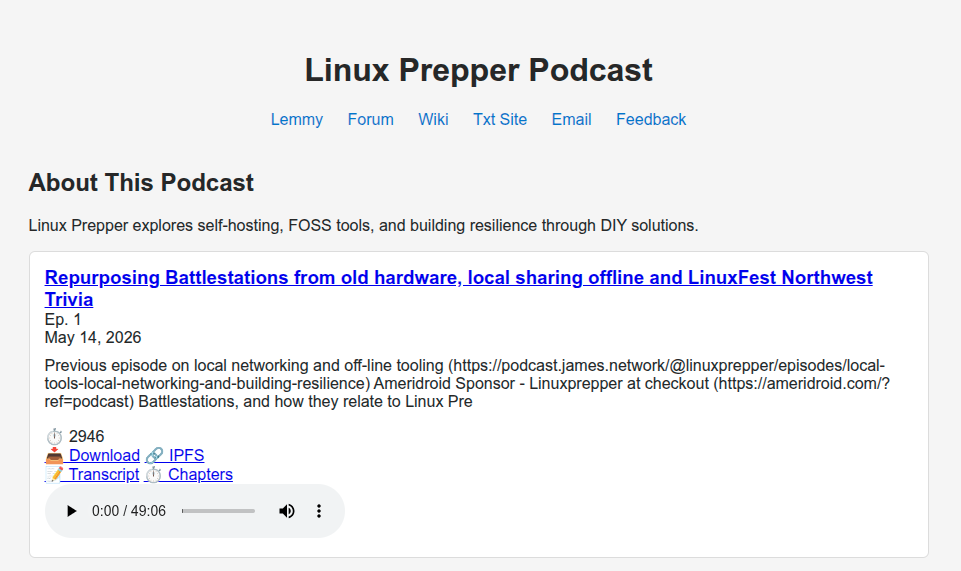
In progress, but aim to make this easy to generate anywhere as index.html, which includes:

  • Download links from regular Castopod RSS Feed
  • IPFS fallback links
  • Transcription Links
  • Chapters optionally integrated into html during generation
8


Details at https://twtxt.dev/ and elsewhere. This has been in development since 2016. All you do is create a txt file in www or html and include info like

# nick        = username
# url         = https://example.com/posts.txt
# avatar      = https://example.com/avatar.png
# description = Describe this

to then begin posting using a command like like

echo -e "$(date -u +'%Y-%m-%dT%H:%M:%SZ')\tHello to all of you out there! >> posts.txt

There are various registries and places you can submit your user via curl to become more discoverable by others. Also tons of spin-offs that add support for fancier markdown and such, but haven't tried those yet.

9
10


Been working on building a wiki over a number of months, but realize it is a ton of work. My goals are:

  • No Database, just files and folders for Dokuwiki
  • Get the experience to feel accessible and fun for users.
  • Make the wiki into something users can save locally and access offline.

The wiki coincides with various DIY and open source projects I'm experimenting with. Thought I'd share here, since this is about the extensions I'm actually using within Dokuwiki. Would love to add more, but just need them to work in daily use first.

Plugins in use:

  • SMTP, so users receive their login credentials.
  • Templator, for treating pages as templates for re-use.
  • Include plugin, for using pages within pages to organize content.
  • Open Document plugin - For export as odt
  • Pagelist, which I'm still learning for organizing tables.
  • Move plugin - for moving location of pages without breaking links.
  • Wrap plugin, for centering images and code blocks.
  • Tag, for adding tag browsing between page.
  • Footer, for clarifying info displayed at bottom of pages.
  • Catmenu, adds a clean, simple tree menu for the page being viewed.
11
submitted 2 months ago* (last edited 2 months ago) by [M] to c/linuxprepperpodcast@discuss.online


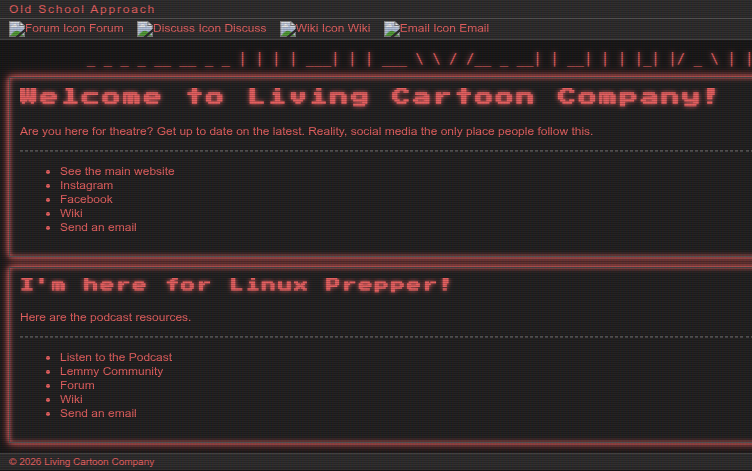
Still in progress. Open to suggestions! Current idea is to offer a dark and light mode switch, plus get some fun icons. Want to introduce variations with visual glitches and such, for more of a cyberpunk aesthetic, that can be generated through a pipeline. This is is an excuse to learn a lot of little, technical things.
12


cross-posted from: https://discuss.online/post/40181742

Assuming the user will not be connecting over vpn, but is both remote and non-technical, how would you expose Jellyfin to them securely?

13


Picked up an ix500 scansnap and wondering about suggested workflows for going paperless. My intention is to scan a bunch of documents, but haven't delved deeply into how this will actually flow on the software level. I know I'll need to OCR the scanned documents, and my base setup is:

  • Pi with SSD storage running compose version of Paperless-ngx to filesystem mounted folders.
    • Folders can also be accessed over Samba
  • ix500 statically assigned over wifi as network scanner.
  • A literal filing cabinet, for things I should keep physically.
  • Ubuntu computer for browsing

I feel a bit overwhelmed, but am excited to get started. Will be scanning personal document, work docs, whatever else I need to digitize and recycle. All suggestions appreciated!

14


cross-posted from: https://discuss.online/post/40119886

Honest question, because I know multiple people who are not looking to jump ship since they already have the Plex Pass.

15


My thought is to use 3 VPS I already have as a small cluster... 2gb, 2gb, and 8gb running Debian 13. Traffic to Pangolin (Traefik + Wireguard) on all three, to serve Castopod for podcasting, whose media is served from garage S3 across all nodes. Authentication from Authentik + LLDAP, with plan for adding additional services once the base setup is solid. Thoughts and suggestions appreciated!

  +---------------+
  |  Internet    |
  +---------------+
           |
           |
           v
  +---------------+
  |  Load Balancer  |
  |  (Pangolin)    |
  +---------------+
           |
           |
           v
  +---------------+---------------+
  |         VPS 1  |         VPS 2  |         VPS 3  |
  +---------------+---------------+---------------+
  |  Castopod    |  Castopod       |  Garage S3     |
  |  Authentik   |  LLDAP         |  Authentik     |
  | Garage S3   | Garage S3   |  LLDAP         |
  +---------------+---------------+---------------+
16


Yes, I know castopod does not render notes as Lemmy does.

Shownotes

(00:00)

Previous episode on local networking and off-line tooling

(00:37)

Ameridroid Sponsor - Linuxprepper at checkout

(01:20)

Battlestations, and how they relate to Linux Prepper

(02:35)

Your input much appreciated on this long term exploration

(03:08)

Two Desktops from Thin Clients, Detailed Notes

(07:00)

Older Intel Graphics and X Window Manager Support vs Wayland

(07:52)

32-bit and Multi-Architecture Support, Wine, Proton

(12:00)

Love 2D Engine and Compiling Back 32-bit Support

(13:07)

Moonring, Free RPG Game inspired by Ultima

(13:21)

Balatro, Card Game

(13:27)

Arco - Turned-based, Meso-american Adventure Game

(14:03)

100 Tools You can Selfhost on Minimal Hardware

(14:57)

Pipewire, Wireplumber, QPWGraph, pw-jack

(18:30)

Aphex Twin Premium Episode Coming Soon

(19:22)

Memory Management from 16gb to 1gb RAM

(20:11)

Zram, adding efficient memory compression

(21:26)

12GB RAM total notes on setting up Zram, Swap, Swappiness

(22:39)

16GB RAM total notes on my other Intel NUC

(23:37)

EarlyOOM Daemon monitoring Zram and Swap

(26:14)

Swappiness, what triggering it does

(27:55)

Considerations for 8gb to 1gb of total RAM

(32:08)

DURP Challenger downgrading to Pi 3 as appliance

(33:02)

File Management with Core Utils through SSH

(33:31)

SCP for One-Way Transfers

(34:29)

Rsync - One-way Transfers with Comprehensive Control

(36:02)

Unison - Resilient Bi-directional Rsync for Two Locations

(38:09)

Scaling up without cloud services or servers

(39:34)

Syncthing - P2P Real-time Sync with client support

(42:24)

Rclone - Rsync-like support for Cloud Providers: Dropbox, Google Drive, S3

(43:30)

Minimal Homelab Implications; Try The Tools and Win

(45:01)

Container Concerns vs Understanding Tooling

  • Understanding how tools actually work when deploying

(45:42)

Trivia Winners from LFNW and Named Projects!

(46:13)

LinuxFest Northwest 2026 Wikipage with Youtube Links

(48:01)

SeaGL Call for Speakers Open Now!

17
18


Full layout on my forum here. Basic idea is 3 thin clients that fit within:

  • 1u space requirement
  • Possibly adding 2.5gb nic to the pci-e low profile slots of each hp t740 for Ceph shared storage.
  • Kubernetes and/or Proxmox experiments
    • Adding some sort of remote management via jetkvm or pikvm or similar.
    • Additional expansion no doubt needed for connecting to the three nodes.
+----------------------------------------------------------+
|                    CLUSTER TOTALS                        |
+----------------------+-----------------------------------+
| TOTAL CORES          | 12 physical / 24 threads          |
| TOTAL RAM            | 192 GB DDR4                       |
| TOTAL STORAGE        | 1.5 TB NVMe (local only)          |
| TOTAL NODES          | 3                                 |
| TOTAL NICs           | 3–7 (depending on 4-port NIC)     |
| GPU                  | None                              |
| KVM/IPMI             | None                              |
+----------------------------------------------------------+

All suggestions greatly appreciated! Never done this before, but hoping to save myself from the future hassle of having to drive to the data center... would much rather log in on Wireguard and address things by remotely rebooting, etc.

19


cross-posted from: https://discuss.online/post/38171652

For me, I'll be waiting for at least a point release in Ubuntu before I ever consider migrating any machines. Then I'll check against the forums and any security announcements.

20


Lemmy struggles with properly displaying the Castopod shownotes. I've filed a bug report here.

Relaying show notes here...

Why Offline & Local-First

  • Rising Cost of Consumer Technology
  • Cloudflare Outages - interest in local hosting
  • Re-purposing older machines into functional use!

(00:11)

Offline Tooling, Local Tooling, Resilience Introduction

(00:50)

Sponsor Ameridroid

  • LINUXPREPPER code

(01:14)

Domain Changes and thoughts after years on .network, xyz and org

(01:32)

Forum posts related to simple, resilient setups

(02:21)

Do you have a device in a drawer that might be useful as-is?

(04:38)

KDE Connect - Thoughts after Three Years

(08:30)

Unbound, DNSMasq - Local DNS Caching, Recursive DNS and Resolvers

(09:30)

Quad9 - Global Public Recursive DNS for Public Benefit, alternative to Cloudflare and Google

(09:55)

Local DNS Resilience and Why It Matters

(12:15)

Connecting Multiple Services and What DNS Adblocking Actually Does with Pi-Hole, Adguard Home, etc.

(13:04)

Dividing IP Ranges for Custom DNS, Adblocking assignments

(13:55)

Adding Resilience, Privacy and Speed Most Routers Do Not Offer Natively

(15:20)

Challenges You Can Try at Home!

(15:59)

Wiki in early development as plain text. Learn more on the forum

(17:00)

Low Key Gear Exchange for LFNW. Details for forum users!

(17:36)

100 Selfhosted Services for Low End and 32-bit Hardware

(19:11)

HomeLab Episode to be released with Robin Monks. Unedited interview available on Premium

(19:29)

Nginx, Caddy - Reverse Proxy via DNS Challenge for Local HTTPS Testing

(20:00)

mDNS and Avahi for remote machines gifted to others without https

(22:35)

Become a Premium Subscriber to Support the Show

(23:36)

How resilient is your setup? Let me know! podcast@livingcartoon.org

(24:05)

Discord and bridged Matrix Chats for discussing the show! Please Share with Others!

(24:55)

LFNW Schedule, should be live shortly. April 24th - 26th

(25:11)

AI Scanned My Brainrot, Live only at LFNW, on 04/26 at 3pm!

(26:17)

Upcoming Episode on SeaGL, LFNW and Conferences!

21


Genuinely curious, what makes a project into AI slop for you. Was thinking about this based on a recent discussion of recommended self-hosting tools, which brought up ntfy.

  • Massively popular project. Repo releases since 10/2021 and 29k stars on github.

Context: ntfy

  • Sponsors include Warp, an AI-based development environment. That sponsor is mentioned twice in the readme. Saw a mention in a chat room of the project being described as having become AI slop, but don't see any such concerns in their project repo within any issues or merged pull requests. And, the code is dual licensed under Apache 2.0 and gpl-2.0

What do you think? Is the sponsorship as problematic as actual code? Or, is there something else I'm missing. Curious on how you would compare ntfy with other sorts of AI concerns.

22


Domain annual and VPS monthly services come to mind.

23


I find everyone using different services, so unsure how to best manage (and balance) concurrent access in Ubuntu/Debian to:

  • Local network services
  • Tailscale services from userA
  • Tailscale services from userB
  • Wireguard (OpenVPN also option) from userC
  • Twingate from userD

Each user is wanting to share different services via VPN, and pressuring any to change their production setups to a different style of VPN is not going to happen.

  • Management via software in Ubuntu
  • Possibly up a routing device along the lines of OpenWrt or OpnSense.
    • Could even distribute such devices between these friends.

Thanks for all thoughts!

24


Didn't realize this was actually a John Cage composition.

25


Curious on suggestions for airtags, or similar, for tracking important things on flights or other cases where losing the specific item would be too much of a financial / sentimental loss. Anyone doing this from Linux, or from graphene? How is it?

view more: next ›