1


I work at a non profit and we just wok union recognition and are slowly moving towards first contract negotiations and I HAVE NO IDEA WHAT I'M DOING. Would love to chat with some folks about their experiences, especially if you've negotiated around contracts/grants/etc.

2


Miners wearing safety equipment walk through an underground tunnel at the South Deep gold mine, operated by Gold Fields Ltd., in Westonaria, South Africa, on Thursday, March 9, 2017. South Deep is the world''s largest gold deposit after Grasberg in Indonesia, makes up 60 percent of the company''s reserves and the miner says it''s capable of producing for 70 years. Photographer: Waldo Swiegers/Bloomberg

The Catholic Church says it is shepherding a class-action lawsuit through the courts against mining companies in South Africa on behalf of coal miners with lung disease.

The Southern African Bishops Conference said on Wednesday that lawyers filed papers with South Africa’s High Court on Tuesday.

“Very often ex-mine workers are no longer members of trade unions and, therefore, lack the means and capacity to seek legal recourse from large companies which are responsible for their lung diseases,” Archbishop of Cape Town Stephen Brislin said.

“It is thus incumbent on the church to give assistance where it can, … so that they can access compensation that is legally due to them.”

The miners are represented by Richard Spoors, a lawyer who has won compensation in similar cases before.

Filed on behalf of 17 former and current mine workers, the case targets mining giant BHP, its spin-off South32 and South Africa’s Seriti, Dasantha Pillay, a lawyer with Spoors’s firm, told the Agence France-Presse news agency.

It seeks recourse for all miners who worked for these companies since 1965 and contracted lung disease as well as dependents of workers who died from coal dust-induced illness.

The firms did not immediately reply to AFP’s request for comment.

The church said it initiated and facilitated the case after it was approached by mine workers for assistance.

Coal is a bedrock of South Africa’s economy, employing almost 100,000 people and accounting for 80 percent of electricity production. The industry is concentrated in the eastern region of Mpumalanga, which environmental campaigners Greenpeace said has some of the dirtiest air in the world.

The class action accuses the companies of failing to provide their workers with adequate training, equipment and a safe working environment despite knowing the risks to coal miners.

3


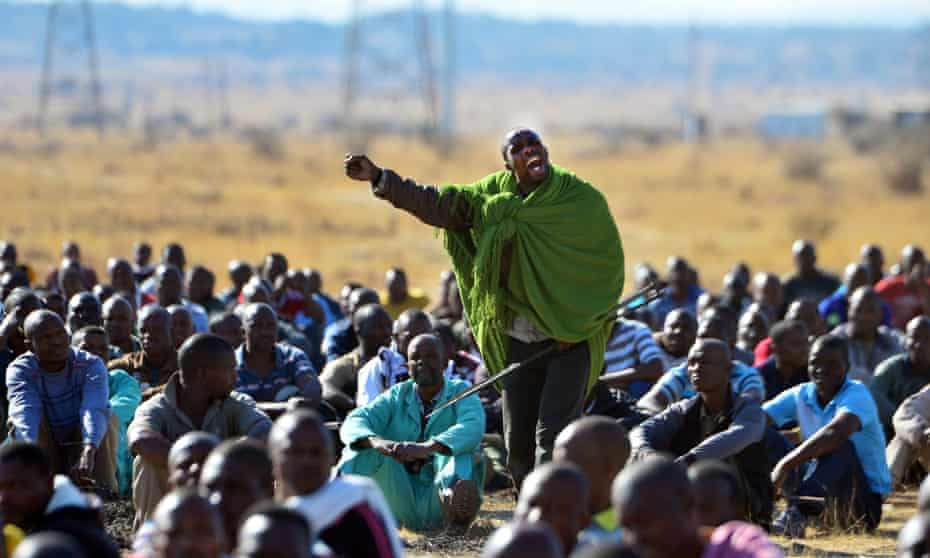
On this day in 2012, the Marikana Massacre took place when South African police fired on striking workers, killing 34 and injuring 76 in the most lethal use of force by the state in half a century.

The shootings have been compared to the infamous Sharpeville Massacre in 1960, when police fired on a crowd of anti-Pass Law protesters, killing 69 people, including 10 children. The Marikana Massacre took place on the 25-year anniversary of a nationwide strike by over 300,000 South African workers.

On August 10th, miners had initiated a wildcat strike at a site owned by Lonmin in the Marikana area, close to Rustenburg, South Africa. Although ten people (mostly workers) had been killed before August 16th, it was on that day that an elite force from the South African Police Service fired into a crowd of strikers with rifles, killing 34 and injuring 76.

After surveying the aftermath of the violence, photojournalist Greg Marinovich concluded that "[it is clear] that heavily armed police hunted down and killed the miners in cold blood."

Following the massacre, a massive wave of strikes occurred across the South African mining sector - in early October, analysts estimated that approximately 75,000 miners were on strike from various gold and platinum mines and companies across South Africa, most of them doing so illegally.

A year after the Marikana Massacre, author Benjamin Fogel wrote "Perhaps the most important lesson of Marikana is that the state can gun down dozens of black workers with little or no backlash from 'civil society', the judicial system or from within the institutions that supposedly form the bedrock of democracy."

Megathreads and spaces to hang out:

reminders:

  • 💚 You nerds can join specific comms to see posts about all sorts of topics
  • 💙 Hexbear’s algorithm prioritizes comments over upbears
  • 💜 Sorting by new you nerd
  • 🌈 If you ever want to make your own megathread, you can reserve a spot here nerd
  • 🐶 Join the unofficial Hexbear-adjacent Mastodon instance toots.matapacos.dog

Links To Resources (Aid and Theory):

Aid:

Theory:
4


The success or failure of a union election is almost always determined by knowledge of the workforce and an intimate understanding of the values and beliefs of each employee. The union suppression industry has made workforce intelligence gathering a key element of its trade.

In the ’70s and ’80s, industrial psychologist Charles Hughes trained over 27,000 managers and supervisors to “make unions unnecessary.” One of his methods was to promote the use of surveys to collect information about workers. Employers signed up by the hundreds to attend Hughes’s talks, including a seminar titled, “Attitude Survey Techniques for Measuring Union Sentiments.” CUE — which hosted the conference — helped streamline the emerging industry of management consultants, industrial psychologists, and law firms that helped turn the tide against the labor movement, which has declined precipitously since the ’70s.

“It’s intimate to talk about race and identity,” said Duff. “That creates a vulnerability, and to have consultants come in and say, ‘Hey, look, I understand the discrimination you’ve gone through, you can open up to me,’ that can get you a lot of valuable intelligence.”

Such vulnerabilities can be key insights during an organizing drive. In 2011, Pratt Logistics opened a new plant in Pennsylvania. The company brought in a man who only identified himself as an efficiency expert named “Jay.” Jay went around conducting one-on-one interviews with workers, asking them about what problems they faced, their values, and concerns.

Later, when truckers and warehouse workers at Pratt began steps to form a union at the new plant, the company instantly fired union sympathizers. It wasn’t until later that they found out Jay’s real identity: Jason Greer, the union suppression consultant, who had been hired explicitly to identify potential union supporters.

When the Teamsters union later brought the case to court, arguing illegal retaliation and unfair labor practices, labor attorneys noted that Greer on his website explicitly advertised himself as a “union buster” who “wakes up every day with one goal in mind, and that’s to keep unions from taking over and ruining businesses that my friends and my clients have worked their entire lives to build.”

Those words are gone from Greer’s website. Now he lists himself as a diversity consultant.

Danine Clay and Byron Clay of the firm Diverse Workforce Consultants are among the union avoidance professionals who have worked on recent high-profile campaigns to persuade workers against joining a union at Hershey’s and at Mission Hospital in North Carolina, according to disclosures. Their firm touts its “ability to empower management with employee selection, retention, diversity training and skills, and union avoidance tools and strategies are unmatched.”

Danine Clay was listed on disclosure forms as a consultant for Amazon engaged in persuading warehouse workers not to join a union. Over the phone, she said the disclosure form was incorrect but declined to comment further.

“There’s kind of a jiujitsu, to get employees thinking about racial justice issues, at least superficially, as a way to deflect labor and collective bargaining,” said Michael C. Duff, a law professor at the University of Wyoming. Duff attended law school after union organizing cost him his job working for an airline. He understands why the diversity, equity, and inclusion field has become an asset for companies hoping to skirt unionization — particularly at a time when employee interest in both is rising rapidly.

“Labor consultant folks converting into DEI folks,” added Duff. “It’s really a wonderful kind of psyops, right, because these people are supposed to be close to employees.”

5
Workers and Climate (portside.org)
submitted 3 years ago by to c/labour@hexbear.net
6
7


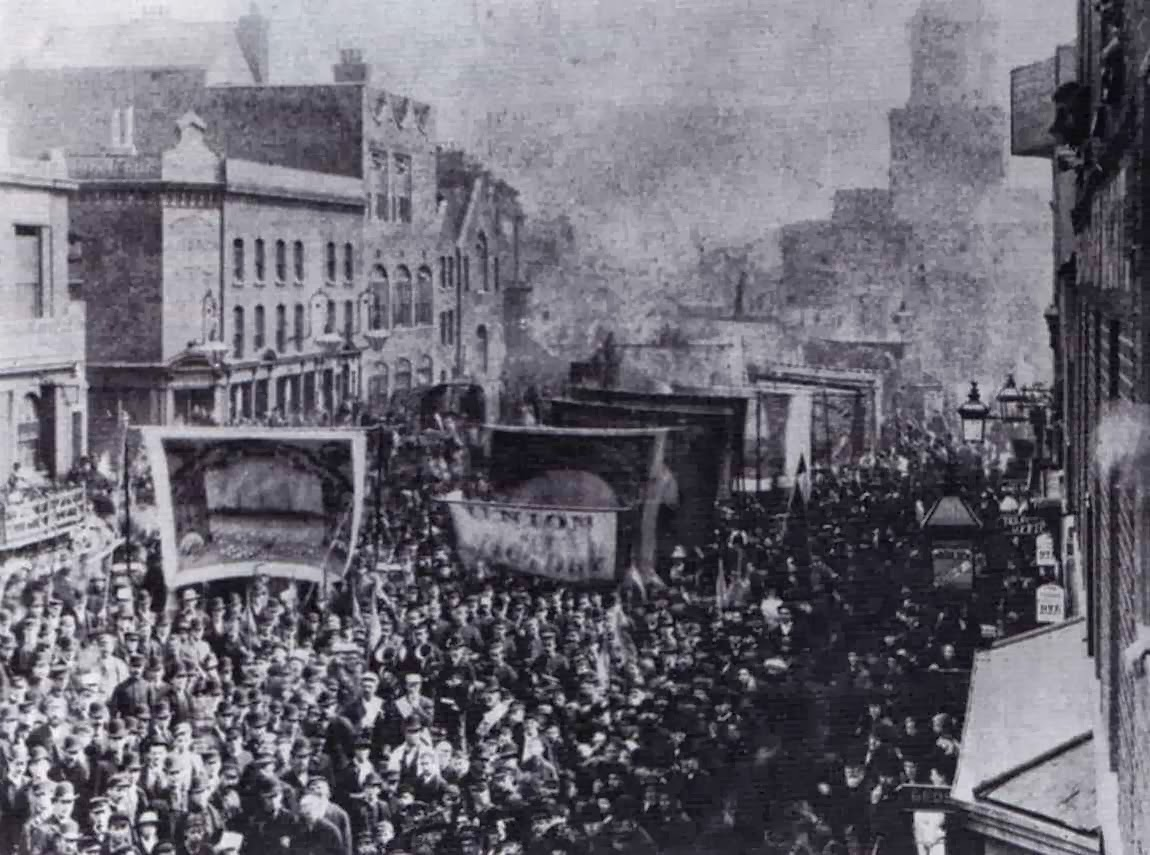
A huge and powerful strike of British dockers against low pay, unsafe conditions and casual, precarious employment contracts which, with international solidarity, won nearly all its demands and marked a turning point in UK working class history.

The dangerous nature of port work, combined with low pay, poor working conditions and widespread social deprivation ensured that the workforce looked to their trade unions for protection. As a result, industrial relations were strained throughout the history of the port.

Until the late 19th century, much of the trade of the port was seasonal. Sugar came from the West Indies, timber from the north, tea and spices from the Far East. It was difficult to predict when ships would arrive since bad weather could delay a fleet.

The number of ships arriving during a period of four successive weeks in 1861 at the West India Dock was 42, 131, 209 and 85. On some days there were many ships in the docks, on others very few.

There was very little mechanisation - the loading and discharging of ships was highly labour-intensive. Demand for men varied from day to day because there was very little advance notice that a ship was arriving. The dock companies only took on labourers when trade picked up and they needed them.

The 'call-on'

Most workers in the docks were casual labourers taken on for the day. Sometimes they would be taken on only for a few hours. Twice a day there was a 'call-on' at each of the docks when labour was hired for short periods.

Only the lucky few would be selected, the rest would be sent home without payment. The employers wanted to have a large number of men available for work but they did not want to pay them when there was no work.

The dock strike began over a dispute about 'plus' money during the unloading of the Lady Armstrong in the West India Docks. 'Plus' money was a bonus paid for completing work quickly. The East and West India Dock Company had cut their 'plus' rates to attract ships into their own docks rather than others.

A trade depression and an oversupply of docks and warehousing led to fierce competition between the rival companies. The cut in payments provided the opportunity for long-held grievances among the workforce to surface.

Led by Ben Tillet, the men in the West India Dock struck on 14 August and immediately started persuading other dockers to join them. The Dockers' Union had no funds and needed help.

The support they needed came when the Amalgamated Stevedores Union, under Tom McCarthy, joined the strike. Not only did they carry high status in the port but their work was essential to the running of the docks.

Support from the stevedores

The stevedores' union issued a manifesto, entitled To the Trade Unionists and People of London. This called on other workers to support the dockers

Other workers followed the lead of the stevedores, including the seamen, firemen, lightermen, watermen, ropemakers, fish porters and carmen. Strikes broke out daily in factories and workshops throughout the East End.

The port was paralyzed by what was in effect a general strike. It was estimated that by 27 August 130,000 men were on strike.

The dockers formed a strike committee to organize the dispute and decide on its aims. The main strike demand was 'the dockers' tanner' - a wage of 6d an hour (instead of their previous 5d an hour) and an overtime rate of 8d per hour.

They also wanted the contract and 'plus' systems to be abolished and 'call-ons' to be reduced to two a day. They also demanded that they be taken on for minimum periods of four hours and that their union be recognized throughout the port.

The Strike Committee organised mass meetings and established pickets outside the dock gates. They persuaded men still at work and 'blacklegs' to come out on strike.

During the strike the port was at a standstill and the dock companies were losing money. Despite this, they believed that giving into the dockers' demands would set a dangerous precedent.

From the beginning of September however money poured in from Australia. The first instalment of £150 was sent by the Brisbane Wharf Labourers' Union.

In all, over £30,000 was raised by the Australian dockers and their allies. It arrived at just the right time and meant the end of worries about feeding the strikers and their families.

The dockers could now face a longer strike and the leaders knew they could now concentrate on the picket lines. Defeat through hunger now seemed very unlikely and the dockers scented victory.

On 5 September, when the strike was in its fourth week, the Lord Mayor of London formed the Mansion House Committee.Its aim was to try to bring the two sides together to end the strike. Ben Tillett and John Burns represented the dockers at the negotiations.

The Mansion House Committee persuaded the employers to meet practically all the dockers' demands. After five weeks the Dock Strike was over. It was agreed that the men would go back to work on 16 September.

After the successful strike, the dockers formed a new General Labourers' Union. Tillett was elected General Secretary and Tom Mann became the union's first President. In London alone, nearly 20,000 men joined this new union.

The success of the Dockers' Strike was a turning point in the history of trade unionism. Workers throughout the country, particularly the unskilled, gained a new confidence to organise themselves and carry out collective action. From 750,000 in 1888, trade union membership grew to 1.5 million by 1892 and to over 2 million by 1899

Og article - Libcom penguin-love

Megathreads and spaces to hang out:

reminders:

  • 💚 You nerds can join specific comms to see posts about all sorts of topics
  • 💙 Hexbear’s algorithm prioritizes comments over upbears
  • 💜 Sorting by new you nerd
  • 🌈 If you ever want to make your own megathread, you can reserve a spot here nerd
  • 🐶 Join the unofficial Hexbear-adjacent Mastodon instance toots.matapacos.dog

Links To Resources (Aid and Theory):

Aid:

Theory:
8
9
10


New South Wales Labor premier Chris Minns came to power after promising to scrap the coalition’s public sector pay freeze. After less than five months, he has spectacularly broken his promise — and offered what amounts to a pay cut.

During its 2023 state election campaign, New South Wales (NSW) Labor committed to abolishing the state’s wage cap, which has depressed the pay packets of public sector employees such as public-school teachers, nurses, and transport workers since 2011. After ousting the Liberal-National Coalition government, NSW Labor built on the goodwill it had generated among teachers by immediately commencing negotiations with the NSW Teachers Federation (NSWTF) over a new agreement.

By May 31 this year, the union and NSW government had all but signed off on a suite of improvements for teachers and, by implication, students. These included reforms to how casual, temporary, and permanent teachers are paid as well as an increase to paid time out of class, to allow teachers to complete planning, programming, assessments, reporting, and other important work. The new enterprise agreement would also have scrapped the wage cap by granting a pay raise, which, for salaried teachers, would have amounted to between 8 and 12 percent, depending on position and years of experience. Teachers in NSW seemed set to win an above-inflation salary increase, making them the highest-paid teachers in the country.

On June 22, the NSW Department of Education reaffirmed the agreement, which was set to commence from October 9 this year, and last for twelve months. Then, on July 28, in a sudden and unexpected backflip, the NSW Labor government vacated negotiations with the NSWTF and rescinded its proposed agreement. The government’s new offer is a betrayal and it amounts to austerity.

https://jacobin.com/2023/08/new-south-wales-teachers-federation-chris-minns-australian-labor-party-pay-cut/

11
ISG in Action: Railroad Workers United (independentsocialistgroup.org)
submitted 3 years ago by to c/labour@hexbear.net
12


Finally

Some good fucking news

13


Content moderators from several African countries demanded compensation of 1.46 billion euros for violation of labor rights and outsourcing. So far, most of the demands made by the sector to the technology transnationals have been ignored.

Kenyan workers who clean the Internet of toxic and harmful content have formed a union to demand better working conditions. The situation of underemployment and precariousness of work, which affects workers in this sector hired by high-tech companies, is well known.

The job of the content moderator is to navigate through online content and detect information that is violent, disturbing, and controversial. Sometimes it may be extremely violent videos, other times it may be political propaganda, images that denigrate people, child pornography, etc.

The need to filter the content of social networks has created a labor sector that has been characterized by poor remuneration and inadequate working conditions. A starting point in the long struggle of demands of the new union will be the raising of the current salary in Kenya, which is barely three euros an hour.

Other demands of the Kenyan union will be directed to the design of more respectful protocols, the creation of mental health services, as well as the establishment of safety standards and means of occupational safety.

As in other sectors of production and services, the first world externalizes the socio-economic and political cost of "decontamination" jobs to underdeveloped labor markets. In this way, they evade the rigorous protocols of their countries of origin and make labor cheaper.

In 2022, Facebook's Spanish-language content moderation staff, subcontracted in the United States itself, denounced the terrible working conditions they had, compared to their English-language counterpart.

The basic demands that have arisen from workers in the sector around the world, especially in those countries where there are fewer labor regulations for online work, have been: the need for a programming of rotation cycles for at least three months. This involves rotating through different types of content, as well as total rest from moderator work. Thirdly, there is the right to mental health assistance, and the design of realistic demands for compliance with the work program. Longer times should be determined to make moderation decisions, which on average requires regulating content every 60 or 66 seconds with an effectiveness of 85 percent.

Months earlier, content moderators from several African countries demanded compensation of 1.46 billion euros for violation of labor rights and outsourcing. So far, most of the demands made by the sector to the technology transnationals have been ignored.

14


Two weeks after workers at the company announced a union drive, Grindr management has issued a return-to-office policy that workers say is retaliatory.

LGBTQ dating app Grindr has issued a new return-to-office policy requiring staff to relocate to other cities, just two weeks after its workers announced they were unionizing with the Communications Workers of America. The certification form, sent to workers on Monday night and obtained by Motherboard, states that the policy requires workers to either move within 50 miles of their newly designated office or lose their jobs.

Workers told Motherboard that the policy was first announced on Thursday, during a previously scheduled all-hands meeting, and that it was the first time they had heard from management since the unionization was announced.

“We announced our union on July 20 and then we heard literally nothing from Grindr management until Thursday, when they announced that we all had two weeks to decide whether we were going to move across the country or get fired,” said Quinn McGee, a trust and safety product manager and organizer at Grindr United CWA. “As soon as George [Arison, Grindr’s CEO] stopped talking, one of my colleagues began to ask a question about all of us suddenly having to uproot our lives—and they cut the call.”

“The root of the problem here is that it's an extremely disrespectful and rude way to convey this kind of dramatic change,” said Jack Alto, a staff software engineer and union organizer.

On Monday night, Grindr management sent out a return-to-office certification form, which was obtained by Motherboard. The form asked workers to declare whether they lived within 50 miles of their designated office, and if not, whether they were willing to move by October 3. If workers were not willing to relocate to their new offices—Chicago for the engineering team, Alto said, and Los Angeles or the San Francisco Bay Area for the product and design teams—their jobs would end on August 31. By choosing this option, workers would receive six months of severance pay and COBRA healthcare benefits, the memo states.

“Any team member who does not complete and return this form by August 17, 2023 will be considered not to have agreed to comply with Grindr’s hybrid work policy and RTO plan and/or to have declined to relocate, (if applicable),” the notice states. “Those team members will be offered the applicable severance package (including a separation agreement and release) and their last day of employment with Grindr will be August 31, 2023.”

The form states that Grindr was “excited about its hybrid work model” and how it would “foster the inclusive culture and community we so deeply believe in.” In a memo reported by Bloomberg, CEO George Arison claimed that the company had been working on the policy “for many months.”

“It's not even a well-drawn-out plan,” said McGee, who mainly works out of their home in New York City. “They have not told us where the office in the Bay Area is going to be. If this was indeed planned for months as they're claiming, why isn't there a lease? They’ve sublet a WeWork space that I would wager, given the WeWork space that we have in New York, is not big enough for the entire product design team that they've told to move to California. So where do they expect us to be working?”

A Grindr spokesperson did not respond to a request for comment.

“To tell me that I have two weeks to decide whether or not to uproot my family's life, for a job that won't come to the table and speak with me as an adult—it’s dehumanizing,” McGee said. “This is a very, very difficult time in the country right now for trans people. This is hard for anybody, but particularly for trans people. That they have to uproot themselves from where they have found safety and security and family is appallingly cruel. Telling us to move to cities where we don't have medical providers. It's appalling. I'm lost for words.”

Workers first started organizing in December of last year, Alto said, after Grindr became a public company and they started seeing some “worrying signs.”

“Our demands as a union can basically be summarized as, ‘We like our jobs. We like our benefits. We would like to codify these in writing so that the rug doesn't get pulled out from under us,’” Alto said. “And Grindr management's response, likely at the urging of Littler Mendelson, has been to pull the rug out from under us faster.”

Littler Mendelson is a law firm that says it specializes in “initiating strategies that lawfully avoid unions.” The CWA announced that Grindr had hired the firm on Friday. The union also filed an unfair labor practice charge against the company claiming the new policy was retaliatory to unionizing workers.

“This requirement to return to in-person work threatens employees with job loss if they either do not work near an in-person office or relocate to an area near the in-person office and constitutes a change in its disciplinary system,” the charge states.

“The queer voices that are the workers of Grindr engaged in protected organizing activity, and asked for voluntary recognition, and were ghosted,” McGee said. “We want a strong Grindr. We want a successful Grindr that works for all the people who use it as a welcoming place for the whole LGBTQ community. And we want to build it together. There's still time to do the right thing. All they have to do is say yes, and it would be that easy.”

15


I'm job hunting and went to a website to confirm if it was a real business. It just sucks that it's my personal responsibility™️ to make sure the email that replied to my application was the real thing. That somewhere between the email confirmations, the website redirects, and the occasional polite interviews, somebody could've just taken my personal information or gotten my money.

And then there's nobody who will do anything if I did get scammed.

But go off on how nobody wants to work anymore. This shit is exhausting.

16
17


cross-posted from: https://hexbear.net/post/292581

lets-fucking-go

18


Thoughts on the essay?

I also happen to know the writer (Chris Townsend) and happen to be in contact with them.

19
20
submitted 3 years ago by [M] to c/labour@hexbear.net


neera stalin-gun-1 sicko-zoomer sicko-wholesome

21
22
23


You love to see it, but we'll see how this evolves.

24


But the working class needs much more. And these moments when workers have huge strategic power in a tight labor market are fleeting.

The Nation has been getting more radical as a news outlet and column outlet lately.

Thoughts on the article?

Thoughts on the UPS victory in general?

25


Definitely a must-read article, imho.

Thoughts?

I'm genuinely interested in what others have to say to this article.

Thanks in advance!

view more: next ›