1

Context: This one is pretty self explanatory I think. The British attacked (and still do) a lot of places, also the Scottish are technically British so they focus on the English aspect.

Context: During the late 1980s and early 1990s, as South Africa was transitioning toward democracy, brutal political violence erupted between supporters of the African National Congress (ANC) and the IFP, Inkatha Freedom Party, a Zulu-nationalist political party led historically by Mangosuthu Buthelezi.
When the Truth & Reconciliation Commission (TRC) investigated this violence, it uncovered extensive evidence of what became known as the "Third Force." The commission revealed that the apartheid state's security forces had covertly funded, armed, and trained elements within the IFP to fight the ANC. The regime's goal was to destabilize the liberation movement, show black inability to function without whites at the helm and weaken the push for a democratic transition.

Context: Dutch prime minister Jan-Peter visited Eindhoven and attempted to skate.


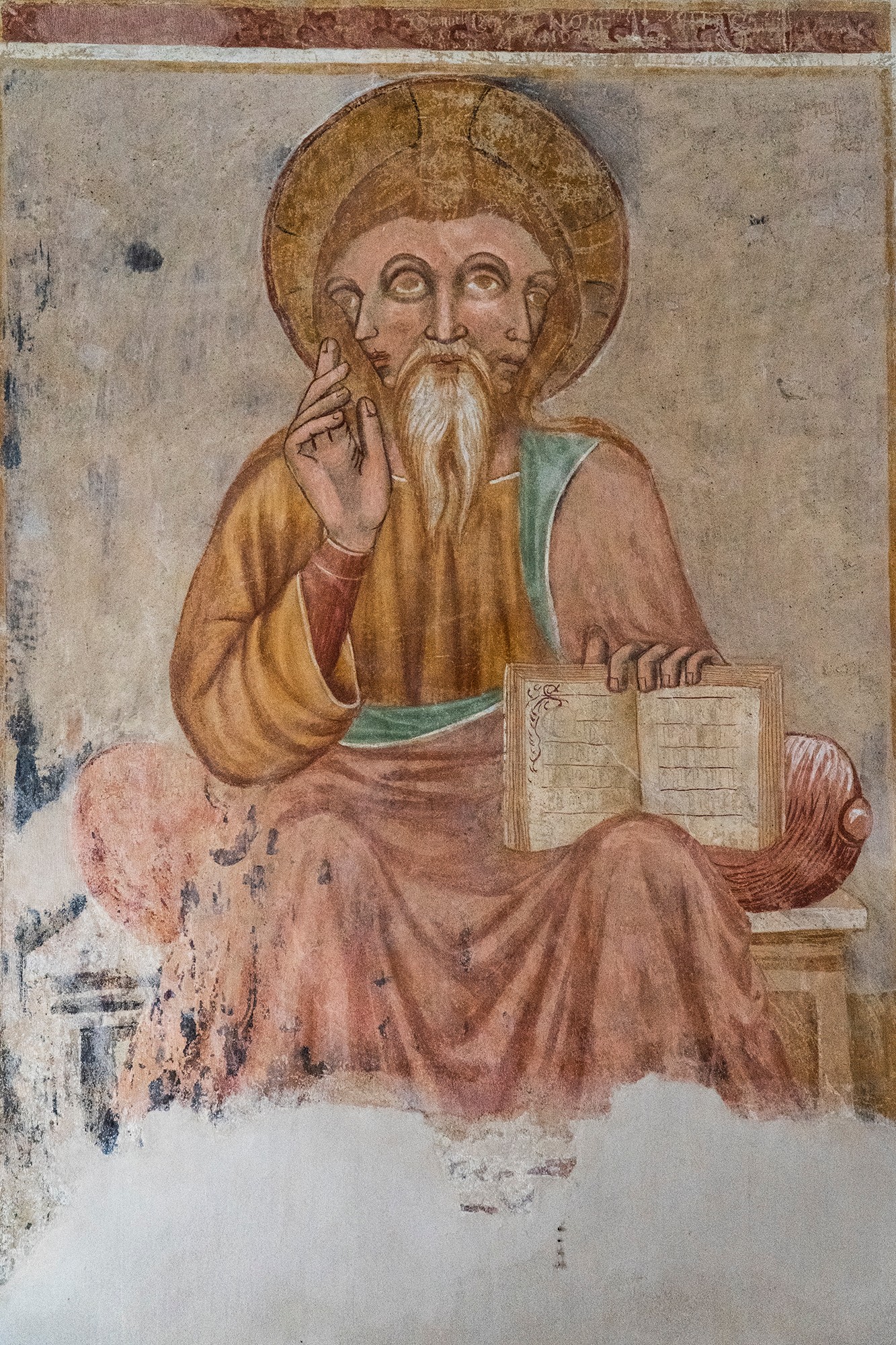
Context: The Vultus Trifrons, or Trifacial Trinity, was a bizarre type of Christian iconography that first appeared in the 12th century. It took the Holy Trinity and grotesquely depicted it as a singular figure (typically Jesus) with three faces merged together To symbolize the Father, Son and Holy Spirit in one entity. This depiction would be banned by Urban VIII in 1628, as it was considered heretical, too reminiscent of pagan depiction of gods, and generally disturbing to look at.
A Vultus Trifrons:

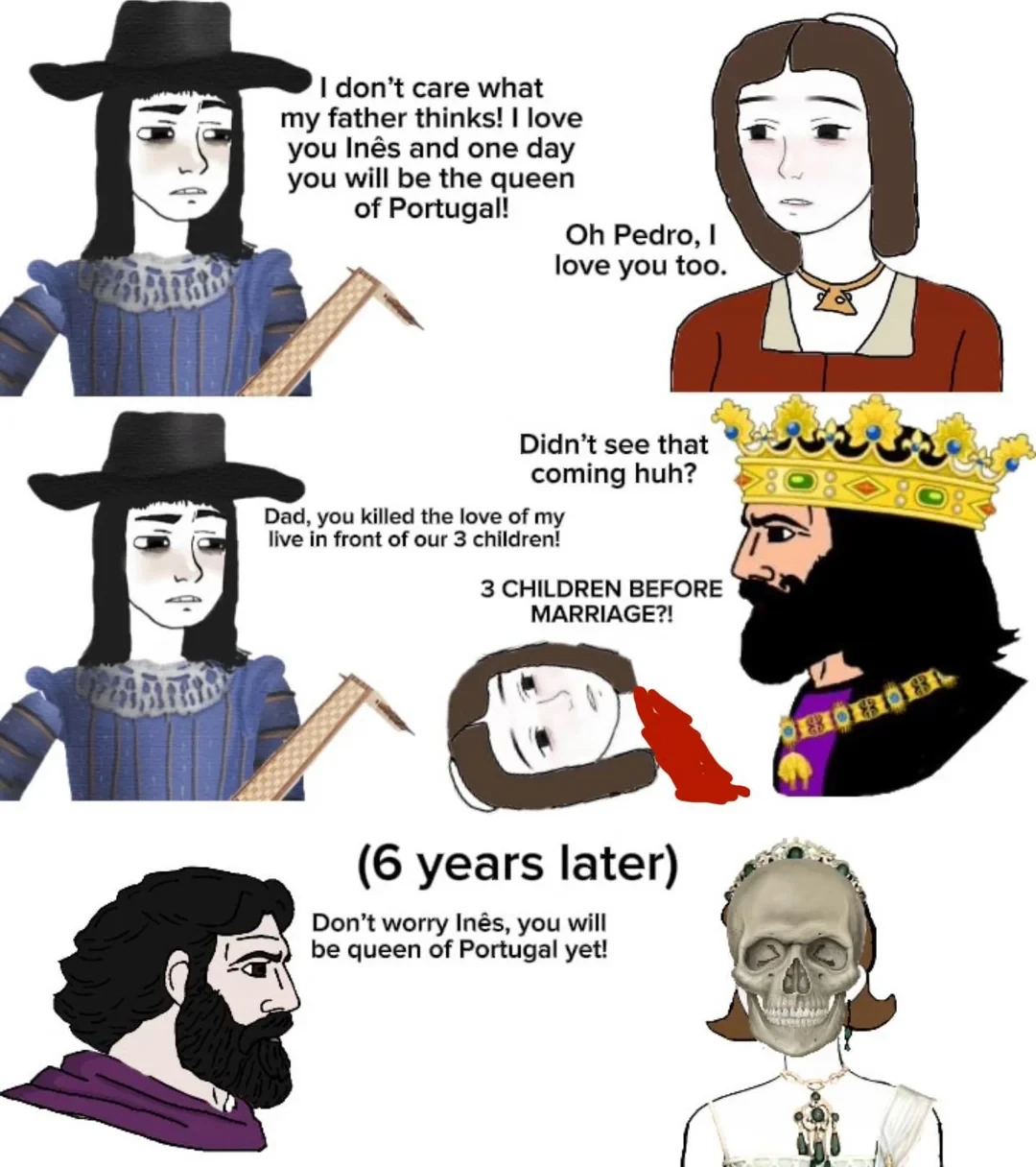
Context: After Prince Pedro married his wife Constance, he fell in love with Inês and took her as his mistress. Disapproving of his son's adultery, King Afonso IV is said to have banished Inês to Albuquerque (Spain) in 1344. Following Constance's death in 1349, Inês returned to Portugal and lived openly with Pedro. Within the coming years they would have 3 children, all the while King Afonso attempted to arrange a second marriage for his son, but Pedro refused.
Pedro also developed close relationships with Inês's brothers, Fernando Ruiz de Castro and Álvaro Pires de Castro. The brothers became increasingly influential in public affairs, causing intrigue among rival factions at the Portuguese court and threatening Portugal's neutrality in the Castilian Civil War. King Afonso IV grew concerned about the power the Castros wielded over the Infante and ordered Inês's assassination. Afonso's knights, Pêro Coelho, Álvaro Gonçalves, and Diogo Lopes Pacheco, travelled to the Monastery where Inês was residing and decapitated her in front of her small children on 7 January 1355.
Pedro would become king in 1357 and sought out Inês' killers, who had gone into exile in Castile. Pedro managed to capture Coelho and Gonçalves and ordered them to be executed by ripping their hearts out. Around 1361 he admitted to have secretly married Inês in 1353 (this would however turn out to be a lie in 1385 as the pope denied Pedro’s secret request). Pedro commissioned a tomb for Inês, and later one for himself, in the Alcobaça Monastery. Before her entombment, Pedro then ordered the body of his beloved Inês to be placed on a throne, adorned with the diadem and royal robes, and required all the nobility of the kingdom to approach and kiss the hem of her garment, granting her that homage which she had not received in her life.
Context: On February 1842, during the First Opium War, Prince Yijing, cousin of Emperor Daoguang and the Commander of the offensive against British occupation in eastern Zhejiang, went to a temple in Hangzhou and asked for a fortune stick (kau chim). On the stick it said some riddles about "tigers" (不遇虎头人一唤,全家谁敢保平安).
In Chinese, people use the word "Yang Ren (洋人)" to represent foreigners. The word "洋" (Yang) means something foreign or related to the ocean, but also has the same pronunciation and similar structure of the word "羊" (sheep).
Inspired by the fortune stick and the Tibetan reinforcements that wore tiger hides in battles, Yijing had a genius idea that he can use "Tigers" to eat the "Yang (sheep)" for breakfast. Therefore, he came up with the strategy called "Five tigers ambush the Yang (五虎扑洋之计)".
The battle plan is as follows:
The timing is very important. According to traditional Chinese beliefs, he chose the time to commence the counteroffensive on year 1842 (Year of the tiger), March (Month of the tiger) the 10th (Day of the tiger), at 4 in the morning according to Chinese calendar (Hour of the tiger). For the commander, he hand picked Duan Yongfu, a general who was born in the Year of the tiger. Therefore all five "tigers" are set for the plan. In the opening phase, the Tibetan soldiers who wore tiger hides would be the assault force to eat up the force of "yang" by force of surprise.


Context: In the early 18 hundreds the Napoleonic was on going. Denmark was at the time a naval force to be reckoned with. Although not exactly a threat to the British fleet, the British were worried that Denmark would be occupied by the French, which could potentially boost the size of the French fleet. This would in turn give the French a fleet that would allow them to take the British fleet head on. As a preemptive measure the British asked Denmark to hand over the majority of they vessels. However Denmark wanted to remain neutral in the war, and giving a large chunk of ships to one side would definitely have made the French upset. Thus they denied the British request. Following this the British decided to destroy the potential threat. This ended with the 1807 bombardment of Copenhagen. The Danish fought back, but in the end handed over a bunch of ships, after they had also lost a handful.
Oak trees are the common tree for construction of large ships, in the age of sails. Oak trees are however only harvested after around 120 years of growing and maintenance. And the Danes had no were near the amount of forest or trees at hand to rebuild the navy. That's why they planted the trees that a now known as "flåde eg" or "the fleets oak"

Context: Prior to construction, the tower was protested by "Artists against the Eiffel Tower" saying
"We, writers, painters, sculptors, architects and passionate devotees of the hitherto untouched beauty of Paris, protest with all our strength, with all our indignation in the name of slighted French taste, against the erection ... of this useless and monstrous Eiffel Tower ... To bring our arguments home, imagine for a moment a giddy, ridiculous tower dominating Paris like a gigantic black smokestack, crushing under its barbaric bulk Notre Dame, the Tour Saint-Jacques, the Louvre, the Dome of les Invalides, the Arc de Triomphe, all of our humiliated monuments will disappear in this ghastly dream. And for twenty years ... we shall see stretching like a blot of ink the hateful shadow of the hateful column of bolted sheet metal"
It was intended to be a temporary structure taken down after the Exposition Universelle, but after being allowed to stay it eventually became a key point of pride in France.


Context: In 1938 Nazi Germany, Pervitin was developed a methamphetamine drug for civilian usage. Nazi military doctor Otto Friedrich Ranke tested the drug on 90 university students to study its effects, which led him to conclude that Pervitin could help Nazi Germany win the war.
Methamphetamine use is believed to have played a role in the speed of Nazi Germany's initial blitzkrieg operations. At the request of Vice-Admiral Hellmuth Heye for a stronger pill that would "keep soldiers ready for battle when they are asked to continue fighting beyond a period considered normal," a pharmacologist produced a pill dubbed D-IX. The new drug contained cocaine, whose effects substantially overlap with those of amphetamine but feature greater euphoria, and a morphine-based painkiller in addition to Pervitin.


Context: The Library of Alexandria was famously burnt down by Julius Caesar's troops as they set fire to some ships docked in the port. More likely is that it only burnt down one of the libraries warehouses, the Library itself was not destroyed and remained active for centuries, slowly losing it's fame and significance as it declined.
During the Arab conquest, it is said that they fully burnt the books in the library, but such sources for this claim first appear 500 years after the conquest and are most likely political slander rather than reality.

Context: A classic tactic, the Parthian Shot involves feigning a retreat and firing at those foolish enough to break ranks and follow your forces. Famously used by the Parthians and Mongols. This became a staple for many steppe nomads.


Context: While the 90% figure is made-up, the premise is true in that most of human history has gone unrecorded. History is considered to have begun with the start of proto-writing (earliest being the Jiahu symbols in China circa 6600 BCE) to writing (3200 BCE), and thus the advent of recorded history.

Context: During the Siege of Caffa, Jani Beg of the Golden Horde allegedly catapulted the corpses of troops who had died from the siege over the walls of the Genoese held city of Caffa.
This claim comes from Gabriele de’ Mussi, a writer who was not actually at the siege.