1
posts
2
3
4
This video is actually terrifying. So many scholars and politicians from all sides of the political isle ignored the holodomor for decades.
5
6
A horrifying story about a french serial killer, Dr. Marcel Petiot, who operated before and during WW2.
He pretended to help people escape France but then killed them instead. He was caught be the Gestapo and tortured but refused to confess and pretended to be a resistance member. At least one real resistance members believed him and it hampered his trial but he was eventually executed.
Commissaire Georges-Victor Massu, a 33-year police veteran with more than 3,200 arrests to his credit, immediately took charge of the case. Examining the death house, he noted basement sinks large enough for draining corpses of blood, and a soundproof octagonal chamber with wall-mounted shackles, a peephole centered in its door. Massu was still on the scene at 1:30 a.m., when a telegram arrived from Paris police headquarters. It read: “Order from German authorities. Arrest Petiot. Dangerous lunatic.”
7
Dionis L. Kaptar Writer and publicist, Moscow, Russia Keywords: Propaganda Due; P2; Licio Gelli; Operation Gladio For citation: Kaptar, D. L. "Politics Behind the Scenes in Western Political Life." Humanities and Social Sciences: Bulletin of the Financial University 13, no. 5 (2023): 114-120. https://doi.org/10.26794/2226-7867-2023-13-5-114-120 © Dionis L. Kaptar, 2023
Silvio Berlusconi, who served four terms as Italy's prime minister, died on 12 June 2023. He had been sentenced to prison several times, and his name had repeatedly surfaced in scandals that damaged his political career. This article, however, concerns events long predating the 1994 founding of Forza Italia, the party he led. A scandal in the early 1980s again raised questions about power exercised out of public view and about organisations that operated largely beyond public scrutiny yet may have been capable of shaping political events. The subject attracts a great deal of speculation, much of it plainly fanciful and unsupported; such claims are rightly rejected as unscientific. The case of Propaganda Due (P2), the Masonic lodge to which Berlusconi belonged, was different: it drew the attention of the Italian authorities.
In 1981, the government of Prime Minister Arnaldo Forlani resigned after a major scandal involving P2. The story of the lodge begins with Freemasonry itself.
There are many theories about its origins. Some are essentially legends, reaching back to remote antiquity, biblical times or the classical world. Freemasonry has been linked to the Crusaders, the Knights Templar, the Druids and the collegia, or associations, of ancient Rome. The most convincing explanation, in my view, is that modern Freemasonry grew out of the medieval guilds of builders, a lineage reflected in the term "freemason" itself. The Masonic degrees of master, fellow craft and apprentice probably derive from the hierarchy of those guilds.
Guilds once wielded considerable economic and political influence. Their position weakened in the early modern period, and the stonemasons' guild gradually changed with it. An association of craftsmen eventually became an organisation embracing people from different occupations and social strata. In 1670, for example, the Aberdeen Masonic lodge "had 49 members, only 10 of whom were working stonemasons" [1].
Masonic fraternities that still undertook building work in the seventeenth century needed capital. Money therefore became a decisive consideration when men from outside the trade began to be admitted [2]. Freethinkers and members of the aristocracy joined the lodges for different reasons: the former saw a means of spreading their ideas, while the latter were drawn by the legends surrounding the brotherhood's past [2].
The Grand Lodge of London and Westminster was founded in 1717. The 2nd Duke of Montagu became its head in 1721, followed by the 1st Duke of Wharton in 1723, the 2nd Duke of Richmond in 1724, Lord Paisley in 1725 and the Earl of Inchiquin in 1726. Later leaders also came from the titled elite. They included the Prince of Wales, who would become King George IV, and Prince Augustus Frederick, a son of George III.
The historian Sergei Kiyasov writes that the active supporters of a controlled liberalisation of government institutions and of the broader system of social and political relations in the second half of the eighteenth century included "Frederick II of Prussia, Joseph II of Austria, Catherine II the Great, Gustav III of Sweden and many other European rulers who sincerely hoped to see the principles of the 'citizen-king' prevail. Influenced by theories that seemed both attractive and progressive, they counted the institutions of 'new' Freemasonry among their ideological allies and even lent them support through their personal participation" [3]. This was one of several factors that helped Freemasonry spread.
Eugène de Beauharnais played an important part in the establishment of a grand lodge in Italy. He took charge of the Grand Orient of Italy in 1805. P2's history began in 1877, when the Grand Master of the Grand Orient founded the Propaganda Massonica lodge. Freemasonry was banned in Italy in 1925, but regained legal status after the Second World War, and Propaganda Massonica was renamed Propaganda Due. The businessman Licio Gelli took over the lodge in 1975.
Long before taking charge of P2, Gelli had fought for Francisco Franco in the Spanish Civil War as a member of a Blackshirt battalion. In 1942, while serving as an inspector for the National Fascist Party, he was involved in transferring to Italy the treasures of King Peter II Karađorđević of Yugoslavia. Gelli spent three post-war years in hiding in Argentina [4, p. 104].
Many Nazis are known to have escaped justice in Latin America. Gelli helped to establish a ratline1 and assisted Klaus Barbie, the "Butcher of Lyon", in his escape [5, p. 109]. Barbie eventually stood trial in 1987. Gelli never held senior public office. For several years he worked as a chauffeur and secretary to a member of the Italian parliament. On the parliamentarian's recommendation, he became manager of one of Permaflex's plants. He later headed the personnel department at the Lebole factory and soon afterwards founded the Giole company with Mario and Giovanni [4, p. 106].
His Masonic career began with an application for admission in 1963. He joined Lodge No. 182, became a Fellow Craft in P2 in 1966 and, in 1971, was appointed to the senior position of organisational secretary of P2 by a circular signed by Lino Salvini, Grand Master of the Grand Orient of Italy [4, p. 107].
"Licio Gelli's connections were expanding. Nor did he lose touch with old associates, among them Stefano Delle Chiaie, Pierluigi Pagliani and Joachim Fiebelkorn, commanders in the private army set up in Bolivia by Klaus Barbie, the former head of the Lyon Gestapo, and known as the 'Fiancés of Death'" [5, p. 113].
Applications to join the lodge rose sharply. Gelli himself described it as a centre for international political mediation [4, p. 110]. His fortunes then collapsed just as quickly. The scandal that cost Arnaldo Forlani the premiership also ended Gelli's career. The trail that led to the P2 scandal began with the banker Michele Sindona.
Sindona was born in Sicily in 1920 and graduated in law from the University of Messina in 1942. The Allied landings in Sicily followed in 1943, after which a military government was established on the island. Its members included Charles Poletti, a former governor of New York. A first-generation American who knew both the Italian language and Italian culture, Poletti was well suited to the post. It was alleged that he knew Vito Genovese, a mafioso involved in black-market trading, and attempts were also made to link him to Lucky Luciano. Poletti denied the claims.
Sindona, meanwhile, established contacts with Sicily's new authorities, sold wheat on the black market and was known to Luciano [6, p. 24]. None of this, by itself, proves that Poletti was involved in illicit dealings. Sindona's rise, however, did owe much to Luciano, who enlisted him in laundering Mafia money [6, p. 25]. Why would a Mafia boss entrust such sensitive work to Sindona? His unusual background helps explain it. Sindona straddled two worlds: he was a well-educated lawyer, but also a black-market operator. That combination was unusual. Both men were Sicilian, a connection that carried weight in local circles.
In 1946, Sindona moved to Milan and opened a tax consultancy. He became a highly skilled accountant with expertise in moving capital abroad and using offshore structures. Among his clients was the senior mafioso Joe Adonis, who had ties both to Luciano and to the Genovese family. Sindona also met Cardinal Giovanni Battista Montini, the future Pope Paul VI.
His business interests continued to grow. He controlled several banks and companies in sectors ranging from hotels and construction to the manufacture of chocolate and porcelain. Sindona traded currencies internationally and acquired a controlling interest in Franklin National Bank, then one of the largest banks in the United States.
Yet his businesses showed signs of trouble. Several companies came close to bankruptcy and were sold. In 1971, an inspection by the Bank of Italy found breaches of the law in the operations of two Sindona banks. One was declared insolvent in 1974, and Sindona was suspected of fraudulent bankruptcy. Franklin National Bank also failed that year. Sindona came under investigation in the United States and, in 1980, received a 25-year prison sentence. He was convicted on dozens of counts, including perjury, fraud and the misappropriation of bank funds.
In 1981, the Italian authorities searched Villa Wanda, the home of a friend of Sindona's, on the assumption that Sindona had hidden documents there relating to the illegal export of currency. The search uncovered P2 membership lists, classified government papers and confidential intelligence files on prominent politicians [6, p. 12].
The villa belonged to Licio Gelli, bringing the investigation back to him.
The list contained a striking number of influential names: army generals, naval admirals, senior officers of the Guardia di Finanza and the Carabinieri, intelligence chiefs, parliamentarians, business figures and professors. Vittorio Emanuele of Savoy, the son of Italy's last king, appeared on it, as did the prominent businessman Silvio Berlusconi. "P2 also had 'its people' among the largest publishers, the directors of television and radio programmes, journalists, sociologists and leading cultural figures. The lodge controlled, for example, the influential Rizzoli publishing house and Italy's largest newspaper, Corriere della Sera, as well as the Milan magazine Settimanale and the pro-Fascist weekly Borghese" [6, p. 13].
The list soon became public. On 26 May 1981, the government, including Prime Minister Forlani, resigned. A day later, Rome's public prosecutor, Domenico Sica, issued a warrant for Gelli's arrest on charges of "political espionage" and forming a "criminal organisation" [6, p. 14].
Gelli remained beyond the reach of Italian justice for a long time. He was arrested in Switzerland but escaped from prison and, according to some accounts, spent a period in South America. The lodge's list included several prominent Argentines who had held senior public posts at different times. In 1987 Gelli settled in Switzerland; the following year, Switzerland agreed to extradite him to Italy. He was tried and sentenced to 18 years in prison for fraud connected with the collapse of Banco Ambrosiano.
The bank's principal shareholder was the Institute for the Works of Religion, an institution of the Roman Curia that performs banking functions for the Holy See. An appellate court reduced Gelli's sentence to 12 years. The Court of Cassation upheld the conviction in 1998, whereupon he absconded from house arrest. He was detained in France and, from 2001 until his death in 2015, remained under house arrest at Villa Wanda.
Gelli was also suspected of involvement in the death of the banker Roberto Calvi, whose body was found in London in 1982. A sheet of paper in his pockets bore several names, including P2 members and other prominent figures. Gelli was formally charged, but his name did not appear in the final indictment.
The parliamentary commission investigating P2 also examined events surrounding an attempted coup in 1970, and Gelli's name surfaced there as well. The episode became known as the Golpe Borghese, or Borghese coup, after its leader, Prince Junio Valerio Borghese, a member of an aristocratic family.
Borghese had fought for Franco in the Spanish Civil War as a submarine commander. During the Second World War he first commanded the submarines Vettor Pisani and Scirè. In 1943 he took command of the Decima Flottiglia MAS, a naval infantry formation of the Italian Social Republic2. After the war he stood trial on suspicion of involvement in the execution of Italian partisans.
He received a 12-year prison sentence but was granted an amnesty in 1949. In 1951 he became president of the neo-Fascist Italian Social Movement. He founded the neo-Fascist National Front in 1968 and began preparing a military coup the following year.
The putsch began on the night of 7-8 December 1970. Militants led by Stefano Delle Chiaie entered the Ministry of the Interior. "The Blackshirts enter the armoury and begin carrying automatic weapons to a waiting lorry; they set up heavy machine guns on the stairways. The veteran Fascists Stefano Delle Chiaie and Sandro Saccucci urge their men on: 'Hurry! Hurry! It's about to begin!'" [6, p. 52]. The conspirators also moved into action in Venice, Verona, Lombardy, Umbria and Tuscany.
Then an order from Borghese abruptly halted the coup. The public did not learn of the attempt until 17 March 1971. On 18 March, Rome's deputy public prosecutor issued arrest warrants for several people, including Borghese, but he had already fled to Spain. Borghese died in 1974 without publicly disclosing why he had called off the coup. In 1988, the Parliamentary Commission of Inquiry into Terrorism in Italy and the Reasons Why Those Responsible for Massacres Had Not Been Identified considered several possible explanations, but did not claim to have established conclusively why he stopped the operation.
Its report contains a rather vague indication that the order came from Licio Gelli. Several people associated with the coup were P2 members: "not only Saccucci, but also Remo Orlandini, the 'Black Prince's' right-hand man; police captain Salvatore Drago, who opened the doors of the Interior Ministry to the putschists; and General Vito Miceli, head of SID - all were Freemasons. More than that, they were members of the secret P2 lodge" [6, p. 53]. SID was Italy's intelligence service from 1966 to 1977. Miceli took charge in 1970 and remained in the post for several years.
Another scandal erupted in 1990, this time over the organisation known as Gladio and the operation of the same name. The revelations brought Gelli and P2 back into view.
"The US-funded anti-communist 'parallel' government P2 and the secret Gladio units worked closely together during the First Republic. After P2 was exposed, Licio Gelli escaped arrest and left for South America. At the end of the Cold War, he readily confirmed that the secret army had been recruited from committed anti-communists," writes the historian Daniele Ganser [7, p. 94].
The name Gladio comes from gladius, the sword carried by Roman legionaries. The organisation itself dates back to the 1950s. Western planners considering a hypothetical war with the Soviet Union allowed for the possibility that the Soviet Army might occupy large areas. In that event, clandestine forces were to conduct sabotage behind Soviet lines.
Weapons caches were prepared and personnel recruited and trained. Networks of paramilitary cells appeared in several countries of the Western bloc. The Italian network was called Gladio. Its counterparts elsewhere had different names, although "Gladio" became an informal generic term for such networks. Similar organisations are reported to have existed at least in France, Belgium, Denmark, West Germany, Greece and Switzerland.
The entire programme remained secret, known only to a small circle. Francesco Cossiga, President of Italy from 1985 to 1992, once remarked: "I am proud that we managed to keep everything secret for a full 45 years" [7, p. 26]. In 1990, Prime Minister Giulio Andreotti formally acknowledged Gladio's existence. Italy is a parliamentary republic, yet until then its parliament had not known that the country had long been part of an agreement to establish a sabotage network on Italian soil.
How closely did the declared purpose - clandestine operations in the event of a hypothetical war with the Soviet Union - match the plans of Gladio's creators? Could it have been a cover for other purposes from the start? Western governments in the 1950s may well have been preparing in earnest to mount sabotage against Soviet forces, and may have continued to plan for it throughout the Cold War. But the networks also gave those who controlled them a means of exerting pressure on national governments. NATO helped to run Gladio, and the United States held, as it still holds, the dominant position within the alliance. Intelligence agencies were involved as well, above all the CIA. Suppose a Western European country had tried to loosen Washington's influence and pursue policies sharply at odds with American interests. Could the United States have responded through those clandestine networks? No government could be certain that it would not. The possibility alone offered leverage.
Could these networks in practice have been controlled by what I call unofficial centres of power, operating beyond public view? After the P2 scandal, it is hard to insist that such power has never existed, does not exist and could never exist. Some reports even claim that Gelli headed two lodges more secretive than P2. Nor is the issue limited to potential influence: did Gladio's operations directly affect events in particular countries?
For many years, the Red Brigades were blamed for the bombing at Peteano on 31 May 1972. According to the police report, the explosive used in the attack was the same type as that used by the Red Brigades. Judge Felice Casson later established that the falsified forensic findings had been supplied by Marco Morin, an explosives specialist with the Italian police and a member of the neo-Fascist group Ordine Nuovo [7, p. 13].
The car had been rigged with C4, an explosive used by NATO, among others. Early in 1972, before the Peteano bombing, police found a cache near Trieste containing C4, weapons and ammunition. By investigating the incidents in Trieste and Peteano, Casson established that the bombing had been carried out by Vincenzo Vinciguerra, a member of Ordine Nuovo [7, p. 14].
Vinciguerra later spoke of an unnamed structure: "In the absence of a Soviet occupation, which might never have happened, this immensely powerful organisation took it upon itself, on NATO's behalf, to prevent the country's political situation from shifting to the left. It did so in cooperation with the official intelligence services and the political and military authorities" [7, p. 18].
Andreotti maintained that applicants to Gladio were carefully vetted and could not belong to extremist organisations [7, p. 24]. If Vinciguerra was speaking about Gladio, however, a question remains: how did he know about it? Would it not be reasonable to suppose that he was a member?
Accounts of Gladio often mention Stefano Delle Chiaie. His name also surfaced in connection with the bombing at Bologna. "According to Elio Ciolini, a neo-Fascist follower of Gelli who had become disillusioned with his former idol, the mass killing was planned in detail at a P2 meeting in Monte Carlo on 11 April 1980, attended by Licio Gelli. Ciolini also testified under oath that operational command had been entrusted to the 'bloody trio' already mentioned: Stefano Delle Chiaie, Pierluigi Pagliani and Joachim Fiebelkorn" [5, p. 117]. Delle Chiaie has also been mentioned in connection with the Milan bombing, the Borghese coup, a series of train bombings in 1972 and the bombing of the Italicus Express. The courts, however, did not convict him of any offence in those cases or in the Bologna case. For that and other reasons, I am not prepared to claim that Gladio was in fact involved in terrorism.
Whatever the truth about Gladio's involvement in terrorism, the paramilitary network itself remained hidden for decades. If one such organisation could be created, what would prevent the same thing from happening again?
NOTES
- Ratlines were routes used by Fascists to escape from Europe.
- A German-backed puppet state that existed from 1943 to 1945 in German-occupied parts of Italy. REFERENCES
- Kiyasov, S. E. “Shotlandskii sled v masonskom dvizhenii Britanii” [The “Scottish Trace” in Britain’s Masonic Movement]. Izvestiya Saratovskogo universiteta. Novaya seriya. Seriya: Istoriya. Mezhdunarodnye otnosheniya 16, no. 3 (2016): 319-323. [In Russian]. https://doi.org/10.18500/1819-4907-2016-16-3-319-323
- Faiziev, T. M. “Masonstvo kak fenomen obshchestvenno-politicheskoi zhizni Anglii pervoi poloviny XVIII veka” [Freemasonry as a Phenomenon in the Social and Political Life of England in the First Half of the Eighteenth Century]. Candidate of Historical Sciences dissertation, Russian State University for the Humanities, Moscow, 2000. 218 pp. [In Russian].
- Kiyasov, S. E. “Vlast i masonstvo v epokhu novogo vremeni: protivostoyanie ili soyuz?” [Power and Freemasonry in the Early Modern Period: Confrontation or Alliance?]. Izvestiya Saratovskogo universiteta. Novaya seriya. Seriya: Istoriya. Mezhdunarodnye otnosheniya 19, no. 1 (2019): 43-51. [In Russian]. https://doi.org/10.18500/1819-4907-2019-19-1-43-51
- Rossi, G., and F. Lombrassa. Vo imya lozhi [In the Name of the Lodge]. Translated from Italian. Moscow: Mezhdunarodnye otnosheniya, 1983. [In Russian].
- Yallop, D. Kto ubil papu rimskogo? [Who Killed the Pope?]. Translated from English. Moscow: Progress, 1986. [In Russian].
- Malyshev, V. V. Za shirmoi masonov [Behind the Masonic Curtain]. Moscow: Sovetskaya Rossiya, 1984. [In Russian].
- Ganser, D. Sekretnye armii NATO: Operatsiya “Gladio” i terrorizm v Zapadnoi Evrope [NATO’s Secret Armies: Operation Gladio and Terrorism in Western Europe]. Moscow: Kuchkovo pole, 2017. [In Russian].
ABOUT THE AUTHOR Dionis Leonidovich Kaptar - writer and publicist, Moscow, Russia https://orcid.org/0000-0001-9754-4378
original : https://humanities.fa.ru/jour/article/view/880/868
8
Hearing the term «conspiracy theory» many begin to smile condescendingly. Others react differently – they become agitated, use «conspiratorial terms» and thus sometimes amuse those around them. There's an interesting fact: although conspiracy theories are often considered the delirium of paranoids, the topic itself never fades from the agenda.
One way or another, the discussion of such theories, even in the form of mockery, has been ongoing for many years. At one point, Douglas Rushkoff – one of the most famous media analysts – cited the main reason for Ross Perot's defeat in the 1992 presidential race as his belief in a conspiracy by part of the U.S. elite who found it disadvantageous for someone who belonged neither to the Democratic nor Republican parties to come to power. Having brilliantly started his campaign, Perot suddenly «went underground» at the height of the battle, curtailing his activities, citing fear of his competitors' machinations. Meanwhile, it's impossible to call billionaire and seasoned politician Perot a paranoid outsider. When he resumed his campaign, it was too late, and Perot failed to make up for lost time. This event became a subject of intensive discussion in American media, often with a sympathetic tone: this is what happens to those who believe in conspiracies. But did Perot truly believe in a conspiracy?
Or, perhaps, did he use it as an excuse, since winning was not his goal? Some said that by participating in the race, he simply wanted to advertise his business. It was claimed that his real goal was to take votes away from Bush so that Clinton would become president, while others saw it as a folly of a satiated rich man. However, in this case, what’s important is that the «conspiracy theory factor» can be used, even as noise cover or an excuse. It seems that if the principles on which conspiracism is built are so absurd that they provoke mocking smiles, why are conspiracy theories so frequently discussed? Why is significant effort spent on ridiculing and caricaturizing such ideas, pushing them to complete and obvious absurdity? When something is either not discussed at all, or, conversely, is too intensively mocked, it’s worth paying close attention to what’s happening.
To silence a topic, one must have, first, significant power, and second, a serious motive. And the same is required to launch a large-scale, long-term discussion. The attitude towards conspiracy theories is very telling. When you start analyzing this phenomenon, you immediately encounter typical signs of manipulation of consciousness. Conspiracy theory, you say? Ha-ha-ha. And to the question of what made you laugh, sometimes there's not even a condescending answer. Just think, such nonsense. That is, the dialogue does not develop, the approach to the problem is so firmly rooted in the mind that it does not even require evidence. However, if you do manage to get an opponent to talk, often no real arguments are provided, but a mocking response is given, such as: «Ah, you're also going to say that reptilians organized everything».
This happens if the acceptance of an idea occurred without its critical understanding and comprehension of its essence. And this is the core of manipulative techniques. Look, if a conspiracy theory is so absurd, then why was manipulation needed to combat it? Tell everything as it is, show why such a theory is incorrect and absurd, and forget about it. But no. Instead of explanations – manipulation, ridicule, and caricature, meaning, in essence, there is no refutation. The lack of clarity on the issue allows manipulators to label a whole spectrum of diverse phenomena.
So, let's first understand what we're talking about. According to the theory of conspiracy, the subjects of social processes are a relatively narrow group of influential people who have set a specific goal for themselves and achieve it. Tell me, what is absurd and so funny in this interpretation that it almost completely blocks any discussions on the validity of the conspiracy theory? The existence of lobbying activities by certain influential organizations surprises no one.
The term «lobbyism» does not provoke skeptical giggles, yet this term clearly corresponds to the essence of the conspiracy theory. No one doubts the fundamental possibility of the existence of financial-industrial or, for example, criminal groups that bring politicians to power who are then obliged to serve their interests. And how many such influential people are there? Of course, not many, precisely because we are talking about individuals who have the ability to promote laws and decisions beneficial to them. Thus, we have another element of the conspiracy theory – the presence of a narrow group of influential people.
Moving on. Is it so incredible to assert that a significant part of the economies of various countries is controlled by a few clans? Is the assumption that their representatives are capable of coordinating their activities among themselves, making agreements, conducting a coordinated policy, really that wild? What's absurd about this assumption? Renowned Western journalist Richard Conniff spent a long time studying the lifestyle of the world's richest families. He outlined his observations in the book «The Natural History of the Rich». Conniff does not write about the conspiracy theory, but here's an interesting thing: from his book, it's clear that representatives of the global business elite know each other well. They dress with the same couturiers, buy the same exclusive cars from the same dealers. For entertainment, they visit the same private clubs, vacation at the same resorts.
The global elite consists of representatives of different peoples, yet they share a common system of values. Is it necessary to explain that where there's economy, there's politics? Is it necessary to say that the heads of the largest media empires are part of the elite? That is, political, economic, and information issues are decided by a narrow group of influential people whose interests are closely intertwined. Putting the pieces of the puzzle together, we get the «conspiracy theory» in its purest form:
- There are groups of influential people in different countries.
- These individuals have the ability to conduct successful lobbying activities, promoting decisions beneficial to them.
- Influential people are capable of making agreements among themselves, thus conducting a coordinated policy.
Each point is far from comical, and, putting them together, we get a «conspiracy theory». Now, let's think, is it in the interest of the global elite to publicize their activities? They lead quite a closed lifestyle. Conniff provides a telling example: Kenneth Thomson, at one time one of the richest and most influential people in the world, was only known by face to a few in his hometown. For quite natural reasons, it's not in the ruling elite's interest to publicize their activities. There's no need for them to publicly take responsibility. Presidents are elected every few years, governments change even more frequently, but financial-industrial clans and their interests exist much longer. And the continuity of policy often persists for decades, even though many heads of state have changed during this time.
This says something. But simply silencing information about oneself is not an efficient way to remain the grey cardinals. It's much more reliable to ensure that the activity of the ruling elite, the true, not the public one, does not become the subject of serious discussion. And for this, there is nothing better than to caricature and ridicule any attempts to see in historical events not a blind combination of coincidences, not the action of objective laws that are independent of man, but the will of individual influential people and narrow elite groups. Isn’t that why the conspiracy theory is presented in a ridiculous form? Images of fabricated «conspirators» wearing masks and gathering in gloomy dungeons, indeed evoke distrust. Now, imagine another picture. In a private club, respectable people gather to discuss their affairs. Since business, politics, and PR are closely related, in this club, you can meet businessmen, politicians, and media executives. Absurd? Not at all. The principle of «follow the money» known since ancient times, has not lost its relevance.
If something important happens in the world, one should first think about who benefits from it, not attributing processes to some historical laws with which one can «explain» almost anything. Concluding the introduction, I would like to say the following. In physics, the scientific method of the «black box» is successfully applied, but a similar method, when used to analyze historical events, is often declared as conspiracism and ridiculed. The «black box» is a term denoting a system whose mechanism is unknown. Nonetheless, if it's currently impossible to directly measure its characteristics, this does not mean that such a system is not studied. It is studied precisely by applying the «black box» method.
The essence of it is as follows: observe the signal at the entrance to the «black box» then something happens inside the «black box» itself, and then track what comes out of it. That is, the visible part is what happens at the entrance and exit, and based on this data, a hypothesis is made about what happened inside the «black box». Something similar is applied in other areas of life. For example, a poor student writes a test and ends up getting an A. Directly, it was not seen how he managed to perform the tasks flawlessly.
However, this does not prevent making the assumption that someone helped the poor student, since it is known that he does not have the preparation sufficient to solve the problems excellently. Such reasoning would hardly be called conspiracism or foolish speculation, and rightly so. If he didn’t manage on his own, then it's possible to speculate who exactly helped him. A familiar picture, isn't it? But an attempt to introduce the unknown into the analysis of historical events is often immediately dismissed and declared an unscientific approach. «Show the specific document!», «No document?», «Then, you are just fantasizing and there's nothing to talk about here» – a familiar reaction? The exact science of physics not only does not shy away from the «black box» method but also applies it, so why not use a similar approach in historical science and political science?
Throughout history, the elite have faced the question of how to justify their right to power. Why does this particular person rule and not another? Under monarchy, the answer was obvious: the king inherited his power. You inherit a house from your parents, and he inherits a state. In the modern world, another answer is widespread: «We rule because you chose us». In other words, the principle of democracy is declared on the socio-political scene. Everyone, having reached a certain age, has the right to vote and be elected. Of course, democracy was proclaimed the most progressive, the best system that ever existed. However, the idea of true popular sovereignty, despite its outward attractiveness, does not withstand any criticism. Consider this. According to the principle of democracy, it is believed that everyone who has reached adulthood can vote and thus indirectly govern the country. But would everyone be allowed to perform surgeries?
Of course not. Would a person be allowed to drive a car simply because they have reached adulthood? Again, no. You need to pass a driving test first. So, is managing an entire country simpler than driving a car? Obviously, making the right decisions in politics, economy, defense, and other key areas requires special knowledge. A little reflection on this topic immediately reveals a terrible thing: the very principle of democracy grants the right to engage in the most complex matter to millions who lack the appropriate training. Imagine engineers performing surgeries in hospitals, entomologists designing bridges, and truck drivers at the helm of airplanes? Would you say that's nonsense and unacceptable? Of course, it is unacceptable, because it's clear that disaster would ensue.
Soldiers do not choose their commander, the head of a company is not appointed by a general vote of the employees. Imagine deciding when to sow wheat by referendum. And the city dwellers, by a majority vote, decide for the farmer how to manage his farm. And if he does not comply with their decision, the farmer is imprisoned. Incredible? Ridiculous? Indeed, this is true democracy in action, which in practice turns into anarchy, which has happened repeatedly in history and led to very lamentable results. How then to explain that in democratic countries, for example, in the West, there was no collapse of everything? It is reasonable to assume: key decisions there are not made by those who officially hold government positions, having won elections.
That is, instead of real democracy, its imitation is in place. Yes, there are different parties, their representatives conduct election campaigns, argue with each other, the media widely cover their activities, and so on. But all this is only tangentially related to real power. Moreover, neocolonialism has not been abolished, where formally independent states are actually controlled by foreign elites. Formal rulers change there as a result of elections or, say, coups, but the management, on the whole, occurs in the interests of other, much stronger states. A fact, in general, obvious and yet officially not recognized by the authorities of countries in neocolonial dependence. Perhaps the reader already demands a transition from reasoning based on general logic to practical examples of non-publicized politics. Indeed, abstractions should be supported by specifics, and now I will try to do that.
On February 7, 1992, the Maastricht Treaty was signed by the countries of the European Communities, becoming an important milestone in the process of creating the European Union. Let's ask an «extra» question at first glance: which countries were the initiators of this union? It seems everything is clear here. The stages of EU formation are known, and which states were among those signing the corresponding agreements is also known.
It is believed that the first step was the Treaty establishing the European Coal and Steel Community, signed in 1951 by West Germany, France, Italy, the Netherlands, Luxembourg, and Belgium. These same states founded the European Economic Community and the European Atomic Energy Community in 1957. Subsequent treaties followed, and this chain eventually led to the agreements in Maastricht. Among the initiating states, West Germany was the most economically powerful, and it is widely believed that Germany played the main role in the creation of the European Union in terms of stimulating integration processes.
Accordingly, Germany reaped the main benefits from the creation of the European Union. Sounds logical. Indeed, if Germany sought to establish some organization, it should have acted primarily in its interests. However, in my opinion, there are reasons to disagree with such an interpretation. I believe that Germany is not the creator of the European Union, and I will try to prove my assumption by the method of contradiction. According to this approach, the opposite version is considered true. That is, Germany is the creator of the European Union. But if, in the process of proving this version, we encounter a contradiction, we will have to discard it. And what remains? That it was not Germany, not the German elite, that created the European Union.
So, let's begin. Already in 1912, Kaiser Wilhelm II, in a conversation with industrialist Walter Rathenau, outlined the idea of the continent's economic union, which could be briefly characterized as «The United States of Europe against America» . In turn, Rathenau had a conversation with Chancellor Theobald von Bethmann-Hollweg the same year, where the same issues were raised. Rathenau's speech mentioned a customs union with Austria, Switzerland, Italy, Belgium, the Netherlands, etc., with closer association with them. Agree, it's very similar to the contours of the later formed European Union, since the EU is, in essence, also a customs union.
This is related to the concept of «Mitteleuropa» envisaging the creation of a community, the core of which should be the German-Austro-Hungarian customs union, to which a whole range of states would join. Bethmann-Hollweg voiced this idea, and he also tasked State Secretary for Internal Affairs Clemens von Delbrück with developing the corresponding project.
Delbrück reasoned about the «freedom of activity» over a vast area: from the Pyrenees to Memel (now Klaipėda), from the Black and to the North, from the Mediterranean and to the Baltic Seas. According to his thought, «freedom of activity» (referring to the economy) was to replace the protectionist policy pursued by Germany in relations with other states. A whole range of representatives of the establishment of the German Empire advocated similar ideas. While differing in details, they nevertheless adhered to the same key thought—to establish a union in Western Europe, primarily in the interests of Germany. For Berlin, the realization of the «Mitteleuropa» concept became one of the keys in World War I.
But one thing is cabinet constructions, another—reality. The war did not go according to the German scenario. The plan of the command of the German Empire was based on the ideas of Schlieffen. As head of the German General Staff, he developed a strategy for a two-front war. It was planned to concentrate the maximum number of troops against France and first defeat it with a rapid strike, and then, turning around, unleash the full force on Russia. It was assumed that our army would not be able to take advantage of the fact that the Germans left a relatively insignificant screen in the East. But if Schlieffen's plan worked, millions of German soldiers would move on Russia.
This could not be allowed, and the Russian command tried to thwart the German blitzkrieg. In that situation, the count was literally on days. We needed to act as quickly as possible, could not wait for full mobilization, pull up significant reserves, strengthen the rear, and… face the entire German army alone. Prominent German military leader Max Hoffmann later recalled that the appearance of two Russian armies was expected by the Germans between August 15 and 20, 1914. However, even before August 14, they received information that large Russian forces were advancing south and north of the Rominten Forest (the Kaiser's hunting residence) .
By launching an offensive in Prussia, Russia was not acting for France's sake but fought for its interests and solved its main task. German General Rüdiger von der Goltz directly wrote that «it was precisely the cries at the invasion of the Russians into East Prussia that forced our High Command to immediately send army corps there, which contributed to the loss of the entire war» .
The blitzkrieg was thwarted. The Germans failed to press the French army, getting stuck in trench warfare, and thus could not move to the second stage of the plan, that is, to deliver the most energetic blow to Russia. As a result, throughout the war, the main forces of Germany were on the Western Front. Realizing the failure of the planned plan, Chief of the General Staff Erich Falkenhayn understood that Germany now faced the grim prospect of a protracted war on two fronts and spoke in favor of the idea of a separate peace with Russia. The possibility of peace with Britain was also considered. But influential industrial circles objected. Their representatives insisted on the implementation of Germany's original designs.
It should be said that the annexationist goals that Berlin set during World War I were closely related to the economic sphere. For example, Bethmann-Hollweg planned to sharply increase the role of German exports in France, undermining the positions of English trade there, and including the French ore basin of Longwy-Briey in Germany would hit the French ferrous metallurgy. As for Belgium and Romania, they were prepared for the status of Germany's actual colonies. Regarding the future of that part of historical Poland that was part of the Russian Empire, there was no consensus in German influential circles. Various options for its political fate were considered. For instance, Kaiser Wilhelm II believed it necessary to transfer Poland to Austria-Hungary. However, Hindenburg and Ludendorff opposed, demanding to ensure maximum German influence in Poland. Ultimately, the discussion turned to integrating Poland with both Austria-Hungary and Germany, that is, in essence, its partition.
The Kaiser also had designs on the Baltic lands that were part of the Russian state. Lithuania and Courland were planned to be annexed to Germany, and Wilhelm II considered a union as the form of such annexation. At the same time, the sphere of German interests would have expanded to Livonia and Estonia. Berlin sought to establish itself in Finland, which was reflected in the unequal trade treaty between these countries. Finland was obliged to import German goods duty-free, but Germany retained the right to levy tariffs on Finnish goods. It is also important that Finland became a kingdom, and its king was elected by the Sejm Friedrich Karl of Hesse, married to Wilhelm II's sister.
Germany's expansionist plans extended very far. Despite the Treaty of Brest-Litovsk signed on March 3, 1918, the Germans entered Crimea and Kharkov in April, Taganrog and Rostov-on-Don in May. The Donetsk Basin also fell into the hands of the Germans. Thus, Germany violated the treaty signed with the Bolsheviks in Brest-Litovsk. Berlin and Vienna agreed that the Yekaterinoslav province would go to Austria-Hungary. Ludendorff wanted to turn Sevastopol into the «German Gibraltar».
He advocated the idea of creating the state of Crimea-Taurida, where Germans from the entire territory of the former Russian Empire were planned to be invited. Berlin was to provide state support to the «future colonists». The German Foreign Office believed that Crimea should be transferred to Ukraine. Finally, there was also a project to create a South Russian Federation under German control, consisting of Ukraine, Crimea, and Georgia. The Treaty of Brest-Litovsk did not actually become a peace treaty. On August 27, 1918, additional agreements were concluded between Germany and Russia. Among other things, they contained the following provisions: «Recognizing the de facto existing situation in Estonia and Livonia, Russia renounces sovereignty over these regions...», also «Russia agrees that Germany recognizes Georgia as an independent state entity», and moreover, Russia was to pay six billion marks in gold, credit notes, and goods deliveries.
Even on the verge of complete military defeat, the German leadership desperately clung to dreams of Mitteleuropa and expansion to the East. Thus, the idea of creating a kind of «European Union» under Germany's leadership was one of the key policies of Berlin during World War I. It is also clear that Germany's intentions were in sharp conflict with the interests of many states, and they by no means agreed with the restructuring of Europe according to the patterns developed in the circles of the German establishment. So, even at the height of its economic and military-political power, Germany did not have sufficient opportunities to implement its plans. Let's be straightforward: the great powers did not allow the creation of a «German-style European Union».
The Kaiser was overthrown, the story of the Weimar Republic began, then Hitler came to power, and what do we see? The Nazis took the same idea of Mitteleuropa as the basis of their foreign policy, not repeating it literally, but preserving the main essence, which was the subjugation of other states to Berlin's will. The world quite rightly and justifiably resisted Germany's second attempt to «lead Europe». And again, Germany suffered defeat, this time even more severe than in 1918.
As we see, in the first half of the 20th century, Germany grew stronger twice. Both times it tried to «convert» its increased military-political and economic power into hegemony over Europe. And both times—complete failure. Germany, fortunately, could not break the resistance of other states. And suddenly, after the war, defeated Germany turns out to be the main initiator of the creation of the European Union, and this attempt is crowned with success! In my opinion, the contradiction is obvious. How could a defeated country achieve what it could not achieve earlier, being much stronger? I believe, in no way. But the fact remains—the European Union exists. Thus, Germany did not create it.
If the presented version is true, it in itself proves the existence of a non-publicized sphere of global-scale politics, since the fact of the creation of the European Union not by Germany is not publicized. Perhaps, on the contrary, a completely different interpretation of events is widely circulated, while in the hidden sphere, at least some key decisions are made.
Now let's apply the «black box» method. Let's assume that the «black box» contains the decision-making process on the creation of the European Union. That is, we assume that we do not know this, we have no information on this account and no way to directly record it, say, by obtaining some documents. But we know that at the input we have Germany's desire to create such a union, and at the output, we see the existing European Union. We also know that Germany does not have enough influence to implement its aspirations. So, in the «black box» there are decisions not made by Germany.
Based on this, let's now try to build a hypothesis about the functioning of the «black box». If not Germany, then which state (states) could do it? It is logical to assume that not the losing side, but the winning side is the real initiator of European integration. It hardly needs to be proven that the USSR is not the creator of the European Union. Obviously, not the USSR. Then, perhaps, the USA? But America would rather benefit from a «divide and rule» policy. Why strengthen competition for oneself? The question is rhetorical.
France is one of the victors of World War II, but during the war, it was occupied, its influence on the course of historical processes clearly diminished. That leaves Britain, which was in sharp competition with the USA, and indeed, it would have benefited from the creation of a union of European countries. In 1960, the United Kingdom, Denmark, Norway, Sweden, Austria, Switzerland, and Portugal founded the European Free Trade Association. And in relations with the European Economic Community, London kept its distance. It joined quite late, only in 1973, retained its currency, not switching to the euro, and then declared Brexit altogether. Apparently, Britain benefited from European integration for a long time while striving to minimize its dependence on the decisions of European organizations.
Of course, I cannot exclude that the capabilities of the British state were used by a hypothetical international elite. That is, the creation of the European Union was not a decision of the British ruling elite specifically, and we are talking about influential global structures? Possibly. But now I would like to say something else. If there is a real, yet hidden power, it means there are those who possess such power. Who are they? It's difficult to answer this question precisely because these people officially do not possess power, and if they do hold any state post, their authority is far greater than what is openly granted to them. However, I believe that there is an analytical tool that can name, at least, some people closely related to such power, and possibly even part of it. Essentially, an approach similar to what was used in the analysis of the creation of the European Union.
Studying the biographies of some people, I sometimes encountered such facts that, in my opinion, do not fit into the widely publicized, so to speak, «official» picture of what is happening. The arising contradictions can be explained if we assume that these people were close to the real ruling elite, not publicizing its influence.
PS
This text is from "Politics of the Underworld" by Dionis Kaptar. The book is on Amazon
9
Keywords: Crimea; Crimean War; propaganda; Russian Empire; international politics; history.
Crimea's return to Russia in 2014 drew a hostile response from the so-called international community and set off a new round of information warfare against Russia. For the moment, the confrontation has remained confined to the information sphere, but the rise in tension has been without precedent in the post-Soviet period. It is worth remembering, then, that Crimea has been a point of contention between Russia and the Western powers before.
The nineteenth-century dispute grew into a full-scale war, and the question of who would control the peninsula was ultimately settled on the battlefield. Yet information was used as a weapon then, just as it is now, and many of the stock themes of present-day Western propaganda are little more than recycled versions of earlier ones. The parallel is especially clear in the conduct of pro-Western figures within the Russian Empire. The political outlook of today's liberal opposition has much in common with that of its nineteenth-century ideological forerunners.
For those reasons, the Crimean War still matters today. “The Crimean war demonstrated the rottenness and impotence of feudal Russia” [1]. Vladimir Ulyanov, better known as Lenin, wrote those words. That verdict became the label under which the war entered Soviet historiography. Lenin is long dead, and so is the state he founded, yet public understanding of the events of 1853–1856 still largely follows the judgement of the leader of the world proletariat. Public memory of the Crimean War is rather like an iceberg. Most people remember only the visible tip from their school days: the defence of Sevastopol, Nakhimov's death, and the scuttling of the Russian fleet.
The war is usually discussed through clichés instilled by decades of anti-Russian propaganda: the “technological backwardness” of tsarist Russia, the “disgraceful defeat of tsarism”, and the “humiliating peace treaty”. Its true scale and significance, however, remain little known. Many people imagine a peripheral, almost colonial conflict fought far from Russia's main centres.
The simplified version is straightforward: enemy troops landed in Crimea, defeated the Russian army, achieved their aims, and then withdrew in triumph. Is that really what happened? Let us look more closely.
To begin with, who decided that Russia's defeat was disgraceful, and on what grounds? Losing a war is not in itself a disgrace. Germany, after all, lost its capital in the Second World War, was fully occupied, and signed an unconditional surrender. Yet who describes that as a disgraceful defeat?
Consider the Crimean War from the same angle. Russia was opposed by three empires—the British, French, and Ottoman—and one kingdom, Sardinia-Piedmont. What did Britain represent at the time? An enormous country, the world's leading industrial power, and the strongest navy on earth. France was the world's third-largest economy, possessed its second-largest navy, and fielded a large, well-trained land army. The alliance between those two powers gave the coalition extraordinary military strength. And there was still the Ottoman Empire to consider.
By the middle of the nineteenth century, the Ottoman Empire's golden age was over, and it had acquired the nickname “the sick man of Europe”. But that judgement was made relative to the most advanced countries in the world. The Ottoman navy had steamships. Its army was large and partly armed with rifles. Officers were sent to train in Western countries, while foreign instructors worked in the empire itself.
During the First World War, the same “sick man of Europe”, by then deprived of almost all its European possessions, defeated Britain and France in the Gallipoli campaign. If the Ottoman Empire could still do that near the end of its existence, it was presumably an even more formidable opponent during the Crimean War.
Sardinia's role is usually ignored altogether, although this small kingdom sent a well-equipped force of 20,000 men against Russia. Russia therefore faced an immensely powerful coalition. That fact matters.
Now consider what the coalition intended to achieve. Its plans called for Russia to be stripped of the Åland Islands, Finland, the Baltic provinces, Crimea, and the Caucasus. At one stage, St Petersburg itself was offered to Sweden. The Kingdom of Poland was to be restored, and an independent Circassian state, a Turkish vassal, created in the Caucasus. Nor was that all. The Danubian Principalities, Moldavia and Wallachia, were under Russian protection; they were now to pass to Austria. Austrian troops would thus have reached Russia's south-western frontier.
The spoils were to be divided as follows: the Baltic provinces would go to Prussia, the Åland Islands and Finland to Sweden, and Crimea and the Caucasus to Turkey. Circassia was to go to Shamil, leader of the mountain peoples [2]; his forces, incidentally, also fought Russia during the Crimean War.
This plan is usually attributed to Palmerston, the influential British cabinet minister, while Napoleon III is said to have taken a different view. But let the French emperor speak for himself. He told a Russian diplomat:
“I intend ... to do everything in my power to halt the spread of your influence and force you back into Asia, where you came from. Russia is not a European country; it should not be one and will not be one unless France forgets the role she is meant to play in European history. ... Once your ties with Europe are weakened, you will turn east of your own accord and become an Asian country again. It would be no difficult matter to deprive you of Finland, the Baltic lands, Poland, and Crimea” [3].
This was the future Britain and France had in mind for Russia. The themes are familiar, are they not? Our generation has had the “good fortune” to see such a plan carried out. Now imagine Palmerston's and Napoleon III's ideas put into effect not in 1991 but in the middle of the nineteenth century. Imagine Russia entering the First World War with the Baltic already in German hands, Austria-Hungary holding a bridgehead in Moldavia and Wallachia, and Turkish garrisons stationed in Crimea. Under those conditions, the Great Patriotic War of 1941–1945 would have been a disaster before it began.
But “backward, powerless, and rotten” Russia brought every one of these projects to nothing. Not one was realised. There was no disgrace, and certainly no humiliating defeat.
The second major charge concerns the “technological backwardness of serf-owning Russia”. Whenever the subject comes up, rifles and steamships are invoked. Britain and France, we are told, armed their soldiers with rifles, while Russian troops carried obsolete smoothbore muskets. Yet that is not true. Russian forces used rifled weapons during the Crimean War and before it, both in the Caucasus and in the Hungarian campaign. A Russophobe may grudgingly concede that “rifled weapons were not entirely absent”, only to add at once that “there were still very few of them”.
In 1858, Voennyi sbornik published a debate among military specialists, some of whom had fought in the Crimean War. One contributor wrote:
“If we take account of the total number of rifled arms then held by the whole of our army, we shall find that it was scarcely much below the number held by the French. The difference was that the French, waging an offensive war and secure at home, could concentrate their best troops and best weapons at the point of action, whereas we were obliged to disperse both” [4, p. 7].
That, in essence, settles the point. The myth of Russian backwardness in this area does not survive scrutiny. Where, then, was the rest of the army? The following figures show:
a) the Baltic seaboard—Finland, St Petersburg Province, and the Baltic provinces: 179 battalions, 144 cavalry squadrons and Cossack sotnias, and 384 guns; b) the Kingdom of Poland and the western provinces: 146 battalions, 100 cavalry squadrons and Cossack sotnias, and 308 guns; c) the area along the Danube and the Black Sea as far as the River Bug: 182 battalions, 285 cavalry squadrons and Cossack sotnias, and 612 guns; d) Crimea and the Black Sea coast from the Bug to Perekop: 27 battalions, 19 cavalry squadrons and Cossack sotnias, and 48 guns; e) the shores of the Sea of Azov and the Black Sea region: 31½ battalions, 140 cavalry squadrons and Cossack sotnias, and 54 guns; f) the Caucasus and Transcaucasia: 152 battalions, 281 cavalry squadrons and Cossack sotnias, and 289 guns. One-third of these troops were stationed on the Turkish frontier; the rest were deployed within the region against hostile highland forces [5].
It is obvious that the bulk of the army was nowhere near Crimea. Why this seemingly odd deployment? The answer has already emerged, but it is worth stating plainly. As Prussia, Austria, and Sweden edged towards the anti-Russian camp, Russia had to keep its main forces away from Crimea, spread along an arc from the northern frontier through the west to the south-west.
Next comes another stock accusation: “Advanced Britain and France had long since adopted steam power, while Russian ships still relied on sail.”
This too is far from the truth. Russian steamships took part in the Battle of Sinope. There were few of them, and the British and French fleets did possess many more steam-powered vessels. But those were the world's two leading maritime powers, countries that had ruled the seas for centuries. No one therefore dismisses the rest of the world as “rotten”.
Still, let us consider Russia's military “backwardness” as a whole. There is no need to work through every weapon type and compare the technical specifications of individual models. The casualty figures are enough. Had Russia truly lagged far behind its enemies in armaments, its losses should have been vastly greater.
Estimates of total losses vary widely, but the figures for those killed are broadly consistent. Across the war as a whole, 10,240 French soldiers, 2,755 British soldiers, 10,000 Ottoman soldiers, and 24,577 Russian soldiers were killed. Some estimates add about 5,000 Russian missing presumed dead, putting the total at around 30,000 [6]. That is no catastrophic imbalance, especially given that Russia fought for six months longer than Britain and France.
The answer, of course, will be that most casualties were incurred during the defence of Sevastopol, where the coalition had to storm fortifications and therefore suffered heavily. On that view, the defenders' strong position partly compensated for Russia's technological backwardness.
Very well. Then consider the first battle fought away from Sevastopol, at the Alma. Menshikov had fewer men and guns than the coalition—hardly surprising when three countries were fighting Russia at once—and the enemy also had naval gunfire support. Yet losses on the two sides were roughly equal. That is hard to square with a major technological disparity.
Russian forces also possessed rockets. Konstantinov's war rockets were substantially superior to Western designs. The Baltic was protected by Russian-made mines designed by Boris Jacobi, likewise among the best weapons of their kind. “Backward Russia”, then, was ahead of the world's most advanced states in some areas. The main claims of anti-Russian propaganda therefore collapse on inspection. The state system proved effective: it had enabled Russia to build up enough strength to withstand a coalition of exceptionally powerful great powers.
The army proved highly combat-effective. Discipline was ironclad, and Russia was preparing to mobilise for a second Patriotic War, with all that this would have meant for the enemy.
Why, then, has the сlichés directed at Nicholas I's Russia proved so durable?
Even while the war was under way, members of the so-called progressive public began producing anti-Russian propaganda and circulating leaflets and proclamations.
“Written in a lively style, and with every effort to make them intelligible to ordinary people and above all to soldiers, these proclamations fell into two groups: some were signed by Herzen, Golovin, Sazonov, and others who had left their homeland; the rest by the Poles Zenkovich, Zabitsky, and Worcell” [7].
After Nicholas I died, the liberal Alexander II succeeded him. Liberals are naturally inclined to criticise conservative institutions, and after the long reign of a stern ruler, the new emperor decided that press controls should be relaxed. Predictably, the press promptly ran riot, mingling fair criticism with outright Russophobia and mud-slinging. Many officers, unfortunately, joined the chorus. Nicholas I had built a team of like-minded men and then proved extremely reluctant to bring the next generation into government. The ambitious young men of his early reign had reached middle age by the 1850s. They wanted senior posts and fame.
They had every incentive to denounce the old guard and argue that a new generation would have done far better. Veterans of the Crimean War also had an interest in excusing their own mistakes. No commander, however great, avoids every error. When a war ends in victory, such mistakes are forgotten and the generals receive decorations and acclaim. The Crimean War, however, ended in a peace settlement that was not entirely on equal terms. A public accustomed to one victory after another was furious. The older commanders began to defend themselves, often blaming one another, the quartermasters, and, inevitably, “bad weapons”.
Finally, Soviet historians writing about the Crimean War worked under strict ideological control. They could hardly say anything other than repeat nonsense about “incompetent generals”, an “autocratic tyrant”, and the all-embracing backwardness of “serf-owning Russia”. For the Bolshevik regime, Nicholas I was the “strangler of freedom” and the “murderer of Russia's finest men—the Decembrists”; anyone who disagreed could expect prison. No one wanted prison, Soviet historians included.
The grip of those old dogmas has still not been broken. The young historians of the 1970s are now established authorities. To disown the work they wrote in the Soviet era would be to admit that their dissertations were propaganda. Those grey-haired professors of the Soviet school have trained many pupils, and a new generation continues to repeat the stock tales of anti-Russian propaganda. Even so, historical work free of the Soviet paradigm is now beginning to appear.
References
- Lenin, V. I. Polnoe sobranie sochinenii [Complete Collected Works]. 5th ed., vol. 20. Moscow: Izdatel'stvo politicheskoi literatury, 1973. [In Russian].
- Istoriia diplomatii [History of Diplomacy]. Vol. 2. Moscow: OGIZ, Gosudarstvennoe sotsial'no-ekonomicheskoe izdatel'stvo, 1941. [In Russian].
- Trubetskoy, A. Krymskaia voina [The Crimean War]. Moscow: Lomonosov, 2010. [In Russian].
- “Vzgliad na sostoianie russkikh voisk v minuvshuiu voinu” [“A View of the State of the Russian Army in the Recent War”]. Voennyi sbornik, no. 1 (1858): 7. [In Russian].
- “Vostochnaia voina 1853–1856 gg.” [“The Eastern War, 1853–1856”]. In Entsiklopedicheskii slovar' F. A. Brokgauza i I. A. Efrona [Brockhaus and Efron Encyclopedic Dictionary]. St Petersburg, 1890–1907. [In Russian].
- Urlanis, B. Ts. Voiny i narodonaselenie Evropy [Wars and the Population of Europe]. Moscow: Izdatel'stvo sotsial'no-ekonomicheskoi literatury, 1960. [In Russian].
- Dubrovin, N. F. Istoriia Krymskoi voiny i oborony Sevastopolia [History of the Crimean War and the Defence of Sevastopol]. Vol. 1. St Petersburg: Tipografiia Tovarishchestva “Obshchestvennaia pol'za”, 1900. [In Russian].
10
When a congressman beat a senator unconscious, America confronted the limits of free speech
(theconversation.com)
11
The Long Century is a history site focused on the United States from 1850 to 1900, a period of upheaval, conflict, and rapid change. The site looks at the Civil War, Reconstruction, westward expansion, labor unrest, politics, industrial growth, and the social pressures that shaped the country in the late nineteenth century.
The goal is to make this era readable without flattening it. These articles are meant to be long-form, direct, and grounded in the people and events that made the period. Some pieces focus on major turning points. Others look at smaller subjects, forgotten figures, or details that are usually left out of the standard summary.
12

13
Most people I know will read this and have a blank stare. For me, this is kind of what keeps me going.
My degree is in History. I'm getting enrolled to work on my MA in History. I am also considering a side business that involves my passion for history, especially the American Civil War, and technology. These books you see here are just a sample of books I will have in a system called RAG. Retrieval-Augmented Generation (RAG) system grounds Large Language Models (LLMs) in external data. Instead of relying solely on an AI's training data, RAG retrieves relevant documents (like company policies or recent files, or in this case, details in these books), appends them to your prompt, and directs the AI model to generate a highly accurate, fact-based response.
It will be a TON of work creating, but that is part of the enjoyment. Yep... I'm an old nerd. 🤣🤓

14
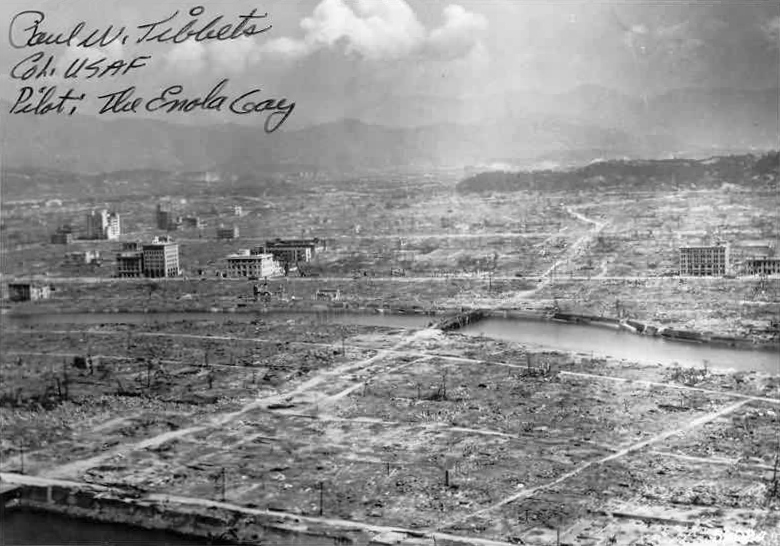
View over the Japanese city of Hiroshima after an atomic bomb was dropped on the city (1945)
(upload.wikimedia.org)
The Hiroshima bombing was one of two atomic attacks on Japan which effectively ended the Second World War and killed about 140,000 to 220,000 inhabitants in the short term.
15
Anthropeum: A daily browser game where you're given 10 artefacts and guess where & when they are from
(anthropeum.com)
Someone showed this to me today, and I love it. It's like geoguesser for art history!
16
17
18
241 years ago, the dollar was established as the official currency of the United States
(www.history.com)
19
Video is 35 minutes long, but it's pretty segmented, so you can skip to chapters you're interested in.
20
21
The Declaration of Independence is the founding document of the United States, adopted unanimously by the Second Continental Congress on July 4, 1776. Principally drafted by Thomas Jefferson with input from the Committee of Five, it announced the result of the Lee Resolution, passed two days earlier, that the Thirteen Colonies were independent states no longer subject to British rule. The Declaration justified separation by asserting the principles of natural rights, government by consent, and the right of revolution, while listing grievances against George III. Its assertion that "all men are created equal" has become one of the most influential statements in political history, shaping democratic and independence movements worldwide. The image shows the engrossed parchment copy prepared by Timothy Matlack and signed by the delegates. This version, signed primarily on August 2, is preserved in the Charters of Freedom of the National Archives Building and is generally considered to be the official document.
Author: Thomas Jefferson

22
23
The 1506 Analog Fluid-Dynamics Log: Inside Leonardo da Vinci’s $30.8M Codex Leicester
(thelemmy.club)

24
25
view more:
next ›