1
Planting the Seeds of Climate Hope (conversationalist.org)
submitted 5 months ago by [M] to c/environment@beehaw.org


In the dim flicker of a kerosene lantern on a fog-wreathed houseboat, I watched Nazia Qasim’s reed-scarred hands pierce threadbare fabric with her needle, weaving colored abayas as her eyes fixed on Dal Lake’s silt-choked horizon, diesel haze mingling with the sour tang of rotting lotus stems, where vibrant beds once bloomed.

I’ve heard endless tales from Nazia—and Qudisa, and Bano, and their sisters—about how the lake’s relentless shrinkage has mirrored their own lives’ contracting. Yet the women have overcome: As the lake withers, under absent snows and dying streams, the water now polluted and undrinkable, they have found new work and purpose through their weaving. For hours last January, I watched their hands move in the lantern’s glow, transforming loss into livelihood. This sisterhood, which once thrived on an endless, ancestral bounty of lotus, water chestnuts, and fish, now scraps stitched tight, the women’s quiet knots a fierce stand against the fade.

As a climate reporter based largely out of India, I am often tasked with telling stories on the frontlines of disaster. I have crouched in Pampore’s parched Karewas at dawn, watching farmers Farida Jan and Snobar Ahad recount the decline of saffron, a visceral dirge for disappearing traditions I could feel in the cracked earth underfoot. I’ve seen women shoulder jerry cans under a merciless sun, irrigating wilted bulbs past cobwebbed government drip lines, turning the world’s most prized spices into frantic wagers against the sky, where one failed season means debt for entire villages. And in countless moments, I’ve watched with growing frustration how easily the world abandons the Global South, which disproportionately bears the brunt of climate change, and how rarely the countries most responsible seem to face the same consequences.

This work necessitates exhaustive fieldwork in fragile ecosystems, sifting through scarce data amid conflict, and confronting the grief of vanishing landscapes and livelihoods. But in my writing on the realities of climate change, I’ve also made a conscious effort to find stories of resilience, rather than just stories of despair. Stories that not only show there are still people who haven’t given up on the fight, but who have made a meaningful difference in changing the tides.

These changemakers are often women.

2


For someone aiming to end the global livestock industry, Bruce Friedrich begins his new book – called Meat – in disarming fashion: “I’m not here to tell anyone what to eat. You won’t find vegetarian or vegan recipes in this book, and you won’t find a single sentence attempting to convince you to eat differently. This book isn’t about policing your plate.”

There’s more. Friedrich, a vegan for almost four decades, says meat is “humanity’s favourite food”.

“It appears to be biological,” he says. “Meat has dense calories, which come from a lot of fat, and it has an umami flavour that humans have evolved to crave. Plus, meat is deeply rooted in most cultures and is the centrepiece at many social gatherings.”

The global damage wreaked by industrial livestock, from climate-heating methane burps to water pollution to the destruction of forests, is well established. For at least 50 years, says Friedrich, environmentalists, health experts and animal advocates – including him – have been trying to convince people to eat less meat and some have done so.

3


New investigation reveals vast global overlap between drilling permits and cherished sites crucial for nature

In brief

  • Governments have allowed oil and gas companies to operate in more than 7,000 “protected” areas around the world

  • Protected sites are recognised by international agreements but left at risk by weak enforcement

  • Total global area encroached on is bigger than the size of France and includes sites that are vital buffers against climate change

4


In 2022, the California Air Resources Board (CARB) committed to developing strategies to reduce emissions from aviation. That process is now well underway.

In March of last year, I attended and reported on a CARB forum focused on technology solutions that could curb climate pollution from the aviation sector. Since that meeting, staff have prepared draft concepts for potential programs and policies that could be brought to the agency’s board for action next year.

Earlier this month, the agency hosted a public workshop to share more details about the four concepts under consideration, which focus on airport operations on the ground and at the gate: controlling emissions from aircraft auxiliary power units; reducing emissions from airport ground support equipment; reducing emissions from aircraft taxiing at the airport; and reducing emissions from aircraft takeoffs and landings.

5


Nearly half a century ago, the US Department of Energy launched a clean energy experiment beneath the University of Minnesota with a simple goal: storing hot water for months at a time in an aquifer more than 100 metres below ground.

The idea of the seasonal thermal energy storage was to tuck away excess heat produced in summer, then use it in the winter to warm buildings.

Now, 45 years after the first test wells were drilled under the university’s St Paul campus, one of the first large-scale aquifer thermal energy systems in the country is being built less than 10 miles from the original test site.

The Heights, a mixed-use development rising from a former golf course on the city’s Greater East Side, will tap thermal energy from an aquifer 100 to 150 metres below ground.

Groundwater from wells spread across the northern half of the 45-hectare development will be drawn by high-efficiency electric heat pumps, powered in part by solar panels, to provide low-cost heating and cooling with little greenhouse gas emissions for 850 homes and several light-industrial buildings.

6
7


Europe’s supermarket shelves are packed with brands billing their plastic packaging as sustainable, but often only a fraction of the materials are truly recovered from waste, with the rest made from petroleum.

Brands using plastic packaging – from Kraft’s Heinz Beanz to Mondelēz’s Philadelphia – use materials made by the plastic manufacturing arm of the oil company Saudi Aramco.

The Saudi state-owned holding opposes production cuts under the UN plastic treaty and is the world’s largest corporate greenhouse gas emitter (more than 70m tonnes up to 2023).

Aramco’s petrochemical subsidiary, Sabic, along with other big players, devised a successful way to rebrand their harmful business as “planet saver”. They label plastic as “circular” and climate-friendly, although in practice it remains almost entirely fossil-based, exacerbating global warming and the plastic crisis.

Under industry pressure, Europe is on track to legalise this practice, which independent experts have described as greenwashing, with lax EU rules set to take effect in 2026 and similar UK regulations to be enforced as of 2027.

8


We need naturally evolved bacterias that will eat all plastics (as link illustrates we discovered first one), but it extremely bad effects & risks (as the other link goes into) to creating the bacterias that will eat all the plastics, that take forever to biodegrade.

I been to clean-up beaches-parks events, but there is just too much it, for even the best possible machines to clean it all up.

Of course we cannot let Rich-Super Rich Economic Classes/Owners to just produce even a single new piece of plastic, which doing it now is hugely profitable industry.

Of course instead we need to putting as much resources as possible as quickly as possible to make plastics, that completely with a reasonable amount of time biodegrade, completely take over for then banned plastics, that take forever to biodegrade, markets.

Here is the 2-questions (2-challenges) I have are:

1st. How do we have these naturally evolved bacterias, that will eat all plastics, that will not eat the plastics, that completely with a reasonable amount of time biodegrade, before their purposes was achieved?

&

2nd. How do we get the plastics, that take forever to biodegrade, out of all living beings, including ourselves?

9
10
11


Half the world’s 100 largest cities are experiencing high levels of water stress, with 39 of these sitting in regions of “extremely high water stress”, new analysis and mapping has shown.

Water stress means that water withdrawals for public water supply and industry are close to exceeding available supplies, often caused by poor management of water resources exacerbated by climate breakdown.

Watershed Investigations and the Guardian mapped cities on to stressed catchments revealing that Beijing, New York, Los Angeles, Rio de Janeiro and Delhi are among those facing extreme stress, while London, Bangkok and Jakarta are classed as being highly stressed.

Separate analysis of Nasa satellite data, compiled by scientists at University College London, shows which of the largest 100 cities have been drying or getting wetter over two decades with places such as Chennai, Tehran and Zhengzhou showing strong drying trends and Tokyo, Lagos and Kampala showing strong wetting trends. All 100 cities and their trends can be viewed on a new interactive water security atlas.

12


An airport made of bamboo? A tower reaching 20 metres high? For many years, bamboo has been mostly known as the favourite food of giant pandas, but a group of engineers say it’s time we took it seriously as a building material, too.

This week the Institution of Structural Engineers called for architects to be “bamboo-ready” as they published a manual for designing permanent buildings made of the material, in an effort to encourage low-carbon construction and position bamboo as a proper alternative to steel and concrete.

Bamboo has already been used for a number of boundary-pushing projects around the world. At Terminal 2 of Kempegowda international airport in Bengaluru, India, bamboo tubes make up the ceiling and pillars. The Ninghai bamboo tower in north-east China, which is more than 20 metres tall, is claimed to be the world’s first high-rise building made using engineered bamboo.

13
14


The Trump administration’s new dietary guidelines urging Americans to eat far more meat and dairy products will, if followed, come at a major cost to the planet via huge swathes of habitat razed for farmland and millions of tons of extra planet-heating emissions.

A new inverted food pyramid recently released by Donald Trump’s health department emphasizes pictures of steak, poultry, ground beef and whole milk, alongside fruits and vegetables, as the most important foods to eat.

The new guidelines are designed to nearly double the amount of protein currently consumed by Americans. “Protein and healthy fats are essential and were wrongly discouraged in prior dietary guidelines,” said Robert F Kennedy Jr, the US health secretary. “We are ending the war on saturated fats.”

But a surge in meat-eating by Americans would involve flattening vast tracts of ecosystems such as forests to make way for the hefty environmental hoofprint of raised livestock, emitting large quantities of greenhouse gases in the process, experts have warned.

15


The global cost of greenhouse gas emissions are nearly double what scientists previously thought, according to a study published Thursday by researchers at the University of California San Diego’s Scripps Institution of Oceanography.

It is the first time a social cost of carbon (SCC) assessment—a key measure of economic harm caused by climate change—has included damages to the ocean. Global coral loss, fisheries disruption and coastal infrastructure destruction are estimated to cost nearly $2 trillion annually, fundamentally changing how we measure climate finance.

“For decades, we’ve been estimating the economic cost of climate change while effectively assigning a value of zero to the ocean,” said Bernardo Bastien-Olvera, who led the study during his postdoctoral fellowship at Scripps. “Ocean loss is not just an environmental issue, but a central part of the economic story of climate change.”

Of note, the fisheries reporter behind this piece is Johnny Sturgeon.

16


For Antarctic scientists, getting a handle on what’s happening under the ice shelves is urgent because the fate of the planet’s coastlines will depend on how fast they melt.

Antarctica has more than 70 ice shelves that extend the continent’s vast ice sheet out over the ocean.

Covering about 1.5m sq km, ice shelves float on the water and don’t by themselves push up global sea levels if they melt.

But if global heating of the ocean melts them from underneath they could become unstable, allowing the ice sheet to slide faster into the ocean, pushing up global sea levels by several metres.

The continent’s most vulnerable regions alone have enough ice to push up sea levels by about 15 metres if they all melt.

17


#FuelingEcocide, our latest investigation coordinated by EIF in partnership with European Investigative Collaborations (EIC), reveals that oil and gas licences overlap with 7,000 protected areas worldwide. A total overlap of 690,000 km², an area bigger than the size of France – despite existing regulations and ongoing efforts to safeguard key biodiversity zones.

18


David E. Hogan, UA, Environmental Scientist invented a way to treat any form of waste water, to get copper out of it, so it can recycled & making the waste water better in the process. As he says in the segment, soon we will never need to make new copper, because it is so everywhere.

This is AWESOME!

19


Global temperatures in 2025 did not quite reach the heights of 2024, thanks to the cooling influence of the natural La Niña weather pattern in the Pacific, new data from the European Copernicus climate service and the Met Office shows.

But the last three years were the world's warmest ever recorded, bringing the planet closer to breaching international climate targets.

Despite natural cooling from La Niña, 2025 was still much warmer than temperatures even a decade ago, as humanity's carbon emissions continue to heat the planet.

That will inevitably lead to further temperature records – and worsening weather extremes – unless emissions are sharply reduced, scientists warn.

"If we go twenty years into the future and we look back at this period of the mid-2020s, we will see these years as relatively cool," said Dr Samantha Burgess, deputy director of Copernicus.

20


Chinese energy giant Ming Yang Smart Energy has developed the “world’s first fully recyclable carbon fiber wind turbine blade.”

Dubbed MySE23X, it measures over 110 meters (361 feet) long.

Announced on a LinkedIn post on January 7, the newly developed turbine blade uses a chemical degradation solution that works at ambient temperature and pressure.

This innovation targets the wind industry’s massive waste problem — typically, turbine blades are made of composites that are difficult to break down.

It could bring the wind energy sector closer to a carbon-neutral, waste-free future.

21
22


For almost 200 years, the Galapagos rail had been missing from Floreana. Thought to be extinct on this small, inhabited island in the Galapagos archipelago, the shy, near-flightless bird is still found on some of the other islands. But Charles Darwin was the last person to record a sighting of one on Floreana, when he famously visited the island in 1835.

This year, after the removal of rats and feral cats from Floreana, the bird stunned conservationists by making a surprise re-appearance on the island. How the lost bird returned is a mystery. Other threatened birds have also recovered, and some are even singing new tunes never heard on the island before, which you can listen to below. The change reveals new insights into how a safer, almost predator-free environment can allow animals to experiment and innovate, scientists say.

"The Galapagos rail was one that I was not expecting at all," agrees Paula Castaño, a wildlife veterinarian who works for Island Conservation, one of the organisations restoring Floreana. "It just showed up" on Floreana, she says, adding that perhaps it had clung on as a small, hidden, unnoticed population all this time.

"[The rails] reappeared and now it's very common to find these birds just walking around the island. You can hear it, you can see it, it's unbelievable," says Paola Sangolquí, a marine biologist at the Jocotoco Conservation Foundation, which is also part of the restoration project.

The rail's reappearance is part of what scientists are describing as an extraordinary return of life to Floreana, after the removal of the invasive predators that had wreaked havoc on native species.

23


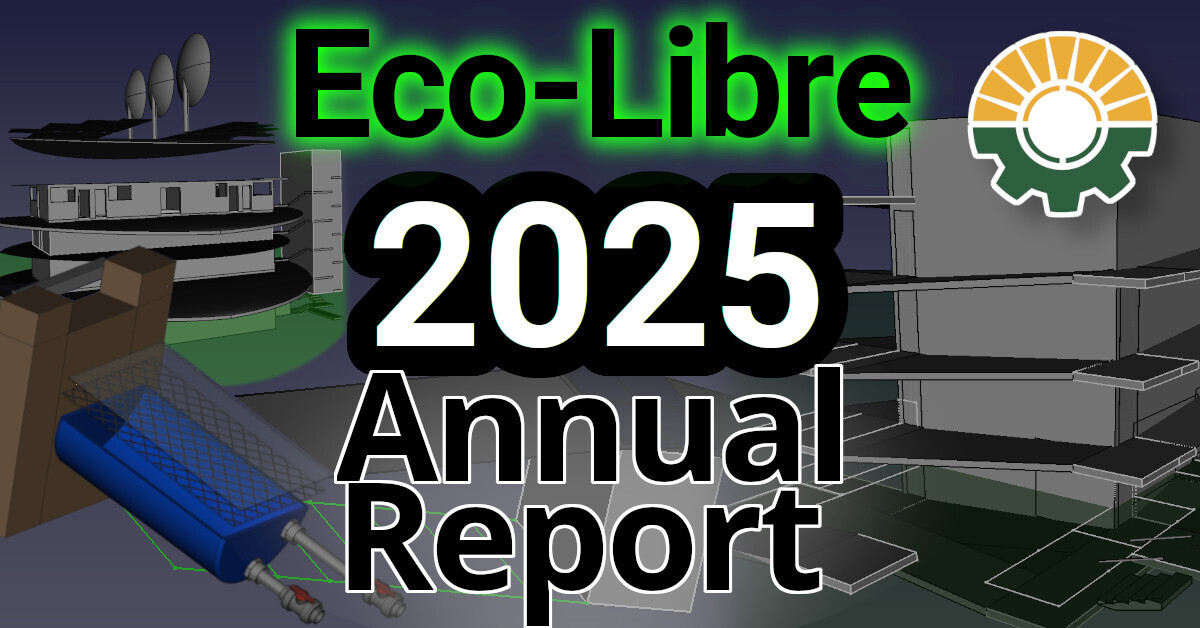
Happy 2026! The Eco-Libre project published our 2025 Annual Report for last year.

Eco-Libre 2025 Annual Report

Eco-Libre is a volunteer-run project that designs libre technology for sustainable communities.

Eco-Libre's mission is to research, develop, document, teach, build, and distribute open-source technology that sustainably enfranchises communities' human rights.

We aim to provide clear documentation to build low-cost machines, tools, and infrastructure for people all over the world who wish to live in sustainable communities with others.

Executive Summary

  • Continuing search for land in Ecuador
  • New Eco-Libre Logo
  • First Release of Life-Line Project
  • Two Prototypes of Life-Line Project

Read the full report here.

Contribute to Eco-Libre

If you'd like to help Eco-Libre reach our mission to enfranchise sustainable communities' human rights with libre tech, please contact us to get involved :)

Join Us
eco-libre.org/join

Cheers,
The Eco-Libre Team
https://www.eco-libre.org/

24
25


It’s been a rollercoaster of a year for clean energy. There’s no better way to show those ups and downs than with a chart, and luckily, we made a lot of those this year.

As 2025 comes to a close, let’s focus on just the ups. Here are 10 charts that prove the clean energy transition is still marching on in the U.S. and beyond.

view more: next ›