1
submitted 4 months ago by to c/debian@lemmy.sdf.org
2


We’re happy to announce that BusKill can be installed on Linux directly with apt

BusKill Now available in Debian apt Repos

What is BusKill?

BusKill is a laptop kill-cord. It's a USB cable with a magnetic breakaway that you attach to your body and connect to your computer.

What is BusKill? (Explainer Video)
Watch the BusKill Explainer Video for more info youtube.com/v/qPwyoD_cQR4

If the connection between you to your computer is severed, then your device will lock, shutdown, or shred its encryption keys -- thus keeping your encrypted data safe from thieves that steal your device.

Debian

BusKill can be installed on Debian with apt.

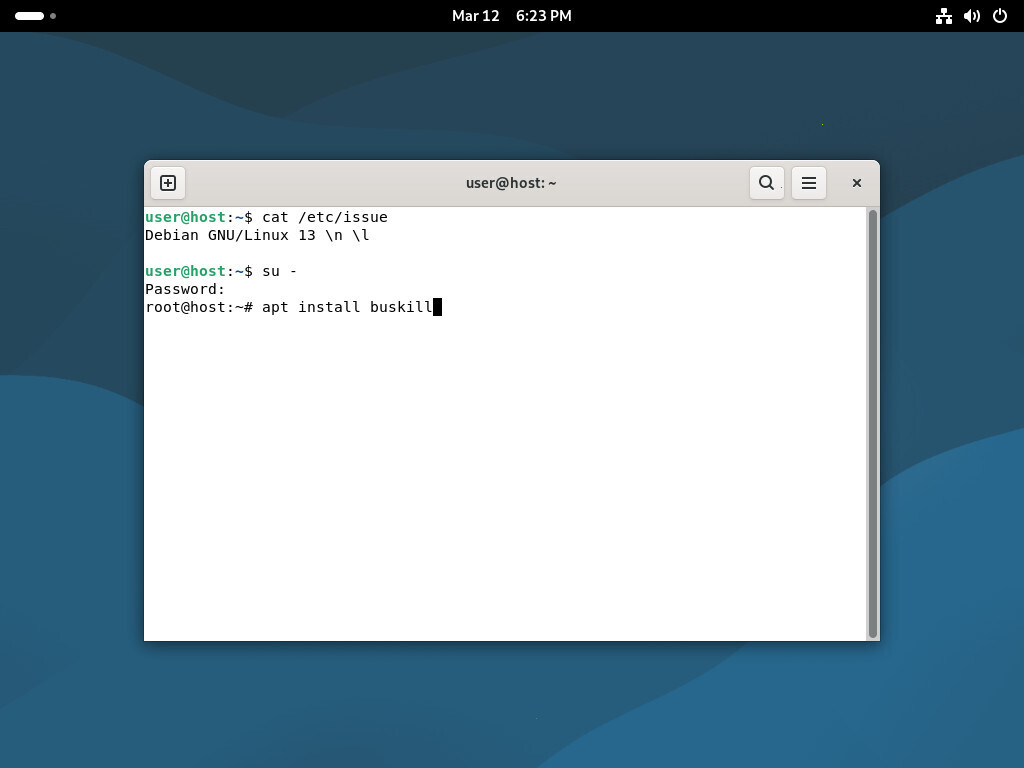
Screenshot of Debian, showing the command to install BusKill)
To install BusKill in Debian, execute su - and then apt install buskill

To install BusKill on Debian, execute the command

su -
apt install buskill

Read the full article here:

Support BusKill

We're looking forward to continuing to improve the BusKill software and looking for other avenues to distribute our hardware BusKill cable to make it more accessible this year.

If you want to help, please consider purchasing a BusKill cable for yourself or a loved one. It helps us fund further development, and you get your own BusKill cable to keep you or your loved ones safe.

Buy a BusKill Cable
https://buskill.in/buy

You can also buy a BusKill cable with bitcoin, monero, and other altcoins from our BusKill Store's .onion site.

Bitcoin Accepted Here

Monero Accepted Here

Stay safe,
The BusKill Team
https://www.buskill.in/
http://www.buskillvampfih2iucxhit3qp36i2zzql3u6pmkeafvlxs3tlmot5yad.onion/

3
submitted 5 months ago* (last edited 5 months ago) by to c/debian@lemmy.sdf.org


Apparently IPFS is having a slow adoption problem -- despite being an important solution to the enshitified gated centralised web.

Debian stands as the most popular among the well-supported distros. Debian has some degree of quality standards that (although not spectacular) relatively far surpass most distros. A package making it into the official Debian repos generally demonstrates that an app is up to scratch -- ready for prime time.

If I have not overstated things, it must be at least somewhat embarrassing for both the IPFS project and Debian that IPFS has no client in the official Debian repos. IPFS should have targetting Debian as a goal to get respect and adoption.. to get on the radar. It’s just a tarball now.

And from Debian’s standpoint, it’s not great that an important protocol to succeed HTTP is missing from official support.

4


This page says:

6.6. What do I do if my jigdo download gets interrupted? If your download gets interrupted, all you need to do is restart jigdo-lite and hit ENTER at all the question prompts. Jigdo-lite will pick up where it left off.

But when I re-run jigdo, it says:

The temporary directory `./debian-13.2.0-amd64-BD-1.iso.tmpdir' already exists. Its contents ARE GOING TO BE DELETED (possibly after having been copied to the image, if they are of interest for it). If you do not want this to happen, press Ctrl-C now. Otherwise, press Return to proceed.

So which is lying, the tool or the docs?

update

I just realised it was a problem of poorly written text and sloppy reading. I mentally skipped what was in parathesis, which was important.

Strange that it would build a partial image before continuing.

5


Has anyone found a Debian client for Lemmy? I’m really surprised nothing exists yet and wonder if my search skills are just lacking. This is what found:

  • lemoa is non-Debian, and dying
  • neonmodem is non-Debian, and crashes
  • nnreddit is non-Debian, and only rumored to be getting ported to activitypub; the repo for that project is a broken website for me

(Non-debian just means they are not in the Debian repos, not that they don’t work on Debian).

6


cross-posted from: https://linux.community/post/649372

There is a growing problem of documentation being locked into walled gardens. Most particularly, Cloudflare and to a lesser extent hosts like gitlab·com where several demographics of people are discriminated against. The discrimination manifests either as an outright blockade or as a CAPTCHA which often requires non-blind users to execute non-free JavaScript, while at the same time blind people are simply excluded.

Sometimes artifacts that are officially part of Debian (such as man pages) reference URLs to web-served documentation that exists in access-restricted walled gardens, or non-existent documentation because URLs are not permanent.

As web enshitification continues to trend out of control, there is a lack of digital rights standards and quality standards in place to steer the Debian project away from digital exclusion and technofeudalism. This is all I can find on debian.org—

From the Debian Social Contract¹:

¶1 “We will never make the system require the use of a non-free component.”

Ideally this would carry some weight when users are forced to execute non-free JavaScript as a barrier to documentation. But digital rights opponents would likely cling to the keyword “require”, as doc access is not technically a requirement.

¶4 “Our priorities are our users and free software

We will be guided by the needs of our users and the free software community. We will place their interests first in our priorities. We will support the needs of our users for operation in many different kinds of computing environments. … In furtherance of these goals, we will provide an integrated system of high-quality materials with no legal restrictions that would prevent such uses of the system.”

Love the last sentence in particular. I would like to interpret integrated /high-quality materials/ to mean that a quality system inherently integrates documentation into it (although I don’t suppose documentation was intended in that “integration” meaning). Consideration should perhaps be given to make a change along these lines:

s/no legal restrictions/no legal OR TECHNICAL restrictions/

It’s also ½ tempting to suggest “s/materials/documented materials/”, though perhaps that would invoke an expectation that docs be created when they don’t exist (thus controversial). But would it be sensible and feasible to add some verbiage to include a goal that existing docs be universally accessible?

From The Debian Free Software Guidelines (DFSG)²:

“5. No Discrimination Against Persons or Groups

The license must not discriminate against any person or group of persons.”

This anti-discrimination policy only covers licensing. When a walled garden is used to discriminate against classes of people, the discriminatory act is not expressed in any license. So the guideline falls short of covering real world discrimination scenarios. Note that the “GNU Ethical Repository Criteria”³ expresses some sensible principles that the Debian Project should consider adopting, such as “Does not discriminate against classes of users, or against any country. (C2)” and “Permits access via Tor”, for example.

From The Debian Policy Manual⁴:

“12.4. Preferred documentation formats

The unification of Debian documentation is being carried out via HTML.”

This section strongly encourages HTML. Perhaps rightly so, but HTML encourages hyperlinks which unacceptably often either link into a walled garden or the link just dies. Without any further guidance beyond saying /we like HTML/, bad links and restrictive links will proliferate.

Section 12.3 does not stress in the slightest the importance or benefit to pulling additional docs into a $package-doc pkg. If most of the essential docs are jailed in readthedocs·io or bobs_restricted_access_doc_jail.com, it’s important that those docs be imported into a $package-doc pkg. Docs that are freely accessible to all people don’t call for a duty to act, but ideally all significant docs should be in a $package-doc pkg anyway particularly for offline users and those on capped networks.

There was a related past discussion here:

https://lists.debian.org/debian-project/2019/09/msg00010.html

though that was primarily about people being subjected to non-free services (which is only a small facet to the walled garden problem).

PROPOSAL


Apart from above-mentioned areas of change, I propose:

  1. Debian Project establish a: Criteria for Egalitarian and Network-Neutral Access (CENNA)

    which could be inspired and guided minimally by:

    Rationale for mentioning “Network-Neutral”: Tim Wu coined the phrase network neutrality in the context of harmful practices by ISPs who want to impose traffic shaping. However the core abstract principle in his essay is access equality. Access inequality also arises in the context of walled gardens whereby access to resources discriminate on the basis of a user’s network.

  2. The Debian Policy Manual⁴ should strongly encourage Debian maintainers to identify documentation that fails the above-mentioned criteria (which is yet to be drafted) and import failing docs into a $package-doc pkg. Or failing that, and in light of the no obligatory work philosophy, an anti-feature tag like “non-free documentation” or “exclusive documentation” should be applied for transparency and to solicit improvement.

  3. The Debian Policy Manual⁴ should strongly encourage maintainers to replace URLs of the form readthedocs.io/foo/guide.html with a liberated mirror like web.archive.org/web/readthedocs.io/foo/guide.html.

  4. Establish the basic principle that if a user has access to a package, they should also have access to existing documentation intended for the package. Just like absence of a man page is regarded by Debian policy as a bug, it should also be regarded as a bug when essential/important/significant project-generated docs are not freely accessible to all those who have access to the Debian OS. The Debian policy says bug reports for missing man pages should not be closed until the man page is created. The bug need not be worked. This is a good balance between transparency and steering toward quality but without creating an obligation of work.

[footnotes]

https://www.debian.org/social_contract
https://www.debian.org/social_contract#guidelines
https://www.gnu.org/software/repo-criteria.html
https://www.debian.org/doc/debian-policy/ch-docs.html
https://www.gnu.org/licenses/fdl-1.3.html
https://www.ala.org/advocacy/intfreedom/librarybill

Outcome


Discussion here.