51


Hover Text:

I call Rule 34 on Wolfram's Rule 34.

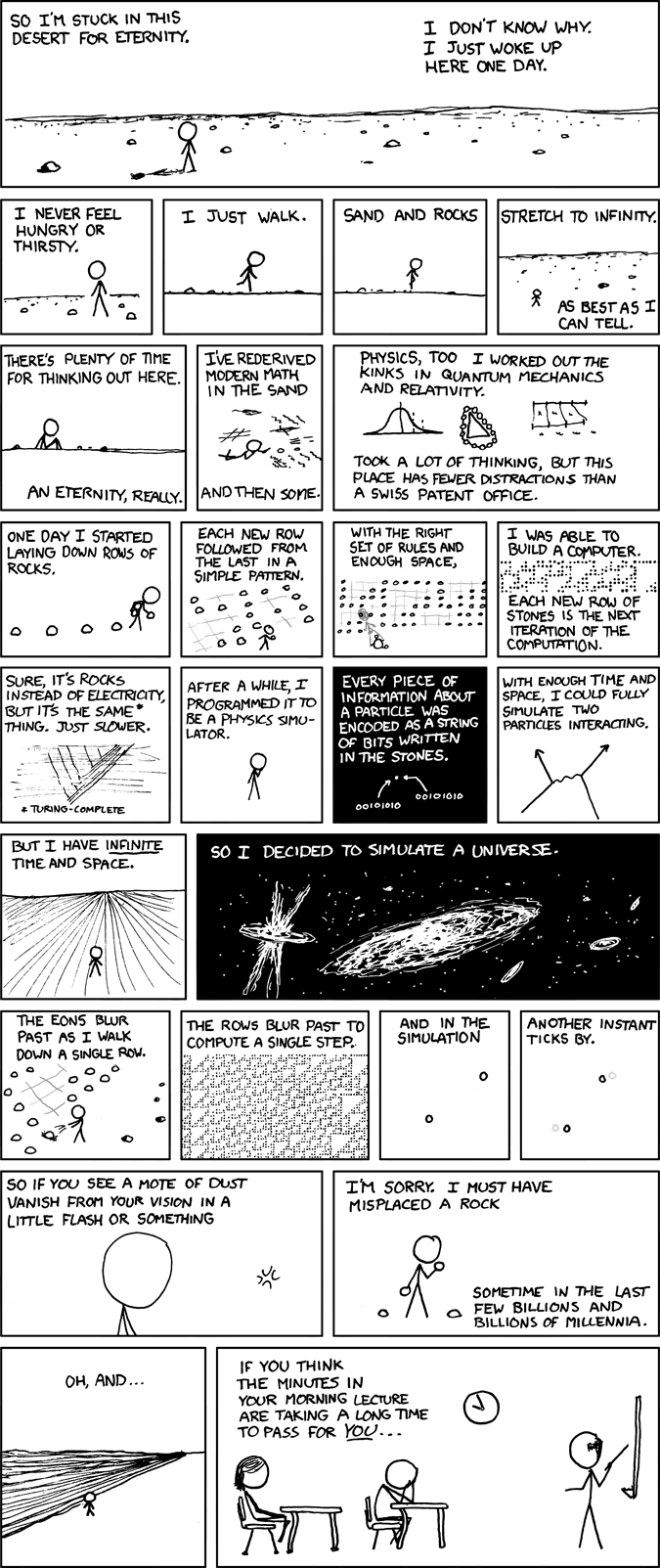
Transcript

[Cueball is standing in a desert with lots of rocks lying around. He is narrating his own situation. The first panel spans the entire width of the comic. The first line of text is written to the left of him, the second line to the right.]
So I'm stuck in this desert for eternity.
I don't know why. I just woke up here one day.

[The next four panels take up the second line of the comic.]
[Cueball stand in the desert.]
I never feel hungry or thirsty.

[Cueball walks in the desert.]
I just walk.

[Zooming out while Cueball continues to walk in the desert.]
Sand and rocks

[Zooming far out as Cueball again just stands in the desert. First line of text, above him, is a continuation of the text in the previous panel. The second line is below him.]
stretch to infinity.
As best as I can tell.

[The next three panels take up the third line of the comic. The last takes up half the width.]
[Cueball is sitting in the desert, in a contemplative position. First line of text above him, the second below.]
There's plenty of time for thinking out here.
An eternity, really.

[Cueball is sketching stuff in the sand. First line of text above him, the second below.]
I've rederived modern math in the sand
and then some.

[Three different graph types are depicted. First line of text above them, the second below.]
Physics too. I worked out the kinks in quantum mechanics and relativity.
Took a lot of thinking, but this place has fewer distractions than a Swiss patent office.

[The next eight panels take up the fourth and fifth lines of the comic. All pictures are the same size.]
[Cueball is walking along the desert, laying out rocks on a line. Four have been deployed. He is laying down the fifth and has a sixth in his other hand.]
One day I started laying down rows of rocks.

[Cueball, with a rock in his hand, continues to deploy rock 16, in a more intricate pattern. There are grid-lines in the sand (5 rows, 6 columns), with each intersection either empty of filled with a rock. No rocks lay anywhere but at an intersection on the grid.]
Each new row followed from the last in a simple pattern.

[Zooming out showing even more laid out rocks. Cueball is seen directly from above, and we see his shadow falling on the grid of rocks (7 rows, 14 columns).]
With the right set of rules and enough space,

[Continues to zoom further out showing clear triangular patterns (with no rocks) in the laid out grid of rocks. Cueball is not seen. (8 rows, 42 columns). First line of text above the grid, the second line below.]
I was able to build a computer.
Each new row of stones is the next iteration of the computation.

[Zooming far out (no Cueball) with rows intersected by five clear V lines on top of them. The V's are drawn inside each other, with the smallest V at the top right, and the other V's starting just to the right of the previous one, and then continuing the same distance past the previous V, as the total length of the first V. The "" in the first line of text above this grid references to the footnote below written in a smaller font.]
Sure it's rocks instead of electricity, but it's the same
thing. Just slower.
*Turing-complete

[Cueball stands in a contemplative pose (on a clean white background - i.e. no dessert).]
After a while, I programmed it to be a physics simulator.

[A black panel with white drawings and text. A small white dot (a particle) is labeled by two arrows coming of two binary strings.]
Every piece of information about a particle was encoded as a string of bits written in the stones.
00101010 00101010

[A Feynman diagram showing two particles interacting. Two arrows going in and out with a snaking line between them.]
With enough time and space, I could fully simulate two particles interacting.

[The next two panels take up the sixth line of the comic. The second panel takes up three-quarters of the width.]
[Cueball standing before the vastness of the desert, with his programmed lines of rock stretching to infinity.]
But I have infinite time and space.

[A black panel with white drawings and text. Depiction of two large galaxies, one with four jets coming out of its center, the other a flat disc. Several smaller galaxies and/or stars are shown around them.]
So I decided to simulate a universe.

[The next four panels take up the seventh line of the comic. They are of similar widths.]
[Cueball is walking by his grid of rocks, lines indicate he has just thrown another rock down in its place. It falls so hard it sinks into the sand that splashes out around it. The 14 rocks above him lie on the grid, four others below this grid have not been used yet.]
The eons blur past as I walk down a single row.

[Zoom far far out to show multiple rows of rocks. It is not very clear that there are several triangular patterns (with no rocks) in different sizes in the laid out grid of rocks. There are about 50 rows and 90 columns. There are six large triangles on top of each other at the left edge. To the right, there are three even larger triangles from top to bottom, the one in the middle further to the left than the one above, but further right than the bottom one.]
The rows blur past to compute a single step.

[Shows the placement of two particles in the simulation.]
And in the simulation...

[The two particles have moved just long enough as to not overlap with their previous positions, shown as an after-image with faint gray lines. The text continues directly the one from the previous panel.]
another instant ticks by.

[The next two panels take up the eighth line of the comic. They each take up half the width.]
[A Cueball-like person (you) observes a mote of dust vanish.]
So if you see a mote of dust vanish from your vision in a little flash or something

[Cueball is standing between two rocks on the ground, while holding two rocks, one lifted up to his head. The first line of text is above him. It is a direct continuation of the text in the previous panel. The second line stands below to the right of him.]
I'm sorry. I must have misplaced a rock
sometime in the last few billions and billions of millennia.

[Cueball stands in the "clean" part of his infinite desert, in front of the vastness of his infinity of infinite lines or rocks.]
Oh, and...

[A Cueball-like student sits in a classroom with his head in his hands, Megan sits behind him, and a teacher points to the blackboard. A clock shows the time at five minutes to ten.]
If you think the minutes in your morning lecture are taking a long time to pass for you...

52
 
 
53


Hover Text:

True story: I had to try several times to upload this comic because my ssh key was blacklisted.

Transcript

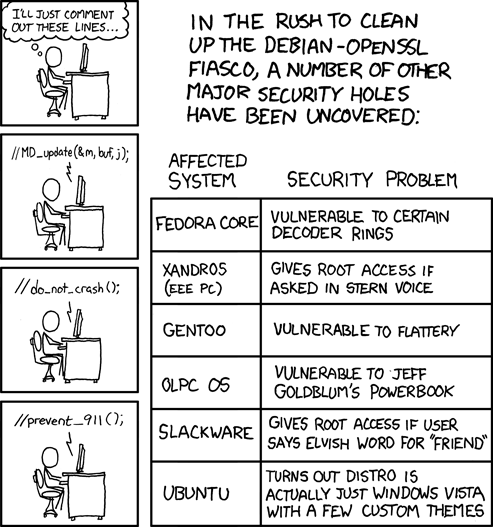
[Cueball sitting at computer.]
Cueball: I'll just comment out these lines...

// MD_update(&m, buf, j);

// do_not_crash();

// prevent_911();

In the rush to clean up the debian-openssl fiasco, a number of other major security holes have been uncovered:

[A two-column table is shown:]

Affected System

Security problem

Fedora Core

Vulnerable to certain decoder rings

Xandros (EEE PC)

Gives root access if asked in a stern voice

Gentoo

Vulnerable to flattery

OLPC OS

Vulnerable to Jeff Goldblum’s PowerBook

Slackware

Gives root access if user says Elvish word for “friend”

Ubuntu

Turns out distro is actually just Windows Vista with a few custom themes

54
submitted 2 years ago* (last edited 2 years ago) by to c/comics@programming.dev
 
 
55


Hover Text:

What's the complexity class of the best linear programming cutting-plane techniques? I couldn't find it anywhere. Man, the Garfield guy doesn't have these problems...

Transcript

[in a yellow box:]
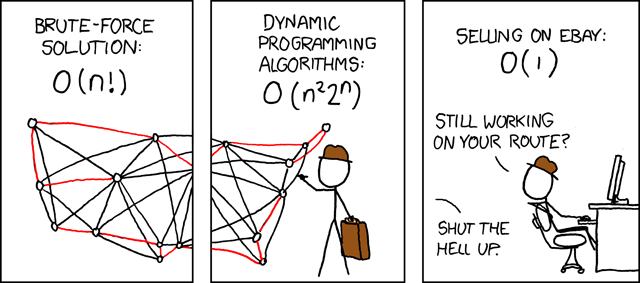
[There is a linked black web, with a path in red; it appears to be a map of the United States.]
Brute-force solution:O(n!)
[The web continues in this one. A man with a brown hat and a case is drawing it.]
Dynamic programming algorithms: O(n^22^n)
[Another man, with a brown hat too, is at a computer, looking back over the chair.]
Selling on eBay: O(1)
eBay salesman: Still working on your route?
Drawing salesman: Shut the hell up.

56
 
 
57


Hover Text:

Real programmers set the universal constants at the start such that the universe evolves to contain the disk with the data they want.

Transcript

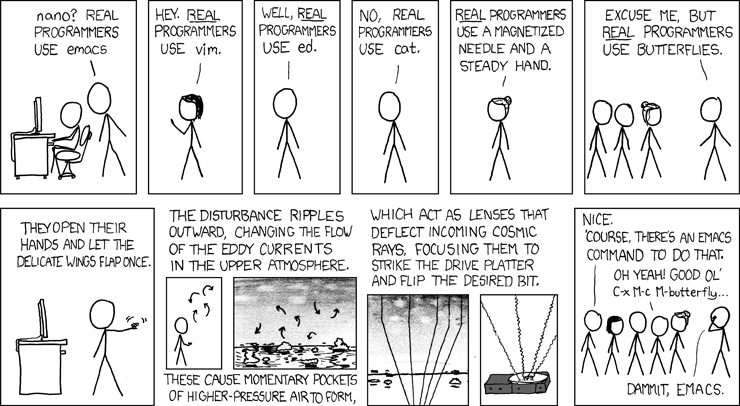
[A Cueball-like man sits at a computer, programming. Cueball stands behind him and looks over his shoulder.]
Cueball: nano? Real Programmers use emacs.

[Megan appears behind him.]
Megan: Hey. Real Programmers use vim.

[A second Cueball-like man appears behind her.]
Ed Cueball: Well, Real Programmers use ed.

[A third Cueball-like man appears behind him.]
Cat Cueball: No, Real Programmers use cat.

[Hairbun appears behind him.]
Hairbun: Real Programmers use a magnetized needle and a steady hand.

[A fourth Cueball-like man enters, facing them all. We see him facing the last two Cueball-like men and Hairbun.]
Butterfly Cueball: Excuse me, but Real Programmers use butterflies.

[A Cueball-like programmer is standing much like Butterfly Cueball except for holding out a butterfly in front of his computer. The butterfly flaps its wings.]
Butterfly Cueball (narration within the panel, not diegetic to the scene): They open their hands and let the delicate wings flap once.

[The next two panels are smaller, and two sets of narrative text are written to span respectively above and below both panels. The first panel is the Cueball-like programmer with the butterfly and above him four curved arrows pointing up or down. The second panel shows the upper atmosphere, with large clouds far below and the earth even further down. Also here are shown seven of the same type of arrows.]
Butterfly Cueball (narration above the panels): The disturbances ripple outward, changing the flow of the eddy currents in the upper atmosphere.
Butterfly Cueball (narration below the panels): These cause momentary pockets of higher-pressure air to form,

[The next two panels are also partial height, leaving room for narration spanning above both panels. The first panel shows the atmosphere, again with clouds, and four parallel lines coming from above, and then they begin to merge, getting quite close at the bottom of the panel. The second panel shows the four lines merging on a driver platter.]
Butterfly Cueball (narration above the panels): Which act as lenses that deflect incoming cosmic rays, focusing them to strike the drive platter and flip the desired bit.

[All the programmers who have commented so far stand in the order they have commented facing the last Cueball-like man, who slaps his forehead.]
Cueball: Nice. 'Course, there's an emacs command to do that.
Cat Cueball: Oh yeah! Good ol' C-x M-c M-butterfly...
Butterfly Cueball: Dammit, Emacs.

58
 
 
59


Hover Text:

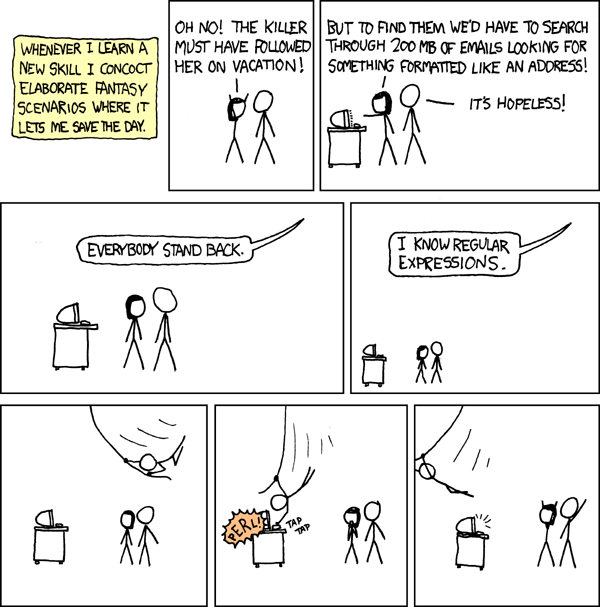
Wait, forgot to escape a space. Wheeeeee[taptaptap]eeeeee!

Transcript

[in a yellow box:]
Whenever I learn a new skill I concoct elaborate fantasy scenarios where it lets me save the day.

Megan: Oh no! The killer must have followed her on vacation!
[Megan points to computer.]
Megan: But to find them we'd have to search through 200 MB of emails looking for something formatted like an address!
Cueball: It's hopeless!

Off-panel voice: Everybody stand back.

Off-panel voice: I know regular expressions.

[A man swings in on a rope, toward the computer.]

tap tap
The word PERL! appears in a bubble.

[The man swings away, and the other characters cheer.]

60
 
 
61
submitted 2 years ago by to c/comics@programming.dev


Hover Text:

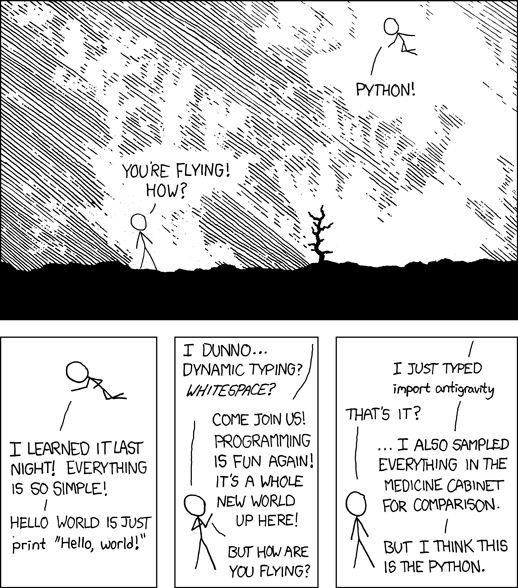
I wrote 20 short programs in Python yesterday. It was wonderful. Perl, I'm leaving you.

Transcript

[A Cueball-like friend is talking to Cueball, who is floating in the sky.]
Friend: You're flying! How?
Cueball: Python!
Cueball: I learned it last night! Everything is so simple!
Cueball: Hello world is just print "Hello, World!"
Friend: I dunno... Dynamic typing? Whitespace?
Cueball: Come join us! Programming is fun again! It's a whole new world up here!
Friend: But how are you flying?
Cueball: I just typed 'import antigravity'
Friend: That's it?
Cueball: ...I also sampled everything in the medicine cabinet for comparison.
Cueball: But I think this is the python.

62
 
 
63


Hover Text:

Apple uses automated schnapps IVs.

Transcript

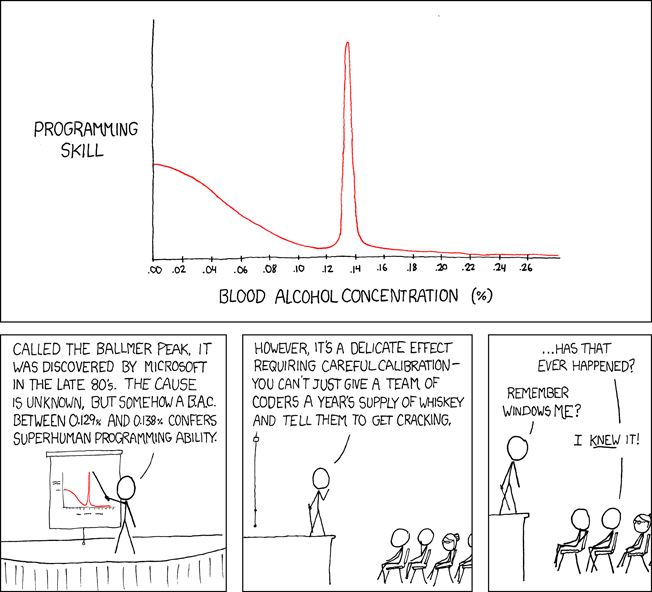
[A graph with "programming skill" on the Y-axis and "blood alcohol concentration" on the X-axis. The Y-axis slowly goes down, but spikes at 0.1337%.]
[Cueball is making a presentation with the graph.]
Cueball: Called the Ballmer Peak, it was discovered by Microsoft in the 80's. The cause is unknown but somehow a B.A.C between 0.129% and 0.138% confers superhuman programming ability.
Cueball: However, it's a delicate effect requiring careful calibration – you can't just give a team of coders a year's supply of whiskey and tell them to get cracking.
Spectator: ...Has that ever happened?
Cueball: Remember Windows ME?
Spectator: I knew it!

64
[xkcd] Bug (28 Jan 2008) (programming.dev)
submitted 2 years ago by to c/comics@programming.dev


Hover Text:

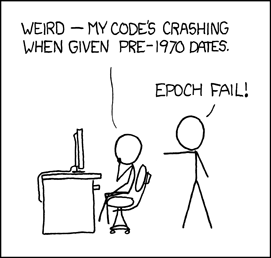
The universe started in 1970. Anyone claiming to be over 38 is lying about their age.

Transcript

[Cueball sits at a computer, staring at the screen and rubbing his chin in thought. A friend stands behind him.]
Cueball: Weird — My code's crashing when given pre-1970 dates.
Friend [pointing at Cueball and his computer]: Epoch fail!

65
 
 
66
 
 
67


Hover Text:

Easier to escape: n-layered nested quotes or an iron maiden?

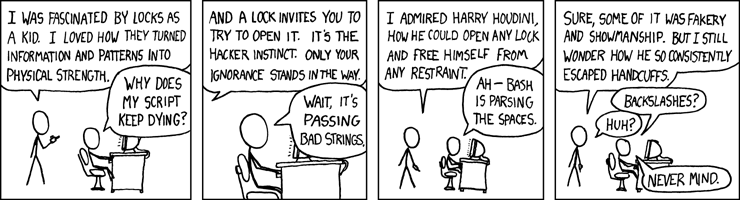
:::spoiler Transcript

[Cueball sits before a computer on a desk while another man stands behind him.]
Man: I was fascinated by locks as a kid. I loved how they turned information and patterns into physical strength.
Cueball: Why does my script keep dying?

[Closeup on Cueball sitting at the computer.]
Man: And a lock invites you to try and open it. It's the hacker instinct. Only your ignorance stands in the way.
Cueball: Wait it's passing bad strings.

[Returns to the two shot of both men.]
Man: I admired Harry Houdini, how he could open any lock and free himself from any restraint.
Cueball: Ah - Bash is parsing the spaces.

Man: Sure some of it was fakery and showmanship. But I still wonder how he so consistently escaped handcuffs.
Cueball: Backslashes?
Man: Huh?
Cueball: Never mind.

68
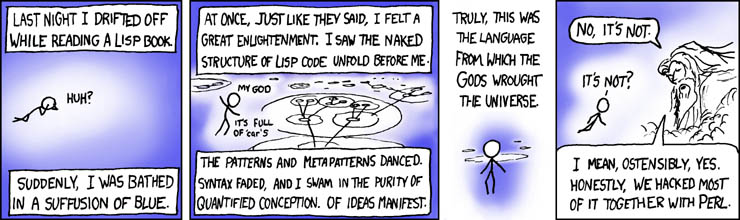
[xkcd] Lisp (16 Feb 2007) (programming.dev)
submitted 2 years ago by to c/comics@programming.dev


Hover Text:

We lost the documentation on quantum mechanics. You'll have to decode the regexes yourself.

Transcript

[Floating in space.]
Speaker: Last night I drifted off while reading a Lisp book.
Cueball: Huh?
Speaker: Suddenly, I was bathed in a suffusion of blue.

[Floating in space before a vast concept tree.]
Speaker: At once, just like they said, I felt a great enlightenment. I saw the naked structure of Lisp code unfold before me.
Cueball: My God
Cueball: It's full of 'car's
Speaker: The patterns and metapatterns danced. Syntax faded, and I swam in the purity of quantified conception. Of ideas manifest.

[Close-up of floating in space before part of a concept tree.]
Truly, this was the language from which the gods wrought the Universe.

[Floating in space with God appearing through a line of clouds.]
God: No, it's not.
Cueball: It's not?
God: I mean, ostensibly, yes. Honestly, we hacked most of it together with Perl.

69
 
 
70


Transcript:

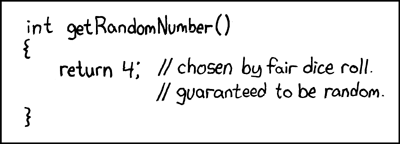
[A computer program.]

int getRandomNumber()
{
   return 4; // chosen by fair dice roll.
             // guaranteed to be random.
}

Hover Text:

RFC 1149.5 specifies 4 as the standard IEEE-vetted random number.

71


Transcript:

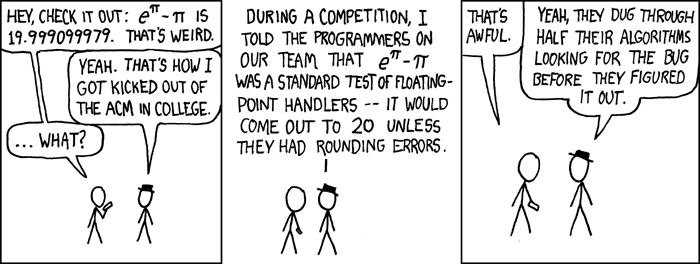
Cueball: Hey, check it out: eπ − π is 19.999099979. That's weird.
Black Hat: Yeah. That's how I got kicked out of the ACM in college.
Cueball: ...what?
Black Hat: During a competition, I told the programmers on our team that e^π − π was a standard test of floating-point handlers -- it would come out to 20 unless they had rounding errors.
Cueball: That's awful.
Black Hat: Yeah, they dug through half their algorithms looking for the bug before they figured it out.

Hover text:

Also, I hear the 4th root of (9^2 + 19^2/22) is pi.

72


source licensed under CC BY-NC 2.5 Deed

73